

Recognizing intolerances: Interpreting symptoms correctly
TL;DR:
- Around 20% of the Swiss population suffer from food intolerances, which are often difficult to diagnose.
- Intolerances differ fundamentally from allergies, are usually not immune reactions, and have various mechanisms.
- Diagnosis and treatment require a structured evaluation and targeted tests to avoid misdiagnoses and unnecessary diets.
Around 20% of the Swiss population suffer from some form of food intolerance. Nevertheless, it takes many affected people years to receive a clear diagnosis. The reason: the symptoms are often so nonspecific that they can easily be confused with stress, irritable bowel syndrome, or other conditions. Abdominal pain after eating, persistent fatigue, skin problems without an obvious cause. All of this may point to an intolerance. Or it may not. This article explains how intolerances really work, which symptoms are typical, which diagnostic approaches are genuinely reliable, and where common mistakes are made.
Table of contents
- What are intolerances? Distinctions and mechanisms
- Typical symptoms and their pitfalls
- Diagnosis: How are food intolerances diagnosed?
- Special cases and pitfalls: histamine, irritable bowel syndrome, and misdiagnoses
- Practical experience: Why the path to diagnosis is often more complicated
- Next steps: For greater clarity about your health
- Frequently asked questions about intolerances
Key findings
| Point | Details |
|---|---|
| Symptoms are often nonspecific | Stomach pain, fatigue, or skin problems can have many causes—a targeted evaluation is important. |
| Medical tests provide clarity | Only established medical tests, such as breath tests or antibody tests, are suitable for a reliable diagnosis. |
| Avoiding overdiagnosis | Many misjudgments arise from self-observation and unreliable rapid tests. |
| Medical supervision protects against mistakes | Expert advice helps ensure that no unnecessary diets or health risks arise. |
What are intolerances? Distinctions and mechanisms
To put the topic into proper perspective, it is worth first understanding the basics. A food intolerance is not an allergy. This sounds simple, but the two are constantly confused in everyday life, with noticeable consequences for diagnosis and treatment.
With a true allergy, the immune system reacts to a specific substance. The body produces antibodies, and the reaction can occur within minutes and sometimes even be life-threatening. With an intolerance, on the other hand, the immune system is usually not involved. It is more a matter of an enzyme deficiency, impaired absorption in the intestine, or irritation of the intestinal lining.
The best-known example is lactose intolerance. Anyone who produces too little lactase cannot properly break down milk sugar. The undigested sugar reaches the large intestine, where bacteria ferment it, resulting in bloating, cramps, and diarrhea. No immune system is involved. Purely mechanical.
Celiac disease is a special case: here, the immune system does react to gluten, but differently than in a classic allergy. It is an autoimmune disease in which the intestinal lining is permanently damaged. Anyone who wants to understand food intolerances explained scientifically can find a detailed overview of the various mechanisms there.
Common forms of food intolerances:
- Lactose intolerance: A deficiency of lactase, the enzyme responsible for digesting lactose
- Fructose intolerance: Impaired transport of fructose in the small intestine
- Histamine intolerance: An excess of histamine or a deficiency of the enzyme that breaks it down
- Celiac disease: An autoimmune reaction to gluten that damages the intestines
- Wheat sensitivity: Symptoms caused by wheat without celiac disease or an allergy
Important difference: Allergies are caused by an immune response involving antibodies. Intolerances are caused by enzyme deficiencies or absorption disorders. The symptoms may overlap, but the underlying mechanisms are fundamentally different.
This distinction is not merely academic. It determines which tests are appropriate, which diet may help, and whether emergency medical care is necessary. Treating an intolerance like an allergy, or vice versa, results in valuable time and resources being lost.
Typical symptoms and their pitfalls
Once we understand the mechanisms, it is important to recognize typical signs. The problem is that the symptoms of intolerances are rarely clear-cut. They often occur with a delay, sometimes not until hours after eating, and vary greatly in intensity.
The most common complaints include:
- Digestive complaints: Abdominal pain, bloating, diarrhea, constipation, nausea
- Skin reactions: Rashes, redness, itching
- General complaints: Fatigue, headaches, difficulty concentrating
- Respiratory tract: In rare cases, a runny nose or irritating cough
The tricky part is that the same symptoms can also be caused by stress, lack of sleep, irritable bowel syndrome, or other conditions. A headache after lunch does not necessarily indicate histamine intolerance. It could also be due to dehydration, a drop in blood pressure, or simply too little sleep.
Statistics: According to an NZZ analysis, around 37% of the population suspect that they suffer from a food hypersensitivity. However, this is medically confirmed in only about 6% of cases. The gap between self-perception and an actual diagnosis is enormous.
This discrepancy has a practical reason. After experiencing symptoms following a meal, people automatically look for an explanation in the food itself. This is understandable but often misleading. Symptoms such as bloating or fatigue are so common that they are rarely perceived as an independent clinical condition.
The timing is particularly difficult to determine. With lactose intolerance, symptoms can occur 30 minutes to 2 hours after consumption. With histamine intolerance, they may occur even later. Someone who eats cheese in the evening and sleeps poorly at night rarely connects the two.

A food intolerance test can provide initial indications, but it does not replace structured diagnostic testing. Anyone who wants to address symptoms and diagnosis systematically should first document patterns.
Pro tip: Keep a symptom diary for at least two weeks. Record what you eat, when symptoms occur, and how severe they are. This log is more valuable to any doctor than a vague description during a consultation.
Diagnosis: How are food intolerances diagnosed?
Once the symptoms have been identified, the question is how to clarify the cause reliably. There are clear differences between medically recognized methods and commercial offerings that often promise more than they can deliver.
The key diagnostic steps in medical practice:
- Medical history and symptom log: The first step is always a conversation. When do the symptoms occur? After which foods? How long do they last?
- H2 breath test: The gold standard for lactose and fructose intolerance. The patient drinks a sugar solution, and the hydrogen in their breath is measured. Elevated levels indicate that the sugar is being fermented in the colon.
- Antibody test and biopsy: Specific antibodies are measured in the blood to diagnose celiac disease. If the result is positive, a small-intestinal biopsy is performed for confirmation.
- Elimination diet: If histamine intolerance or wheat sensitivity is suspected, the suspected food is eliminated for several weeks. If the symptoms improve, this is a strong indication.
Standard methods such as the H2 breath test, antibody tests, and biopsy have been scientifically validated and are recommended by professional medical societies.
| Method | Suitable for | Reliability |
|---|---|---|
| H2 breath test | Lactose, fructose | High |
| Antibody test | Celiac disease | High |
| Elimination diet | Histamine, wheat | Moderate to high |
| IgG blood test | Various | Not scientifically recognized |
| Kinesiology, bioresonance | Various | No evidence |
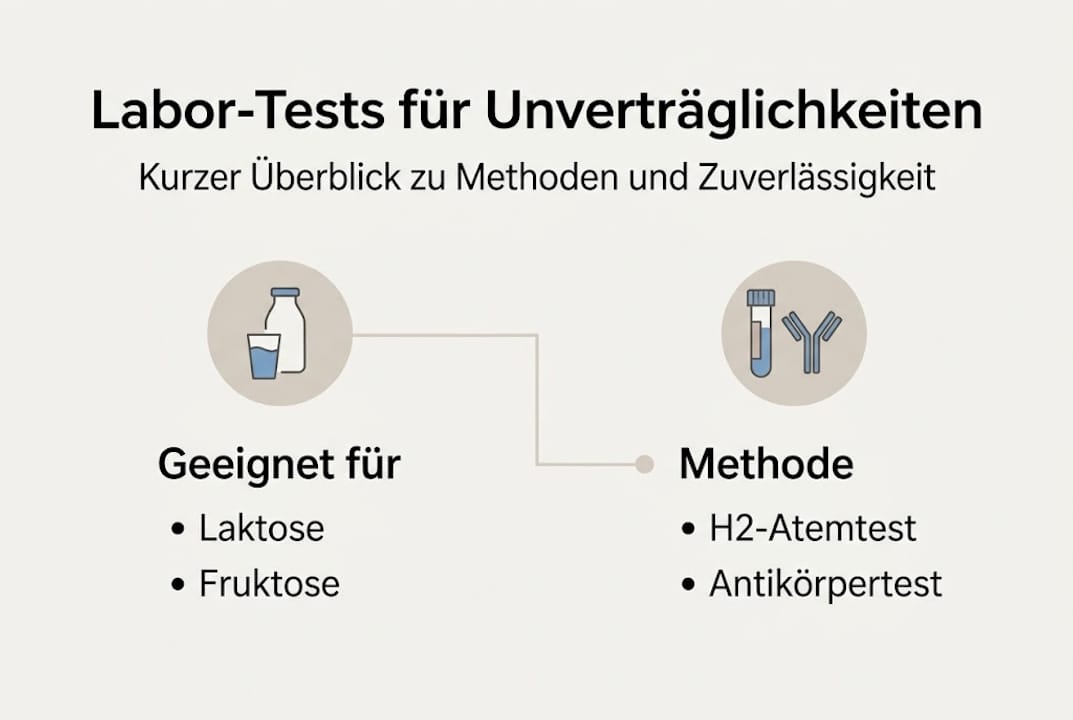
IgG tests, which are frequently offered online or in pharmacies, are a critical issue. They measure IgG-class antibodies against various foods. The problem is that elevated IgG levels merely show that a person regularly eats a food. They are not proof of an intolerance. Anyone who compares diagnostic methods at a glance will quickly see where sound science ends and marketing begins.
Anyone who wants to compare test types will find a structured comparison there. And anyone who wants to properly interpret self-tests should know: They can be useful supplements, but never the sole basis for a diagnosis.
Pro tip: Only undergo testing when there is a specific suspicion and on medical advice. A test without symptoms and without a clinical indication rarely provides actionable results and often leads to unnecessary restrictions.
Special cases and pitfalls: histamine, irritable bowel syndrome, and misdiagnoses
Accurate diagnosis is important, especially since exceptional cases and misinterpretations are common. Two areas deserve particular attention: histamine intolerance and irritable bowel syndrome.
Histamine intolerance is medically controversial. Histamine occurs naturally in many foods, especially aged cheese, red wine, canned fish, and fermented vegetables. Anyone who experiences headaches or a racing heart after a glass of red wine may quickly suspect histamine. But the evidence is limited: there is no reliable blood test, no clear threshold values, and no standardized diagnosis. An elimination diet remains the only practical method, but it is time-consuming and prone to error.
| Characteristic | Irritable bowel syndrome | Food intolerance |
|---|---|---|
| Trigger | Stress, diet, microbiome | Specific food |
| Symptoms | Variable, diffuse | Often after certain foods |
| Diagnosis | Diagnosis of exclusion | Specific test available |
| Treatment | Multimodal | Dietary adjustment |
Irritable bowel syndrome is a common misdiagnosis in both directions. Some people with IBS think they have an intolerance. Others with a genuine intolerance are treated for IBS for years. The symptoms overlap considerably.
So-called silent celiac disease is particularly problematic. It occurs without classic digestive symptoms but can manifest as iron deficiency, osteoporosis, or chronic fatigue. Many affected people wait more than ten years for the correct diagnosis.
Cross-allergies are another issue that is easily overlooked. People who are allergic to birch pollen may also react to apples, carrots, or celery because the protein structures are similar. This looks like a food intolerance, but is actually a pollen-associated allergy.
Anyone who wants to identify and avoid misdiagnoses should always consider several differential diagnoses before starting a diet.
Self-perception also plays a major role. Studies show that 37% suspect hypersensitivity, but only 6% are actually affected. Psychosomatic influences, expectations, and nocebo effects can produce real symptoms even without an organic cause.
Practical experience: Why the path to diagnosis is often more complicated
Our practical experience shows that the path to the correct diagnosis is rarely straightforward. Many people come to the consultation with a stack of self-test results and have already eliminated several food groups. The result is often an unbalanced diet that causes new problems, including nutrient deficiencies that can even worsen the original symptoms.
The problem is not the desire for clarity, but the expectation that a single test can provide it. As experts emphasize, many symptoms are so nonspecific that careful evaluation is essential. A diet should only be started after a confirmed diagnosis, not before.
Anyone who wants to critically assess and use self-tests effectively needs a clear framework: What does the test really measure? What do the results mean? And what don’t they mean? The answers to these questions determine whether a test helps or causes harm. Our recommendation: Always have symptoms assessed in the context of several medical specialties, ideally through a joint evaluation by gastroenterology, allergology, and nutritional counseling.
Next steps: For greater clarity about your health
Anyone struggling with unclear symptoms after eating deserves more than guesswork. mybody® offers ISO-certified laboratory analyses that are scientifically sound and evaluated transparently. Whether it’s a microbiome analysis, nutrient check, or validated intolerance tests, all tests can be conveniently completed at home, with personalized evaluation and specific recommendations for action.

With more than 11,300 satisfied customers and a rating of 4.77 stars, mybody® is a reliable partner for anyone who wants to take an active role in managing their health. Take the opportunity to stop guessing about your symptoms and start understanding them. Find out now at mybody-x.com about the analyses suited to your situation.
Frequently asked questions about intolerances
How do intolerances differ from allergies?
Intolerances usually affect digestion and are not caused by the immune system. Allergies, on the other hand, result from an immune response that can also be life-threatening.
Which tests for intolerances are actually useful?
Recommended methods include the H2 breath test, antibody tests, and an elimination diet. IgG tests are considered not scientifically recognized and can lead to misinterpretations.
Can I reliably identify intolerances myself at home?
A symptom diary can provide valuable clues, but it does not replace a medical diagnosis. Because the symptoms are nonspecific, medical evaluation is always recommended.
Are all symptoms after eating signs of an intolerance?
No. Many symptoms have other causes, such as irritable bowel syndrome, stress, or other conditions. Differential diagnoses must always be considered before starting a diet.



Share now:
What is an allergy? Recognize and understand the symptoms.
Skin Allergic Reaction: What’s Really Behind It