

Watery diarrhea without nausea: what the absent symptom reveals
The essentials at a glance
If the diarrhea is watery but you do not feel nauseated, this argues against a classic gastrointestinal infection. Nausea and vomiting are typical symptoms. When they are absent, other explanations become more likely: an intolerance, a medication, irritable bowel syndrome—or simply something you eat regularly without realizing it.
This is a statement about probability, not a diagnosis. An infection can also occur without nausea, and watery diarrhea means fluid loss that needs to be replaced regardless of the cause.
This article follows the clue. First, it explains why the absent symptom is informative at all and how common the possible causes are. Then it covers three common misconceptions, guidance on what you can observe yourself, and a comparison of the three most common explanations. Finally, it discusses warning signs and what a gut microbiome analysis can contribute.
What to expect in this article
1. Why the absence of nausea is a clue
2. How common the possible causes are
3. The four groups of causes in detail
4. Three misconceptions that prolong the search
5. What you can observe yourself
6. When it is no longer a case for observation
7. The three most common explanations compared
8. What a gut microbiome analysis can contribute
9. What matters
Frequently asked questions
Sources
Why the absence of nausea is a clue
A gastrointestinal infection affects both sections, as the name suggests. That is why nausea and vomiting are typical symptoms—the stomach is involved, not just the intestines.
If the stomach remains calm and only the stool is watery, this points to a process taking place farther down. Other mechanisms come into play there: substances that draw water into the intestine, accelerated transit, or impaired absorption.
The most common condition in this group is an intolerance to a component of food that reaches the large intestine undigested. Lactose intolerance is the best-known example.
“
“People with lactose intolerance can tolerate only small amounts of lactose.”
Institute for Quality and Efficiency in Health Care (IQWiG)
Lactose intolerance, as of 2024
Key takeaway
The absence of nausea makes a gastrointestinal infection less likely because it typically affects both sections—but it does not rule it out.
What stool consistency reveals about the location
As food passes through the intestines, water is removed from it. How firm the stool is at the end therefore depends on how much time this process had and whether it was able to proceed undisturbed.
Watery stools mean that a significant amount of water has remained in the intestines. There are three ways this can happen: too little was absorbed, additional water was released, or the contents moved through too quickly.
The second route is the most interesting one for this set of symptoms. It occurs when substances reach the colon undigested and bind water there—exactly what happens with an intolerance. This process takes place exclusively in the intestines, without involving the stomach. Hence the absence of nausea.
Watery does not always mean watery
Before considering the causes, it is worth clarifying the starting point. According to IQWiG, diarrhea means very soft or liquid stools at least three times within 24 hours (as of 2023). Both criteria must be met.
This definition is more important when looking for causes than it may seem. Someone who has very soft stools once a day is looking for an explanation for something that is not yet medically considered diarrhea—and may overlook the fact that their bowel movements simply fall within the normal range.
How common the possible causes are
The two most common noninfectious explanations are so widespread that statistically they are almost always the more obvious possibilities.
Source: Institute for Quality and Efficiency in Health Care (IQWiG), 2023 and 2024
These two figures are why the search for causes almost never ends with something exotic. If ten to twenty out of every hundred people have irritable bowel syndrome and five to fifteen percent cannot tolerate lactose, then one of these is the statistically most likely explanation for persistent digestive symptoms—not the rare condition one first encounters when searching online.
This is not reassurance but prioritization. The common explanations are checked first because they are common. Only when they do not fit is the search broadened.
One detail from the same source is particularly revealing for this topic: In irritable bowel syndrome, diarrhea occurs more frequently in men, while constipation is more common in women (IQWiG, 2023). The condition is therefore not only more common among women—it also manifests differently in the two sexes.
The four groups of causes in detail
Intolerances to food components
With lactose intolerance, milk sugar is not broken down sufficiently and reaches the large intestine undigested. According to IQWiG, symptoms typically occur within 30 minutes to two hours after consuming foods containing lactose (as of 2024).
This time window is the most useful information for self-observation. Anyone who records the connection between meals and symptoms over several days will ultimately have more to go on than mere speculation.
One important note about frequency: Lactose intolerance is least common in Northern Europe and most common in Africa and East Asia, where it affects 65 to 90 percent of people (IQWiG, 2024). Anyone from one of these regions, or with ancestors from there, has a significantly higher pretest probability.
In addition to lactose, other food components that work in the same way may be involved. Sugar substitutes in sugar-free chewing gum and sweets are among them, as are larger amounts of fructose from juices and dried fruit. Here too, the stomach is not involved.
This group has one feature that makes the search more difficult: it is about quantities, not a yes-or-no answer. A glass of milk in coffee may cause no problems, while a latte macchiato and a yogurt later that same morning might. That is why people looking for a single trigger often fail to find it.
Medications as an overlooked cause
Antibiotics are the best-known group, but not the only one. Magnesium-containing preparations, certain blood-pressure medications, and laxatives can also cause watery stools—without any nausea.
This cause is so often overlooked because the timing does not seem to fit. A medication that has been taken for weeks is no longer suspected. Even so, it is worth going through the list and comparing it with when the symptoms began. Prescribed medications should never be discontinued without authorization.
Preparations that people do not think of as medication are particularly easy to overlook: magnesium for calf cramps, effervescent vitamin tablets, and dietary supplements from the drugstore. They are not included in any medication plan and are rarely mentioned spontaneously during a doctor’s appointment.
With antibiotics, the timing of the connection is clearer, but it extends further than many people assume. Symptoms may persist even after you stop taking them because the composition of the gut flora first needs to settle back into balance. Anyone who has taken antibiotics in the past three months should mention it—even if the package has long since run out.
Irritable bowel syndrome
According to IQWiG, irritable bowel syndrome is characterized by persistent abdominal or lower abdominal pain, cramps, and altered stools. It is considered harmless but can significantly interfere with daily life. The typical onset is between the ages of 20 and 30 (as of 2023).
One connection mentioned by the same source is noteworthy: Irritable bowel syndrome can develop after an intestinal infection with fever and severe diarrhea. So anyone who had an infection months ago and has not returned to their usual pattern since has a documented explanation for it.
It is important to understand how this diagnosis is made. It is not established by a test, but after ruling out other causes and based on the symptom pattern. That is why no self-test can detect irritable bowel syndrome—there is no value that would indicate it.
One detail is helpful for self-assessment: According to IQWiG, abdominal or lower abdominal pain and cramps are the main features of irritable bowel syndrome, not the stool alone. Someone who has exclusively watery stools without any pain fits this picture less well than someone who has both.
And yet, an infection
The absence of nausea shifts the probabilities, but rules nothing out. An infection can also occur without stomach involvement, especially if it is mild or has only just begun.
Two clues nevertheless point toward an infection: sudden onset within a few hours and other people in your surroundings becoming ill. Together, these make an infection likely, even if the stomach remains calm.
A third clue is recent travel. After a trip abroad, pathogens that are rare here may be involved, and self-observation is then the wrong approach. This should be medically evaluated, even if the symptoms seem mild.
For practical purposes, one simple rule of thumb remains: An infection has a beginning you can identify. An intolerance and irritable bowel syndrome usually do not—the onset is blurred, and the question “exactly since when?” cannot be answered.
In brief
Four groups of causes are possible with watery diarrhea without nausea: intolerances to components of food, medications, irritable bowel syndrome, and, despite everything, an infection. According to IQWiG, lactose intolerance affects 5 to 15 percent of Europeans, while irritable bowel syndrome affects 10 to 20 out of 100 people. The timing in relation to a meal is the most useful information you can gather yourself.
Three misconceptions that prolong the search
What you can observe yourself
Before any test becomes worthwhile, structured observation over one to two weeks is useful. The question is not whether you should do something – but whether your case even falls into the category in which self-observation can help.
Useful for you if …
… the symptoms have persisted for weeks but are neither getting worse nor improving.
… you suspect that certain meals play a role and want to test that suspicion.
… you are already planning to see a doctor and want to bring reliable notes with you.
Probably not if …
… you notice one of the warning signs from Chapter 6 – then the appointment matters, not the diary.
… the symptoms have only been present for one or two days; then it is an acute course, not a search for the cause.
… you have already lost a significant amount of weight – in that case, you are monitored while the cause is investigated, not instead of it.
Four columns are enough
This belongs in your symptom diary
- ✓ Time and contents of every meal – not the calories, but what was in it.
- ✓ Time and consistency of every bowel movement – the time interval is the information that really matters.
- ✓ Accompanying symptoms – bloating, cramps, a feeling of fullness, and whether nausea does occur after all.
- ✓ Medications and dietary supplements – including the time, even for over-the-counter products.
- ✓ Special circumstances – stress, lack of sleep, travel, antibiotics in the preceding weeks.
Two weeks are usually enough to identify a pattern. If none emerges, that is information too: the symptoms are probably not linked to individual meals.
Why you shouldn’t eliminate foods just in case
The obvious reflex is simply to cut out dairy products and see what happens. That sounds reasonable and has two catches.
The first: If you eliminate several things at once, you will not know afterward which one made a difference. And if you then continue restricting your diet, you may give up an entire food group without reason – in the case of dairy products, this can affect your calcium intake, among other things.
The second: Trying to eliminate foods before medical evaluation can alter the results of subsequent tests. IQWiG explicitly lists an elimination diet as one of three methods – so it belongs in a structured process, not at the beginning based on suspicion alone.
The more sensible order is the reverse: observe and record first, then specifically investigate a single suspicion, and finally seek medical evaluation.
What can be learned from the diary
After two weeks, you will have a list that can be checked against three questions. Together, they almost always indicate which direction to take next.
First: Is there a recurring time interval between a particular meal and the symptoms? If it is between 30 minutes and two hours and involves foods containing lactose, the suspicion of lactose intolerance is specific enough to warrant further evaluation.
Second: Do the symptoms also occur on days when you ate completely differently? Then they are probably not linked to a single food, and searching for the one trigger will not get you any further.
Third: Are there pains and cramps, or is the stool the only symptom? According to IQWiG, pain is the main symptom of irritable bowel syndrome – if it is consistently absent, the picture is less consistent with it.
Regardless of which of the three answers emerges, the notes should be taken to the doctor's appointment. They do not replace a diagnosis, but they save you from reconstructing everything from memory, which otherwise takes up most of the time during the consultation.
When it is no longer a case for observation
Certain signs mean you should stop monitoring yourself immediately. They apply regardless of whether or not you feel nauseated.
These signs require medical evaluation
- ✓ Blood in the stool – listed as a warning sign both for acute diarrhea and when irritable bowel syndrome is suspected.
- ✓ Unintentional weight loss – suggests that the condition is not harmless.
- ✓ Fever – is associated with neither irritable bowel syndrome nor an intolerance.
- ✓ Paleness – may indicate anemia and is considered a warning sign when irritable bowel syndrome is suspected.
- ✓ Signs of severe dehydration – dizziness, sunken facial features, rapid breathing, rapid heartbeat, or inelastic skin.
The first four points are identified by the IQWiG as warning signs in connection with irritable bowel syndrome, and the last in connection with acute diarrhea. This classification does not matter when deciding whether to make an appointment.
Fluid loss persists regardless of the cause
One point is easily overlooked when searching for the cause: Watery stools mean loss of fluids and electrolytes, regardless of why they occur. Anyone who spends weeks searching while not drinking enough develops a second problem alongside the original one.
In a chronic course, this is less noticeable than in an acute one because the loss occurs more slowly. Persistent fatigue, concentration problems, or muscle cramps may indicate it and are then mistakenly attributed to the underlying condition.
In practical terms: while you are monitoring the situation, drink enough. This is not treatment, but it prevents a second problem from developing while you investigate the first.
Who should seek medical evaluation sooner
For young children, very old people, pregnant people, and people with weakened immune systems or chronic illnesses, the threshold is lower. Fluid loss becomes critical more quickly in these groups, and the observation period that makes sense for healthy adults is not appropriate here.
The three most common explanations compared
The following comparison organizes the three explanations according to the same criteria. It does not replace a diagnosis, but it helps you classify your own pattern.
| Criterion | Gastrointestinal infection | Lactose intolerance | Irritable bowel syndrome |
|---|---|---|---|
| Onset | Sudden, within hours | 30 minutes to 2 hours after eating | Gradual, typically between the ages of 20 and 30 |
| Is nausea typical? | Yes, it is part of the typical picture | Possible, but not inevitable | Not predominant—pain and cramps are the main symptoms |
| Connection with meals | No regular pattern | Clear, linked to lactose-containing foods | Variable, not linked to a single food |
| Duration | A few days to one week | As long as lactose-containing foods are eaten | Over months, with better and worse phases |
| How is it diagnosed? | Medical assessment, with pathogen testing if necessary | Hydrogen breath test as the standard; meaningful only if symptoms occur during the test | Medical assessment, after ruling out other causes |
Timing, frequency, and diagnostic approaches: Institute for Quality and Efficiency in Health Care (IQWiG), 2023 and 2024
How to read the table for yourself
The most informative line is the third. A clear, recurring connection between a particular meal and the symptoms is the pattern that most strongly suggests an intolerance—and it is also the pattern that almost never emerges without keeping a diary.
The second most important one is the fourth. A course lasting a few days is different from one lasting months, and the two lead to completely different next steps. Someone who has had symptoms for three days is in an acute situation. Someone who has had symptoms for three months is searching for the cause.
What the table deliberately does not include is a probability estimate for each row. The available sources do not establish how often each cause occurs with this exact symptom profile—and an estimated figure would be a worse error here than leaving the gap.
What is missing when you investigate only one explanation
A common course looks like this: Someone suspects lactose intolerance, eliminates dairy products, feels somewhat better—and considers the matter settled. Sometimes that is correct. Often, however, it is incomplete.
Several causes can coexist. Irritable bowel syndrome does not rule out lactose intolerance, and a medication may also contribute. Anyone who investigates only one explanation and achieves partial improvement stops at the point where the second half remains unresolved.
That is also why medical evaluation does not become unnecessary simply because a self-experiment helped. Partial improvement is an indication, not the end of the process.
What a gut microbiome analysis can contribute
If medical evaluation has not identified a treatable cause and the symptoms persist, the question arises: what is the current state of the gut? A stool analysis answers that question—as a description, not a diagnosis.
mybody®x (MYBODY Lab GmbH) offers an analysis of the gut microbiome for this purpose. It belongs at the end of a process, not at the beginning.
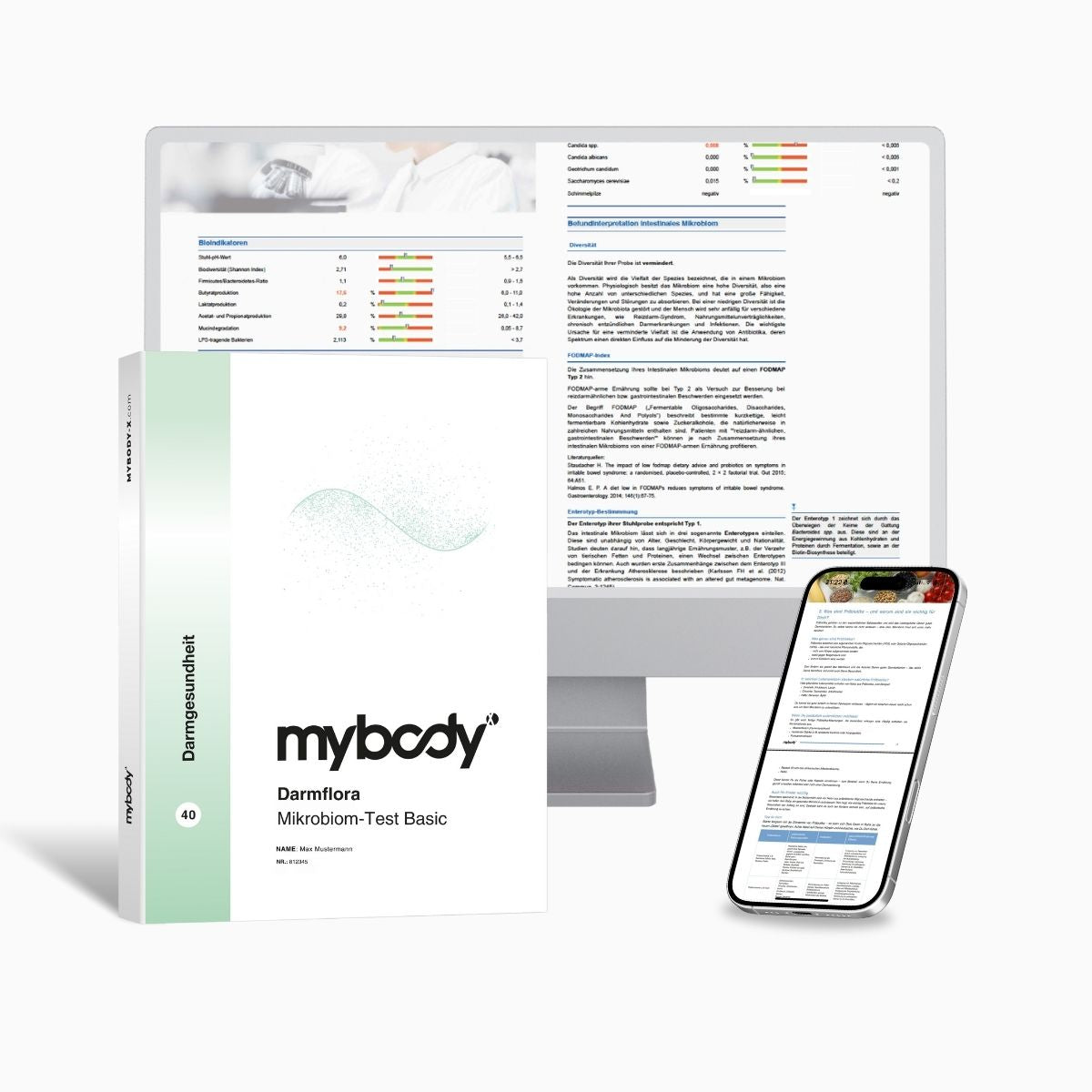
Gut Microbiome TEST | Essential
Analyzes a stool sample to determine the composition of the gut microbiome, the ratio of protective to potentially problematic bacteria, the pH level in the gut, and indications of dysbiosis. What the test does not do: It does not detect lactose intolerance – the hydrogen breath test is the standard procedure for this. It does not diagnose irritable bowel syndrome and does not detect pathogens. An abnormal finding is a description, not a diagnosis.
Price: €149.00 (instead of €169.00) · Sample type: Stool sample · Processing time: Kit shipping 1–3 business days, laboratory analysis 5–10 business days after receipt of the sample · Laboratory: ISO-certified laboratory analysis in Germany
To the Microbiome Test EssentialThe bacterial groups and markers that may appear in such a report can be found in the Gut Encyclopedia.
All price and service information is current as of August 5, 2026. Prices and the scope of services may change; the relevant product page always governs.
The limitations that remain
The most important limitation concerns causality. Even if an analysis shows an unusual composition, it does not follow that this is causing your symptoms. Establishing that connection is a medical task.
The second limitation is timing. An analysis during an acute phase, shortly after an infection, or while taking antibiotics measures an exceptional state. Anyone who wants to know their normal state needs to allow some time to pass.
And the third point, which is crucial for this topic: All three most common explanations from the table above are not detected by a gut flora analysis. It answers a different question—one that only becomes useful once the others have been clarified.
What matters
The absence of nausea is not a random detail but a useful clue. It makes a classic gastrointestinal infection less likely and directs attention toward intolerances, medications, and functional causes.
What this does not replace is observation. The time between a meal and the onset of symptoms is the only information you can collect yourself that no one else can collect for you.
Two things apply regardless of the cause. Drink enough fluids while your stool is watery—the loss is occurring no matter where it comes from. And don’t eliminate entire food groups on suspicion before you know what’s going on.
Your specific next step: For two weeks, fill in the five columns from Chapter 5. If a pattern emerges, you’ve found it. If not, you’ll have a solid basis for speaking with your doctor—and both are worth more than any test you order without a specific question in mind.
Frequently asked questions
What does watery diarrhea without nausea mean?
This makes a classic gastrointestinal infection less likely, because it typically affects both sections and includes nausea. Food intolerance, a medication trigger, or irritable bowel syndrome are more likely. However, an infection is not ruled out—a sudden onset and other people around you becoming ill still point to one.
Could lactose intolerance be the cause?
It is one of the most common explanations: According to IQWiG, 5 to 15 percent of Europeans are unable to tolerate lactose, compared with 65 to 90 percent in Africa and East Asia. The most useful clue is the timing—the symptoms typically occur 30 minutes to two hours after consuming foods containing lactose. In Germany, the hydrogen breath test is considered the standard method for investigating this.
When should I see a doctor?
Immediately if there is blood in the stool, fever, unintentional weight loss, paleness, or signs of severe dehydration such as dizziness, sunken facial features, rapid breathing, a fast heartbeat, or inelastic skin. Regardless, the following applies: no improvement after 48 hours in an acute case, or persistent symptoms for more than three months with a noticeable impact on quality of life.
Can medications cause watery diarrhea?
Yes, and this is often overlooked. Antibiotics are the best-known group, but magnesium-containing supplements, certain blood pressure medications, and laxatives may also be responsible. The reason this is overlooked is the lack of a clear temporal connection: a medication taken for weeks is no longer suspected. Compare your medication list with when the symptoms began and discuss it with a doctor—never stop prescribed medication on your own.
Can a gut flora analysis identify the cause?
No. A stool analysis describes the composition of the bacterial community. It does not detect the three most common explanations for watery diarrhea without nausea: lactose intolerance is assessed using a hydrogen breath test, irritable bowel syndrome is diagnosed by a doctor after other causes have been ruled out, and an infection is identified by detecting the pathogen. Such an analysis only becomes useful once these avenues have been pursued and the symptoms persist.
When the investigation has found nothing
If the symptoms persist even though the usual causes have been ruled out, taking stock of the gut flora can be an additional piece of the puzzle—as a description of the current state to inform the next conversation.
View Microbiome Test Essential Overview of all gut analysesYou might also be interested in
→ Abdominal cramps and diarrhea: causes, immediate measures, and warning signs
The variant involving cramp-like pain—and how it differs from this pattern of symptoms.
→ How can you tell when you are low on electrolytes?
What prolonged fluid loss does to the body and how to recognize it.
→ Gut encyclopedia: all bacteria and markers in your gut flora
Reference work with more than 6,000 microbiome biomarkers—from beneficial bacteria and fiber degraders to the metrics in the report.
Sources
- Institute for Quality and Efficiency in Health Care (IQWiG): Lactose intolerance, as of 2024 — gesundheitsinformation.de
- Institute for Quality and Efficiency in Health Care (IQWiG): Irritable bowel syndrome, as of 2023 — gesundheitsinformation.de
- Institute for Quality and Efficiency in Health Care (IQWiG): Diarrhea, as of 2023 — gesundheitsinformation.de
Information on lactose intolerance—its definition, prevalence, symptom onset, and diagnosis using the hydrogen breath test—is based on source [1]. Information on the prevalence, sex distribution, onset, symptoms, and warning signs of irritable bowel syndrome comes from source [2]. The definition of diarrhea and warning signs in acute cases come from source [3]. The classification of individual medication groups is general information and is not supported by numerical values in the text. Product information comes from the mybody®x product pages, accessed on August 5, 2026.

mybody®x editorial & expert team
Gut health Intolerances Nutritional science
This article was created and medically reviewed by the mybody®x editorial and expert team. The team combines expertise in nutrigenetics, microbiome and gut science, blood analysis interpretation, nutritional science, and laboratory diagnostics.
Published on August 5, 2026 · Last updated on August 5, 2026
Medical notice: This article is for general information only and does not replace medical advice, diagnosis, or treatment. Blood in the stool, fever, unexplained weight loss, and signs of severe dehydration require immediate medical evaluation.




Share now:
Symptoms When Candida Dies: What’s Behind the Die-Off Theory
How do I calculate my calorie needs: the calculation in four steps