



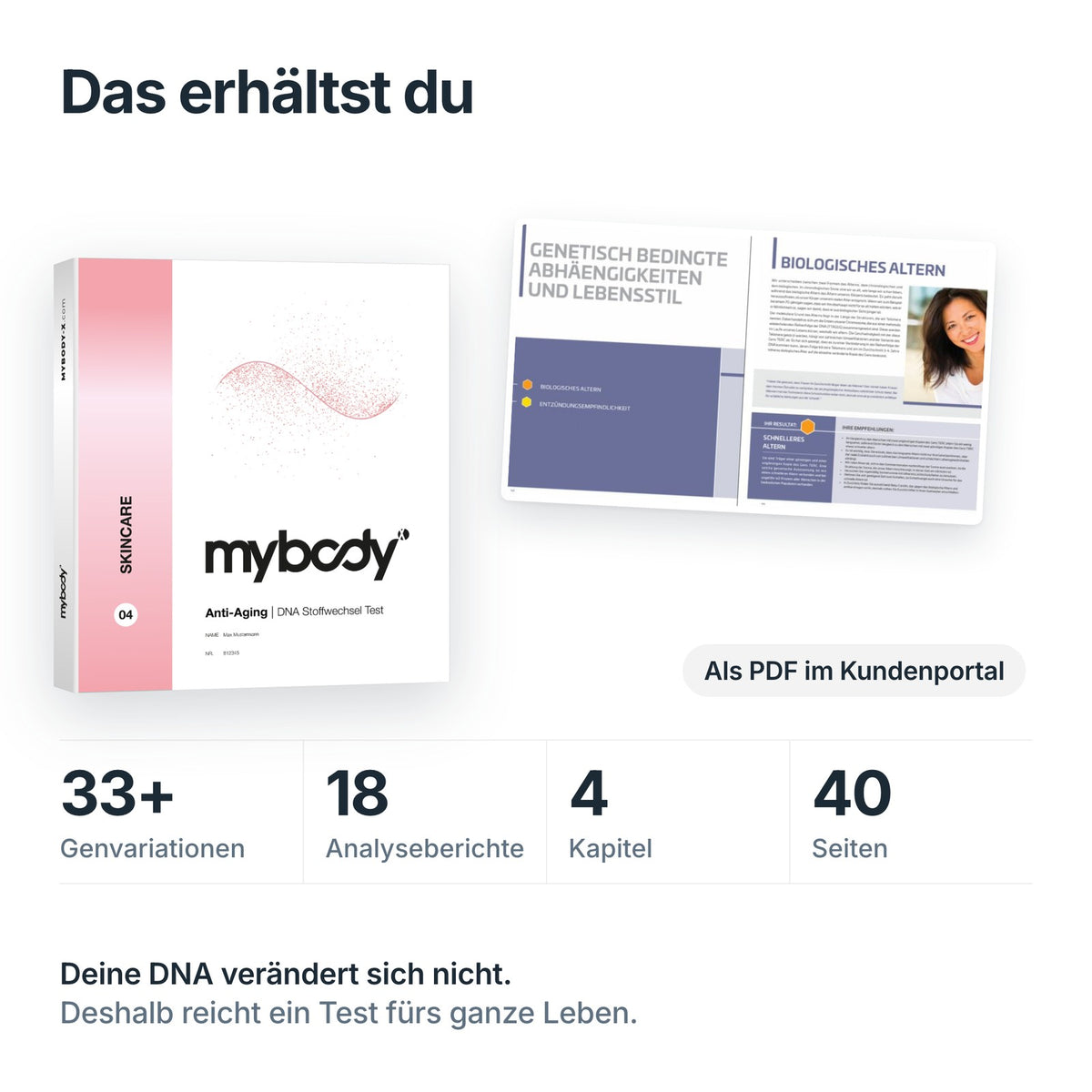

Anti-Aging | SKINCARE DNA Test






You keep feeling:
Without a glow and worried that your skin is aging quickly?
When the skin itches, flakes, becomes red, or develops hives and pustules, a variety of causes may be responsible. Skin diseases, allergies, or intolerances are often the triggers, but certain nutrients and hormones also play a significant role.
It is suspected that even the gut microbiome affects skin problems, as the microorganisms in the gut can influence skin health. In view of these complex connections, the question arises:
Where should you start when skin problems occur and the exact cause is unclear?
mybody® gives you valuable clarity
Highest quality standard
Our analyses are not only ISO-certified, but are also recognized as medical self-tests.
Personal customer service
You will receive a free consultation and discussion of your results reports from us.
Scientific analyses
Our detailed reports are based on your information and analysis results.

Why Take a DNA Test for Skin Health & Anti-Aging?
A DNA test for skin health and anti-aging shows you how your skin is structured at the genetic level and how quickly it ages. While conventional skin analyses only assess its current condition, a DNA test provides information about how your body produces collagen, how it repairs UV damage, how pronounced your tendency toward inflammation is, and how well your antioxidant defense system functions.
The mybody® DNA skin test analyzes relevant genes that determine whether you are predisposed to pigmentation spots, wrinkle formation, loss of elasticity, dry skin, or accelerated aging. With this information, you receive personalized recommendations for skincare, nutrition, nutrients, and lifestyle—tailored to your genetic predisposition.
This allows you to take early action and develop an intelligent anti-aging strategy that truly suits your skin.
Causes of Skin Problems and Premature Skin Aging
Skin problems and early signs of aging result from an interplay of genetics, lifestyle, and the environment. Common causes include UV radiation, oxidative stress, an unhealthy diet, stress, hormonal fluctuations, smoking, excessive alcohol consumption, and chronic inflammation. A disrupted skin barrier or inadequate supplies of vitamins and minerals can also cause the skin to age more quickly.
Genetics plays a crucial role: Some people break down collagen more quickly, while others have weaker antioxidant defenses or a greater tendency toward inflammation. This explains why some skin types develop wrinkles earlier or react more sensitively to environmental factors.
A DNA test helps identify which causes are particularly relevant to you—and how you can positively influence them through nutrition, skincare, and lifestyle.
Understanding Skin Aging in Everyday Life: The Influence of Nutrients and the Environment
Skin aging begins much earlier than many people think—often as early as the mid-20s. Numerous factors influence the aging process in everyday life: UV radiation damages collagen structures, air pollution promotes inflammation, and stress and lack of sleep impair regeneration. At the same time, insufficient nutrients such as vitamins D, C, and E, zinc, selenium, or omega-3 can also negatively affect the skin because they support important repair and protective mechanisms.
When your body does not have sufficient antioxidant capacity, the skin ages more quickly: Fine lines, pigmentation spots, dryness, and loss of elasticity develop. Genetic factors also determine how strongly your body reacts to UV radiation or how well it builds collagen.
A sound understanding of these everyday influences—combined with DNA and blood test results—allows you to tailor your skincare and nutrition precisely to your individual needs.
Improve Skin Health & Anti-Aging with a DNA Test—Easily from Home
With a DNA test for skin health, you can easily understand which skincare, nutrition, and nutrients your skin really needs. You do not have to visit a clinic—you simply collect the saliva sample at home, send it to the laboratory, and receive a detailed results report a few days later.
The test shows you how your body responds to sunlight, collagen breakdown, moisture loss, sugar (glycation), or environmental factors. At the same time, you learn which active ingredients may be especially beneficial for you—for example, retinol, vitamin C, peptides, hyaluronic acid, or antioxidants.
Together with an optional blood test measuring vitamin D, B vitamins, iron, omega-3, or zinc, you receive a complete picture of your internal and external skin health. This allows you to approach anti-aging in a smart and personalized way.
What Effects Can Nutrient Deficiencies Have on the Skin?
A nutrient deficiency often first affects the skin—because skin cells renew quickly and require an optimal supply of nutrients to do so. A lack of vitamins or minerals can lead to dry skin, wrinkle formation, pigmentation disorders, a dull complexion, poor wound healing, or increased inflammation.
Vitamin C deficiency weakens collagen synthesis, vitamin D deficiency impairs cell regeneration, iron deficiency can cause pale skin, and a lack of omega-3 promotes dryness and inflammation. B vitamins are essential for the skin barrier, while zinc and selenium have antioxidant effects and reduce inflammation.
If left untreated, such deficiencies can cause the skin to age more quickly and worsen existing skin problems. A blood test helps you identify these deficiencies at an early stage—before they become visible on your skin.
Why Does My Diet Affect Skin Aging and My Complexion?
Your diet is one of the most important factors for healthy, radiant skin. Vitamins, minerals, healthy fats, and antioxidants support repair processes, cell protection, and hydration—and therefore make a significant contribution to anti-aging.
A diet high in sugar promotes glycation, a process that damages collagen and elastin and accelerates wrinkle formation. Too little omega-3 can lead to dry skin, while antioxidants from fruit and vegetables neutralize free radicals and reduce UV damage.
At the same time, gut health and the microbiome influence how well you absorb nutrients. An unbalanced diet can cause inflammation that is directly reflected in your complexion—for example, as redness, blemishes, or premature aging.
A personalized nutrition strategy based on DNA and blood test results helps support your skin from within and maintain a younger-looking appearance over the long term.
Understand skin problems and treat them effectively
Gut flora and skin health. Did you know that an imbalanced gut flora can contribute to skin problems such as acne or eczema? An imbalance in gut bacteria affects the immune system and can promote inflammation. Through a targeted analysis of your gut flora, you can take steps to improve both your gut and skin health.
Skin analysis: The key to personalized care. Every skin is unique. A professional skin analysis helps you identify your skin type and specific needs. Based on this, you can choose a skincare routine that is optimally tailored to you to effectively treat or prevent skin problems.
Vitamin D3 blood levels and their impact on the skin. Vitamin D3 plays a crucial role in skin health. A deficiency can lead to dry skin and an increased risk of infection. A simple blood test can determine your vitamin D3 levels, allowing you to take targeted supplements if needed to minimize skin problems.
Skin type test: Understand your skin better. A skin type test allows you to identify your skin’s specific characteristics. Whether it’s dry, oily, or sensitive, this knowledge helps you tailor your skincare routine and prevent skin problems.
Create a skincare routine: Step by step to healthy skin. An individually tailored skincare routine is essential for healthy skin. By following the right order of cleansing, care, and protection, you can reduce skin problems and give your complexion a fresh glow.
Online skincare consultation: Expert advice for your complexion. Take advantage of an online skincare consultation to receive professional recommendations for your skin. Experts analyze your complexion and give you personalized tips on how to effectively address skin concerns.
Frequently Asked Questions
In this overview, you’ll find answers to common questions about the mybody tests.
What are DNA metabolism, blood, gut, and self-tests?
- DNA metabolism tests (saliva): show genetic tendencies related to fat/carbohydrate utilization, appetite regulation, and exercise tolerance – the basis for personalized nutrition and sports. Learn more. mybody®x
- Blood tests (capillary blood): check vitamins, minerals, hormones, and inflammation markers – ideal for prevention and monitoring. Blood tests. mybody®x
- Gut/microbiome tests (stool): analyze bacterial diversity and dysbiosis and provide nutritional recommendations for a stable gut flora. Microbiome tests. mybody®x
- Self-tests: tested home kits with laboratory analysis – simple, discreet, and without a doctor’s appointment. All self-tests. mybody®x
Are the mybody tests ISO-certified laboratory analyses?
Yes. mybody® repeatedly states that the analyses are carried out in ISO-certified laboratories and are recognized as medical self-tests. This ensures reproducibility, accuracy, and quality-assured processes—the basis for reliable results and clear recommendations. mybody®x+1
Are mybody products also available through a subscription?
A classic subscription with savings is currently not promoted as a standard option on the website. However, there are promotions/bundles as well as payment options such as installment payments or “buy now, pay later” that are communicated in several places. For recurring benefits, we recommend subscribing to the newsletter and checking combination sets; this way, you can secure discounts and seasonal deals (e.g., Black Week).