
How do I calculate my kcal needs? The calculation in four steps
The essentials at a glance
The calculation involves two variables: resting energy expenditure multiplied by the activity factor gives total energy requirements. That is how the German Nutrition Society describes it. A formula based on weight and age provides the resting energy expenditure, while the activity factor—the PAL value—ranges from 1.2 for being bedridden to 2.4 for heavy physical work.
According to the IQWiG, resting energy expenditure accounts for about 70 percent of total calorie needs on average, activity-related energy expenditure for around 20 percent, and digestion of food for the remaining 10 percent. This explains why the biggest lever is not exercise, but what the body burns anyway.
This article walks through the process step by step. First, it explains what makes up your energy needs and in what proportions. Then it covers the four calculation steps using the DGE formulas, compares the PAL levels, and explores why the figure differs for two people of the same weight. Finally, it discusses what the formula systematically fails to capture.
What to expect in this article
1. What your calorie needs consist of
2. The three components in numbers
3. What determines resting energy expenditure
4. The calculation in four steps
5. A worked example
6. PAL levels compared
7. Why two people of the same weight get different results
8. What the formula does not capture
9. What matters in the end
Frequently asked questions
Sources
What your calorie needs consist of
Before doing the math, it is worth looking at what is being calculated. According to the IQWiG, daily calorie needs consist of three parts, and the largest is the one no one notices.
“
“Resting energy expenditure (also called basal metabolic rate) comprises the calories needed to maintain vital bodily functions, such as heartbeat and breathing.”
Institute for Quality and Efficiency in Health Care (IQWiG)
Causes of obesity, as of 2022
Alongside resting energy expenditure, the same source identifies activity-related energy expenditure—that is, everything you actively do, from walking and climbing stairs to exercising—and the thermic effect of food, the energy required for digestion itself.
Key point
According to the DGE, total energy requirements are calculated as resting energy expenditure multiplied by the PAL value—two variables, the first of which is calculated and the second estimated.
Why a formula is needed at all
Resting energy expenditure can be measured in a laboratory by analyzing the air you breathe. For everyday use, this method is too cumbersome, which is why formulas estimate an approximate value from a few known variables.
These formulas are based on large datasets: Researchers measured the resting metabolic rate of many people and derived a relationship with weight, age, and sex. The result is a statistical average for people with your key characteristics.
This leads to a limitation that applies to the entire article: The formula tells you how much an average person of your weight and age consumes. It does not tell you whether you are that average.
Calculator or Calculation Method: A Distinction
If you only need the number, you will reach your goal faster with our calorie needs calculator—it does the calculations, while this article explains them. This article is intended for anyone who wants to understand where the number comes from and why it fluctuates.
The Three Components in Numbers
IQWiG quantifies the distribution. These proportions explain why some approaches to influencing energy needs are more effective than others.
Source: Institute for Quality and Efficiency in Health Care (IQWiG), 2022
The distribution is an average and shifts significantly for very active people. For most people, however, the rule is: Even those who exercise a lot use exercise to influence the smaller portion of their energy needs.
This is not an excuse, but a matter of perspective. Exercise does have an effect—just not where most people assume. Over the course of months, it also changes resting metabolic rate because it maintains or builds muscle mass, and that is the lever with the greater impact.
What Determines Resting Metabolic Rate
If the resting metabolic rate accounts for around 70 percent, the question arises: What does it depend on? IQWiG identifies a clear order of importance.
According to IQWiG, the proportion of muscle mass relative to body weight is the most important factor. That is why men have a higher resting metabolic rate on average than women of the same height. Other factors include age, height, and genetic predisposition (as of 2022).
Why Muscle Mass Matters, Not Weight
Muscle tissue consumes more energy at rest than fat tissue. Therefore, two people with identical weights can have different resting metabolic rates if their body compositions differ.
This is precisely where the first inaccuracy of every formula lies. The DGE formula uses weight and age, not muscle mass—simply because weight is shown on every scale, whereas body composition is not.
The result is an estimate, not a measured value. It is sufficient for practical purposes as long as you understand that it is an estimate.
In brief
According to IQWiG, resting metabolic rate accounts for around 70 percent of calorie requirements, energy expenditure from activity for around 20 percent, and the thermic effect of food for around 10 percent. Resting metabolic rate depends primarily on the proportion of muscle mass relative to body weight, as well as on age, height, and genetic predisposition. Because formulas use weight rather than muscle mass, they provide an estimate.
The calculation in four steps
The DGE describes the process in a single equation: resting metabolic rate multiplied by the PAL value equals total energy expenditure. In practice, this breaks down into four successive steps.
Calculate resting metabolic rate
For women: (0.047 × weight in kg − 0.01452 × age in years + 3.21) × 239. For men: (0.047 × weight in kg + 1.009 − 0.01452 × age in years + 3.21) × 239. The result is kilocalories per day.
Determine the PAL value
Choose the level that matches your working day—from 1.4 to 1.5 for predominantly sedentary work to 2.0 to 2.4 for heavy physical labor. According to the DGE, regular exercise for 30 to 60 minutes on four to five days a week adds 0.3 units.
Multiply
Resting metabolic rate multiplied by the PAL value gives your total daily energy requirement in kilocalories. If it is accurate, this is the figure that maintains your weight.
Check the result
Eat according to the calculated figure for four weeks and weigh yourself weekly under the same conditions. If your weight remains stable, the calculation is correct. If it changes, adjust—not the formula, but the figure.
The fourth step is the one almost everyone skips—and the only one that turns an estimate into a reliable figure. Everything before it is preparation.
How to verify it in practice
Four weeks were not chosen arbitrarily. Body weight fluctuates by up to one or two kilograms from day to day, simply due to water balance, digestion, and salt intake. You cannot identify a trend from one week, but you can over four weeks.
Same conditions means: the same day of the week, the same time, after getting up and before breakfast, without clothes. Weighing yourself fasting in the morning and then a week later in the evening after eating means comparing two different things.
If your weight remains stable for four weeks, your calculated number corresponds to your actual needs. If you gain weight, your actual needs are lower; if you lose weight, they are higher. Adjustments of 100 to 150 kilocalories are sufficient; then the four-week period starts over.
That may sound like a lot of effort for one number. But it is the only way to resolve the formula's uncertainty—and it only needs to be done once.
The three most common calculation errors
The first concerns the formula itself. Compared with the women's formula, the men's formula contains an additional term of 1.009. Anyone who uses the wrong version will be systematically off, by an amount that is not apparent from the result.
The second concerns the factor 239. It converts the intermediate result from megajoules to kilocalories. Anyone who forgets it gets a single-digit number and notices the error immediately. Anyone who applies it twice gets a five-digit number—which is also obvious.
The third is the most dangerous because it goes unnoticed: choosing a PAL level that is too high. Someone who works in an office, drives there, and goes jogging twice a week falls into the 1.4 to 1.5 range plus the exercise allowance—not at 1.8. In the example calculation, the difference amounts to several hundred kilocalories per day.
A worked example
Let's take a 40-year-old woman weighing 68 kilograms who works in an office without any significant compensatory activity in her free time. Substituted into the DGE formula:
0.047 × 68 equals 3.196. Subtracting 0.01452 × 40, or 0.581, leaves 2.615. Plus 3.21 gives 5.825. Multiplied by 239, this results in a resting energy expenditure of around 1,392 kilocalories per day.
For office work without compensatory leisure activity, the PAL value is 1.4 to 1.5. Using 1.4 gives around 1,949 kilocalories; using 1.5 gives around 2,088. Total energy needs are therefore approximately 1,950 to 2,090 kilocalories per day.
This range of around 140 kilocalories results solely from the choice within a single PAL level. It is a good measure of how accurate this kind of calculation can be—and how inaccurate it can be.
If you want to lose weight
The calculated value is your maintenance requirement. To lose weight, you subtract a deficit from it—but how large that deficit should be is a separate question and depends on your starting weight, timeframe, and tolerance.
The only thing that matters here is this: subtract the deficit from the verified value, not the estimated one. Anyone who directly subtracts 500 kilocalories from the calculated result without completing step four is working with an uncertainty that may be greater than the deficit itself.
A numerical example makes this clear. If the calculated requirement is 1,950 kilocalories but the actual requirement is 1,750, then only half of the assumed 500-kilocalorie deficit remains in reality—and the person wonders why the scale is barely moving.
The same applies in reverse: if the actual requirement is higher than calculated, the deficit is greater than planned. That may sound good at first, but it more often leads to cravings and quitting than a moderately chosen deficit.
That is why the order matters: check the number first, then set the deficit. A four-week delay at the beginning can save months of guesswork later.
The DGE comparison values as a plausibility check
In addition to the formulas, the DGE also provides reference values for specific groups. For women aged 65 and over with a PAL value of 1.4, this is 1,600 kilocalories per day; for men in the same group, it is 2,000 kilocalories.
Such values are useful as a rough comparison. If your own calculation differs substantially from the range that applies to comparable people, it is worth taking a second look at the figures used—usually the error lies in the PAL value or in a formula that was transposed.
For pregnant women, the DGE adds an allowance of 250 kilocalories per day from the second trimester onward, and 500 kilocalories for women who are exclusively breastfeeding. Both are additions to the requirement already calculated, not standalone values.
Comparing the PAL levels
The PAL value is the part of the calculation that you estimate yourself—and therefore the part where most errors occur. The following overview shows what the levels mean and how much they affect the result.
| Criterion | Office work | A mix of sitting and standing | Mostly walking or standing |
|---|---|---|---|
| PAL value according to the DGE | 1.4 to 1.5 | 1.6 to 1.7 | 1.8 to 1.9 |
| Description | Office work with little leisure-time activity | Mixed sitting and standing work, with little strenuous activity | Occupations involving mostly standing or walking |
| Example calculation with a resting metabolic rate of 1,392 kcal | approximately 1,950 to 2,090 kcal | approximately 2,230 to 2,370 kcal | approximately 2,510 to 2,640 kcal |
| Allowance for regular exercise | +0.3 for 30 to 60 minutes on 4 to 5 days per week | +0.3 under the same conditions | +0.3 under the same conditions |
| Most common estimation error | Overestimated because everyday travel is included | Confusion with the office-work level on work-from-home days | Underestimated because the activity feels normal |
PAL values and exercise allowance: German Nutrition Society (DGE). The example calculations are based on the resting metabolic rate of 1,392 kcal determined above and are rounded. The line about estimation errors reflects editorial experience, not information provided by the DGE.
The figures in the third row convey the real message: There are around 690 kilocalories per day between the lowest and highest level shown here. Choosing the wrong PAL level has a greater effect than any fine-tuning of the formula.
Why two people of the same weight calculate differently
Two people weighing 68 kilograms and of the same age and sex get the same resting energy expenditure from the formula. Their actual requirements can nevertheless differ significantly.
Choosing the wrong PAL level has a greater effect than any fine-tuning of the formula.
The first reason is body composition. Because resting energy expenditure, according to IQWiG, depends primarily on the proportion of muscle mass, a more muscular person burns more energy at rest at the same weight.
The second reason is the familial predisposition that IQWiG explicitly identifies as an influencing factor alongside age and height. It explains some of the differences that cannot be explained by weight and activity alone.
The third reason is everyday movement outside of exercise. Two office workers can differ several-fold in their number of daily steps without their PAL level formally changing.
Why the figure changes over time
A figure determined once does not remain accurate forever. Age is directly included in the formula, and the calculated resting energy expenditure decreases slightly year after year as a result.
A change in weight has an even clearer effect because weight has the greatest leverage in the formula. Anyone who loses ten kilograms will have a lower requirement afterward than before—the figure with which the weight loss began is no longer valid at the end.
The PAL value also changes, often unnoticed. Switching from a field-service job to an office job, moving somewhere with a shorter commute, or taking a break due to an injury can shift it by an entire level.
It therefore makes sense to repeat the calculation once a year—and whenever your weight or daily routine changes significantly.
What the formula does not capture
The DGE formula uses weight, age, and sex. Nothing else is taken into account—and that is why the fourth step in the calculation is not optional.
The predisposition that IQWiG identifies as a factor can be described in part genetically. mybody®x (MYBODY Lab GmbH) offers a DNA test for this purpose that analyzes, among other things, the response to fats and carbohydrates as well as adaptation to physical activity.
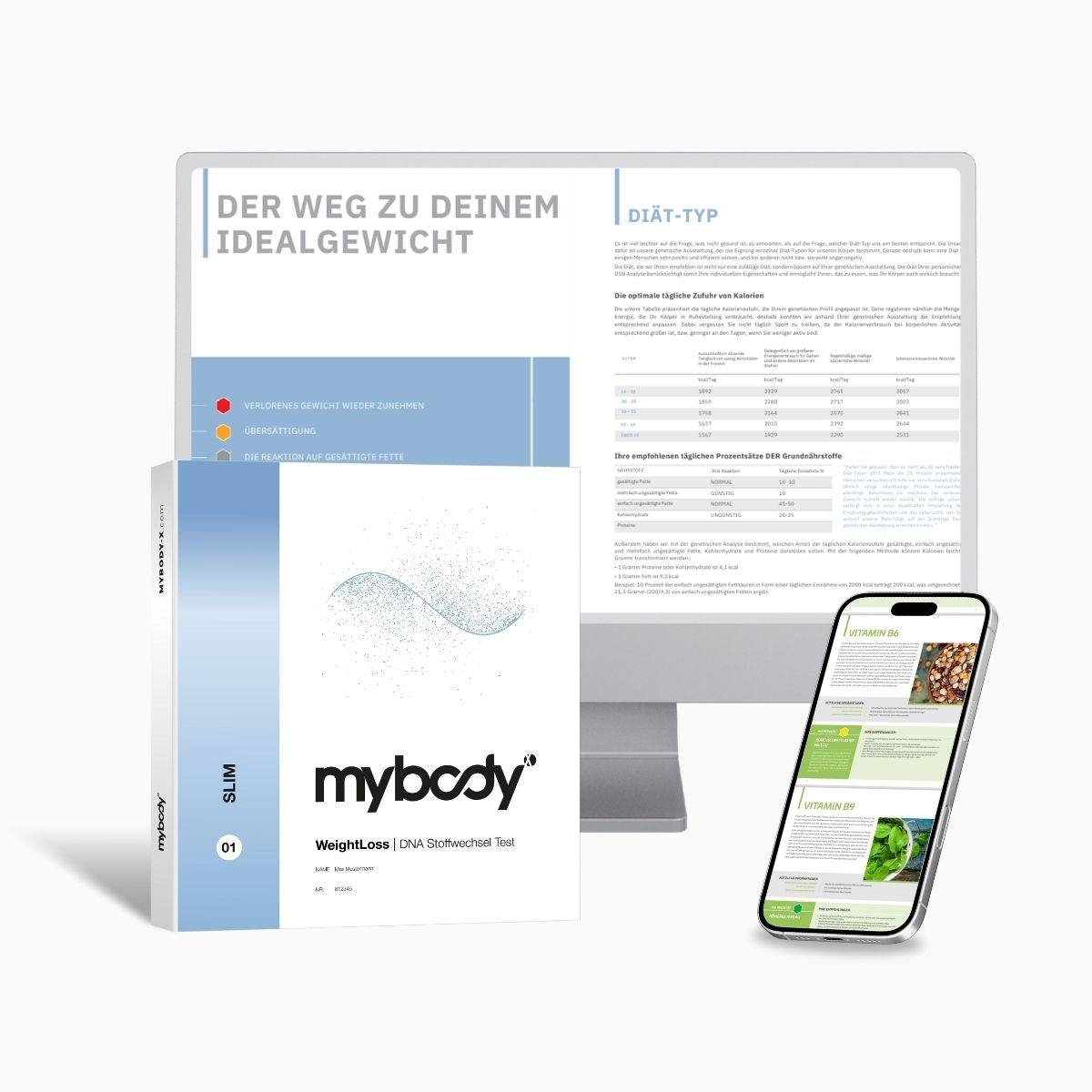
WeightLoss | SLIM DNA Test
Analyzes more than 80 genetic variations and provides 24 reports in five chapters, including responses to fats and carbohydrates as well as adaptation to physical activity. What the test does not do: It does not calculate your calorie needs and does not replace the formula. It does not provide a diagnosis or predict weight-loss success. Method: SNP genotyping with more than 700,000 SNPs, not whole-genome sequencing.
Price: €169.00 · Sample type: Saliva sample · Processing time: Kit shipping 1–3 business days, laboratory analysis 15–25 business days after sample receipt · Laboratory: ISO-certified laboratory analysis in Germany
About WeightLoss SLIMThe limitations should be clearly stated. A DNA test does not provide a calorie figure, nor does it replace the four calculation steps. What it describes is a predisposition—useful for the question of which dietary approach suits you, not for the question of how much you should eat.
And a second point: For genetic, blood, and microbiome analyses, the DGE states that they generally did not produce statistically verifiable improvements in dietary behavior, and cites moderate effects from increased motivation. The honest benefit therefore lies in structure and motivation, not in a more precise number.
All price and service information is current as of August 5, 2026. Prices and the scope of services may change; the respective product page is always authoritative.
What ultimately matters
The calculation is brief: resting metabolic rate from the DGE formula, multiplied by the PAL value for your activity level. Two values, one multiplication, five minutes of effort.
The accuracy lies not in the formula, but in the verification. Eating according to the calculated number for four weeks and weighing yourself weekly turns an estimate into a number that is right for you—regardless of how accurately the formula captured your body composition.
Your specific next step: Work through the formula once and record the result with the date. Weigh yourself on the same day and then weekly under the same conditions. After four weeks, you’ll know whether your number is right—and you’ll have more to go on than any calculator on the internet can give you.
Frequently asked questions
How do I calculate my calorie needs?
According to the DGE, the rule is: resting energy expenditure multiplied by the PAL value equals total energy needs. Resting energy expenditure is provided by a formula based on weight and age—for women (0.047 × kg − 0.01452 × age + 3.21) × 239, and for men (0.047 × kg + 1.009 − 0.01452 × age + 3.21) × 239. The PAL value depends on activity and ranges from 1.4 to 1.5 for office work to 2.0 to 2.4 for heavy physical work.
What is the difference between basal metabolic rate and total energy expenditure?
Basal metabolic rate—also called resting energy expenditure by IQWiG—covers the calories needed for vital bodily functions such as heartbeat and breathing. On average, it accounts for around 70 percent of energy needs. Total energy expenditure results when energy expenditure from physical activity and sports, at around 20 percent, and the thermic effect of food, at around 10 percent, are added.
Which PAL value should I use?
The DGE assigns activity profiles to the levels: 1.2 to 1.3 for frail, immobile, or bedridden people; 1.4 to 1.5 for office work with little leisure-time activity; 1.6 to 1.7 for a mix of sitting and standing work; 1.8 to 1.9 for predominantly standing or walking jobs; and 2.0 to 2.4 for heavy physical work or competitive sports. For regular exercise lasting 30 to 60 minutes on four to five days, add 0.3 units.
Why doesn't my calculated number match?
Because the formula uses weight, while resting energy expenditure, according to IQWiG, depends primarily on the proportion of muscle mass. Age, height, and hereditary predisposition also play a role. The result is therefore an estimate. It becomes reliable only through monitoring: eat according to the calculated number for four weeks, weigh yourself weekly under the same conditions, and adjust the value accordingly.
Can a DNA test determine my calorie needs?
No. A DNA test does not provide a calorie count and does not replace the formula. It describes a predisposition, such as your response to fats and carbohydrates or your adaptation to physical activity. The DGE also states that gene, blood, and microbiome analyses have generally not resulted in statistically verifiable improvements in dietary behavior, and cites moderate effects from increased motivation.
The number is there—and now what?
You calculate your calorie needs yourself. Which type of diet suits your predisposition is another question—the DNA test analyzes, among other things, your response to fats and carbohydrates.
View WeightLoss SLIM NutriCare INFINITYYou might also be interested in
→ Calorie Needs Calculator: Find Out What Your Body Really Needs
If you want the number directly, without calculating it yourself.
→ Calculate Basal Metabolic Rate for Weight Loss
The focus on basal metabolic rate and what it means for weight loss.
Sources
- German Nutrition Society (DGE): Selected questions and answers about energy intake — dge.de
- Institute for Quality and Efficiency in Health Care (IQWiG): Causes of obesity, as of 2022 — gesundheitsinformation.de
The calculation method of multiplying basal metabolic rate by the PAL value, the two formulas for basal metabolic rate, all PAL levels, and the sports supplement of 0.3 units are based on source [1]. The definition of basal metabolic rate, the proportions of around 70, 20, and 10 percent, and the influencing factors of muscle mass, age, height, and genetic predisposition come from source [2]. The example calculations were calculated from this information and rounded. The DGE's assessment of genetic, blood, and microbiome analyses comes from the mybody®x knowledge base, as of 2022. Product information comes from the mybody®x product pages, accessed on August 5, 2026.

mybody®x Editorial & Expert Team
Metabolism Energy requirements Nutritional science
This article was created and medically reviewed by the mybody®x Editorial and Expert Team. The team brings together expertise in nutrigenetics, microbiome and gut science, blood test interpretation, nutritional science, and laboratory diagnostics.
Published on August 5, 2026 · Last updated on August 5, 2026
Medical notice: This article is for general information only and does not replace medical advice, diagnosis, or treatment. A significant reduction in energy intake, unintended weight loss, and existing medical conditions should be medically or nutritionally supervised.




Share now:
Watery diarrhea without nausea: what the absent symptom reveals
Is non-alcoholic beer really healthy? What it contains—and what it doesn’t