

Calorie BMI Calculator
The intelligent mybody online calculator
Calculate your personal calorie needs or BMI – precise & personalized
💪 Strength sports
🏃 Endurance sports
⚽ Team sports & martial arts
Why did people have a DNA analysis done at mybody®?
wanted to lose weight and eat healthier.
wanted to improve their overall health and fitness.
wanted to learn more about their body.
Real customers with real results



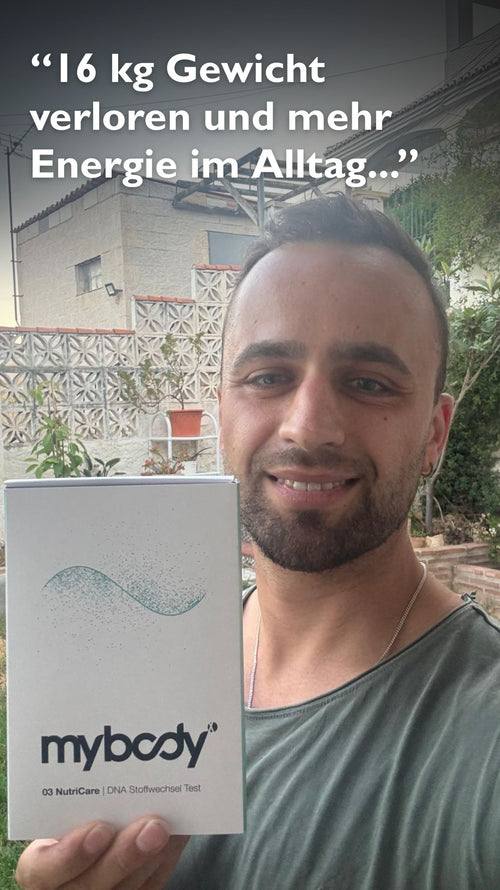

mybody® gives you valuable clarity
Highest quality standard
Our analyses are not only ISO-certified, but are also recognized as medical self-tests.
Personal customer service
You will receive a free consultation and discussion of your results reports from us.
Scientific analyses
Our detailed reports are based on your information and analysis results.
What is a Calorie & BMI Calculator—and why do you really need one?
Many people start a new phase of healthier eating feeling motivated—and give up after just a few weeks. The most common reason: They simply eat without knowing how much energy their body actually needs each day. That's exactly where the Calorie & BMI Calculator from myBody-X comes in. In just a few minutes, you get a clear, personalized overview of your daily calorie needs and Body Mass Index—free of charge and without complicated technical knowledge.
But what lies behind it? A calorie calculator calculates how much energy your body needs per day to maintain all its functions—from digestion and body temperature to movement and exercise. This value is known as total daily energy expenditure. It consists of your basal metabolic rate (the energy your body uses at rest) and the additional calories burned through physical activity.
The BMI calculator completes the picture. The Body Mass Index measures the relationship between body weight and height and gives you a quick indication of whether your current weight is within a healthy range. It isn't a perfect measure—it doesn't take muscle mass into account, for example—but it is a useful starting point.
Why is it so important to know both? If you don't know your calorie needs, you're working blind. You can't lose weight intentionally if you don't know how much you can eat. You can't build muscle if you don't know how much energy your body needs for it. And you can't maintain your weight in the long term if you don't understand your energy balance.
But a calorie calculator alone is only the first step. What many people don't know is that two people with identical body measurements can still have a completely different metabolism. The reason lies deep in biology—in their own DNA. That's exactly why myBody-X goes one crucial step further. With the DNA metabolism analysis, you learn not only how many calories you need—you also understand why your body reacts the way it does. You get answers to questions such as: Why am I barely losing weight despite dieting? Why is it so difficult for me to build muscle? Which type of diet is really right for me?
That is why the myBody-X Calorie & BMI Calculator is more than an online tool. It is the first step on a journey toward a genuine understanding of your body – and, together with our DNA analysis, toward an eating approach that truly suits you.
Get started now: Enter your data, choose your goal, and have your personal calorie and BMI values calculated. It takes less than two minutes – and could be the starting point for real, lasting change.
How the myBody-X Calorie & BMI Calculator works – step by step
The myBody-X Calorie & BMI Calculator is designed so that you can use it immediately without any prior knowledge. No specialized knowledge required, no complicated operation. Here you can find out how it works.
Step 1: Enter your personal data
In the first step, you enter your basic body data: age, sex, height, and current body weight. These four details form the basis for all further calculations. They directly contribute to calculating your basal metabolic rate – the number of calories your body burns each day when you do not move at all.
myBody-X uses the scientifically recognized Mifflin-St. Jeor equation, which nutrition and sports experts worldwide consider one of the most accurate methods. So you do not receive a rough estimate, but a well-founded figure based on scientific research.
Step 2: Determine your activity level
In the second step, you determine how active you are in your everyday life. This is crucial – because two people with identical body data can have completely different calorie needs, depending on whether someone sits in an office all day or does physical work.
myBody-X specifically asks about your everyday activity level:
- Mostly sedentary (e.g. office work, working from home)
- Lightly active (e.g. standing activities, short commutes)
- Active (e.g. physically demanding jobs, lots of movement)
- Very active (e.g. manual work, exercise several times a day)
You also enter your sports activities separately – type, frequency, and intensity. This makes your total daily energy expenditure much more precise than simple calculators that use only one general activity level.
Step 3: Set your goal
In the third step, you choose your personal goal:
- Weight loss – reduce calorie intake to lose body fat
- Maintain weight – Keep calorie intake stable
- Build muscle – Increase calorie intake to build muscle mass
Based on your selections, the calculator determines not only your total calorie needs but also a recommended macronutrient distribution—that is, how much protein, fat, carbohydrates, and fiber you should consume each day.
The result—and what comes next
After calculating, you will see your basal metabolic rate, total daily energy expenditure, recommended daily calorie intake, BMI, and recommendations for all key macronutrients at a glance.
But myBody-X does not stop there. Calories are only part of the story. Your metabolism, nutrient utilization, and genetic predispositions largely determine how your body responds to nutrition and training. That is exactly what the myBody-X DNA Metabolism Analysis shows you: It analyzes your individual genetic makeup and provides you with a fully personalized nutrition plan—including cooking recipes and diet plans tailored to you and genuinely suited to your body. Feel free to take a look at our products.
Basal metabolic rate and total daily energy expenditure—what you really need to know
When you want to calculate your calorie needs, you quickly encounter two terms: basal metabolic rate and total daily energy expenditure. Many people confuse them or do not know the difference. Yet understanding this distinction is crucial—because only those who know what these two values mean can truly manage their diet effectively.
What is the basal metabolic rate?
The basal metabolic rate (BMR) is the number of calories your body burns each day when you are completely at rest—that is, lying down, sleeping, or doing nothing. This energy is needed for vital functions such as heartbeat, breathing, body temperature, cell renewal, and organ function.
For most people, the basal metabolic rate accounts for 60–75% of total daily energy expenditure. It is influenced by age (the older you are, the lower it tends to be), sex (men generally have a higher basal metabolic rate), height and weight, as well as muscle mass (more muscle means a higher basal metabolic rate).
One important point: Even with identical age, weight, and activity level, basal metabolic rate can vary noticeably from person to person. This is partly due to genetic predisposition—in other words, DNA. The myBody-X DNA Metabolism Analysis makes precisely these individual differences visible. This allows you to truly get to know your metabolism—instead of merely estimating it.
What is total daily energy expenditure?
Total daily energy expenditure (TDEE) goes an important step further. It takes into account not only your resting metabolic rate, but also all the calories you additionally burn through movement, exercise, and everyday activities.
Formula: Total daily energy expenditure = basal metabolic rate × activity factor
The more active you are, the higher your total daily energy expenditure—and the more calories you can eat without gaining weight.
Why the difference is so important
Many people make the mistake of using only their basal metabolic rate as a reference. That would provide far too little energy—even for a very inactive person. Your total daily energy expenditure is the figure you should use as a guide when planning your diet.
- For losing weight: Eat 300–500 calories below your total daily energy expenditure each day—for controlled, sustainable fat loss without muscle loss.
- For maintaining your weight: Calorie intake ≈ total daily energy expenditure.
- For building muscle: Eat 200–400 calories above your total daily energy expenditure to provide your body with enough energy for muscle growth.
The myBody-X calorie and BMI calculator automatically calculates both values for you and uses them to provide the right recommendation for your goal.
Anyone who wants to understand more deeply how their metabolism works will find the right answer with the myBody-X DNA Metabolism Analysis: at the genetic level, it shows you which type of diet and which training are truly optimal for your individual body—complemented by customized diet plans and cooking recipes for everyday life.
Calculate your BMI, understand your DNA—this is how you discover what your body really needs
The BMI (Body Mass Index) is one of the best-known reference values for body weight and health. The myBody-X calculator automatically calculates it for you—directly alongside your personal calorie requirement. But what does BMI really tell you? And where does what a calculator alone cannot do begin?
How BMI is calculated
The formula is simple:
BMI = body weight (kg) ÷ height² (m²)
Example: A person weighs 75 kg and is 1.75 m tall.
BMI = 75 ÷ (1.75 × 1.75) ≈ 24.5
The BMI scale at a glance
BMI valueClassificationBelow 18.5Underweight18.5 – 24.9Normal weight25.0 – 29.9Overweight30.0 and aboveObesity
This scale applies to adults and is an internationally recognized reference value established by the World Health Organization (WHO).
What BMI can tell you
BMI is a quick, straightforward indicator. It immediately shows whether your body weight is in a healthy proportion to your height. For the general population, it is a useful initial benchmark – especially for identifying health risks associated with being significantly underweight or overweight.
Where BMI reaches its limits
BMI is not a perfect measure. It does not distinguish between muscle mass and fat mass. According to the BMI scale, a trained strength athlete may be classified as “overweight” even though their body fat percentage is very low. BMI also does not take factors such as age, ethnic background, or body fat distribution into account.
And this is where a calorie calculator and BMI value alone are not enough – because they do not tell you why your body is the way it is. They do not tell you which foods your metabolism processes particularly well or poorly. They do not tell you which type of diet is genetically suited to you.
The big picture: DNA analysis as the next step
That is precisely why the myBody-X DNA Metabolism Analysis is the logical complement to the calorie and BMI calculator. It analyzes your genetic makeup and gives you answers that no standard calculator can provide:
- How well does your body process carbohydrates, fats, and proteins?
- Which type of training suits your genetic predisposition?
- Which micronutrients does your body need most?
- Why do you respond differently to certain diets than other people?
Based on this analysis, myBody-X provides you with a fully personalized nutrition plan – including a diet plan and suitable cooking recipes tailored precisely to your metabolism and goals. Explore all available offers in our product section.
Use your BMI value for what it is: a helpful starting point that shows you where you currently stand. Then decide whether you want to stick with an estimate or truly understand your body.
Everything you want to know.
FAQs
How does the mybodyx calorie and BMI calculator work?
The myBodyX Calorie & BMI Calculator analyzes your personal data—age, gender, height, weight, and activity level—and uses it to calculate your individual daily calorie needs and BMI. The calculation is based on the scientifically recognized Mifflin–St Jeor equation. Depending on your chosen goal (losing weight, maintaining your weight, or building muscle), you will also receive a suitable recommendation for protein, fat, carbohydrates, and fiber. The entire process takes less than two minutes and is free of charge. If you want to go even deeper, the myBodyX DNA Metabolism Analysis offers an even more personalized solution—tailored directly to your body’s genetic makeup.
What is the difference between basal metabolic rate and total daily energy expenditure?
Basal metabolic rate is the number of calories your body needs each day simply to maintain all vital functions—in complete rest, without any movement. Total daily energy expenditure (TDEE) goes beyond this: It includes your basal metabolic rate plus all the calories you burn through everyday movement, work, and exercise. Total daily energy expenditure is the key figure for planning your daily diet. It’s important to know that your basal metabolic rate and how efficiently your body uses energy also depend on your genes. The DNA Metabolism Analysis from myBodyX gives you precisely this deeper understanding of your body.
How accurate are the calculator’s results?
The results of the myBodyX calorie and BMI calculator are based on scientifically recognized calculation formulas and provide very good guidance. The more accurate your inputs, the more precise the result. Individual factors such as hormone levels, medications, or genetic characteristics may slightly shift the actual values. The calculator is an excellent starting point for well-founded nutrition planning. Anyone who wants an even more precise, truly personalized assessment of their body and metabolism can find one with the DNA Metabolism Analysis on mybody-x.com.
Why does my result differ from other calorie calculators?
The calorie calculator gives you a solid starting point—it shows you how much energy your body needs each day. The DNA Metabolism Analysis from myBodyX takes a crucial step further: it reveals how your body genetically responds to certain foods, macronutrients, and types of exercise. For example, you’ll learn whether you’re genetically more responsive to a low-carb or Mediterranean diet, whether your body uses fat efficiently as an energy source, and how quickly you recover after training. Together with the myBodyX Diet Plan and Recipe Book, you get not only knowledge but also personalized meal recommendations that you can put into practice right away. You can find all products at mybody-x.com/collections/alle-produkte.
How often should I recalculate my calorie needs?
Your calorie needs change as soon as your body weight, activity level, or life situation changes. As a rule of thumb, recalculate your needs every 4–6 weeks—or whenever you have lost or gained more than 3–5 kg, significantly changed your exercise routine, or your progress stalls. The myBodyX calorie and BMI calculator is available to you free of charge at any time. If you want to understand in the long term why your needs change and how to respond more strategically, it is worth taking a look at the DNA Metabolism Analysis—for a lasting understanding of your unique body and metabolism.
Do I have to eat exactly the same number of calories every day?
No—and that’s good news! What matters is not the exact daily figure, but the average over the week. If you eat a little more on one day and a little less on another, it usually balances out. The important thing is that your weekly average roughly matches your target value. This flexibility makes healthy eating much more practical in everyday life. For an even more personalized approach—for example, which meals and foods truly suit your metabolism—myBodyX offers exactly the right support with its DNA analysis and personalized recipe and diet plan. You can find all offers at mybody-x.com/collections/alle-produkte.