

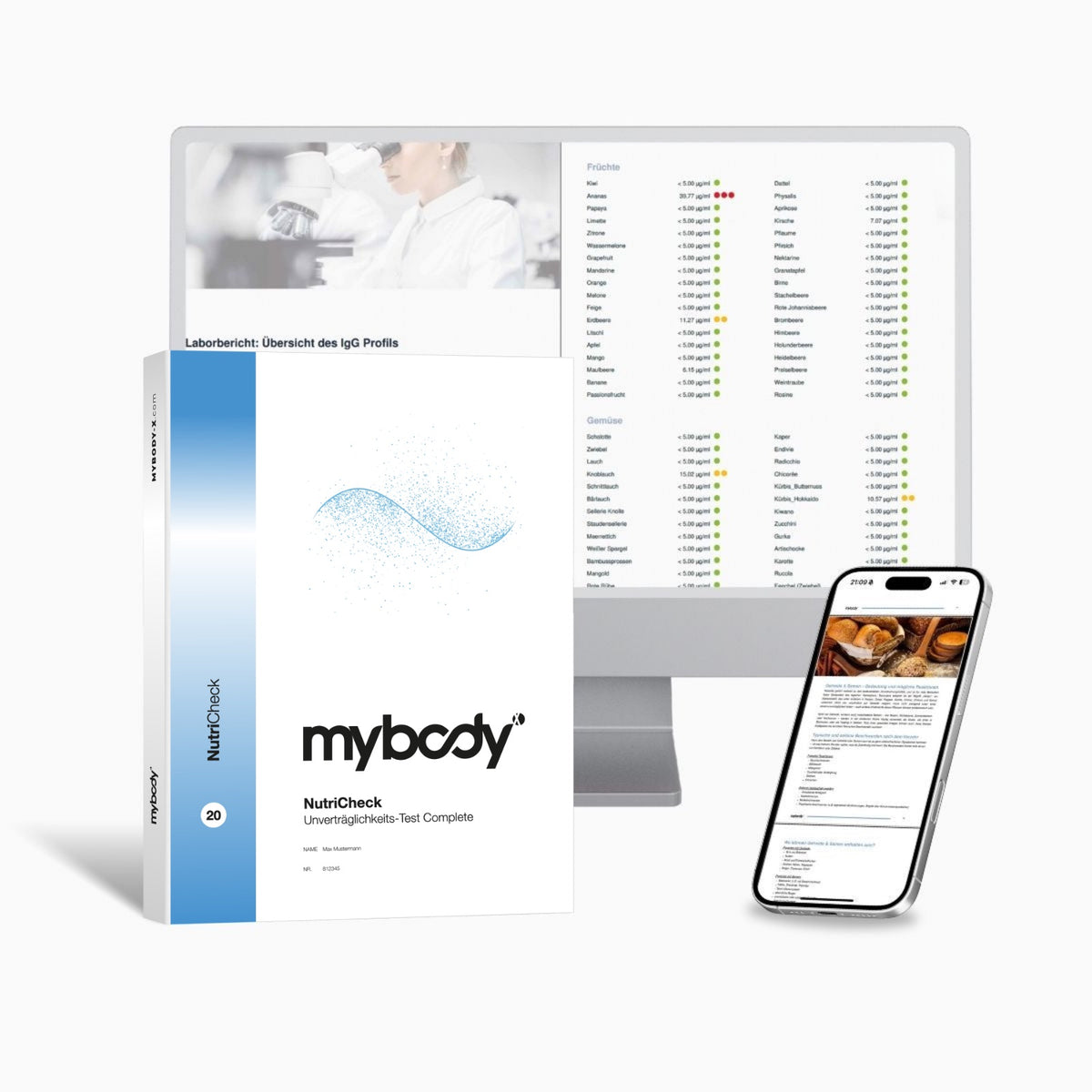

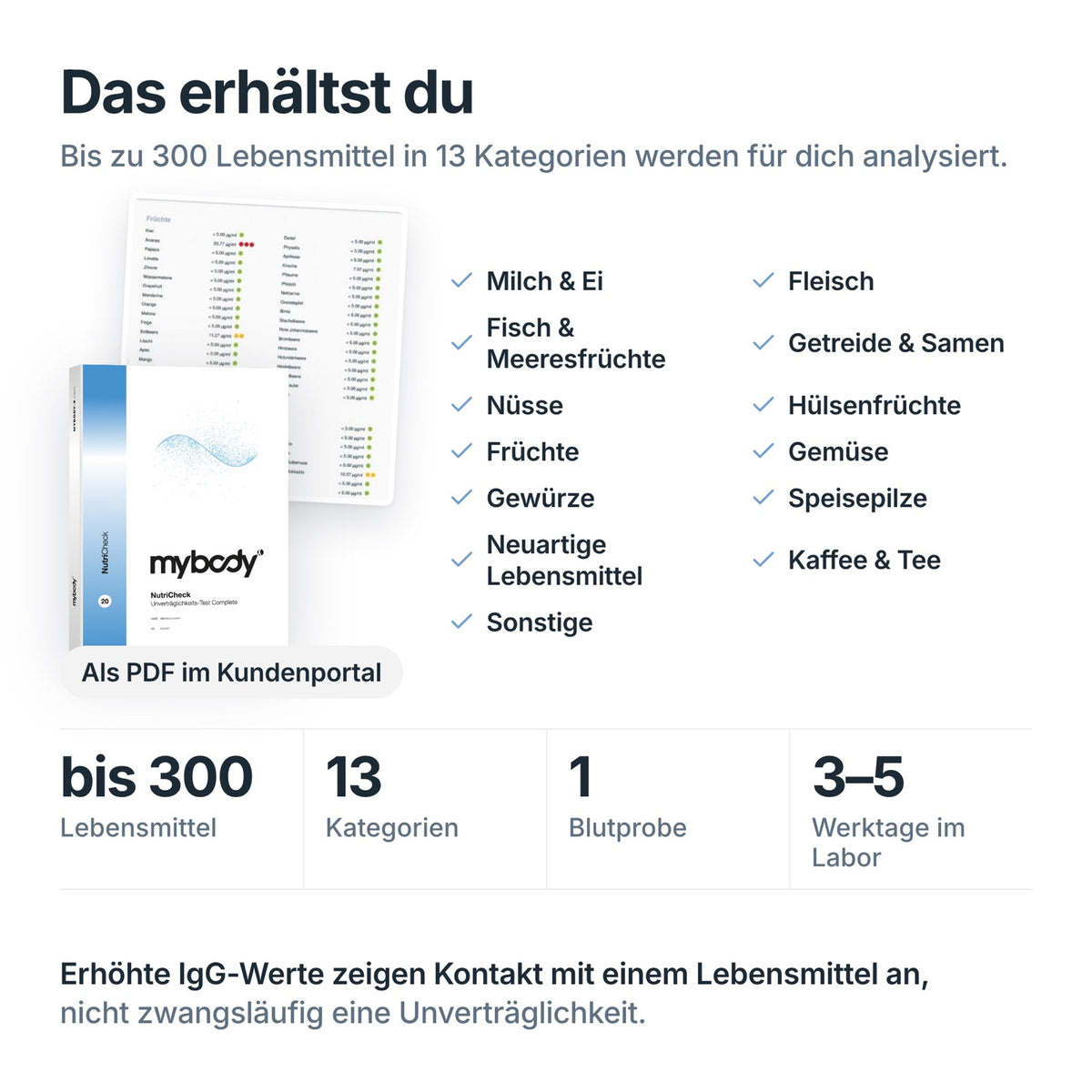

NutriCheck I Complete Intolerance Test
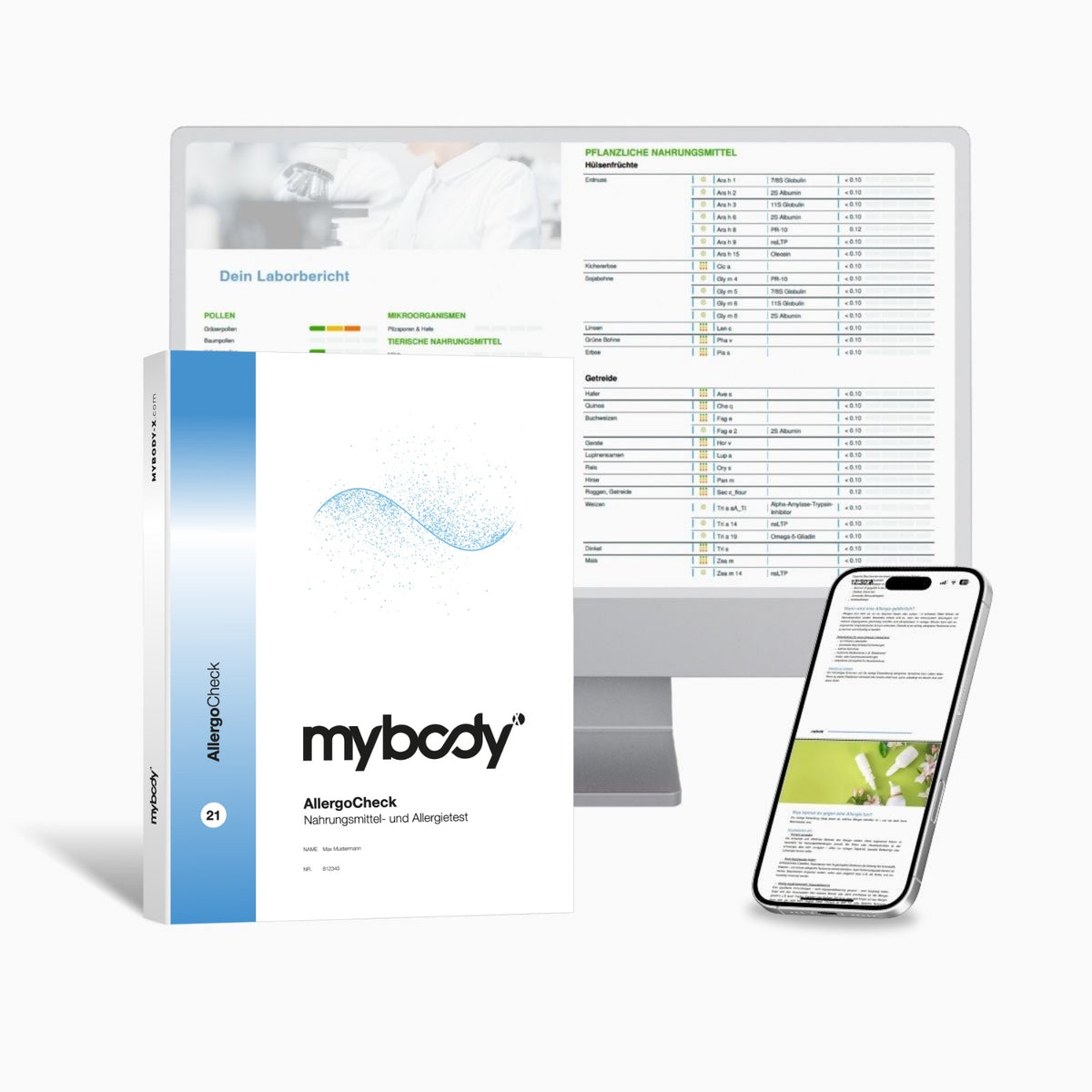

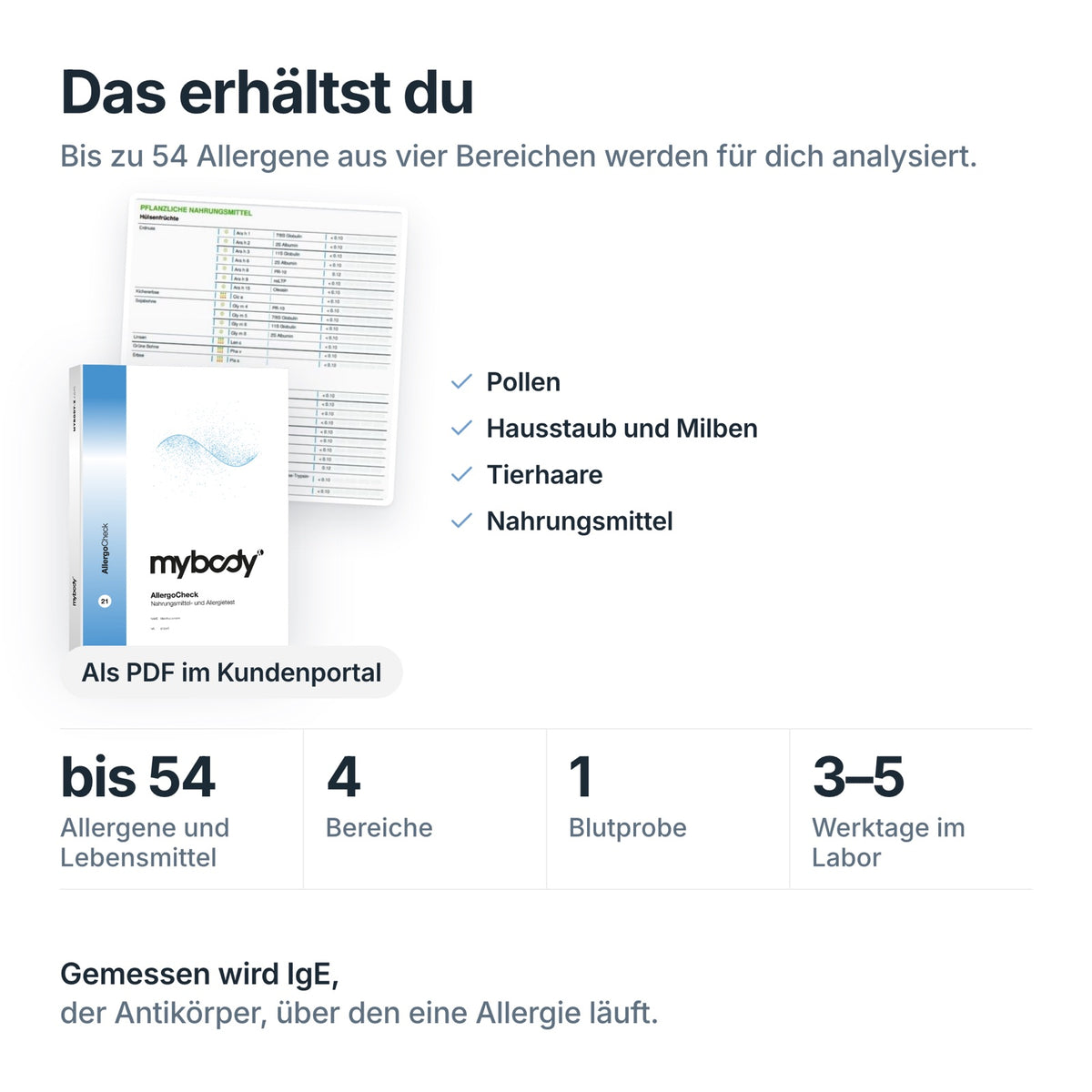

Blood tests from mybody®
Identify intolerances and allergies—for greater ease in everyday life
Our intolerance and allergy tests can be carried out easily and conveniently at home. The analysis shows how your body reacts to certain foods, additives, or environmental triggers—and identifies possible intolerances or allergic reactions.
You will receive a personalized evaluation with specific recommendations to help you avoid triggers in a targeted way and alleviate symptoms such as fatigue, skin problems, or digestive issues in the long term—for a better quality of life and improved awareness of your body.
mybody® gives you valuable clarity
Highest quality standard
Our analyses are not only ISO-certified, but are also recognized as medical self-tests.
Personal customer service
You will receive a free consultation and discussion of your results reports from us.
Scientific analyses
Our detailed reports are based on your information and analysis results.

FAQs - You asked, we answer:
What are the benefits of an intolerance test at home?
An intolerance test helps you find out whether your body does not tolerate certain foods well. It analyzes your reaction to proteins in foods and gives you clear guidance on how to adjust your diet—without a doctor’s visit, conveniently from home.
What is the difference between an allergy and an intolerance?
An allergy is an immediate immune reaction, while a food intolerance usually occurs later and is caused by impaired processing of food components. Our tests help you distinguish between the two.
How does an intolerance test work?
You collect a small blood sample at home and send it to our certified partner laboratory. There, your reaction to certain foods (e.g., IgG antibodies) is analyzed. You receive the results online with specific dietary recommendations.
What symptoms may indicate a food intolerance?
Typical complaints include bloating, abdominal pain, skin problems, chronic fatigue, or headaches after eating. Such nonspecific symptoms can be better identified and treated with a test.
Who can benefit from a food intolerance test?
A test is suitable for anyone who regularly suffers from digestive problems, skin irritation, or lack of energy and suspects that certain foods may be triggers. A test can also provide clarity in cases of unexplained symptoms.
Do I need nutritional counseling for an elimination diet?
It makes sense. With an elimination diet, you avoid certain foods for a while and then reintroduce them in a structured way. When people eliminate foods on their own, they usually cut out too much, and after four weeks entire food groups may be missing without making it any clearer what the issue was. A nutrition professional can help you make targeted choices. Along with the results, you’ll receive guidance on how to proceed. If symptoms persist or worsen, you should see a doctor regardless of the test.
Our products are not intended to diagnose, treat, cure, or prevent diseases.
The content is for general information only and is not a substitute for medical advice, diagnosis, or treatment. Reference ranges depend on the laboratory, method, and age - the information on your test result is always authoritative.
At-Home Intolerance and Allergy Tests
At-home intolerance and allergy tests give you clarity about what your body really does not tolerate—without a doctor’s appointment, but with genuine laboratory analysis. The blood can be tested for antibodies against common allergens. This provides valuable indications of whether your immune system reacts to certain foods or environmental triggers such as pollen, pet dander, dust mites, mold spores, or latex.
With mybody® self-tests, you collect the sample yourself—conveniently using capillary blood—and send it to the certified laboratory. There, immune reactions to one hundred to several hundred foods and allergens are analyzed, depending on the test selected (e.g., NUTRI CHECK IgG Food Test, IgE Allergy Blood Test, Combo Check).
You receive a structured report with clear tables, reactivity levels, and specific recommendations for your everyday life—for example, reducing certain foods or avoiding common allergy triggers. Important: The tests provide indications and a basis for decision-making, but they do not replace a medical diagnosis. If you have severe or acute symptoms, you should always discuss your results with a doctor or allergist.
How Allergies Work in the Body
An allergy is an exaggerated reaction by your immune system to substances that are actually harmless—such as pollen, dust mites, foods, pet dander, or latex. Your body produces specific IgE antibodies against these allergens. When an allergen and IgE come into contact, they activate mast cells and basophils, which release messengers such as histamine. This release causes typical allergy symptoms: itching, sneezing, watery eyes, skin rashes, swelling, or breathing difficulties.
Medically, this is referred to as a type I immediate hypersensitivity reaction (IgE-mediated). It can occur locally (e.g., hay fever or contact allergy) or systemically—in extreme cases, as anaphylaxis. This should be distinguished from food intolerances, in which digestion, enzymes, or the intestinal barrier often play a role (e.g., lactose or fructose intolerance) and IgE is usually not the primary factor.
mybody® tests address this distinction: IgE blood tests provide indications of classic allergies, while IgG-based intolerance tests can reveal patterns of immune reactions to foods. The results can help you better categorize your symptoms—but an exact diagnosis and treatment should always be handled by a doctor.
How Can I Test Myself for Allergies?
If you want to test yourself for allergies, modern blood self-tests offer a convenient way to obtain initial indications. With mybody®, you take a small blood sample from your fingertip and send it to the laboratory. The IgE Allergy Blood Test measures specific IgE antibodies against numerous allergens—including foods (e.g., milk, eggs, nuts, and grains), pollen, pet dander, house-dust and storage mites, mold spores, and latex.
The laboratory checks whether and to what extent your immune system reacts to these substances. You receive a detailed report with reactivity levels, allergen groups, and practical everyday tips. You can also choose the Combo Check, which combines allergic (IgE) and intolerance-related (IgG) reactions to around 600 foods and allergens in a single test—ideal if you want to consider both environmental allergies and digestive or skin problems.
Important: A self-test is a screening tool, not a substitute for medical evaluation. If you experience severe symptoms such as shortness of breath, facial swelling, circulatory problems, or suspected anaphylaxis, you must contact emergency services immediately. For treatment, desensitization, and medication, you should discuss your test results with a specialist.
What Intolerance and Allergy Tests Are Available?
At mybody®, you will find various at-home intolerance and allergy tests that differ in their purpose and antibody type:
- NUTRI CHECK (IgG Food Intolerance Test)
Measures IgG antibodies against up to 300 foods and nutrients. This can reveal reaction patterns that may be associated with digestive problems, fatigue, or skin issues. You receive suggestions for elimination and rotation strategies to better tailor your diet to your body.
- IgE Allergy Blood Test
Focuses on classic allergies: The test identifies IgE-mediated reactions to up to 300 allergy variants—including foods, grass and tree pollen, pet dander, dust mites, insect venoms, mold spores, and latex. Ideal for typical hay fever, respiratory, or skin symptoms. - Combo Check (Allergies & Intolerances)
The Combo Check Blood Test combines both approaches: It analyzes immune reactions to around 600 foods and allergens and covers both allergic (IgE) and intolerance patterns (IgG). It is particularly suitable if you have complex symptoms and want to address both dietary and environmental factors.
In addition, mybody® points out in its guides and FAQs that medical tests such as skin prick tests, challenge tests, or specialized laboratory analyses remain the gold standard for diagnosis. However, mybody® tests provide a convenient, scientifically grounded starting point from home and support you in planning targeted next steps with your doctor.
If you frequently suffer from bloating, skin irritation, or discomfort after eating, an at-home intolerance test can finally give you clarity. The self-tests are easy to use: collect a sample, send it to the laboratory, and receive your results digitally—including personalized recommendations. This way, you can quickly find out which foods your body does not tolerate well and how to adjust your diet specifically.
Many nonspecific complaints, such as abdominal pain, fatigue, or bloating, can be attributed to food intolerances. Since the symptoms often develop gradually, the cause frequently remains undetected for a long time. With a targeted test, you can reliably identify problematic foods and finally adjust your diet. The result: more energy, better digestion, and a significant improvement in your overall well-being.
If certain foods regularly cause you problems, an intolerance test is the best way to identify the triggers. The laboratory analysis shows you exactly which foods your body has difficulty processing. With this information, you can specifically address symptoms such as bloating, fatigue, skin problems, or headaches—and tailor your diet to your personal needs.
Skin irritation, headaches, or digestive problems after eating? These symptoms may indicate a food intolerance. Our self-tests provide scientifically backed results and show you what doesn’t agree with your body. This allows you to reduce symptoms, actively manage intolerances, and improve your diet sustainably – quickly, discreetly, and from the comfort of your own home.