
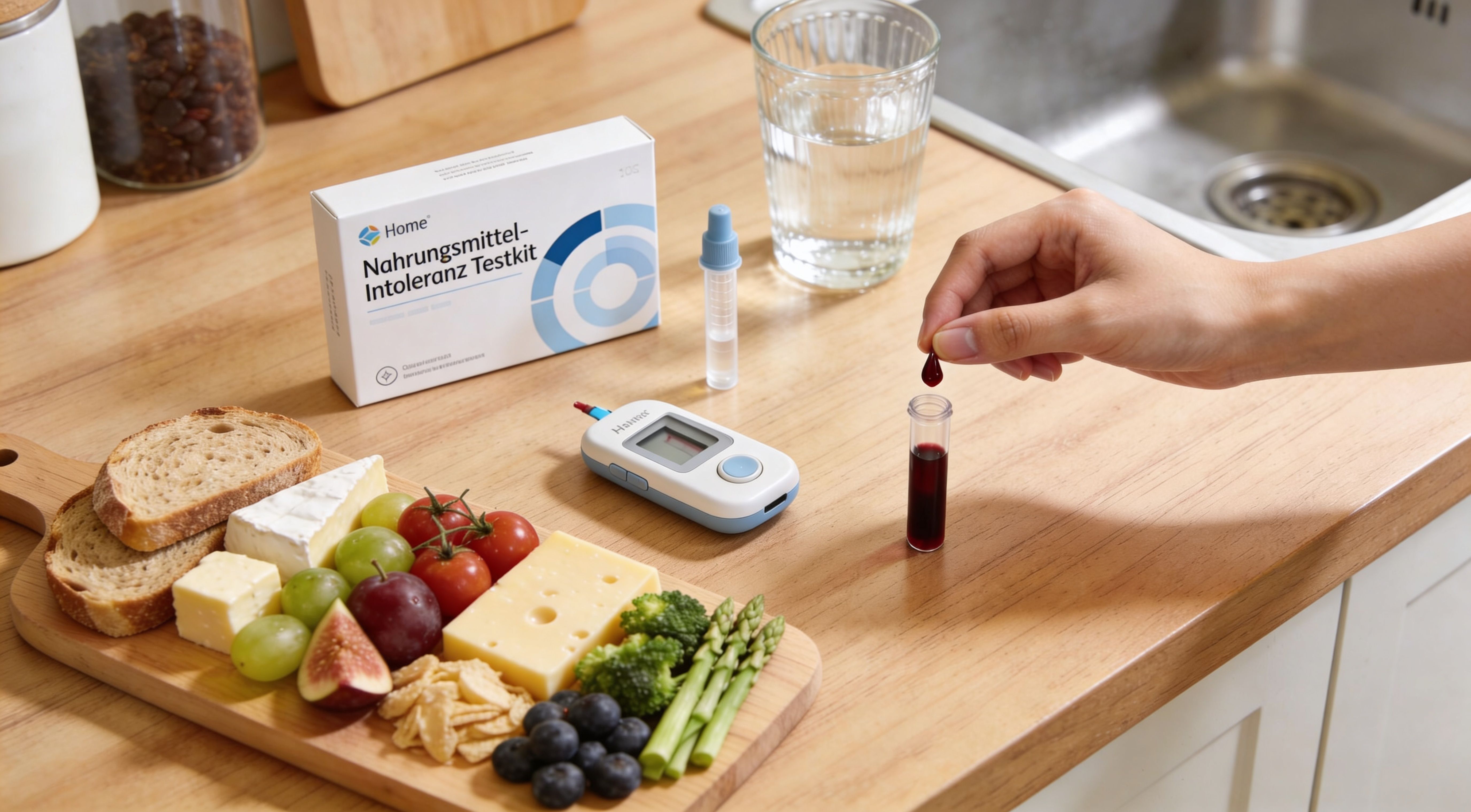
Food Intolerance Test: How to Find Clarity
You eat quite normally. Cereal in the morning, a quick sandwich for lunch, maybe yogurt or pasta in the evening. And yet, your body reports issues. Your stomach feels bloated, your skin acts up, your head feels heavy, your energy drains. Not always immediately after eating, and not always with the same intensity. That's exactly what makes it so confusing.
Many people then get caught in an endless loop of Googling, eliminating foods, and re-puzzling. Was it dairy, wheat, stress, or something else entirely? If you're looking for a food intolerance test, you're often not seeking a trend, but something much simpler. Clarity.
Stomach rumbling, fatigue, skin problems – Does this sound familiar?
It often starts unspectacularly. At first, there's just a feeling of fullness after certain meals. Then fatigue sets in, even though you've had enough sleep. Perhaps your skin suddenly reacts more sensitively, or you experience discomfort that can never be clearly linked to a specific food.

The frustrating part is not just the symptom itself. It's the feeling of no longer being able to truly trust your own body. You try hard, perhaps already pay attention to your diet, and yet the question of what's actually going on remains unanswered.
Some then try the obvious first. Less milk. Less bread. Less sugar. Less everything. For a short time, this feels controlled, but it often quickly becomes exhausting. Because if you eliminate several foods on suspicion, eating becomes complicated, even though you actually want relief.
You are not alone in this uncertainty. The desire for a test is often not a sign of exaggeration, but a sensible attempt to make diffuse symptoms tangible.
Typical patterns that lead people to consider a food intolerance test include:
- Digestion after eating: Bloating, pressure, restless bowel, or fluctuating tolerance.
- Symptoms outside the abdomen: Fatigue, head pressure, or the feeling of not being able to perform properly after certain meals.
- Skin and well-being: Irritations, itching, or simply the sensation that something is not right.
- Unclear triggers: You can't clearly identify a single food, because the reaction isn't always the same.
If this sounds familiar, it doesn't automatically mean you have an allergy. But it does mean that your body deserves attention. And that's where it becomes important what kind of test is even appropriate for the question at hand.
Allergy or Intolerance – More than just word-splitting
You experience discomfort after eating and are looking for a test. Then "allergy" often sounds like the obvious umbrella term. This is exactly where much confusion begins for many, because allergy and intolerance do not describe the same thing. For choosing a meaningful test, this difference makes a big difference.
When the immune system triggers an alarm
A food allergy is a reaction of the immune system. The body classifies an otherwise harmless substance as a threat and reacts to it. In the classical immediate-type allergy, specific IgE antibodies play a central role.
Such reactions can occur quickly and be clearly noticeable. Typical symptoms include skin, mucous membrane, respiratory, or gastrointestinal complaints. The crucial point here is not whether a food "lies heavy in the stomach," but that the immune system is involved.
Many people prematurely classify their symptoms as allergies. Among adults, the rate of actual food allergies is 3.7%, while approximately 30% of the population claim to suffer from one (Allergieinformationsdienst on the prevalence of food allergies).
When processing, rather than defense, is the problem
An intolerance works differently. Here, the immune system is usually not the focus, but rather how your body processes a component of food. This can, for example, be related to enzymes, as with lactose, or to the amount that your body can still tolerate well.
This explains why symptoms of intolerances often seem irregular. On one day, a small portion is well tolerated, on another, even less is enough. Your body then reacts more like a system with limited capacity. As long as the load remains small, you notice little. If it becomes too high, symptoms appear.
If you want to understand the difference in more detail, this article on the difference between allergy and intolerance will also help you.
Practical rule of thumb: The clearer you distinguish between allergy and intolerance, the more targeted you can test, instead of eliminating more and more foods on suspicion.
Why this is so important for tests
Many online self-diagnoses lump various mechanisms together. This often leads to false expectations of a food intolerance test. Because a test is only helpful if it matches the question.
For a suspected allergy, medically, different markers are involved than for lactose or fructose intolerance. And the situation is different again for non-specific complaints, where initially it only seems that certain foods might play a role. A home blood test can be a sensible first step here to more systematically identify patterns and to prepare for further medical clarification in a more targeted way. It does not replace a diagnosis, but it can help you proceed with more clarity instead of mere guesswork.
Understanding the diversity of your body's reactions
You eat a roll with cream cheese in the morning. At midday, your stomach is bloated, in the evening your skin itches, and the next day you are tired and wonder: Was it the gluten, the dairy, the stress, or something else entirely?
This is precisely where it often gets confusing. In everyday language, very different processes are lumped together under the term "reaction to food." For you, however, this distinction makes a big difference, because not every reaction can be meaningfully detected with the same test.

The classic IgE allergy
In a true food allergy, your immune system reacts to a specific protein in the food. This can happen quickly, sometimes within minutes. Typical symptoms include itching in the mouth, swelling, skin reactions, or breathing difficulties.
An important point that is often misunderstood is that an IgE value describes an immunological reaction. It does not automatically answer the question of whether this specific food actually triggers your symptoms in everyday life. This always requires a comparison with symptoms, timing, and quantity.
You can imagine it like a smoke detector. If it goes off, something is wrong. But it doesn't definitively tell you where the fire is or how big it really is.
Enzymatic intolerances such as lactose and fructose
Here, something different is happening. The problem is not primarily an immune system defense reaction, but rather the processing in the digestive system. If certain sugars are not properly broken down or absorbed, they enter further into the intestine and are fermented there. This can cause bloating, abdominal pain, a feeling of fullness, or diarrhea.
These reactions are often dose-dependent. A small portion may be well tolerated, but a larger one may not. This is precisely why intolerances sometimes seem contradictory in everyday life.
If you also want to better assess whether your gut microbiome plays a role, a look at typical symptoms of a disturbed gut flora will help. Many complaints feel similar, although the cause is different.
Gluten is not synonymous with a gluten problem
The topic of gluten leads to a lot of misconceptions online. Some mean celiac disease, others an intolerance to wheat products in general, and still others talk about a diffuse unease after bread or pasta.
Celiac disease, however, is not a common intolerance, but an autoimmune disease. This is a different medical category. Therefore, a general self-test is not sufficient here if there is a real suspicion. In such cases, targeted medical clarification is required.
Again, just because you don't feel well after baked goods doesn't automatically mean gluten is the cause. Sometimes other components play a role, such as the quantity, the composition of the meal, or accompanying digestive problems.
IgG tests and why they are so often misunderstood
Many people first come across IgG tests during their research because they appear simple at first glance. A blood sample, many foods, a list of abnormalities. That sounds like quick clarity.
But this is precisely where the confusion often begins. In German professional discourse, IgG is not considered reliable evidence for food intolerance. Such values can primarily show that your body has had contact with a food. They alone do not answer the crucial question of whether this food causes your symptoms.
For practical purposes, this means: A home blood test can be a sensible first step to observe patterns more systematically and to consciously monitor one's own eating habits. However, it is not a conclusive diagnosis. It only becomes truly helpful when you use the results as a starting point, rather than as a final judgment.
This classification helps for orientation:
| Reaction type | What may be behind it | Typical sensible approach |
|---|---|---|
| True allergy | Immune reaction with IgE | IgE diagnostics and medical assessment |
| Lactose or Fructose | Processing problem in the gut | Breath test and targeted clarification |
| Suspicion of celiac disease | Autoimmune disease | Medical diagnostics |
| IgG abnormality | Contact with foods, not automatically the cause | Interpret very carefully |
A test result is not a dietary command. Only the combination of symptoms, food diary, test type, and medical assessment makes it a useful decision-making tool.
The big test comparison: What really makes sense
You're sitting on the sofa in the evening with your laptop, searching for a food intolerance test, and in ten minutes you find five completely different offers. A blood test promises clarity, a breath test seems more medical, a stool test sounds particularly thorough. At this point, a simple counter-question helps: Which reaction do you even want to check?

A good test is like the right tool in the house. You won't fix a leaky pipe with a screwdriver. Similarly, a test can be very well performed and still miss the actual question.
IgE blood tests. Useful for suspected true allergies
If symptoms occur shortly after eating, for example with tingling in the mouth, swelling, breathing problems or skin reactions, the question is more likely to be an allergy. Then it is medically about an immediate-type immune reaction. For this, specific IgE antibodies are examined.
The advantage lies in the clear logic. Here, not randomly many foods are searched for, but a specific allergic reaction. In Germany, this is the much better classified type of test if there is a real suspicion of allergy, as explained above.
If you want to understand the differences between blood test types in more detail, this classification of blood tests for food intolerance will also help you.
IgG blood tests. Many values, but no reliable diagnosis
IgG tests appear attractive at first glance because they often provide long lists of foods. This is precisely what is quickly confused with certainty online. An elevated IgG value primarily indicates that your immune system has had contact with a food. It alone does not reliably answer whether this specific food causes your symptoms.
For you, the difference is important. IgE asks: Is my body reacting allergically? IgG asks: Has my body had contact? These are two very different statements.
Therefore, an IgG home test is more suitable as a first sorting step than as a final judgment. It can provide clues about where you might want to look more closely. The diagnosis itself only arises from symptoms, course, food diary, and appropriate medical clarification.
Breath tests. More appropriate for lactose and fructose
For bloating, diarrhea, or abdominal pain after lactose or fructose, an H2 breath test is usually the more appropriate method. It does not test the immune system, but what happens during digestion in the intestine.
This is an important distinction, because many people confuse allergy, intolerance, and sensitivity in everyday life. The test must match the biological mechanism. Otherwise, you'll get a result, but no useful answer.
Elimination diet. Useful, but easily misinterpreted
A temporary elimination diet can help to identify patterns when planned structurally. Without a plan, it quickly becomes inaccurate. Then several foods are eliminated at the same time, symptoms fluctuate for other reasons, and in the end, more uncertainty remains than before. That is why a step-by-step approach is so important. First narrow down the suspicion, then test appropriately, then check specifically. This avoids unnecessary restrictions in everyday life.
Home test or doctor's office. What is more realistic?
A home test can be useful if you want to examine your symptoms more systematically and are looking for an initial indication. However, it does not replace a diagnosis. Especially in cases of strong reactions, unclear symptoms, weight loss, blood in the stool, or suspected celiac disease, clarification belongs in the hands of a doctor.
This classification helps for quick orientation:
| Test type | What it's suitable for | Where the limit lies |
|---|---|---|
| IgE blood test | Suspicion of true food allergy | Requires medical assessment in conjunction with symptoms |
| IgG blood test | At most as a first orientation for observations | Does not prove intolerance |
| H2 breath test | Lactose and fructose intolerance | Does not test for allergies |
| Elimination diet | To check patterns in everyday life | Prone to errors without a clear structure |
So the most important question is not: Which test sounds the most modern? The better question is: Which test matches your suspicion and truly brings you closer to the next sensible step?
The self-experiment at home: What you can really find out
A food diary is not a bad start. On the contrary. If you note down what you ate and when symptoms occur, you often learn a lot about patterns, portion sizes, and problematic situations. So you are on the right track.
Nevertheless, self-observation has its limits. Food is never just a single factor. Sleep, stress, cycle, medication intake, portion size, and preparation all play a role. This quickly makes it seem as if a certain food is to blame, although the connection is not so clear.
Where self-observation is helpful
Self-experimentation is particularly useful for clarifying questions:
- When do symptoms occur: Immediately after eating or later?
- What quantity plays a role: Is a small amount still okay, but a large amount not?
- Are there combination patterns: For example, problems only with certain meals or during stressful periods?
This is valuable. But it does not replace a proper diagnosis.
Where trial and error goes wrong
It becomes problematic when observation turns into an ever-longer period of abstinence. Specialist sources point out that false-positive or misinterpreted test results can lead people to unnecessarily avoid foods like wheat, dairy, or eggs. This increases the risk of malnutrition and restricts quality of life unnecessarily, as summarized by internists online regarding the misjudgment of food allergies.
If you're considering a home test, this overview of self-testing for food intolerance will also help you.
A food diary provides clues. It does not automatically provide a diagnosis.
Many people today no longer want to just guess at their values and symptoms. This is understandable. Others are optimizing more specifically, instead of eliminating everything on suspicion for months. This is precisely why it's worth looking at tests that give you a clearer initial direction.
Your path to precise results with mybody®x
If you no longer want to just observe symptoms but rather classify them more systematically, a home test can be a sensible first step. The crucial thing is the expectation: not as a definitive diagnosis for every conceivable reaction, but as a data-supported basis for the next decisions.
When a home blood test can be useful
Especially if you want to proceed more targeted than just with suspicion and abstinence. For the area of true allergy, an IgE-based blood test is the right direction. For other questions, it remains important to realistically assess the informative value of the respective test type.
As a practical option for this, mybody®x offers the Allergy IgE Blood Test for Home Use as well as an overview of Intolerance and Allergy Tests. This is particularly suitable if you want to efficiently create an initial, structured basis before experimenting further.
What to look for when choosing
Pay less attention to big promises and more to these points:
- Clear test logic: Does the test really measure what is relevant to your question?
- Understandable evaluation: Can you interpret the result in everyday life?
- Clean follow-up: Does the test help you plan the next steps effectively?
- Comfort without arbitrariness: Testing at home is practical, but it doesn't replace proper interpretation.
Good tests don't do the thinking for you. They make your next decisions more precise.
So, if you no longer want to blindly eliminate foods, but want to make your path more evidence-based, a targeted blood test is often the more efficient start.
Frequently Asked Questions about Food Intolerance Tests
My doctor doesn't take my symptoms seriously. What then?
Stick to concrete observations. Note down foods, time, symptom, and severity as objectively as possible. The clearer you describe patterns, the easier a factual discussion will be. A structured test can also help to clarify your questions.
Does a positive test mean I can never eat that food again?
Not automatically. That depends heavily on which test was positive and what exactly was measured. Especially with widely marketed self-tests, a rigid list of prohibitions would be too simplistic.
Are such tests covered by health insurance?
For self-tests, this is usually not the case. The AOK states that such tests often cost well over 100 euros and, according to their assessment, none of them provide reliable information about an intolerance. Therefore, the costs are generally not covered by statutory health insurance, as the AOK explains about self-tests for food intolerance.
What do I do with an IgG result?
Do not view it as a definitive diagnosis. Use it at most as an opportunity to look more closely, in conjunction with symptoms, a food diary, and possibly further diagnostics. You should not derive a strict diet solely from an IgG value.
Is a food intolerance test useful at all?
Yes, if you first clearly clarify what type of reaction you want to investigate. A suitable test can save you a lot of trial and error. An unsuitable test, on the other hand, is more likely to create new question marks.
If you no longer want to just suspect your symptoms, but want to classify them more specifically, check out the mybody x blood test. A structured home test can help you choose the next step more evidence-based and better prepare for conversations with medical professionals.
Share:
Measuring Cortisol Levels: Guide and Interpretation 2026
Understanding Progesterone: The Women's Health Guide