
Measuring Cortisol Levels: Guide and Interpretation 2026
You somehow function during the day. Coffee only helps for a short while, in the evening you're tired but still mentally awake. Maybe you fall asleep easily but then wake up with a clear mind at night. Maybe you exercise, pay attention to your diet, and still feel like your body isn't reacting the way it should.
This is exactly where it's worth measuring your cortisol levels. Not out of fear. But because data often brings clarity faster than more overthinking, another supplement, or the next self-experiment.
Always tired and stressed? Your cortisol level could be the answer
There's a phase where you still appear organized on the outside, but inwardly, you no longer feel stable. In the mornings, you struggle to get going. During the day, you switch into functional mode. In the evenings, your mind won't shut down. Your body sends signals, but they're blurry.

Many initially interpret this as purely a stress problem. Others suspect sleep deprivation, too much screen time, or simply a few strenuous weeks. All of these can play a role. But when exhaustion, restlessness, cravings, concentration problems, or a feeling of constant tension come together, cortisol is often a useful marker to better understand the underlying pattern.
When everyday life creates pressure
This doesn't just apply to classic high-stress phases at work. Exam pressure, care work, intense training, sleep problems, or constant multitasking can also disrupt your rhythm. Those who need to achieve a lot often look for quick solutions. This is why even small reliefs in everyday life are valuable. For example, if you're in the middle of a submission phase, structured tips for submission at IntelliSchreiber can help reduce unnecessary last-minute stress.
A cortisol test doesn't replace body awareness. It makes it more precise.
Incidentally, many affected individuals don't have a clear picture of how hormonal stress manifests in everyday life. Especially in women, the spectrum is often broader than expected. You can find a good overview of typical signs of high cortisol in women.
Why measuring is more sensible than guessing
Symptoms alone are a poor detective. Fatigue can mean too much stress. Or too little recovery. Or a problem that isn't primarily related to cortisol at all. That's exactly why testing is so useful.
Others have long been specifically optimizing their blood values, nutrients, and hormone patterns instead of working with trial and error for months. So you're not late. You're at the point where a vague feeling can become a concrete next step.
Understanding the stress hormone cortisol
Cortisol is often reduced to a single label. Stress hormone. This isn't wrong, but it's too short-sighted. Cortisol is also your biological pacemaker. It helps you wake up in the morning, react to demands, and keep your daily rhythm stable.
When this rhythm runs smoothly, cortisol is not a problem, but part of good regulation. It only becomes difficult when the system is permanently too high, too low, or active at the wrong time.
The normal daily rhythm
In Germany, cortisol determination follows standardized measurement protocols based on circadian rhythm. Blood samples are usually taken in the early morning around 8:00 AM, as this is when the value is highest. Normal morning values for adults in blood serum are between 4.8–19.5 µg/dl, as described in technical information on cortisol reference values.
This is the crucial point: a cortisol value can never be understood in isolation from the time of day. High in the morning can be normal. High in the evening can be noticeable. A single value without context is therefore only of limited help.
If you want to read a more concise overview of the basics, you can find a good introduction to what cortisol actually does in the body.
Two directions, two very different patterns
Some people feel constantly on edge. They are tired, but not relaxed. Falling asleep is difficult, as is switching off. For others, it's the opposite: they feel empty, flat, unmotivated, and can barely get up in the morning.
Both can be related to cortisol. In practice, I like to think of it as an alarm system:
- Too active: The system starts quickly and stays vigilant for too long.
- Too flat: The system provides too little drive when the day begins.
- Improperly timed: The energy comes at the wrong time.
Key takeaway: Not just the height of the value counts. The course over the day is often more telling than an isolated single value.
Why symptoms alone are not enough
Many symptoms overlap. Sleep problems, belly fat, irritability, lack of energy, mood swings, or brain fog can fit with a disturbed cortisol rhythm. But they can also point in other directions.
That's why measuring cortisol levels is useful when you want to compare your body's feeling with an objective signal. Evidence-based instead of trend. This often saves time, money, and unnecessary self-experiments.
Measuring your cortisol levels – Which method is right for you?
If you want clarity, the practical question quickly arises: How should I measure? In everyday life, three main methods are suitable: saliva, blood, and 24-hour urine. Each method has its place. None is universally ideal for every purpose.
The graphic shows the difference at a glance.

What practically distinguishes saliva, blood, and urine
The saliva sample has established itself in German stress diagnostics as the preferred non-invasive method because it is easy to collect and reliably reflects free cortisol levels. Transport to the laboratory is not time-critical and can be done by mail, as described in the article on saliva measurement of cortisol in stress diagnostics.
Blood, on the other hand, provides a clean snapshot. This can be useful when a specific, defined point in time needs to be captured. 24-hour urine shows the total excretion over the day, but is more prone to errors in execution because collection must be consistently adhered to.
| Test Method | What is Measured? | Advantages | Disadvantages | Ideal For |
|---|---|---|---|---|
| Saliva Test | Free cortisol throughout the day | Non-invasive, can be done at home, good for rhythm patterns | Highly dependent on proper sample collection | People with sleep, energy, or stress concerns |
| Blood Test | Snapshot at a defined time | Clear lab value, established diagnostic | No daily profile, appointment and collection needed | Medical clarification of specific time points |
| Urine Test | Total excretion over the day | Shows daily output | Collection effort, prone to practical errors | Supplementary clarification for specific questions |
What often works best in practice
For everyday complaints such as being tired in the morning, agitated in the evening, performance drops, or a feeling of constant stress, a daily profile is often more helpful than a single value. This is where the saliva test excels. You measure where your life takes place. Not in the waiting room.
The blood test is useful when specialists want to assess a clearly standardized point in time. The urine test can be a useful supplement, but it is impractical for many people.
Sometimes, sleep problems are not only due to stress but also to nocturnal breathing issues. Those who snore heavily or don't feel rested despite sleeping should consider this. Individual dental splints for nocturnal breathing interruptions provide a good overview, as sleep quality and cortisol rhythm can influence each other.
Which method suits which goal
- You want to understand your rhythm: Saliva is usually the first choice.
- You want a medically standardized single value: Blood is suitable.
- You want to record daily excretion: Urine can be a useful supplement.
Those who want to optimize symptoms often benefit more from a pattern over the day than from a single laboratory measurement.
Your Cortisol Home Test Explained Step by Step
A home test is only helpful if you perform it correctly. The good news: it's doable. You don't need a medical degree, just clear procedures and a bit of discipline with timing.

For an optimal salivary diurnal cortisol profile, laboratory diagnostics recommend a three-stage scheme with sample 1 between 07:00–09:00 AM, sample 2 between 02:30–04:30 PM, and sample 3 between 10:00 PM–12:00 AM, as described in the professional recommendations for salivary diurnal cortisol profiles. This specific timing effectively captures the natural rhythm.
Planning correctly before the test
Many errors arise not from the sample itself, but beforehand. Plan the test on a day that reasonably reflects your normal everyday life. No exceptional circumstances, no chaotic travel day, no night with three hours of sleep, if you can avoid it.
Make sure you know the collection times beforehand and set reminders. If you want to measure cortisol levels, you primarily need one thing: reliable timing.
Practical Rule: A good test day isn't perfectly calm. It's typical for your everyday life.
If you want to review the exact procedure beforehand, you can find a complementary overview at Measuring Cortisol at Home.
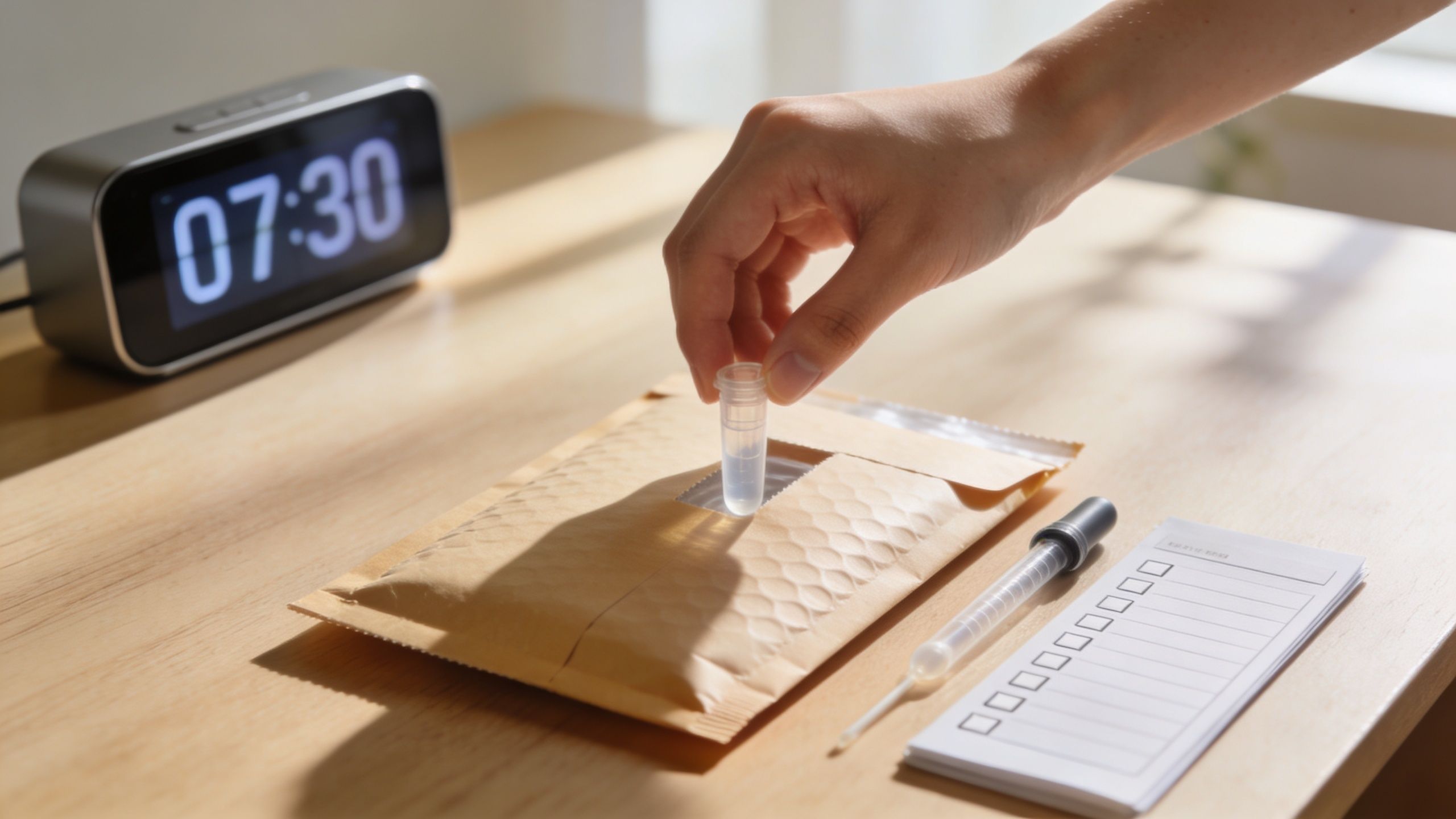
How to collect samples at home
-
Prepare Test Kit
Lay out all tubes and label them clearly, if the kit doesn't already do so. Record the times in writing. -
Take First Morning Sample
This sample should be taken within the specified time window. Adhere as closely as possible to your kit's instructions. -
Second Sample in the Afternoon
This value is often particularly interesting if you experience a mental slump or a drop in performance after lunch. -
Third Sample in the Evening
This sample shows whether your system truly winds down in the evening or if it's still activated. -
Securely Package and Send Samples
Ensure all samples are correctly sealed and shipped according to instructions.
What a home test can and cannot do
A good self-assessment helps you recognize patterns. However, it does not replace laboratory data. Many people are wrong in their self-assessment. They consider themselves "too high in cortisol," although their curve is rather flat. Or they confuse exhaustion with relaxation.
This is precisely where structured health checks are useful. The Women's Health Test and the Men's Wellness Check from mybody-x cover several relevant areas via a home blood sample. If you suspect hidden deficiencies in supply and energy, the Nutrient Deficiency Tests are the obvious complement.
Why a comprehensive view often leads to the goal faster
Cortisol is important. But in practice, it is rarely the only issue. Those who only look at one hormone quickly overlook the whole picture. Fatigue, irritability, skin issues, or performance fluctuations can also be related to other areas.
Therefore, a structured testing approach often saves months of trial and error. That is the actual ROI. Less puzzling, clearer decisions, more targeted next steps.
Avoiding common pitfalls in cortisol measurement
Most unusable cortisol tests are not "wrong" because the lab performs poorly. They are imprecise because the sample collection occurs too close to everyday hustle and bustle. Especially with saliva samples, small details make a big difference.

The quality of cortisol measurement is massively influenced by pre-analytical factors. Key sources of error include sample collection after brushing teeth, food intake less than 30 minutes before sample collection, or psychological stress immediately beforehand, as described in the notes on sources of error in cortisol measurement.
The most common mistakes in everyday life
- Brushing teeth right beforehand: This can falsify the sample.
- Eating or drinking shortly beforehand: This also changes the initial situation.
- Emails, arguments, or hectic activity directly before the sample: Acute stress can create a spike that says nothing about your normal course.
- Inaccurate timing: A daily profile relies on precise timing.
- Taking the sample on the side: Quality almost always suffers when done on the go.
What works better instead
Take a few quiet minutes before each sample. No hectic stair climbing, no conflict discussions, no "I'll just do this quickly." You don't have to turn it into a wellness retreat. But a neutral state is significantly more helpful than chaos.
Even small deviations before the sample can turn a useful trend into a misleading result.
When I guide people through home tests, that is often the decisive lever. Not measuring more. Measuring better. This saves repetitions and leads faster to data that can actually be worked with.
Receiving and understanding results – What now?
When the results arrive, the temptation is great to immediately label them. Too high. Too low. Problem found. Unfortunately, it's rarely that simple.
A cortisol value or even a daily profile is a data point in the context of your body. It helps make patterns visible. It does not replace an assessment by a professional. This is precisely why results should always be considered together with symptoms, daily life, sleep, nutrition, and other lab values.
What you can meaningfully deduce from the result
A noticeable pattern can explain why you can't get out of bed in the morning, crash in the afternoon, or can't wind down in the evening. That's valuable. But it's not yet a complete answer.
For a comprehensive assessment of hormonal imbalances, cortisol alone is often not sufficient. Symptoms such as weight gain or lack of energy can also be related to thyroid values like TSH, fT3, and fT4, with insulin resistance, or with an imbalance in estrogen or testosterone, as described in the guide on combined hormone questions around cortisol.
Three sensible next steps
-
Don't look at the result in isolation
Don't just ask: Is the value good or bad? Ask: Does the pattern fit my symptoms? -
Consider other markers
If fatigue, weight, mood, or skin are involved, a broader look at thyroid, blood sugar regulation, sex hormones, and nutrients is often worthwhile. -
Test specific adjustments
Depending on the pattern, sleep routine, eating rhythm, training time, recovery window, or stress management can be the most logical first levers.
A lab report is not an endpoint. It's a shortcut to better decisions.
If you want to take action based on your results, the next step isn't blind activism. It's about targeted adjustments. More daylight in the morning, a more reliable evening routine, less overstimulation late in the day, more suitable training times, more structured meals. Anyone who suspects an increased stress mode can find practical approaches for everyday life in Naturally lowering cortisol.
The most important thing remains: If symptoms are severe or values appear significantly abnormal, the interpretation belongs in professional hands. This is not a step backward into external control. It is the clean use of good data.
If you no longer want to guess but want to understand your body thoroughly, a mybody x blood test is a sensible next step. You test comfortably from home, receive lab values as a reliable basis, and can classify symptoms such as exhaustion, sleep problems, or performance dips more precisely instead of remaining in trial-and-error mode.
Share:
Understanding and Addressing Progesterone Deficiency
Understanding Progesterone: The Women's Health Guide