
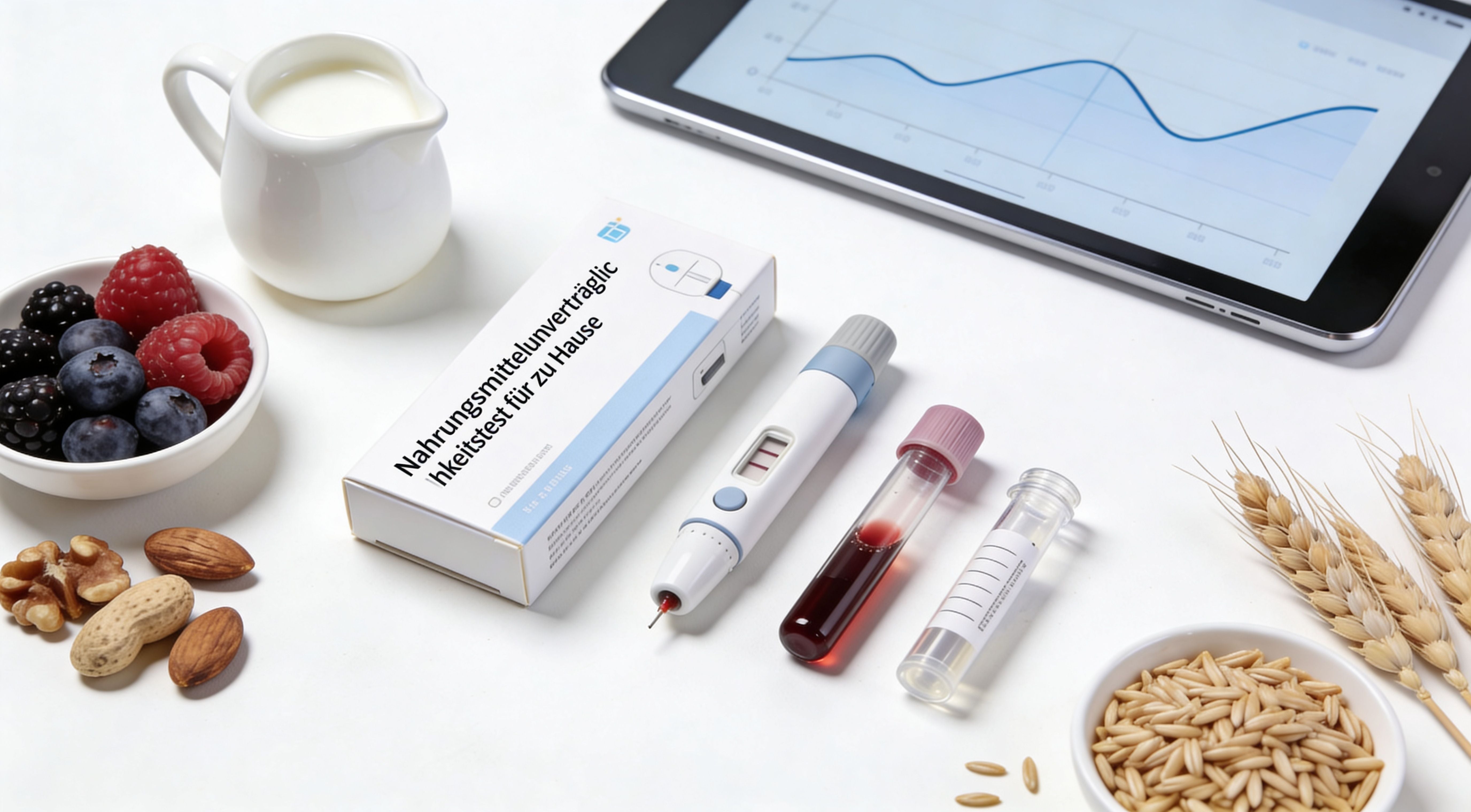
Food Intolerance Test: Finding Clarity 2026
Sometimes it goes like this: You eat completely normally, but shortly afterward, your stomach feels bloated. On other days, you're unusually tired after eating, develop skin reactions, or wonder why your digestive system reacts so sensitively to seemingly harmless foods. Then the guessing game often begins. Was it the milk? The bread? Tomatoes? Or stress, lack of sleep, or something else entirely?
If you're currently looking for a food intolerance test, you're not alone with this uncertainty. Many people finally want clarity instead of constantly cutting out new foods and hoping things will somehow get better. A clear look at the question of which test is suitable for which symptoms helps with exactly that.
Bloating, Tiredness, Skin Problems – Does this sound familiar?
You have muesli with yogurt for breakfast and feel bloated a short time later. At lunchtime, you eat pasta, in the evening, tiredness sets in, perhaps some itchy skin, or the feeling that your stomach "isn't cooperating." Such symptoms are often non-specific. That's why many quickly suspect a food intolerance.
This is understandable. Anyone who experiences similar symptoms repeatedly looks for a pattern. Then a cycle of Googling, cutting out, trying again, and pondering anew often begins. This costs time, nerves, and suddenly makes eating complicated.
The uncertainty is great. About 30% of Germans state in surveys that they suffer from a food allergy, but only about 3.7% of adults have a medically confirmed diagnosis according to the Allergy Information Service on the prevalence of food allergies. Exactly this gap shows why assumptions and actual diagnoses are often not the same.
Important: Your symptoms are real. But the suspected trigger is not always the actual trigger.
Many therefore start with typical self-help steps. Less milk. Less wheat. Less sugar. This can be useful in the short term but doesn't automatically bring clarity. If you frequently struggle with bloating, you can also find practical everyday tips in the article Tips for Bloating.
Why Guessing is so Exhausting
One problem almost always arises: Symptoms can appear with a time delay. Some occur directly after eating, others only hours later. In addition, there are mixed meals. If you eat pizza, are you reacting to cheese, wheat, tomato sauce, or the quantity in general?
A good test doesn't replace every conversation with a doctor. But it can turn diffuse suspicion into a much more precise direction. And that often saves you a lot of trial and error.
Allergy, Intolerance, or Hypersensitivity – What's Behind It?

Many people use the terms allergy, intolerance, and hypersensitivity as if they were all the same. Medically, this is not the case. However, precisely this distinction determines which test is useful and which is more likely to lead astray.
True allergies involve the immune system. Intolerances often have to do with digestion or metabolism. In addition, there are reactions that are described as "hypersensitivity" in everyday life but need to be classified more precisely. A good, easy-to-understand classification can also be found in the article on the Difference between Allergy and Intolerance.
The Classic Allergy
In a true food allergy, the immune system reacts to a substance that is actually harmless. IgE antibodies play a role here. Simply put, the body behaves like an over-nervous alarm system. It signals danger, even though the trigger is unproblematic for other people.
Typical reactions are rather fast, for example, tingling in the mouth, swelling, skin reactions, or other distinct symptoms shortly after eating. An IgE test can be a useful component here. However, it remains important: A positive IgE finding alone does not automatically prove a clinical allergy.
The Intolerance
This is not about a false alarm of the immune system, but often about a digestive problem. An illustrative image is a factory where an important tool is missing. Then a certain food component cannot be processed correctly.
Medically, a clear distinction is made: True allergies involve the immune system (IgE antibodies). More common, however, are intolerances such as lactose intolerance or fructose malabsorption, which are based on metabolic problems, or histamine intolerance due to a lack of the enzyme diamine oxidase (DAO) according to IMD Berlin on food intolerances beyond allergies.
Four Common Types of Reactions That are Often Confused
-
Lactose Problems
After milk, cream, or ice cream, bloating, rumbling, or diarrhea are more likely. This fits more with lactose intolerance than with an allergy. -
Fructose Symptoms
Fruit, juices, or certain sweet products lead to a feeling of fullness or stomach problems. This can fit with fructose malabsorption. -
Histamine-related Reactions
Aged cheese, red wine, or certain highly processed foods are less well tolerated. Histamine intolerance is often discussed here. -
True Food Allergy
Immunological reactions occur directly after nuts, eggs, or other foods. Then allergy clarification is paramount.
Not every reaction to food is an allergy. And not every "intolerance" can be detected with the same test.
Tracking Your Symptoms – Why a Food Diary Is Only the Beginning
A food diary is a sensible start. You note what you eat, when symptoms appear, and how severe they are. This helps many people for the first time to turn a diffuse gut feeling into concrete observations.
Especially when symptoms fluctuate, such a diary can be useful. You might realize that symptoms are more likely to occur after certain meals, portion sizes, or combinations. This is an active, smart first step.
What a Diary Does Well
It brings structure to a chaotic feeling. Instead of "I somehow don't tolerate many things," it becomes more like "Something happens particularly often after latte macchiato and pastry." That's already much more tangible.
This principle is also helpful for other health topics. Those who want to better understand healing processes will find a good example of how diet and targeted observation can interact in the article Accelerating Scar Healing with Dermamedix.
Where the Diary Reaches its Limits
Now comes the catch. A diary shows patterns, but no clear biological cause. If symptoms occur with a delay, it quickly becomes confusing. You eat several things during the day but only react in the evening. Then it's hard to say what was really decisive.
In addition, there's the effort. Many only keep notes for a short time. Others cautiously cut out more and more foods from their diet. Exactly this can become unnecessary.
Practical Rule: A diary provides suspicions. A test provides measurable data.
If you want to understand your body better, self-observation is helpful, but rarely the whole answer. Those who want to proceed efficiently use the diary as a guide and supplement it with a method that matches the suspected mechanism.
From Breath Test to Blood Test – These are the Actual Testing Methods

As soon as you deal with the topic, many terms appear. H2 breath test, IgE blood test, IgG self-test, elimination diet. Sounds like a choice. It is. But not every method fits every question.
If you want to get an overview specifically of blood-based approaches, the article on Blood Test for Food Intolerance can also help.
H2 Breath Test
The H2 breath test is standard when lactose or fructose problems are suspected. The idea behind it is simple: If a sugar is not properly processed in the intestine, intestinal bacteria ferment it. This produces hydrogen, which becomes measurable in the exhaled air.
This is a functional test. It does not test antibodies, but whether the body processes a certain sugar cleanly. Therefore, it is often useful for typical symptoms after lactose or fructose.
IgE Blood Test
The IgE test belongs to allergy diagnostics. It can indicate whether there is a sensitization to certain foods. This is particularly important if reactions are fast and immunological.
However, a single laboratory value is often not enough for a reliable classification. In practice, the context of symptoms, anamnesis, and possibly further medically supervised steps counts.
Elimination Diet and Challenge
If symptoms are non-specific, the structured elimination diet with subsequent targeted reintroduction of foods remains an important path. This should ideally be accompanied, so you don't cut out more than necessary.
In case of suspected allergy, the medically supervised challenge is considered particularly meaningful. It is not for self-experimentation in the living room, but belongs in professional hands.
Why IgG Tests are Viewed Critically
This is often confusing because online providers tempt with quick answers. However, professionally, the situation is clearly limited: The scientific validity of IgG self-tests is controversial, as IgG antibodies also occur in healthy individuals as a normal immune system reaction to food. Leading allergy societies advise against diets based solely on IgG results according to IMD Berlin on Type IV allergy and IgG classification.
This does not mean that every blood test is useless. It means: You have to look closely at what the test actually measures and what question it is supposed to answer.
A Short Reality Check
| Test Method | Typical Strength | Typical Limitation |
|---|---|---|
| H2 Breath Test | Useful for suspected lactose or fructose problems | Not intended for classic allergies |
| IgE Blood Test | Helpful for suspected true allergies | Must be evaluated in a clinical context |
| Elimination Diet | Often shows everyday reactions | Requires discipline and good guidance |
| IgG Self-Test | Seems convenient | Is professionally controversial for reliable diagnosis of allergy or intolerance |
The most important question is not “Which test is the fastest?”, but “Which test fits my suspicion?”
Which Food Intolerance Test Suits Your Symptoms?

The right test choice depends less on your favorite food than on the type, timing, and pattern of your symptoms. This is exactly where many self-tests fail. They act as if there is "the one" food intolerance test for everything. There isn't.
Depending on the suspicion, different tests are standard: For fructose and lactose problems, H2 breath tests are used. For celiac disease, antibody diagnostics. And for unclear allergy symptoms, a combination of anamnesis, IgE test, and, if necessary, medically supervised challenge is the gold standard according to AOK on the usefulness of self-tests for food intolerance.
Three Typical Patterns
You react quickly and clearly to a specific food
Then this speaks more for an allergic question. Example: After nuts, your mouth tingles or your lip swells. Then a medical allergy clarification with IgE reference is the right way.
You get bloating, abdominal pressure, or diarrhea after milk or fructose
This fits more with a functional intolerance. Here, the H2 breath test is often professionally more accurate than any general all-round test.
You have diffuse, recurring symptoms without a clear pattern
Then anamnesis, food diary, and a targeted medical classification are particularly important. In this situation, many people are looking for a structured entry point for home, for example, through experiences with intolerance tests, to better classify the next step.
Test Methods Compared
| Test Method | What is Measured? | Suitable for Suspected... | Validity & Execution |
|---|---|---|---|
| H2 Breath Test | Hydrogen in exhaled air | Lactose intolerance, fructose malabsorption | Useful functional test, usually medically or professionally supervised |
| IgE Blood Test | IgE antibodies | Classic food allergy | Helpful component, but not solely decisive |
| Antibody Diagnostics for Celiac Disease | Specific antibodies in the blood | Suspected celiac disease | Belongs in a targeted medical clarification |
| Elimination Diet with Challenge | Reaction to omission and reintroduction | Unclear symptoms, suspected specific triggers | Everyday relevant, but complex and ideally supervised |
A Simple Decision Aid
-
Immediate reaction after a food
Think of allergy clarification first. -
Digestive problems after milk or fructose
Think of an H2 breath test first. -
Nonspecific symptoms plus suspected gluten problem
Think of targeted celiac disease clarification first. -
Diffuse symptoms without a clear trigger
Start with structured symptom tracking and then choose the test that matches the most probable cause.
Your Path to Clarity – How Easy the At-Home Blood Test Works

Many people are not deterred by the test itself, but primarily by the effort involved. Finding an appointment, waiting, going again, understanding the results. That's why so many are interested in blood tests that you can perform at home.
The process is usually simpler than many think.
This is How it Works in Practice
-
You order a test kit online
This saves you the initial organizational detour and allows you to calmly check whether the test suits your question. -
You take the sample at home
For home tests, this is usually done via a finger prick. It's about a few drops of blood, not a complicated procedure. -
You send the sample to the laboratory
After that, the laboratory performs the analysis. For you, the active part is usually already done. -
You'll receive your results digitally
Not only the result is important, but also its comprehensible presentation. Good reports help you understand what the values mean and what they do not mean.
Why this is suitable for everyday life for many
A home test primarily offers convenience, speed, and discretion. You don't have to schedule your daily routine around multiple appointments. Especially if you've been oscillating between assumptions and semi-helpful diets for a while, this is an efficient step.
You are already on the right track. A quick blood test can make it more precise.
If you choose a blood-based approach, the method should match the specific question. For an allergy question, for example, an IgE blood test for home use is significantly more sensible than a general test that measures something else.
A reliable answer instead of guesswork – The advantages of your mybody®x test
If you've read this far, you probably don't want to spend weeks guessing what you tolerate and what you don't. You want a clean, data-driven basis. That's precisely where the value of a well-chosen home test lies.
With mybody®x, you get health self-tests for home use that are analyzed in ISO-certified laboratories in Germany. This includes strict GDPR and ISO-27001 standards, comprehensible result preparation, and free coaching by health experts. For many, this is the crucial difference between a mere laboratory value and truly usable guidance.
What matters in everyday life
-
You save yourself trial and error
Instead of constantly avoiding foods on suspicion, you proceed more systematically. -
You test comfortably from home
This lowers the barrier to even starting. -
You get data instead of just assumptions
Especially health-conscious people today optimize not only training and sleep, but also their blood values and symptom causes. -
You are not left alone with the result
Coaching and comprehensible reports help to derive meaningful next steps from data.
Which products are relevant here
If you primarily suspect a real allergy, an allergy IgE blood test for home use is the appropriate direction.
If you want to get a broader overview of suitable home solutions, you can find the corresponding options in the overview of intolerance and allergy tests.
Others have long been specifically optimizing their health data instead of relying solely on feeling and chance. You don't have to start perfectly. You just have to choose the next sensible step.
If you finally want clarity instead of guesswork, a mybody®x blood test is a practical next step. You test comfortably from home, receive laboratory-based results, and can align your diet and daily life on a more informed basis.
Share:
Understanding and Addressing Progesterone Deficiency
Measuring Cortisol Levels: Guide and Interpretation 2026