

Understanding progesterone deficiency and restoring balance in a targeted way
TL;DR:
- Progesterone deficiency in midlife often causes mood swings, sleep problems, and menstrual irregularities, but is frequently overlooked. Accurate diagnosis during the luteal phase and individualized counseling are crucial for effective treatment. Evidence-based approaches, including cyclical or continuous progesterone supplementation, help restore hormonal balance.
Mood swings, sleepless nights, and an irregular cycle: Many women in midlife look for explanations and initially hear about estrogen deficiency. Yet progesterone, the second major female hormone, is surprisingly often overlooked. Progesterone deficiency can cause symptoms that differ significantly from those of estrogen deficiency alone, and it is nevertheless frequently misclassified or not investigated at all. In this article, you will learn which causes and symptoms are truly consistent with progesterone deficiency, how diagnosis is properly carried out, and which treatment options are actually evidence-based.
Table of contents
- Causes and effects of progesterone deficiency in midlife
- Symptoms and diagnosis: How progesterone deficiency can be identified
- Evidence on therapy: When and how progesterone is used appropriately
- Controversies surrounding “natural” and bioidentical progesterone: benefits and risks
- Why general recommendations are not sufficient for progesterone deficiency
- Next steps toward greater hormonal balance with mybody®x
- Frequently asked questions about progesterone deficiency
Key findings
| Point | Details |
|---|---|
| Recognizing progesterone deficiency | Symptoms such as menstrual irregularities and mood swings are common, but diagnosis should always be made individually. |
| Diagnostics are crucial | The timing of blood collection is essential for reliably determining hormone levels. |
| Individualized treatment | Treatment options should be discussed with healthcare professionals, and other causes should be ruled out. |
| Consider controversies | Natural and bioidentical progesterone supplements have limited supporting evidence; medical supervision is advisable. |
| Practical support | Consultations and testing options provide reassurance and clarity when seeking hormonal balance. |
Causes and effects of progesterone deficiency in midlife
Progesterone is produced mainly by the corpus luteum after ovulation. If ovulation does not occur, progesterone levels fall significantly. This happens increasingly often during perimenopause, the transition to menopause. For many women, this process begins in their mid-40s, sometimes even earlier, and continues for several years.
Progesterone deficiency during perimenopause and menopause is generally not described as an absolute zero level, but as a relative imbalance in relation to estrogen. This means that even if estrogen also declines, progesterone can fall disproportionately, creating an imbalance with noticeable effects. This imbalance is sometimes referred to as estrogen dominance, meaning a state in which estrogen outweighs progesterone relatively.
The effects of this imbalance affect the body and mind equally. Women report longer or shorter cycles, PMS-like symptoms that suddenly become more severe, sleep problems during the second half of the cycle, and an inner restlessness that is difficult to describe. It is important to understand that not all of these symptoms can automatically be attributed to progesterone deficiency, as other factors also play a role.
Important: Cycle irregularities, sleep problems, and mood swings during perimenopause can have many causes. In addition to progesterone deficiency, possible causes include thyroid problems, iron deficiency, a dysregulated nervous system, or psychosocial stress. Jumping to a self-diagnosis can easily lead in the wrong direction.
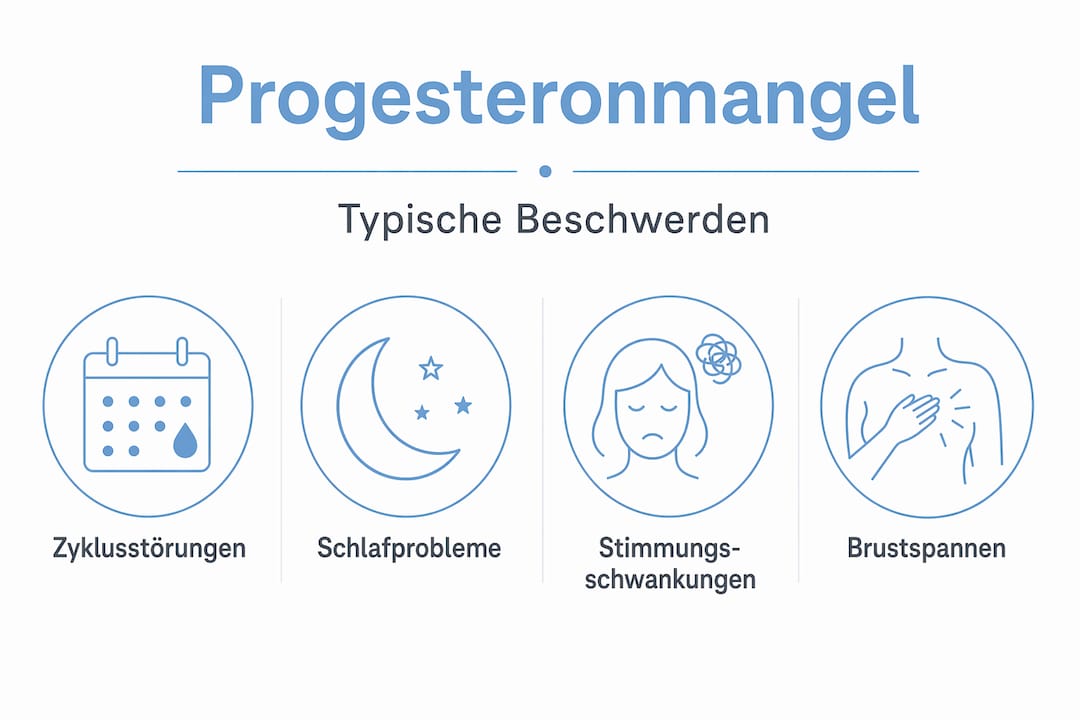
Typical symptoms associated with a relative progesterone deficiency:
- Shortened or lengthened cycle, especially during the second phase of the cycle
- Increased premenstrual symptoms such as breast tenderness, irritability, and water retention
- Difficulty falling asleep and staying asleep, often during the luteal phase (the second half of the cycle)
- Tension, inner restlessness, and mood swings
- Heavier or more irregular menstrual bleeding
- Weight gain, especially around the abdomen
When trying to understand these symptoms, it is worth taking a closer look at related hormonal topics. Understanding a possible estrogen deficiency helps provide a better overall assessment. Similarly, a solid basic understanding of hormone balance offers important clues about the interactions between different hormones.
What many people do not know is that progesterone also has direct effects on the brain. It influences neurotransmitters such as GABA, which have a calming effect. When progesterone levels fall, this can lead to feelings of inner tension and sleep problems that cannot be resolved with conventional sleep hygiene advice. This explains why women in perimenopause often report feeling like a different person, even though little has changed externally.
Symptoms and diagnosis: How progesterone deficiency can be identified
Once the causes are understood, the practical question arises: How can you recognize progesterone deficiency specifically, and how can it be measured reliably? This is one of the greatest challenges in clinical practice.
The symptoms overlap with many other conditions. A table helps put them into context:
| Symptom | Progesterone deficiency | Estrogen deficiency | Hypothyroidism |
|---|---|---|---|
| Sleep problems | Common (luteal phase) | Possible | Possible |
| Menstrual irregularities | Typical | Typical | Typical |
| Mood swings | Common | Common | Common |
| Hot flashes | Rare | Very common | Rare |
| Breast tenderness | Typical | Rare | Rare |
| Fatigue and weight gain | Possible | Possible | Very typical |
| Dryness of the mucous membranes | Rare | Very typical | Rare |
This overview shows that no single symptom is sufficient to diagnose progesterone deficiency. A combination of symptoms, menstrual history, and laboratory values is necessary.
The timing of the blood draw is crucial because progesterone levels fluctuate considerably over the course of the cycle. In the first half of the cycle, the level is physiologically very low. A meaningful value can only be measured during the luteal phase, that is, approximately 7 days after ovulation or about 7 days before the expected menstruation. Interpreting hormone tests correctly therefore always requires stating the cycle day on which the blood was drawn; otherwise, the value is difficult to interpret.
With irregular or long cycles, which are common during perimenopause, this timing is difficult to predict. In this case, repeated testing or combining it with an ovulation test is recommended to narrow down the optimal time for the blood draw.
Important points for a meaningful diagnosis:
- Blood draw during the luteal phase (days 19 to 23 of a 28-day cycle)
- Always document the cycle day and inform the laboratory
- Fasting is usually not necessary for hormone levels, but avoid stress and extreme physical exertion shortly before the blood draw
- Repeated measurements are advisable for irregular cycles
- Also have estradiol, FSH, and LH measured to obtain the complete picture
- Thyroid levels (TSH) and ferritin should be checked at the same time, as overlaps are common
Anyone who wants to have their hormone levels tested can now find practical options that work without a doctor's visit. A targeted hormone test for women provides information about several relevant parameters at once, saving time and hassle. For comparison, it is also worth looking at estrogen deficiency symptoms to better assess similarities and differences in the symptom profile.
Pro tip: Keep a simple cycle diary for at least 3 to 4 weeks before having your blood drawn. Record your mood, sleep, physical symptoms, and bleeding status each day. This information is at least as valuable for evaluating your hormone levels as the laboratory findings themselves.
Evidence on therapy: When and how progesterone is used appropriately
With diagnostics in mind, we now examine evidence-based treatment approaches. One crucial question is: When is medication-based progesterone supplementation truly useful, and which regimen is appropriate for each situation?
In principle, two main approaches to progesterone therapy can be distinguished:
- Cyclic administration: Progesterone is administered only during the second half of the cycle, usually for 12 to 14 days per month. This regimen follows the natural cycle and is particularly suitable for women in perimenopause who are still menstruating. Typical dosage: 200 mg of micronized progesterone daily, taken in the evening.
- Continuous administration: Progesterone is administered daily without interruption, usually at a lower dose (100 mg daily). This regimen is more suitable for women after menopause when continuous hormone therapy is desired and bleeding is to be avoided.
| Criterion | Cyclic administration | Continuous administration |
|---|---|---|
| Suitable for | Perimenopause, still menstruating | Postmenopause |
| Likelihood of bleeding | Regular withdrawal bleeding | No bleeding after the adjustment period |
| Dosage (example) | 200 mg/day, 12–14 days/month | 100 mg/day, continuously |
| Endometrial protection | Well established | Supported by evidence, but dose-dependent |
| Improved sleep | Frequently reported | Possible, but less pronounced |
One particularly important aspect: With systemic estrogen therapy, an additional progestogen or progesterone is indicated to protect the endometrium (the lining of the uterus). Estrogen without a counterbalancing hormone can lead to uncontrolled thickening of the uterine lining, increasing the risk of certain conditions. This is not an optional addition but the medical standard for women with a uterus.
Step by step: How a typical course of starting treatment proceeds
- Complete medical history, including menstrual history, symptoms, and pre-existing conditions
- Hormone testing during the luteal phase, including estradiol, FSH, LH, and progesterone
- Ruling out other causes: thyroid function, ferritin, vitamin D
- Discussing the individual benefit-risk profile with the doctor
- Choosing the regimen: cyclic or continuous, depending on cycle status
- Starting with the lowest effective dose, with a follow-up appointment after 3 months
- Adjusting the dose based on symptoms and follow-up test results
Anyone who wants to regulate their hormones should also consider complementary measures. Sleep, diet, stress management, and exercise measurably affect hormone levels. Helpful tips for hormone balance can usefully complement drug therapy and may, in some cases, reduce the need for medication.
Controversies surrounding “natural” and bioidentical progesterone: benefits and risks

Once evidence-based therapy has been covered, we take a look at the controversial natural preparations. Confusion is particularly widespread when it comes to hormone gels, creams, and dietary supplements.
The term “bioidentical” means that a hormone is chemically identical in structure to the hormone produced by the body. Micronized progesterone, as used in approved medicines, is bioidentical. At first, this sounds clear-cut. However, the marketing of this term often goes far beyond what the scientific evidence supports.
Bioidentical progesterone preparations are often the subject of controversial debates about efficacy and safety. Studies have shown that over-the-counter creams and gels in particular are absorbed—meaning taken up into the bloodstream—very unreliably. What is applied to the skin reaches the bloodstream in barely predictable amounts. This means you do not really know how much progesterone is actually having an effect.
In addition: The effectiveness of progesterone supplementation for symptoms interpreted as progesterone deficiency has not been clearly established in every case. The evidence is inconsistent, particularly for psychological symptoms such as anxiety and mood swings. Some women report significant improvement, while others notice no difference.
Critical points regarding OTC progesterone preparations (that is, freely available products):
- Unreliable bioavailability of creams and gels
- Lack of regulation and quality control for many dietary supplements
- No protection of the endometrium for women undergoing estrogen therapy, as absorption may be too low
- False sense of security: Women believe that a natural product is automatically harmless
- Difficult dosage control without accompanying laboratory results
Important note: Plant-based preparations such as wild yam extract are often marketed as natural sources of progesterone. However, the human body cannot convert the active compound diosgenin contained in wild yam into progesterone. This is biochemically impossible. Products making this claim therefore do not deliver what they promise.
Pro tip: If you use or want to use progesterone preparations, have your levels measured before and after starting. This is the only way to know whether the product actually works and whether the dosage is correct. An Estrogen Dominance Test can help make the ratio of estrogen to progesterone visible in laboratory testing.
A frequently cited figure from clinical practice: A significant proportion of women who use over-the-counter hormone cream show no measurable change in their progesterone levels in blood tests. This is a clear sign that skin absorption is unreliable with many products and that monitoring by a specialist cannot be replaced.
Why general recommendations are not sufficient for progesterone deficiency
Here is our direct assessment: The biggest pitfall when it comes to progesterone deficiency is not the wrong treatment, but the wrong expectation. Many women come with a clear idea of what is wrong with them and look for simple confirmation. That is understandable. But the body rarely functions so straightforwardly.
Standardized recommendations found online or in well-intentioned books can lead you astray. A regimen that works exceptionally well for one woman may be completely ineffective for another woman with seemingly identical symptoms or may even cause new complaints. This is because hormone metabolism does not function in isolation. The thyroid, adrenal glands, liver, and even the gut influence how hormones are produced, transported, and broken down.
Individualized treatment recommendations clearly show that personalized hormone therapy, which takes a woman’s overall situation into account, is significantly superior to standardized protocols. In practice, this means that anyone who takes progesterone supplements based solely on internet research risks overlooking genuine causes and losing valuable time.
The thyroid is particularly often overlooked. An underactive thyroid, including subclinical hypothyroidism (that is, with a borderline but still normal TSH level), can cause symptoms that are difficult to distinguish from progesterone deficiency. Fatigue, weight gain, mood swings, and menstrual irregularities: The picture is almost identical. Iron deficiency creates a similar problem. That is why hormone testing should always include these parameters as well.
What matters especially to us is that women in perimenopause are often not taken seriously by the healthcare system. Symptoms are dismissed as “normal” or broadly attributed to “the menopause.” This leads women to seek out information themselves, which is courageous on the one hand but carries the risk of drawing incorrect conclusions on the other. The solution is neither to leave everything to your doctor nor to manage everything yourself, but to enter the conversation well informed. Anyone who consults their doctor with specific laboratory values and a documented history of symptoms receives a different quality of advice.
If you want to find out what you can do about estrogen deficiency, this is a good first step. Understanding estrogen status is often a prerequisite for properly assessing progesterone status. The two are connected.
Next steps toward greater hormonal balance with mybody®x
You now know that progesterone deficiency is far more than a simple laboratory issue. It involves the interplay of different hormones, individual symptom patterns, and diagnostics that are truly tailored to you. At mybody®x, you can find certified hormone tests that you can conveniently perform at home and that provide you and your doctor with a reliable data basis. Scientifically validated evaluations, personal advice, and a holistic view of your hormone balance are included. The first step is simple: have your hormone levels tested and discuss the results with your specialist. This way, you can become the expert on your own body.
Frequently asked questions about progesterone deficiency
What symptoms are typical of progesterone deficiency?
Typical symptoms include menstrual irregularities, sleep problems during the second half of the cycle, breast tenderness, irritability, and PMS-like patterns. These symptoms occur particularly during perimenopause, when anovulatory cycles become more frequent.
What is the best way to diagnose progesterone deficiency?
Progesterone should be measured during the luteal phase of the cycle, approximately 7 days after ovulation. For irregular cycles, repeated blood sampling together with other hormone levels such as estradiol and FSH is recommended.
Can I use progesterone preparations without medical supervision?
The effectiveness and safety of progesterone preparations, especially over-the-counter creams, have not been consistently established by scientific research. Medical supervision, including laboratory monitoring, is expressly recommended to minimize risks.
What treatment regimen is commonly used for progesterone supplementation?
During perimenopause, cyclical administration for 12 to 14 days per month, with approximately 200 mg of micronized progesterone daily, is often recommended. The exact regimen should always be determined individually in consultation with a specialist.
Which other hormonal disorders can cause symptoms similar to progesterone deficiency?
Other common causes include thyroid disorders, iron deficiency, estrogen deficiency, sleep apnea, and mental health conditions such as anxiety disorders or depression. These should always be ruled out through differential diagnosis before progesterone therapy is started.
Recommendation
- Addressing estrogen deficiency and regaining your balance – mybody®x
- What to do about estrogen deficiency? Paths to greater balance and well-being – mybody®x
- Recognizing estrogen deficiency symptoms – How to interpret your body’s signals – mybody®x
- Estrogen deficiency and weight gain: Understanding causes, finding solutions – mybody®x



Share now:
Allergy test at home: Finally, clarity about your symptoms
Understanding Progesterone: The Women’s Health Guide