

Sleep Stages Explained: Science and Tips for Better Sleep
TL;DR:
- Sleep quality depends largely on sufficient deep and REM sleep, not just on sleep duration.
- Through conscious routines, temperature control, and stress reduction, sleep can be made more restorative.
Anyone who sleeps seven or eight hours yet wakes up tired knows the frustrating feeling that sleep duration alone is no guarantee of genuine recovery. Empirical benchmarks show that adults should ideally spend 10 to 25 percent of their sleep time in deep sleep and 20 to 25 percent in REM sleep. Those who do not reach these quality benchmarks may sleep for a long time but not truly restfully. In this article, you will learn how sleep stages are structured, what biological functions they perform, and what you can do specifically tonight to get the most out of your night.
Table of contents
- The Science of Sleep Stages: An Overview
- Deep sleep and REM sleep: Why quality matters more than duration
- How age, stress, and hormones disrupt sleep cycles
- Improve sleep stages effectively: Routines, temperature, and mental hygiene
- Our perspective: Use sleep stages correctly – What really matters
- Experience more healthy sleep with mybody®x
- Frequently asked questions about sleep stages
Key insights
| Point | Details |
|---|---|
| Sleep stage cycles | Healthy sleep consists of 4 to 6 cycles, each with 4 stages that repeat throughout the night. |
| Quality over quantity | What matters for recovery is the proportion of deep and REM sleep, not just the total number of hours. |
| Routines help | Targeted evening routines, temperature management, and stress reduction promote restorative sleep. |
| Age and lifestyle | Age, stress, and lifestyle habits influence sleep architecture, but positive change is possible. |
The Science of Sleep Stages: An Overview
Sleep is not a uniform state but an active, structured process. Your brain works through alternating stages all night, each with its own tasks and biology. Understanding this means you stop viewing sleep merely as an off switch and start using it as a central health tool.
How sleep is structured
Sleep stages occur in cycles lasting 90 to 120 minutes, typically repeating four to six times per night. Each cycle passes through the falling-asleep phase (N1), light sleep (N2), deep sleep (N3), and REM sleep. The exact composition changes considerably over the course of the night.
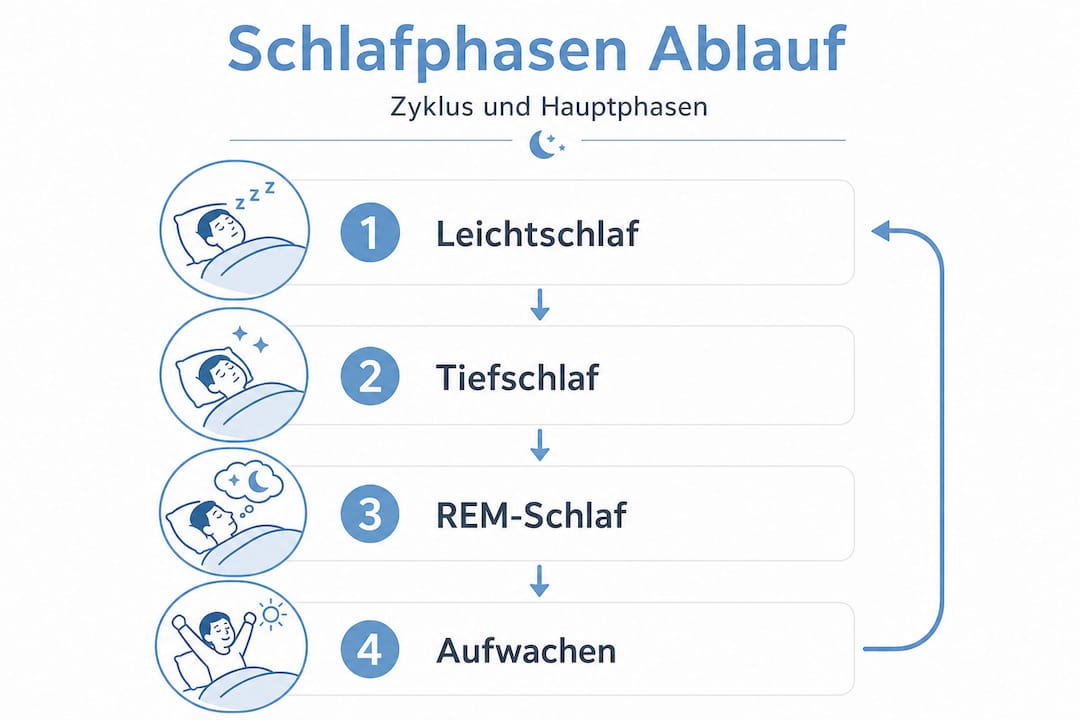
The key insight: Deep sleep (N3) dominates the early hours of the night, while REM sleep increases primarily during the second half. So if you wake up at three in the morning and cannot fall back asleep, you lose a disproportionately large amount of REM sleep, regardless of how many hours you have already slept.
| Sleep stage | Abbreviation | Typical duration | Key characteristics |
|---|---|---|---|
| Falling-asleep phase | N1 | 1–7 minutes | Transition from wakefulness to sleep, easily awakened |
| Light sleep | N2 | 10–25 minutes | Heart rate decreases, sleep spindles active |
| Deep sleep | N3 | 20–40 minutes (early) | Slow brain waves, growth hormones, tissue repair |
| REM sleep | REM | 10–60 minutes (late) | Vivid dreams, memory consolidation, eye movements |
Key functions of the individual sleep phases:
- N1 (sleep onset phase): Preparation for deep sleep, muscle relaxation, fading awareness
- N2 (light sleep): Processing of sensory stimuli, initial memory traces, temperature regulation
- N3 (deep sleep): Physical regeneration, growth hormone release, brain cleansing through the glymphatic system
- REM sleep: Emotional processing, long-term memory, creative problem-solving, neural plasticity
“Sleep quality cannot be measured by hours alone. What matters is whether the brain spends enough time in the restorative phases—deep sleep for the body and REM sleep for the mind.” (Sleep research, consensus in modern sleep medicine)
The connection between sleep and genes is stronger than many people realize. Genetic factors influence, among other things, how quickly someone enters deep sleep and how long their individual REM sleep lasts.
Deep sleep and REM sleep: Why quality matters more than duration
Sleeping for eight hours means nothing if deep sleep is too short or REM sleep is constantly interrupted. The biological functions of both phases are so fundamental that even small deficits can have noticeable consequences.
Deep sleep: The body repairs itself
During deep sleep, the so-called N3 phase, heart rate and breathing rate drop to a minimum. The brain produces slow delta waves, and the pituitary gland releases growth hormones. These hormones repair muscles, strengthen the immune system, and regulate metabolism. Deep sleep dominates the first half of the night and is particularly important for physical regeneration, growth hormone release, and brain cleansing through the glymphatic system.

The glymphatic system (the brain’s cleaning system) is up to ten times more active during deep sleep than when awake. It flushes metabolic waste products, including proteins associated with neurodegenerative diseases, out of the brain tissue. People who chronically get too little deep sleep therefore risk these substances accumulating over the years.
REM sleep: The mind processes the day
REM stands for Rapid Eye Movement. During this phase, the eyes move quickly beneath the closed eyelids, the muscles are almost paralyzed (to prevent acting out dreams), and the brain works almost as intensively as when awake. REM sleep is essential for emotional memory, connecting new information with existing knowledge, and creative problem-solving.
| Characteristic | Deep sleep (N3) | REM sleep |
|---|---|---|
| Main function | Physical regeneration | Emotional processing, memory |
| Time window | First half of the night | Second half of the night |
| Brain activity | Slow delta waves | Almost like being awake |
| Hormonal activity | Growth hormones | Low cortisol, high acetylcholine |
| Restorative effect | Muscle repair, immune strength | Learning performance, emotional balance |
Sleep-stage benchmarks for adults show that light sleep should ideally account for 45 to 55 percent, deep sleep for 10 to 25 percent, and REM sleep for 20 to 25 percent of total sleep time. These values vary considerably depending on age, health status, and genetic predisposition.
Pro tip: If you often feel groggy and sluggish in the morning (the technical term is sleep inertia), you are probably waking up in the middle of a deep-sleep cycle. Set your alarm for the end of a cycle, about 90 or 180 minutes after falling asleep, to wake up feeling much fresher. Many sleep apps calculate this time automatically.
Whether you generally get too little restorative deep sleep or genetic causes of sleep problems are responsible can now be clearly determined with a DNA test.
How age, stress, and hormones disrupt sleep cycles
The quality of sleep stages is not set in stone. Many internal and external factors directly affect sleep architecture, sometimes in ways you are not consciously aware of.
How age changes sleep architecture
As we age, sleep structure changes noticeably. Age-related changes are particularly evident in deep sleep, which gradually decreases from around the age of thirty. In people over sixty, the proportion of deep sleep is often only half as large as in younger years. This is not necessarily pathological, but it explains why older people more often complain of light, less restorative sleep.
At the same time, the sleep rhythm shifts: The so-called circadian phase advance causes many older people to become sleepy earlier and wake up earlier. The body produces less melatonin and becomes more sensitive to light and noise. Sleep disturbances during menopause are a particularly common example of hormone-related sleep problems that can be specifically addressed.
Factors that disrupt sleep cycles:
- Alcohol: Strongly suppresses REM sleep during the first half of the night. Later, a REM rebound occurs, with vivid, often disturbing dreams. The deceptive feeling of falling asleep more easily comes at the cost of sleep quality.
- Stress and cortisol: Elevated cortisol levels in the evening keep the nervous system in an alert state. This fragments sleep cycles and particularly shortens deep sleep.
- Caffeine: Blocks adenosine receptors (the molecules that produce drowsiness) for up to six hours after consumption. A coffee at 3 p.m. can interfere with the process of falling asleep and early deep sleep.
- Blue light: Inhibits melatonin production and shifts the internal clock later, delaying the time you fall asleep.
- Irregular sleep times: The absence of a stable sleep schedule confuses the internal clock and makes all stages less consistent.
Pro tip: Anyone who wants to lower their cortisol levels in the evening can start with a short relaxation routine. Breathing exercises, Yoga Nidra, or even a short walk after dinner can demonstrably help. You can find more information on how to lower cortisol in our health portal.
The aging process and sleep are also closely connected: Poor sleep measurably accelerates cellular aging processes, while restorative sleep is considered one of the most effective anti-aging measures that costs nothing.
Improve sleep stages effectively: Routines, temperature, and mental hygiene
Knowing about sleep stages is only useful if you put it into practice. The good news: Even small, consistent measures can significantly improve the proportion of deep and REM sleep.
Seven effective steps for better sleep quality
Scientific approaches to evening routines show that habit stacking (linking new habits with existing ones), a targeted drop in temperature, and journaling noticeably improve sleep latency and sleep quality. A warm bath reduces the time it takes to fall asleep by around ten minutes. People who briefly write down their tasks in the evening spend nine fewer minutes ruminating each night.
- Establish a consistent sleep schedule: Go to bed and get up at the same time every day, including weekends. Your circadian rhythm thrives on predictability and rewards it with deeper sleep.
- Optimize bedroom temperature: Between 16 and 19 degrees Celsius is considered ideal. The body needs to lower its core temperature to enter deep sleep. A warm bath two hours before bedtime accelerates this process.
- Use evening journaling: Before going to sleep, write down three to five tasks or worries for the next day. This relieves the working memory and reduces nighttime rumination.
- Avoid screens for ninety minutes before bed: Blue light and emotional stimulation from shows or social media keep the brain unnecessarily active.
- Stop caffeine in the afternoon: Set a personal cutoff point, such as 2 p.m., and avoid caffeine afterward, including tea and cola.
- Incorporate relaxation rituals: Progressive muscle relaxation, breathing exercises such as the 4-7-8 method, or Yoga Nidra activate the parasympathetic nervous system and make it easier to transition into deep sleep. Special relaxation socks for better circulation can provide additional support, as warm feet help you fall asleep faster.
- Get morning daylight: Ten to twenty minutes of sunlight during the first few hours after waking up synchronizes your internal clock and improves sleepiness in the evening.
Pro tip: Plan your sleep time in ninety-minute intervals. If you fall asleep at 10:30 p.m. and want to get up at 6:00 a.m., you complete five full cycles, which is mathematically better than going to sleep at 10:00 p.m. and waking up at 6:00 a.m. (slightly between two cycles).
If you would like to explore the topic further, you can find detailed healthy routines for better sleep quality from us, along with specific daily schedules and scientific background information.
Our perspective: Use sleep stages correctly – What really matters
There is one thought that is almost completely missing from the public discussion about sleep. Most tips revolve around sleep duration: eight hours here, seven hours there. That is too simplistic and leads many people astray.
We observe that a significant proportion of people who complain of chronic exhaustion do not have too little sleep. They have poor sleep architecture. The stages are out of balance: too little deep sleep in the first half and too little REM sleep in the second. Sometimes this is caused by alcohol, sometimes by stress, and sometimes by genetic predispositions that no one has explained to them.
What particularly stands out to us is that the pressure to perform around sleep has increased. People track sleep stages with wearables and become frustrated when the app shows poor results. Ironically, the fear of sleeping poorly creates exactly the stress that further worsens sleep. In sleep research, this is called orthosomnia: an obsessive fixation on perfect sleep data.
Our practical approach looks different. Start with two or three routine changes, such as consistent sleep times and journaling. Wait four weeks and observe how you feel in the morning, not how the app rates your sleep stages. Your subjective feeling upon waking is the most honest indicator.
Personalization also means that some people genetically need more deep sleep and feel great with seven hours. Others need more REM sleep and only feel truly clear-headed after eight to nine hours. If you are still tired after eight hours, you shouldn’t simply increase your sleep duration but examine your sleep quality, ideally including your genetics.
The most sensible step that most people skip: First understand what is happening in your own body, then take action. Don’t blindly follow recommendations that apply to the average person but not to you.
Experience more healthy sleep with mybody®x
If you really want to understand and specifically improve your sleep quality, general knowledge will eventually no longer be enough. At mybody®x discover, you can find out how your genetic makeup affects your sleep, which nutrients you may be lacking, and which personalized strategies work for you. With ISO-certified laboratory analyses, easy-to-understand reports, and specific recommendations for action, you don’t receive generic advice but an answer tailored to your body. More than 11,300 satisfied customers have already found their way to more energy and better health with it.
Frequently asked questions about sleep stages
How many sleep cycles should I complete per night?
Ideally, you should complete four to six full sleep cycles per night, which corresponds to approximately six to nine hours of sleep when each cycle lasts 90 to 120 minutes.
Which sleep stage is most important for recovery?
Both key stages are essential: Deep sleep promotes physical recovery and the release of growth hormones, while REM sleep supports emotional stability and memory.
Can I influence the proportions of the different sleep stages?
Yes, consistent evening routines, lowering the temperature, and journaling can improve deep and REM sleep. Habit stacking and a temperature drop have been shown to reduce sleep onset latency and improve recovery quality.
Why do I sometimes not feel rested despite getting enough sleep?
You may often lack sufficient deep or REM sleep, or wake up in the middle of a cycle. The quality of your sleep stages is more important than sleep duration alone.
How does the pattern of sleep stages change with age?
As we age, the proportion of deep sleep and REM sleep decreases, reflecting age-related changes in sleep structure. However, this is not necessarily pathological and can be partially offset with targeted routines.



Share now:
Understand electrolytes and use them optimally for your health
Submit a stool sample: Instructions for your 2026 bowel test