
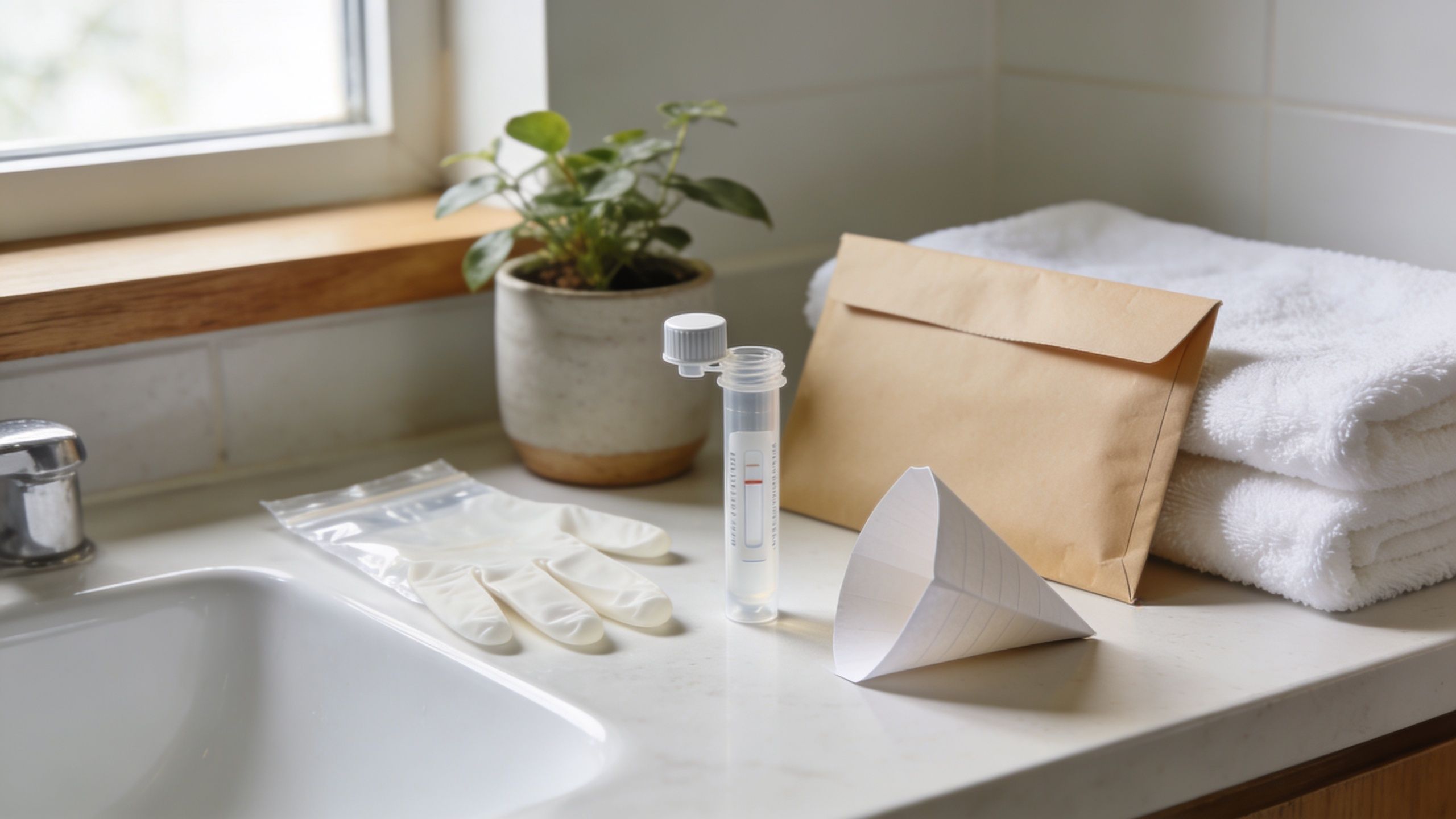
Providing a stool sample: Instructions for your gut test 2026
You have the test kit in front of you, read the instructions, and perhaps think: I hope I do not do anything wrong. Many people feel exactly the same way the first time. Providing a stool sample sounds more unpleasant than it is in practice. Once you understand what matters, the actual process takes only a few minutes.
What matters most is your perspective. The goal is not to do something perfectly, but to obtain a clean, meaningful sample. That is the difference between more guesswork and having data you can use to manage your diet, daily routine, and gut health more purposefully. Especially if you have already tried various things and your stomach is still unsettled, a properly performed home test can save you a lot of trial and error.
Providing a stool sample – The first step toward better gut health
The first hurdle is almost always the same: imagining what it will be like. Many people expect a complicated, unpleasant process. In reality, collecting a sample at home is often more relaxing than spending weeks sorting through symptoms, suspicions, and tips from the internet.

Anyone who wants to understand their gut better will eventually need reliable information. That is exactly why home tests have become so relevant. Participation in traditional colorectal cancer screenings is declining. Between 2009 and 2018, participation among women aged 50 to 54 fell by 21 % and among men by 15 %, as the Felix Burda Foundation explains in connection with preventive care using stool tests. User-friendly self-tests remove a genuine hurdle from the process at this point.
Why the small effort is worthwhile
When digestion, energy, skin, or resilience are not quite running smoothly, it is easy to resort to guesswork. Maybe it is fiber. Maybe stress. Maybe a food. Maybe the gut after all. The problem is that without data, you are often testing blindly.
A properly collected stool test provides more clarity here. Instead of eliminating things indiscriminately or trying random supplements, you gain a basis for making decisions. That is the real health ROI. Test from home with ease and support your health.
Practical rule: Collecting the sample is not the difficult part. The art lies in getting the sample into the tube without compromising it and sending it to the laboratory promptly.
What immediately gives many people peace of mind
Most uncertainties disappear as soon as the setup is clear. You need some peace and quiet, a few minutes, and a test kit designed for use at home. That is all. If you would first like a concise overview, this article about the at-home gut test can help.
This thought can also be helpful: You are not too late if you are only now taking a closer look at your gut. Others are already taking a more targeted approach to optimizing their gut health, but that is exactly why it is worth getting started properly now. Not driven by trends, but based on evidence.
Why your gut knows more than you think
Many symptoms feel nonspecific. Bloating after eating. Sluggish digestion. Fatigue even though you actually get enough sleep. Skin that is calm one day and unsettled again the next. This is exactly where the gut becomes interesting, because it is more than a digestive tube. It is an active ecosystem.

Anyone who wants to understand why a stool sample reveals so much will find a good foundation in this overview of the microbiome explained simply. For everyday purposes, a clear picture is enough: Microorganisms live in the gut, and their composition influences how well your system copes with food, stress, and change.
Four patterns that often lie behind the feeling of uncertainty
Dysbiosis refers to an imbalance in the microbiome. This can manifest as bloating, alternating bowel movements, or the feeling that food “doesn’t sit right,” even though you cannot identify a specific intolerance.
Low microbial diversity is not a symptom in itself, but rather an underlying issue. People often notice only that their gut reacts sensitively and is not very adaptable. Even minor dietary changes can then be enough to cause discomfort.
Leaky gut is often mentioned when the intestinal barrier is suspected to be involved. In everyday life, the topic often comes up when digestive issues are accompanied by vague symptoms, such as a persistently irritated feeling in the abdomen or the sense that the body is overreacting to many things.
Digestive imbalance often manifests in practical ways: a feeling of fullness, incomplete evacuation, pressure after meals, or the feeling that certain foods “sit heavily” without knowing exactly why.
A self-assessment can provide clues. You only get a reliable answer when you measure rather than merely interpret.
Why self-observation only works to a limited extent
A food diary can be useful. So can looking at sleep, stress, and routines. But these self-checks have a limit: symptoms overlap. Bloating can be related to diet, eating habits, the microbiome, stress, or several factors at the same time.
In addition, people rarely assess their own daily lives objectively. They mainly remember the bad days. Or they blame exactly the foods they ate most recently. That is human, but not particularly precise.
What you can use as a general guide
| Observation | What it may mean | What it does not replace |
|---|---|---|
| Frequent bloating | An indication of digestive stress or imbalance | An analysis of the gut flora |
| Changes in bowel movements | Signs that your gut is not functioning stably | A clear attribution of the cause |
| Fatigue despite following a routine | May be related to the gut and nutrient absorption | A reliable assessment |
| Skin or abdominal issues occurring in parallel | May indicate systemic connections | Measurable data |
If you recognize yourself in one or more of these patterns, you are on the right track. A short gut test simply makes the picture more precise. A reliable answer only comes from a microbiome gut test. You can find this in the Microbiome Leaky Gut Test and in the overview of gut health and microbiome analysis.
Your preparation for a perfect result
The best sample collection does not begin in the bathroom, but a few minutes beforehand. Good preparation reduces stress during the process and prevents the typical situations in which you improvise and compromise the quality.
What to have ready before collecting the sample
Place the tube, the instructions, and everything from the kit within reach so you do not have to search in the middle of the process. It may sound trivial, but it helps enormously. If you start calmly and without time pressure, sample collection is almost always smoother.
These points have proven effective:
- Briefly prepare the bathroom. The toilet should be clean, without fresh cleaning-product residue directly in the collection area.
- Empty your bladder beforehand. This reduces the risk of urine getting into the sample.
- Choose a time window. Do not choose a moment between two appointments. A calm time window makes collection much easier.
How to properly assess menstruation and antibiotics
These two questions in particular are often overlooked, even though they are central in everyday life. The situation is clearer with antibiotics: Taking them can distort the results of a microbiome test for 4 to 6 weeks and, according to health information on stool testing, can lead to misinterpretations in women in 22% of cases. It is recommended to wait at least 2 weeks after the last dose.
With menstruation, the answer is more reassuring. Menstrual blood does not contaminate the sample as long as it is directly avoided. So you do not automatically need to postpone the test. Simply make sure that no visible blood or mucus gets into the sample.
If you want to support your gut in everyday life, this post about a healthy gut flora is a practical supplement.
What you do not need to change artificially
You do not need to suddenly eat “perfectly” before providing the sample. No radical diet, no hurriedly cutting out foods, and no overzealous last-minute gut cleanse. Otherwise, you may end up measuring your short-term intervention rather than your normal state.
Instead, it is sensible to keep your routine as normal as possible and note any special circumstances. These may include menstruation, recent antibiotic use, or other factors that you know could currently be affecting your gut.
Collecting a stool sample – Your simple guide for home
Once you are prepared, the practical part is surprisingly straightforward. The most important basic rule is: The sample should be fresh, clean, and representative. The details are guided by this principle as well.

Here’s how to do it in practice
First empty your bladder. Then position the collection aid so that the stool does not come into contact with toilet water. Depending on the kit, this may be a stool catcher or a comparable collection solution.
As soon as the stool has been collected, open the sample tube and use the integrated spatula or spoon. For a representative microbiome analysis, it is crucial to collect the sample from 5 to 8 different points of the stool. This is important because surface bacteria alone can distort diversity indices by up to 30%, as explained in Nortase’s guide to safely collecting stool samples at home.
The tube should be filled about halfway, or approximately 1 to 2 g. More offers no benefit. However, too little is also unfavorable.
What to keep in mind when collecting the sample
- Do not collect only from the surface. Take samples from several points so that the sample better represents the stool.
- Do not press the contents around in the tube. Fill it appropriately, but do not overfill it.
- Reseal it immediately. Then screw the lid on tightly so nothing leaks and the sample remains protected.
Take an extra 30 seconds and collect samples from several points. This improves the reliability of the results far more than collecting a larger amount.
Packaging and sending it off
Label the tube immediately with the required information. Include the date and time if the kit requires them. Then place the sample in the shipping bag and subsequently in the return envelope.
A provider such as mybody x Gesundheit supplies a stool sample kit for home testing, including a sample tube, collection aid, and return shipping for laboratory analysis. Ultimately, the most important thing for you is to follow the instructions for the respective kit precisely and not leave the sample sitting around for long.
The most common mistakes and how to avoid them easily
Most invalid samples do not occur because someone was “too clumsy.” They happen because small details are underestimated. This can easily be avoided if you know the typical pitfalls.

Three mistakes that unnecessarily compromise results
According to data from the Aarau Cantonal Hospital guide to collecting a stool sample, contamination by toilet water or urine is the most common error and accounts for around 35% of invalid samples. The simple solution is to use a collection aid and urinate beforehand.
The second classic issue is the insufficient sample quantity. It accounts for 18% of repeat requests in German laboratories. The solution is not “as much as possible,” but the right amount at the specified fill level.
Then there is shipping. Storing it at room temperature for more than 24 hours can shift the Firmicutes/Bacteroidetes ratio by 25%. In practical terms: Don't put it off; package and send it promptly.
A simple reminder
| Pitfall | What happens | Better solution |
|---|---|---|
| Contact with water or urine | The sample may be slightly distorted or unusable | Use a collection aid and empty your bladder beforehand |
| Too little material | The laboratory often needs a new sample | Fill the tube appropriately |
| Leave it lying around too long | Composition can change | Ship quickly, don't wait |
Clean samples rarely result from perfection. They result from good preparation and a calm process.
If you keep this in mind, submitting a stool sample is not a delicate special procedure, but a short routine with clear rules.
Your final questions about the stool sample
What should I do with very soft stool
Take the sample calmly anyway. If possible, wipe off excess liquid on the edge of the tube and do not overfill it. The right amount matters, not maximum filling.
What if I am currently constipated
Then don't force it. Wait for the next normal bowel movement. A small sample collected under stress is usually less useful than a regular, cleanly collected sample.
How quickly should the sample be sent
As quickly as possible. The less time there is between collection and shipping, the more stable the picture that arrives at the laboratory remains.
Is shipping hygienic
Yes, if you seal the tube tightly and use the provided shipping bag. Home test kits are designed precisely for this.
If you want to stop guessing and understand your gut in a targeted way, get a reliable foundation with mybody x Gesundheit. A reliable answer only with a microbiome gut test. This saves trial and error, provides an evidence-based basis for nutrition and everyday life, and makes at-home optimization measurable in the first place.


Share now:
Sleep stages explained: Science and tips for better sleep
Melatonin effects: facts and use explained scientifically