

Understanding electrolytes and using them optimally for health
TL;DR:
- A recent review shows that people often do not need additional sodium supplements and that excessive drinking without electrolyte replacement can be dangerous. Electrolytes are essential minerals for nerve, muscle, and cell function, and individual needs vary. Blanket recommendations are inadequate; instead, personalized analysis and nutrition are necessary to optimally support health and performance.
Drink more and take electrolytes every day: This formula sounds simple and safe. Yet those who believe it guarantees safety are often mistaken. A recent review of sodium balance shows that people with adequate fluid intake often do not need additional sodium supplementation, and excessive drinking without appropriate electrolyte replacement can even become problematic. Anyone who truly wants to optimize performance, health, and recovery does not need a one-size-fits-all formula. They need an understanding of their own biology.
Table of contents
- What Are Electrolytes? Meaning and Function for the Body
- Individual Electrolyte Needs: What Makes the Difference
- Risks of indiscriminate intake and excessive fluid consumption
- Safety and Limits: How Much Electrolyte Is Healthy?
- A Personal Perspective: Why One-Size-Fits-All Electrolyte Recommendations Rarely Make Sense
- Supporting Your Health Individually: Next Steps with mybody®x
- Frequently Asked Questions About Electrolytes
Key findings
| Point | Details |
|---|---|
| Personalization matters | Your electrolyte needs depend heavily on your lifestyle, exercise, and individual sweating profile. |
| Risks of overdose | Too many electrolytes—especially from supplements—can cause significant side effects. |
| Observe safe limits | Follow official daily upper limits to protect your health. |
| Avoid blanket recommendations | Individual tests and consultations provide more informed answers than general recommendations. |
What Are Electrolytes? Meaning and Function for the Body
Electrolytes are mineral salts that dissolve in the body's water and form electrically charged particles (ions). These charges are not a side effect. They are the basis for nerves transmitting signals, muscles contracting, and cells absorbing or releasing water. Without a functioning electrolyte balance, nothing in the body works properly.
The most important electrolytes in the human body are:
- Sodium (Na+): Regulates fluid balance and blood pressure; the main electrolyte outside cells
- Potassium (K+): Crucial for heart rhythm, muscle contraction, and blood pressure within cells
- Magnesium (Mg2+): Involved in more than 300 enzymatic reactions, including energy production and muscle function
- Calcium (Ca2+): Important for bones, teeth, muscle, and nerve function
- Chloride (Cl-): Supports fluid distribution and stomach acid production
- Phosphate (HPO42-): Essential for energy storage (ATP) and bone metabolism
Each of these substances plays its own role. At the same time, they always work together. If one electrolyte becomes imbalanced, it automatically affects the others.
Daily requirements at a glance
| Electrolyte | Recommended daily intake (adults) | Common sources |
|---|---|---|
| Sodium | 1,500 to 2,300 mg | Table salt, processed foods |
| Potassium | 2,600 to 3,400 mg | Bananas, potatoes, legumes |
| Magnesium | 310 to 420 mg | Nuts, seeds, whole-grain products |
| Calcium | 1,000 to 1,200 mg | Dairy products, green vegetables |
| Chloride | 1,800 to 2,300 mg | Table salt, olives |
| Phosphate | 700 mg | Meat, fish, legumes |
Potassium deserves particular attention when looking at reference values: According to the NIH ODS Potassium Fact Sheet, the recommended targets for adults are around 2,600 to 3,400 mg per day, while potassium deficiency is associated with elevated blood pressure and a higher risk of stroke. This makes it clear: electrolytes are not optional extras but fundamental building blocks of health.
In the context of sports, this becomes even more significant. Those who train intensely lose not only water through sweat but also substantial amounts of sodium, potassium, and magnesium. This noticeably changes their needs and makes individual adjustments necessary.
Individual Electrolyte Needs: What Makes the Difference
Two people train for an hour in identical weather conditions. They drink the same amount. Nevertheless, one may experience cramps afterward, while the other feels fit. This is not due to willpower or fitness. It is due to biological differences in sweating.

Sweat rate (how much a person sweats) and sweat composition (how much sodium is lost per liter of sweat) vary enormously from person to person. Wearables and sweat tests show that sodium content in sweat can range from 200 to more than 2,000 mg per liter of sweat. That is a tenfold difference. A general recommendation therefore only coincidentally meets an individual's needs.
The following factors determine individual electrolyte needs:
- Sweat rate: People who sweat heavily lose more electrolytes per hour than light sweaters
- Sweat composition: Genetically determined differences in the sodium concentration of sweat
- Training intensity and duration: More intense and longer sessions increase losses disproportionately
- Ambient temperature: Heat significantly increases the sweat rate and therefore electrolyte loss
- Acclimatization: Well-acclimatized athletes sweat more efficiently and lose less sodium
- Nutritional status: Anyone who chronically consumes too little potassium or magnesium starts every workout with a deficiency
- Medications and medical conditions: Diuretics, kidney disease, or heart medications fundamentally alter electrolyte balance
Same activity, different losses
| Profile | Sweat per hour | Sodium content | Sodium loss per hour |
|---|---|---|---|
| Light sweater | 0.5 liters | 500 mg/L | 250 mg |
| Average | 1.0 liter | 900 mg/L | 900 mg |
| Heavy sweater | 2.0 liters | 1,500 mg/L | 3,000 mg |
This table shows why a one-size-fits-all electrolyte tablet is not a sensible strategy. Under certain circumstances, a light sweater who uses the same supplementation as a heavy sweater may consume twelve times as much sodium as needed.
Genetic influences on fitness also play a role: Certain gene variants affect how well the body regulates sodium and how pronounced sweat loss is during exertion. Anyone who truly wants to optimize their nutrition as an athlete cannot avoid an individualized assessment.
The same principle applies to exact protein requirements: Generic figures are guidelines, not personal recommendations.
Pro tip: A simple indicator of your sodium loss is the salt film on your skin after training. White marks on clothing after exercise indicate particularly high sodium loss. For precise measurements, standardized sweat tests under controlled conditions or wearable sensors are recommended.
Risks of indiscriminate intake and excessive fluid consumption
Most people know the picture: Endurance athletes drink a lot and regularly consume electrolyte products. What sounds beneficial can become dangerous under certain circumstances. The risk does not necessarily result from drinking too little, but from an imbalance between fluid intake and electrolyte replacement.
The clearest example is hyponatremia, an abnormally low sodium level in the blood. It occurs when someone drinks large amounts of water without taking in enough sodium. The sodium level in the blood falls, water flows into the cells, and in the worst case, the brain swells. Hyponatremia is a known cause of serious medical emergencies during long-distance races and triathlons.
“A blanket approach to daily electrolyte consumption falls short when it comes to sports and training. People with adequate fluid intake and no dehydration often do not need additional sodium supplementation. Excessive water consumption without an appropriate electrolyte content, however, can pose a real problem.” (From: Review article on sodium and fluid balance)
Common myths that lead to incorrect electrolyte strategies:
- “More water is always good”: Excessive drinking without electrolyte replacement lowers sodium levels and can lead to hyponatremia.
- “Electrolytes before exercise always provide protection”: Those who are well hydrated and train moderately often do not need supplementation.
- “Cramps are always caused by electrolyte deficiency”: Current research shows that neuromuscular factors and fatigue are often more important causes.
- “More electrolytes always improve performance”: Excessive potassium intake can promote cardiac arrhythmias, while too much sodium puts strain on the kidneys and raises blood pressure.
- “Electrolyte drinks are mandatory for every athlete”: For sessions lasting less than 60 to 90 minutes, water is fully sufficient in most cases.
A specific example: In summer, a recreational athlete goes for a two-hour run. He drinks from fountains and water bottles along the way, almost four liters in total. He does not consume any electrolytes. After the run, he feels dizzy and has a headache. Not dehydration, but diluted blood caused by insufficient sodium replacement.
The right nutritional recommendations for athletes take this connection into account. Fluids and electrolytes must be considered together, not separately.
Pro tip: Weigh yourself before and after training. Every kilogram lost corresponds to approximately one liter of fluid. If you have lost more than two percent of your body weight, your fluid intake was insufficient. But if you have gained weight, you drank too much. In that case, electrolyte replacement is particularly important.
Safety and Limits: How Much Electrolyte Is Healthy?
Electrolytes are not harmless dietary supplements for which “more is better.” Every mineral has a range in which it works optimally and a threshold beyond which it becomes harmful. These thresholds are called Upper Intake Levels (ULs), meaning the maximum tolerable daily intake.
EFSA defines ULs for micronutrients based on a comprehensive scientific assessment process. They apply to total intake from all sources, meaning food and supplements combined. This is important because many people forget that they take in electrolytes not only through dietary supplements but also through regular meals.
Limit values and common side effects at a glance
| Electrolyte | UL per day (adults) | Possible side effects when exceeded |
|---|---|---|
| Sodium | 2,300 mg (WHO) | High blood pressure, fluid retention, strain on the kidneys |
| Potassium | no formal UL for dietary intake; caution with supplements | Heart rhythm disturbances, muscle weakness |
| Magnesium (supplement) | 350 mg from supplements | Diarrhea, nausea, abdominal cramps |
| Calcium | 2,000 to 2,500 mg | Kidney stones, vascular calcification |
| Phosphate | 4,000 mg | Disrupted calcium metabolism, bone loss |
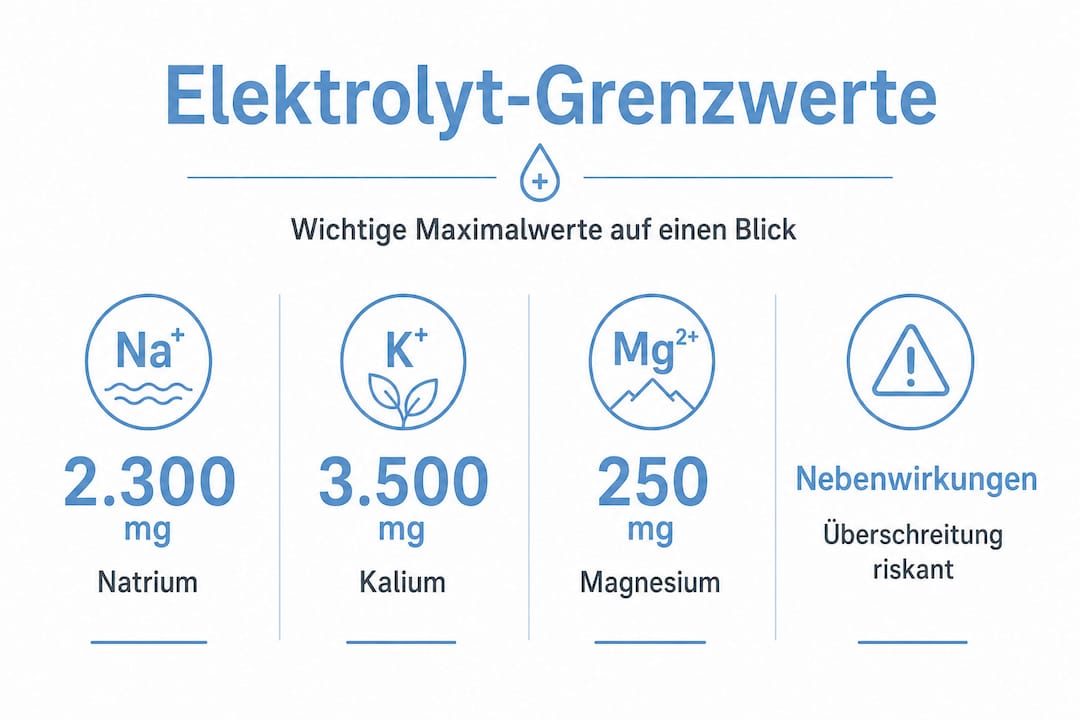
The case of magnesium is particularly revealing. According to the NIH ODS Magnesium Fact Sheet, high magnesium intake from natural foods is virtually unproblematic for healthy people because the body efficiently excretes excess magnesium through the kidneys. Supplements are a different matter: Certain forms of magnesium salts, such as magnesium oxide or magnesium citrate, draw water osmotically into the intestines and reliably cause diarrhea at higher doses. This is not a rare phenomenon but a well-known pharmacological pattern.
Common symptoms of an electrolyte overdose:
- Sodium too high (hypernatremia): intense thirst, confusion, muscle weakness, and, in extreme cases, seizures
- Potassium too high (hyperkalemia): muscle paralysis, irregular heartbeat, tingling in the arms and legs
- Magnesium too high (hypermagnesemia): diarrhea, low blood pressure, muscle weakness, breathing problems at very high doses
- Calcium too high (hypercalcemia): kidney problems, nausea, constipation, bone pain
A magnesium deficiency is actually very common in everyday life, but that does not automatically mean everyone should take magnesium supplements. First determine your current status, then take targeted action. The same applies to every other electrolyte. Anyone who takes a supplement test gets a concrete basis for making decisions instead of supplementing blindly.
Another critical point: Many commercially available electrolyte products contain different salt forms of the same mineral. Magnesium glycinate, magnesium oxide, and magnesium taurate have different bioavailabilities and different side-effect profiles. Without the relevant background knowledge, people often choose a form that is not the most suitable.
A Personal Perspective: Why One-Size-Fits-All Electrolyte Recommendations Rarely Make Sense
In consulting practice and in observing health-conscious people, the same pattern keeps emerging: They do too much of the wrong thing and too little of the right one. Not because they lack motivation, but because they look for universally applicable solutions that simply do not exist when it comes to electrolytes.
It starts with the everyday stress response. Chronic stress raises cortisol levels, which in turn promotes sodium retention while increasing potassium excretion. So anyone under constant stress who consumes electrolyte drinks every day that are primarily formulated around sodium may worsen an existing potassium deficiency. This is not a theory; it is physiology.
There is also a widespread misconception: that muscle cramps during exercise prove an electrolyte deficiency is present. Current research suggests that neuromuscular fatigue and overexertion play a greater role in many cases than sodium levels. So when someone reflexively eats more salt after a cramp, they are not addressing the underlying problem.
What actually helps is what most people consider too time-consuming: paying attention. Listening to your own body. Watching for early warning signs. The most common early signs of an electrolyte imbalance include:
- Recurring fatigue without a clear cause
- Muscle cramps, especially at night or after exercise
- Persistent headaches without an identifiable cause
- A racing heart or irregular pulse after exertion
- Strong cravings for salty or sweet foods
These signals cannot be fixed with a standard electrolyte tablet. They require an individual diagnosis based on knowing the starting point. A nutrient deficiency can only be identified reliably if what is missing in the body has actually been measured.
The reality is this: A person can take magnesium every day and still have a functional deficiency because they choose the wrong form or because a vitamin D deficiency blocks absorption. Another person may be able to meet their magnesium needs entirely through food with simple dietary adjustments. Both need different recommendations. And neither deserves a one-size-fits-all formula.
In the area of electrolytes, personalization specifically means: Measure first, then act. First understand your own sweat type, then decide whether supplementation makes sense and which type to use. First understand which forms of salt and minerals are suitable for your body before investing in products. This is not excessive perfectionism. It is simply efficient.
Supporting Your Health Individually: Next Steps with mybody®x
Anyone who understands that blanket electrolyte strategies are rarely suitable will next ask: How do I find out what my body really needs? mybody® offers the crucial starting point here. With ISO-certified laboratory analyses of nutrients, minerals, and metabolism, mybody® provides not general reference values but specific results tailored to your biology. All tests can be conveniently performed at home. The evaluation comes with personalized nutrition recommendations that directly address your nutritional status. Free shipping on orders over €49, personal consultation, and a money-back guarantee make getting started easy. Discover your individual values at mybody-x.com.
Frequently Asked Questions About Electrolytes
How do I recognize an electrolyte deficiency?
Typical signs include muscle cramps, persistent fatigue, and heart rhythm disturbances. A blood test or individual health analysis provides reliable clarity about your actual nutritional status.
Do I need to take electrolytes as a supplement every day as a recreational athlete?
Not necessarily: With a balanced diet and moderate exertion, the natural intake from food is usually sufficient. Individual factors such as sweat rate and training environment determine whether additional supplementation is beneficial, as a blanket supplementation approach for all athletes is not scientifically supported.
Are electrolyte overdoses dangerous?
Yes, too many electrolytes from supplements can cause stomach problems, diarrhea, or more serious health consequences. Particularly high doses of magnesium from supplements often lead to osmotic diarrhea and other discomfort.
Are there upper limits for electrolytes?
Yes, the EFSA Upper Intake Levels define the maximum daily intake considered safe for various minerals and apply to total intake from food and supplements combined.



Share now:
Genetic nutrition test: what it shows and how much it costs
Sleep stages explained: Science and tips for better sleep