

Lifestyle analysis explained: Achieve personalized health
TL;DR:
- A lifestyle analysis combines genetic data with lifestyle information to provide individualized health advice.
- It is not a substitute for medical diagnoses, but a proactive tool for prevention.
- Success depends on targeted implementation and personal motivation.
Your body processes nutrients differently from your neighbor’s. This is not speculation, but nutrigenetics: the science that explains why the same diet works for one person and fails for another. A lifestyle analysis uses precisely this knowledge to tailor nutrition, weight and well-being to your genetic reality. Many people start with high expectations and end up frustrated because they do not know what such analyses can and cannot actually do. This article dispels myths, explains the process step by step and shows how to truly integrate the results into your everyday life.
Table of contents
- What is a lifestyle analysis?
- What are the benefits of a lifestyle analysis? Benefits and areas of application
- Limitations and criticism: What lifestyle analyses still cannot do
- In practice: How a lifestyle analysis works and what you should look out for
- Our perspective: Why lifestyle analyses only truly work when they are individualized
- Next Steps: Start Your Individual Lifestyle Analysis
- Frequently Asked Questions
Key insights
| Point | Details |
|---|---|
| What lifestyle analyses can do | They show how genes and lifestyle interact and provide personalized nutrition recommendations. |
| Who is it suitable for? | People with clear health goals such as weight loss, vitality and prevention benefit the most. |
| Be aware of the limitations | Lifestyle analyses do not replace a medical diagnosis and are only effective with consistent implementation. |
| What should you look for? | Choose reputable providers, genuine advice and remember to take a holistic approach to health management. |
What is a lifestyle analysis?
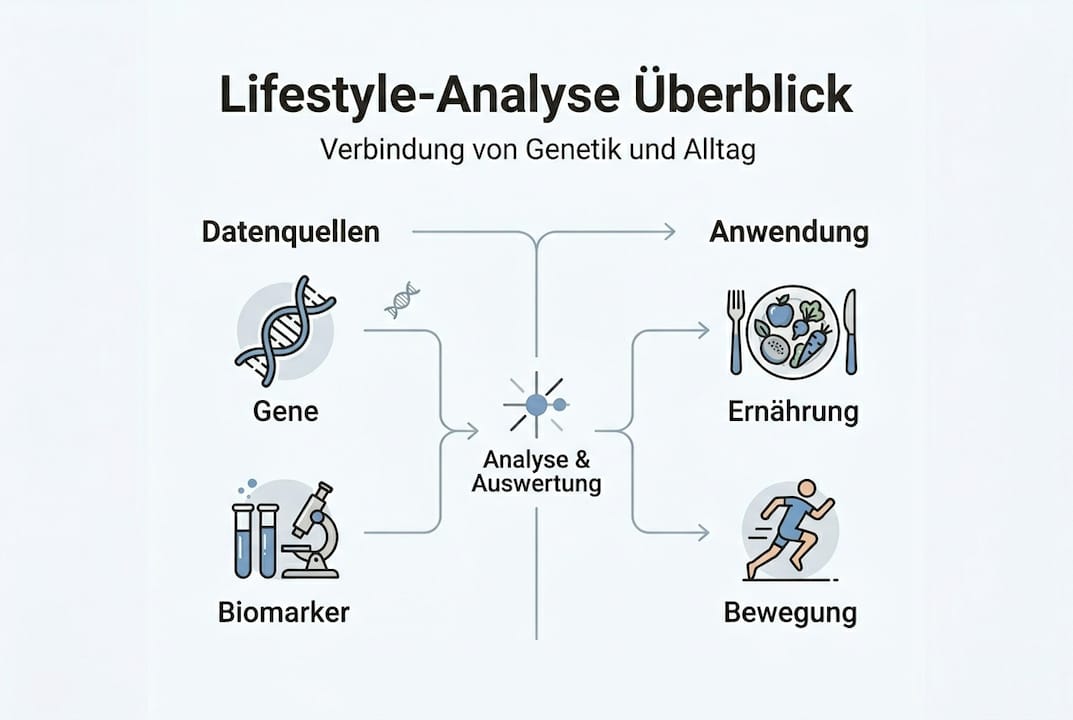
A lifestyle analysis is not a simple health check. It combines genetic data with information about your lifestyle, diet and goals to create an individual picture of your health. At its core is DNA analysis, supplemented by a structured questionnaire about sleep, exercise, stress levels and eating habits.
The process begins with a saliva sample that you can conveniently collect at home. The laboratory then examines specific gene variants, known as SNPs (Single Nucleotide Polymorphisms, or individual letter differences in your DNA). Genes such as FTO, PPARG and MTHFR are particularly relevant because they directly influence your metabolism, fat storage and nutrient requirements. FTO, for example, affects how strongly you feel hunger. MTHFR determines how well your body processes folate.
Three scientific disciplines form the foundation of modern lifestyle analyses:
- Nutrigenetics: How your genes influence how you respond to certain nutrients
- Nutrigenomics: How nutrients change the activity of your genes
- Epigenetics: How lifestyle and the environment determine which genes are active or inactive
Advanced providers also integrate additional biomarkers. Personalized nutrition approaches can incorporate data from microbiome analyses, blood values, and even proteomics (the entirety of all proteins in the body) to provide an even more precise picture. Artificial intelligence helps interpret this volume of data meaningfully.
| Feature | Traditional health check | Lifestyle analysis |
|---|---|---|
| Basis | Blood values, symptoms | DNA, lifestyle, biomarkers |
| Statement | Current state | Long-term potential |
| Recommendations | General | Individual and genetic |
| Prevention | Reactive | Proactive |
An important difference from traditional health checks: While a doctor’s visit shows where you stand today, a lifestyle analysis shows your genetic predispositions and how you can counteract them. This is the crucial shift in perspective from reactive to proactive health.
“The combination of genetic data and lifestyle information enables recommendations that go far beyond blanket advice.”
What are the benefits of a lifestyle analysis? Benefits and areas of application
The practical benefits of a lifestyle analysis are evident in three key areas: nutrition optimization, weight management, and prevention. Those who have previously failed with standard diets often find an explanation and a new approach here.

Current data is particularly relevant: 28% of the population has an increased need for vitamins due to genetic variants, and genes such as FTO are directly associated with an increased risk of obesity. At the same time, the prevalence of diabetes is 9.7%, a condition that can often be significantly delayed or prevented through early, personalized dietary adjustments.
Who is a lifestyle analysis particularly suitable for?
- People who want to lose weight but have not achieved lasting results despite dieting
- Physically active people who want to optimize their performance and recovery
- People over 40 who take prevention seriously and want to identify nutrient deficiencies early
- People with digestive problems that may have a genetic component
- Anyone seeking more energy and vitality in everyday life
A concrete example: Someone with a particular variant of the FTO gene has a statistically higher risk of obesity because their sense of satiety is genetically diminished. A gene-based diet can then focus specifically on satiating foods and meal structure instead of generic calorie counting.
The benefits at a glance:
- Tailored nutrient recommendations instead of general advice
- Early detection of deficiency risks, for example for vitamin D, B12, or folic acid
- Motivation through understanding your own biological starting point
- A long-term strategy instead of short-term diet effects
- A foundation for targeted supplementation without guesswork
Pro tip: When choosing a provider, look for ISO certification of the laboratory, transparent privacy policies, and a scientific advisory board. A reputable DNA test for nutrition provides not only raw data but also easy-to-understand reports with specific recommendations for action.
The combination of genetic information and personalized advice makes the difference between an interesting experiment and real behavioral change. Those who understand their results act differently.
Limitations and criticism: What lifestyle analyses still cannot do
Honesty is more important here than enthusiasm. Lifestyle analyses are not a cure-all, and those who understand this use them more wisely.
The first and most important point: A lifestyle analysis is not a diagnosis. It does not replace a medical examination and cannot detect or rule out diseases. The results are probabilities and tendencies, not certainties. Forgetting this leads to false expectations.
Other specific limitations:
- Limited SNP coverage: No test analyzes all relevant genetic variants. The human genome contains more than 3 billion base pairs. Current tests examine anywhere from a few hundred to a few thousand SNPs.
- Complex interactions: Genes interact with one another and with the environment in ways that even scientists do not yet fully understand.
- Environmental factors are missing: Stress, sleep quality, social environment, and the microbiome influence health at least as much as genes.
- Motivation is not included: A test result does not automatically change behavior. The drive to put it into practice comes from you.
“Critics rightly emphasize that the evidence for lasting behavior change through genetic testing is still weak. Studies show mixed results, particularly regarding long-term adherence.”
This does not mean that lifestyle analyses are worthless. It means that they work best as a starting point, not an endpoint. Anyone who takes a test and then changes nothing is wasting its potential. Those who use the results as a basis for concrete steps benefit from them.
Another critical point is the wide variation in quality on the market. There is a world of difference between reputable, ISO-certified laboratories and questionable online providers. Inexpensive tests without a scientific advisory board and without consultation services often deliver superficial results that create more confusion than help.
Pro tip: Use a lifestyle analysis as a complementary tool alongside medical care, not as a substitute. Always discuss notable results, such as those involving MTHFR or an increased risk of inflammation, with a doctor or nutrition professional.
The strength lies in the combination: genetic data plus professional guidance plus a personal commitment to implementation. If one of these three pillars is missing, the results fall short of their potential.
In practice: How a lifestyle analysis works and what you should look out for
The process is simpler than many people expect. Here is what you can expect in concrete terms:
- Order the test: You choose a provider and receive a kit by mail containing everything needed to collect the sample.
- Collecting the sample: A saliva sample is sufficient for DNA analysis. Some providers combine this with a questionnaire about diet, sleep, and exercise.
- Laboratory analysis: The certified laboratory analyzes your sample for relevant genetic variants. Depending on the provider, this step takes between one and three weeks.
- Results report: You receive a personalized report with explanations of your genetic variants and specific recommendations.
- Consultation: Reputable providers offer a personal consultation to discuss the results and develop an implementation plan.
Personalized nutrition analyses are particularly effective when the results are actively integrated into everyday life. The test result alone is not enough.
What you should look for when choosing a provider:
- ISO certification of the laboratory (quality standard for analyses)
- Clear data protection policies and GDPR compliance
- Pseudonymization and destruction of samples after analysis
- Scientific advisory board and evidence-based methodology
- Personal consultation as part of the service
- Easy-to-understand reports, not raw data alone
How to read your results correctly: Pay attention not only to risk factors, but also to protective factors and strengths. An increased risk associated with a gene does not mean that the disease will occur. It means that preventive measures are especially worthwhile.
Integrating the results into everyday life works best step by step. Start with one recommendation, such as eating more omega-3-rich foods or fewer processed carbohydrates, and build from there. Those who try to change everything at once usually fail. Those who use a DNA test for personalized health as a compass find the right path more easily.
A common pitfall: People start a test without a clear objective. Think beforehand about what you specifically want to learn or change. Weight management, energy, digestion, or prevention. The clearer your goal, the more valuable the results. Those who set specific goals for losing weight with DNA analysis achieve significantly better results than those without preparation.
Our perspective: Why lifestyle analyses only truly work when they are individualized
Generic diets have had their day. Not because they are poorly designed, but because they ignore biological diversity. Personalized approaches show better long-term adherence than generic recommendations, and a healthy lifestyle can demonstrably add 14 to 24 years to your life.
Our experience shows: The biggest mistake is to see a DNA test as the end rather than the beginning. The result is information. Change comes through action. Those who know their genetic tendencies and then take concrete action—adjusting their diet, optimizing their exercise, and changing their routines—experience real results.
The future belongs to multi-omics: the combination of genomics, microbiome analysis, proteomics, and AI-supported evaluation. Current developments show enormous potential, but also clear limitations: Without sufficient randomized studies, part of the promise remains hype. Anyone who understands nutrigenetics knows that the value lies not in the test, but in consistent implementation.
Next Steps: Start Your Individual Lifestyle Analysis
Anyone who now understands what a lifestyle analysis can and cannot do is ready for the next step. At mybody® Lab GmbH, you receive ISO-certified DNA analyses that provide scientifically validated reports with concrete nutrition and lifestyle recommendations. All tests can conveniently be completed at home, and your data is pseudonymized and destroyed after the analysis. With more than 11,300 satisfied customers and a rating of 4.77 stars, mybody® is a reliable partner for evidence-based health. Discover your individual lifestyle analysis and start with a clear goal.
Frequently Asked Questions
How does a lifestyle analysis work in practice?
You collect a saliva sample at home and complete a questionnaire. Combining both data sources provides your individual, genetically informed recommendations.
Are lifestyle analyses safe and do they protect your data?
Reputable providers comply with the GDPR, pseudonymize your sample, and destroy it after the analysis. ISO certification and transparent privacy policies should be considered minimum standards.
Who benefits most from a lifestyle analysis?
People who want to lose weight, are interested in prevention, or aim for greater vitality benefit the most. Targeted, genetics-based nutritional optimization is particularly effective for people who are not making progress with standard recommendations.
Can a lifestyle analysis detect diseases?
No. A lifestyle analysis is not diagnostic; it shows genetic tendencies and provides recommendations for prevention and optimization. A doctor is always responsible for medical diagnoses.
How reliable are the results?
The results are based on scientific evidence, but genes are only part of the picture. Personal adherence and implementation ultimately determine whether the recommendations translate into real improvements.



Share now:
Home Testing: Easily Optimize Personalized Health
Immediate help: What to do in case of an allergic reaction?