
Immediate help: What should you do if you have an allergic reaction?
You are eating something that you normally tolerate well. Suddenly, your mouth starts tingling, your skin itches, or your nose starts running. You may also feel dizzy and immediately ask yourself: What should you do if you have an allergic reaction?
In moments like these, vague half-knowledge is of no help; a clear plan is. Allergic reactions range from bothersome to life-threatening. If you correctly assess your body's signals and act appropriately and quickly, you gain confidence and avoid dangerous delays.
Your skin suddenly starts itching—what to do now
Allergic reactions often begin inconspicuously. A few red spots. Itching. A tight feeling in the mouth. Watery eyes. The problem is not just the symptom itself, but the uncertainty behind it. Is it still harmless, or is it already an emergency?
This is not an uncommon question. More than 30% of the population in Germany develop an allergy during their lifetime, with type I reactions able to trigger symptoms such as itching, swelling, or breathing problems within seconds to minutes (BfR). That is precisely why it is useful to know the first steps before panic takes over decision-making.
How to use the first few seconds correctly
Do one thing first: break contact with the possible trigger. Do not continue eating. Spit out the bite if you currently have something in your mouth. If you have had skin contact, wash the affected area. Remove any visible residue of a cosmetic product or plant. If an insect stinger is visible, carefully remove it.
Then observe yourself not “somehow,” but deliberately:
- Skin: Does it remain limited to itching, redness, or hives?
- Breathing: Does your throat feel tight, are you coughing, or is your breathing wheezy?
- Circulation: Do you feel dizzy, weak, or nauseous?
- Mouth and face: Are your lips or tongue swelling?
Why histamine often plays the leading role
Many acute symptoms occur because the body releases messenger substances, especially histamine. This causes itching, swelling, redness, and sometimes gastrointestinal symptoms. If you want to better understand why your body reacts this way, the article what is histamine provides a good foundation.
Remember this for everyday situations: As long as the reaction remains local and mild, it is important to stay calm. As soon as breathing, circulation, or consciousness is affected, every minute counts.
How to correctly interpret your body's warning signs
Not every reaction requires the same response. The crucial difference is whether your body is reacting locally or whether several systems are affected at the same time. The latter indicates a severe allergic reaction, known as anaphylaxis.
This overview provides a quick guide:

Mild or dangerous
Mild reactions are unpleasant but usually manageable. They include itching, the urge to sneeze, watery eyes, or a limited rash. It becomes critical when the airways, circulation, or consciousness are affected.
| Symptom area | Mild allergic reaction | Severe allergic reaction (anaphylaxis – emergency!) |
|---|---|---|
| Skin | Itching, redness, individual hives | Widespread reaction, swelling of the face, lips, or tongue |
| Airways | Runny nose, sneezing, mild throat irritation | Shortness of breath, wheezing, tightness in the throat |
| Circulation | Usually stable | Dizziness, rapid heartbeat, weakness, collapse |
| Gastrointestinal | Mild symptoms | Symptoms together with shortness of breath or circulatory problems should be taken seriously |
| Consciousness | Awake and oriented | Drowsiness or unconsciousness |
When you must stop waiting
There are symptoms for which I do not recommend waiting:
- Shortness of breath or audible breathing sounds
- Swelling of the tongue, lips, or throat
- Dizziness or the feeling that you are about to faint
- Altered consciousness
- Rapid deterioration within a short time
If you are unsure, do not assess the situation with a “it’ll be fine” attitude. Assess it based on the risk. The condition can worsen quickly.
A common misconception
Many people automatically consider skin symptoms harmless. That may be true, but it does not have to be. If breathing difficulties or signs of circulatory problems suddenly accompany the rash, the situation is different. It is no longer “just the skin.”
If you want to better distinguish typical triggers and reaction patterns, an overview of what allergies are can help.
Practical principle: A mild reaction remains localized. An emergency affects the whole person.
Immediate measures for mild allergic reactions
If you are sure that it is a mild reaction, the main goal is to stop the irritation and relieve the symptoms. This often works well if you proceed in a structured way.
Stop the trigger first
The most important first step is simple but effective: End the contact.
- For food stop eating it immediately
- For cosmetics wash them off thoroughly
- For contact with plants or animals clean your skin, change your clothes
- For pollen or dust leave the situation, wash your hands and face
The shorter the contact, the less likely further irritation is.
Targeted symptom relief
For local skin reactions, cooling often helps. A damp compress or a cool cloth soothes the skin and can reduce itching. Do not place anything icy directly on the skin.
Antihistamines can be useful for mild allergic reactions. They block the effects of histamine and are often used when itching, hives, or sneezing are the main symptoms. For questions about dosage, tolerability, or interactions, consult a pharmacy or medical practice.
What you should monitor
Mild reactions can be managed with self-care—but only as long as they remain mild. During the period afterward, monitor yourself especially for:
- New swelling in the mouth or face
- Coughing or shortness of breath
- Dizziness
- rapid spread of symptoms
Then immediately switch from self-management to emergency mode.
What often does not work
Frantically trying home remedies is not helpful. Nor is “I’ll wait an hour first” a good plan if the reaction is visibly getting worse. And if you have a known pattern of allergic rash, it is worth taking a closer look at possible triggers. The article about allergic rash is also relevant.
Works well: Avoiding the trigger, cooling the affected area, using appropriate medication, monitoring the progression.
Does not work well: Downplaying the situation, remaining exposed, ignoring symptoms.
Anaphylaxis: Every minute counts
A severe allergic reaction is not something to spend a long time thinking about. If the airways, circulation, or consciousness are affected, you must act immediately.

The emergency response chain
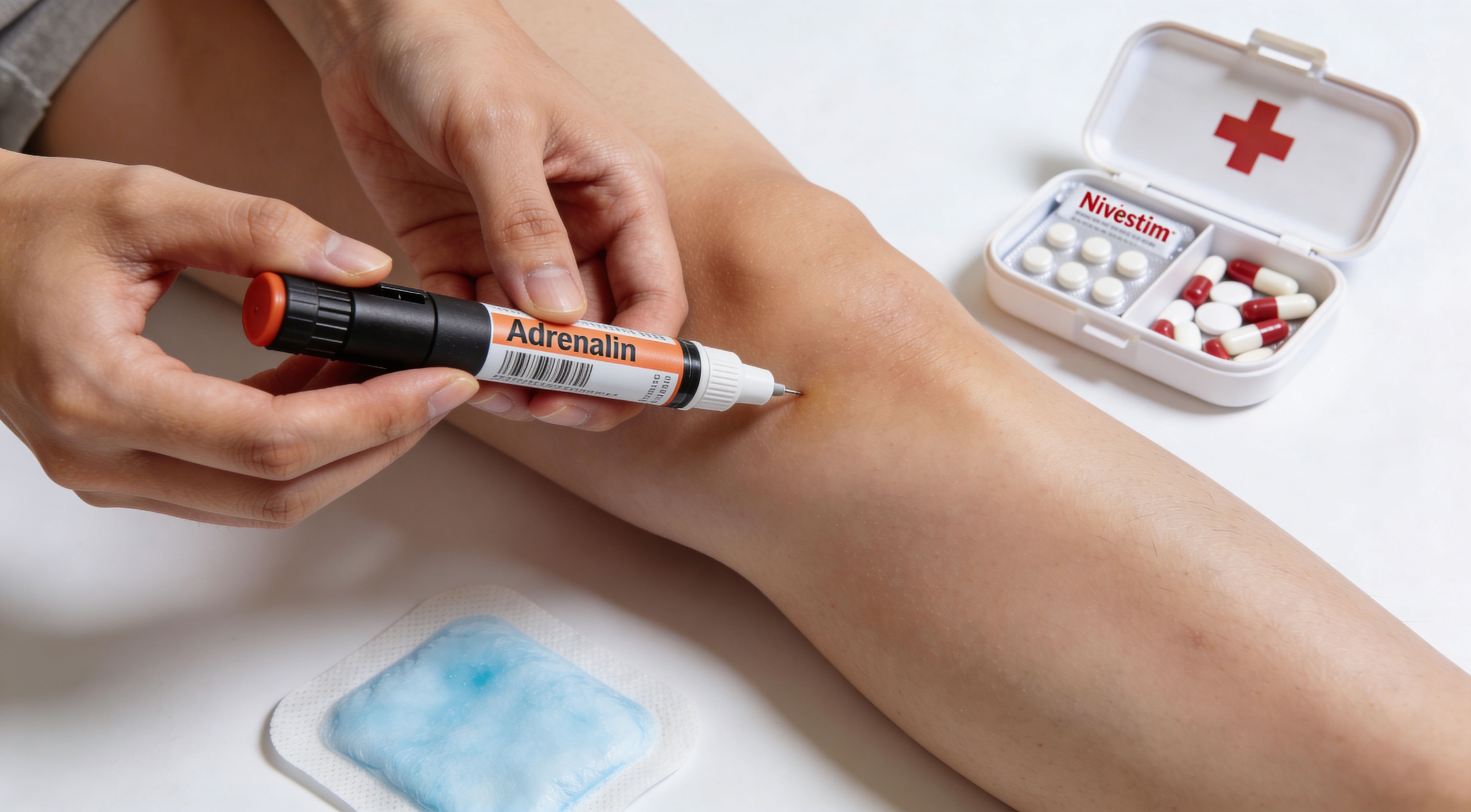
In the event of a severe anaphylactic reaction: Use the adrenaline auto-injector immediately in the thigh muscle; it takes effect in under 5 minutes, then always call 112. In Germany, over 95% of those affected survive when adrenaline is administered within 15 minutes (miomedico).
This is the order that matters in practice:
-
Administer adrenaline
If an auto-injector is available, inject it into the outer thigh. This is the key emergency measure. Do not wait for “more clarity.” -
Call 112
Clearly state that it is a severe allergic reaction. Give the location, the affected person’s condition, and, if possible, the suspected trigger. -
Positioning correctly
In case of breathing difficulties, keep the person upright or with their upper body elevated.
If there are circulatory problems, lay the person flat and raise their legs.
If unconscious, place the person in the recovery position and check their breathing. -
Additional items from the emergency kit
Antihistamines and cortisone work as complementary treatments. They do not replace adrenaline.
Fear of the auto-injector is the lesser problem
Many people hesitate to use epinephrine because they are afraid of making mistakes. In true anaphylaxis, this hesitation is more dangerous than using it. The autoinjector is designed precisely for situations like these. You do not have to be perfect. You have to act quickly.
What you can do as a companion
If someone else is affected, stay clear and direct:
- Speak calmly
- Do not leave the person alone
- Loosen tight clothing
- Monitor symptoms
- respond immediately if symptoms worsen
If normal breathing is no longer present, follow resuscitation procedures until professional help takes over.
Important: Antihistamines are only an adjunct in a severe reaction. In anaphylaxis, epinephrine is decisive.
After one reaction comes the risk of another
When the symptoms subside, everything quickly seems controllable again. This is exactly where many poor decisions are made. A severe reaction is not necessarily over just because things briefly look better.

Why observation is so important
Up to 20–30% of all anaphylactic reactions are biphasic. Symptoms may recur within 1 to 72 hours after initially improving. That is why hospital monitoring after a severe reaction is crucial. (ADAC).
In practical terms, this means that even if you feel stable after the initial treatment, your body may react again later. This second phase is often underestimated.
What you should record afterward
The time immediately after a reaction is extremely valuable medically and practically. Write down the following as soon as possible:
- What you ate or used
- When the reaction began
- Which symptoms appeared first
- How quickly they changed
- Which medications helped
This record will be much more helpful later during the medical evaluation than a vague recollection.
The real opportunity lies after the acute event
Many people focus only on how to get through the next incident. The more important question is often: How can you prevent the next incident altogether?
This is exactly where prevention begins. Not in the emergency call. Not only during the next flare-up. But in investigating the cause. Once you know the trigger, you can make different decisions in everyday life, read labels more carefully, adjust meals, and reduce your personal risk.
Practical tip: After every unexplained reaction, keep a simple allergy diary. Not perfectly—just consistently.
Find the cause and prevent the next emergency
If you react repeatedly but do not know the trigger for certain, you remain stuck in an unfavorable pattern. You treat the symptoms, but the cause continues. This is a typical problem, especially with foods, mixed dishes, or recurring skin and digestive complaints.

Do not think only of classic allergies
Not every reaction is a classic immediate allergy. Some symptoms resemble allergies but have other causes, such as intolerances or an unfavorable nutrient profile. This makes everyday life confusing, especially when the skin, digestion, and energy levels are affected at the same time.
One important point is relevant here: Up to 70% of cases of food allergies or intolerances may be exacerbated by nutrient deficiencies such as vitamin D or zinc deficiency. At-home blood tests can detect such deficiencies and enable early risk identification before reactions escalate (Apotheken Umschau).
Which diagnostic approaches may be useful in everyday life
The appropriate evaluation depends on your pattern. Depending on your symptoms, the following may be useful:
- Allergological evaluation when classic immediate reactions are suspected
- Diet and symptom diary for recurring uncertainties
- Blood-based self-tests for initial, structured guidance at home
- Nutrient tests when reactions, skin issues, or exhaustion repeatedly occur together
- Hormone tests when symptoms appear to be cycle-dependent or hormonally influenced
An example of at-home diagnostics is the do-it-yourself allergy test approach. In the appropriate context, a mybody x blood test can also be used, for example if you want to collect information from home about intolerances, nutrient status, or hormonal factors. Such tests do not replace acute care or every type of specialist diagnosis. However, they can help classify vague symptoms more systematically.
What often works in practice
Good prevention is rarely spectacular. It is concrete:
- Document foods and reactions
- Really read the labels
- Consistently avoid known triggers
- Keep your emergency kit up to date if it has been prescribed
- Do not suppress unexplained symptoms for months
People who understand their own bodies better do not wait until an emergency. They build safety in advance.
If you want to better classify recurring symptoms and are looking for a structured way to investigate their causes, a mybody x blood test may be a sensible next step. This combines acute safety with prevention and gives you a sound basis for addressing your diet, nutrient intake, or potential triggers more specifically.



Share now:
Lifestyle Analysis Explained: Gain Personalized Health
Understand your health metrics and improve them purposefully