

Complete blood count: Which diseases can actually be detected?
You are holding your fresh lab report in your hands and looking at a sea of abbreviations and numbers. What is it all supposed to mean? It's quite simple: A complete blood count is like a detailed map of your body. It is one of the most powerful diagnostic tools your doctor has and provides clear indications of conditions such as anemia, infections, inflammation, or even disorders of blood formation.
What your complete blood count really means

Every single value in your report is a puzzle piece that reveals how well your internal systems are currently working in harmony. Imagine your blood as an extremely diligent courier service that tirelessly collects messages from every cell in your body. The complete blood count is the key to deciphering these messages.
But this is not just about detecting existing diseases. Rather, this analysis is a tremendous opportunity to take preventive action and better understand your body, long before problems become noticeable.
A window into your health
Blood analysis gives you the opportunity to take active responsibility for your well-being. It can reveal imbalances before you even notice symptoms, giving you the chance to take countermeasures in good time. Before we delve into the individual values, however, it is worth taking a brief look at the basic functions of the circulatory system, as this helps you better understand the connections.
Your blood count is a snapshot of your health. It shows not only your current state but can also reveal trends that are crucial for your future health.
While a complete blood count is a comprehensive medical examination, there are also targeted tests that allow you to take specific aspects of your health into your own hands. Nutrient deficiencies in particular, which often manifest through nonspecific symptoms such as fatigue or difficulty concentrating, can be detected early this way.
This is exactly where the nutrient deficiency tests from mybody-x.com come in, which you can conveniently carry out at home. They are the ideal addition for specifically checking and optimizing your nutrient supply if necessary. By the way, if you're wondering what such an examination costs, we have summarized everything you need to know about the cost of a complete blood count in our article.
The most important blood values explained clearly
Now let’s get specific. Together, we’ll take a deeper look at your report and translate the medical jargon into clear, understandable language. Essentially, your complete blood count is a detailed inventory of the three main players in your bloodstream.
It’s best to think of them as a well-coordinated team that works tirelessly for you:
- Red blood cells (erythrocytes): They are your body’s hardworking oxygen taxis. Their main task? To transport vital oxygen from the lungs to every single cell.
- White blood cells (leukocytes): They are the vigilant police force of your immune system. Their mission is to detect intruders such as viruses and bacteria and render them harmless.
- Platelets (thrombocytes): They are the rapid-response team for wound healing. When an injury occurs, they rush to the site immediately to stop the bleeding and close the wound.
To help you visualize this, this simple infographic is useful. It shows you the three main areas of a complete blood count at a glance and helps you quickly understand the structure of your report.
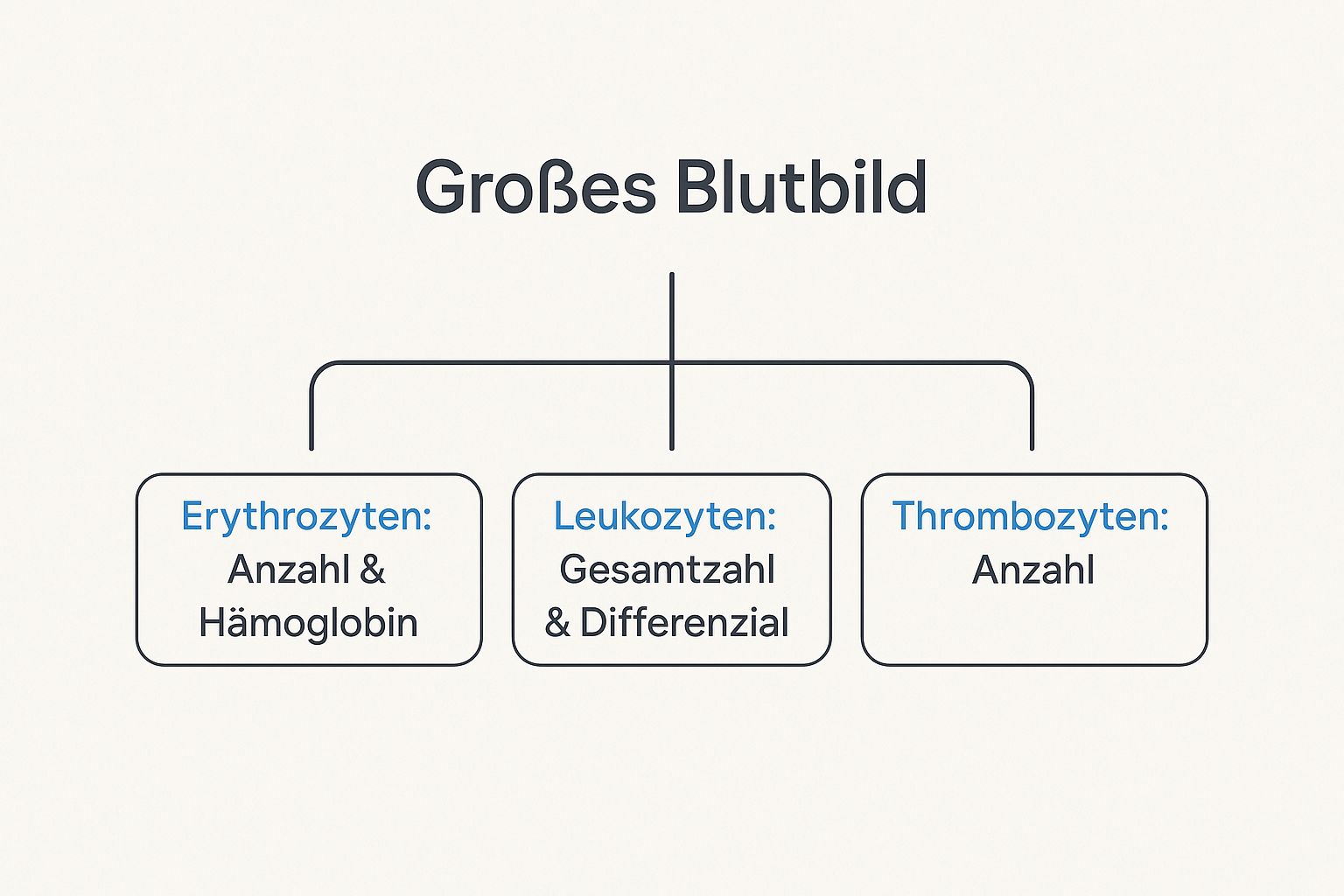
As you can see, the analysis is divided into red cells (erythrocytes), white cells (leukocytes), and platelets (thrombocytes). Each of these areas provides very specific insights into your health.
To give you a quick overview, we have summarized the most important parameters and their functions in a table.
Overview of the key blood values and their function
This table summarizes the key parameters of a complete blood count, their abbreviations, and their main function in the body to provide a quick understanding.
| Blood value (abbreviation) | Name | Main function in the body |
|---|---|---|
| Hb | Hemoglobin | Red blood pigment that binds and transports oxygen |
| Hct | Hematocrit | Proportion of blood cells in the total blood volume |
| ERY | Erythrocytes | Red blood cells, responsible for transporting oxygen |
| LEUKO | Leukocytes | White blood cells, part of the immune system |
| THRO | Thrombocytes | Platelets, essential for blood clotting |
These values form the basic framework. Now let’s take a closer look at what they reveal in detail.
Red blood cells in detail: More than just color
When we talk about red blood cells, three values are particularly important: hemoglobin (Hb), hematocrit (Hct), and the red blood cell count (RBC).
Hemoglobin is the red blood pigment and the actual transport molecule for oxygen. A hemoglobin level that is too low is often the reason you feel tired and exhausted—your cells are simply lacking “fuel.” Hematocrit, in turn, describes the percentage of blood cells in the total volume of blood. A low value may indicate anemia, while a high value is more likely a sign of dehydration.
Deviations in these values therefore provide initial but important indications that you may be suffering from anemia. This is one of the most common diagnoses detectable through a complete blood count and is often attributable to a nutrient deficiency.
Leukocytes: A reflection of your immune system
White blood cells are your personal defense team. A complete blood count goes one crucial step further than a basic blood count and produces what is known as a differential blood count. In a sense, this is your immune system’s personnel file.
The leukocytes are broken down into their various subgroups:
- Neutrophils: The “first responders” in bacterial infections.
- Lymphocytes: The specialists responsible for defending against viruses and for immunological memory.
- Monocytes: The “waste disposal team” that removes cell debris and pathogens.
- Eosinophils and basophils: These are often elevated in allergic reactions or parasitic infections.
The exact composition of this team reveals which type of “enemy” your body is currently fighting. This makes it much easier to distinguish whether it is more likely a bacterial or viral infection.
The detailed breakdown of leukocytes is the key added value of a complete blood count. It enables much more precise diagnostics and helps narrow down the cause of infections and inflammation.
Platelets and what else the blood reveals
Platelets are responsible for blood clotting. If their levels are too low, this can lead to an increased tendency to bleed. If they are too high, however, the risk of blood clots (thrombosis) increases.
But a complete blood count is more than just counting blood cells—it is a powerful screening tool. Did you know that around 85 percent of all laboratory analyses in medicine are based on blood samples? That is because your blood contains an incredible amount of information about your overall health. Other values, such as blood glucose, are often measured at the same time. This is crucial for detecting metabolic diseases such as diabetes mellitus at an early stage. If you want to learn more, you can find out more about the many possibilities of blood diagnostics on vorsorge-online.de.
Some findings, such as mild anemia, may indicate a deficiency in certain nutrients like iron or vitamin B12. If you want to proactively address such imbalances, targeted analyses are an excellent complement. The nutrient deficiency tests from mybody-x.com allow you to check your supply of essential vitamins and minerals precisely and adjust your diet accordingly.
How to detect anemia and nutrient deficiencies
Do you often feel tired and unfocused, and simply lack the energy for everyday life? One of the most common reasons—which a complete blood count can quickly reveal—is anemia, also known as a low red blood cell count.
Imagine your red blood cells as small “oxygen taxis.” With anemia, a deficiency slows these taxis down. Either you have too few of them, or they lack hemoglobin, the red blood pigment, needed to capture oxygen and transport it where it is needed. The result? You feel tired and drained because your cells are not receiving enough oxygen.
The typical signs of anemia in a blood count
A suspicion of anemia becomes apparent fairly quickly in laboratory results. Your doctor focuses primarily on three key values that we already know:
- Red blood cell count (RBC) too low: You simply have too few red blood cells.
- Hemoglobin (Hb) too low: Your existing blood cells lack the pigment needed to bind oxygen.
- Hematocrit (Hct) too low: The proportion of blood cells in the total blood volume is too low.
If these three values are out of range, anemia is very likely. But that is where the real detective work begins, because anemia is usually just a symptom of an underlying problem.
When the building blocks for your blood are missing
By far the most common cause of anemia is iron deficiency. Iron is the absolute essential building block for producing hemoglobin. Without enough iron, your body cannot produce the red blood pigment—and production of your oxygen taxis comes to a standstill.
In Germany, a complete blood count is a key tool for detecting anemia at an early stage. You can read more about the role of a blood count in preventive care on vorsorge-online.de.
Anemia is rarely an independent disease. Rather, it is a clear signal from your body that it lacks important nutrients needed for blood formation.
But it is not just about iron. A deficiency in two other vitamins can also seriously impair the formation of healthy red blood cells:
- Vitamin B12: This vitamin is essential for cell division. If it is lacking, the erythrocytes become too large and do not function properly (this is known as megaloblastic anemia).
- Folate (vitamin B9): Like vitamin B12, folate is also absolutely essential for the maturation of red blood cells in the bone marrow.
These nutrient deficiencies often develop gradually and remain unnoticed for a long time. The symptoms—fatigue, paleness, brittle nails, or difficulty concentrating—are so nonspecific that it is easy to attribute them to stress or a demanding lifestyle.
From suspicion to clarity: Take proactive action
If your complete blood count indicates anemia, your doctor will order further tests to determine the exact cause. These generally include measuring your ferritin level (your iron stores), as well as your vitamin B12 and folate levels.
But you do not have to wait until a deficiency develops into a tangible illness. If you often feel low on energy or simply want to make sure everything is in good shape, you can take action yourself. For example, an article on our blog provides a comprehensive overview of how you can get tested for nutrient deficiencies.
Specific nutrient deficiency tests are an excellent way to gain clarity in a targeted and preventive manner. Rather than waiting for illness to occur, you can check whether you are getting enough critical vitamins and minerals before any noticeable limitations to your quality of life arise.
The nutrient deficiency tests from mybody-x.com are designed precisely for this purpose. They allow you to conveniently find out from home, based on a scientifically sound laboratory analysis, where you may have deficiencies. This gives you a solid data foundation for targeted dietary optimization and helps you take proactive control of your well-being.
Detecting infections and inflammation in the blood

Imagine your immune system as a highly advanced army that fights invisible battles against viruses, bacteria, and other invaders every day. What if you could receive a direct situation report from this front? That is exactly what the differential blood count provides—the crucial, detailed part of the complete blood count.
An elevated total white blood cell count, known as leukocytosis, is often the first loud alarm signal. It is as if your body is calling all available troops to the front because an attack is underway.
But only the details reveal what is really going on. This is where the complete blood count comes in, as it provides the crucial details for an accurate diagnosis.
The immune system’s specialists in detail
The differential blood count is like the personnel file of your immune army. It breaks down the white blood cells (leukocytes) into their specialized subgroups. Each group has its own specific task, and its respective count gives us clear indications of which “opponent” your body is currently battling.
- Neutrophils: These are the storm troopers of your defenses, immediately deploying to fight bacteria. If their number is greatly increased, this is a strong indication of a bacterial infection—such as classic tonsillitis or pneumonia.
- Lymphocytes: These cells are the virus specialists. An increase in lymphocytes is the typical hallmark of a viral infection. Think of a cold, the flu, or mononucleosis.
- Monocytes: You could call them the “cleanup crew.” They occur in greater numbers during prolonged, chronic inflammation or when an infection is already in the healing phase.
- Eosinophils and basophils: These two specialists are mobilized primarily during allergic reactions or a parasite infestation.
This detailed breakdown is worth its weight in gold to doctors. It not only helps them make a diagnosis but also choose the right treatment. For example, it can clearly determine whether an antibiotic is actually appropriate for a bacterial infection.
A complete blood count is much more than simply counting blood cells. It is a functional analysis of your immune defenses that shows how and what your body is currently fighting.
In Germany, a complete blood count is one of the most important laboratory tests. It often provides crucial indications of infections, inflammation, or disorders of blood formation. Hospital statistics also show how relevant this is: diseases of the blood and blood-forming organs are responsible for tens of thousands of hospital stays every year, underscoring the central role of blood analysis in early detection. The Federal Statistical Office provides more in-depth information in the diagnosis data for German hospitals.
Detecting hidden inflammation
Not every inflammation demands attention through fever or pain. So-called silent or chronic inflammation (“silent inflammation”) is an often underestimated health risk. It smolders quietly beneath the surface and can lead to serious secondary conditions such as cardiovascular problems or metabolic disorders in the long term.
Here too, a complete blood count can be a valuable detective. Slightly but persistently elevated inflammatory markers—such as mild leukocytosis or altered proportions of leukocyte subgroups—may indicate such chronic processes. Think of it as a quiet but persistent warning signal that should not be ignored.
Such a finding is often the starting point for further tests to uncover the actual cause of the chronic inflammation. This impressively demonstrates how important a tool a complete blood count can also be for prevention.
If you want to specifically support your body so that your immune system is always in optimal shape, analyzing your nutrient status can provide valuable insights. The nutrient deficiency tests from mybody-x.com can help you identify possible vitamin and mineral deficiencies that are essential for a strong immune response.
First warning signs of more serious blood disorders
In the vast majority of cases, a complete blood count provides reassurance or points to easily treatable issues such as infections or a simple nutrient deficiency. In rare cases, however, it can also be the first, subtle warning sign of more serious hematological diseases. Even though this topic is uncomfortable, it is important for understanding just how powerful an early-warning system a complete blood count can be.
Here we are talking about diseases that arise directly in the bone marrow, the “factory” where our blood cells are produced every day. If something fundamentally gets out of sync there, it often results in extreme changes in blood cell counts.
When blood cell production is disrupted
In diseases such as leukemias (blood cancer) or myelodysplastic syndromes (MDS), this very blood formation in the bone marrow is disrupted. Imagine it this way: The production facility for your blood cells suddenly starts malfunctioning. Either it floods the market with masses of immature, useless cells, or it almost completely shuts down its operations.
A complete blood count can provide the first, often very clear indications here. Certain patterns immediately raise a doctor’s concern:
- Leukocytes (white blood cells): The counts can be extremely high (leukocytosis) because the bone marrow releases immature precursor cells uncontrollably. They can just as easily be extremely low (leukopenia) because healthy cell production is simply suppressed.
- Erythrocytes (red blood cells): There is almost always pronounced anemia. This makes sense, as the production of red blood cells is severely impaired.
- Thrombocytes (platelets): Here too, the counts are often significantly reduced (thrombocytopenia), which explains why those affected are more prone to bleeding or bruising.
One thing is especially important: An abnormal blood count is never a definitive diagnosis. It is a crucial indication that requires immediate evaluation by a specialist—a hematologist.
Fortunately, such serious diseases are rare. But the very possibility of detecting such warning signs early on highlights the immense value of a complete blood count. It works like a sensitive radar that can also draw attention to very serious disorders.
It’s all a matter of context
A single value that falls outside the normal range does not yet indicate a disease. A doctor always looks at the overall picture: How extreme are the deviations? Are multiple cell lines affected? And how does it all fit with your symptoms—for example, unexplained fatigue, recurring infections, night sweats, or bruising?
If, for example, you only have anemia, the most likely cause by far is a simple nutrient deficiency. That is precisely why it is so important not to take a possible iron deficiency lightly. In our article, you can learn more about the symptoms and how an iron deficiency self-test can give you some initial clues.
However, if a serious hematological disease is suspected, further examinations are essential. These may include a bone marrow biopsy or specialized genetic analyses to establish a definitive diagnosis. The complete blood count is the first, but absolutely crucial, step on the path to clarity. It clearly demonstrates why it is so important to listen to our body's signals and have them medically evaluated rather than ignore them.
Your path to clarity with targeted nutrient tests
You now know how much a complete blood count can reveal—from anemia and hidden infections to more serious diseases. There is no question that it is an indispensable tool for medical diagnosis.
But what if you don't want to wait for problems to arise and would rather take action one step earlier? What if your goal is not to diagnose a disease, but to proactively optimize your health and well-being?
This is exactly where a modern understanding of health begins—by taking the wheel yourself. While the doctor primarily looks for pathological changes, you can specifically check whether your body is optimally supplied.
From reacting to taking action
That is the crucial difference between a diagnostic blood count at the doctor's office and a preventive nutrient test. The doctor reacts to symptoms or looks for signs of disease as part of a check-up. You, on the other hand, can take proactive action to ensure that your body has all the building blocks it needs for peak performance.
Imagine a complete blood count as being like a vehicle inspection for your car—it checks for basic defects and safety risks. A nutrient test, on the other hand, is like targeted tuning: You ensure that the engine delivers its best performance because it is optimally supplied.
Instead of waiting until a deficiency becomes noticeable through symptoms such as constant fatigue, concentration problems, or a weakened immune system, you create a solid data foundation. With this information, you can make targeted adjustments to your diet and lifestyle—long before real difficulties arise.
Complete blood count compared with a specific nutrient test
A clear comparison highlights the different goals of a doctor's complete blood count and a preventive at-home nutrient test.
| Characteristic | Complete blood count (doctor) | Nutrient test (e.g., mybody-x.com) |
|---|---|---|
| Primary goal | Diagnosing diseases, clarifying symptoms, and monitoring treatment. | Prevention, optimizing nutritional status, and improving well-being. |
| Focus | Pathological (disease-related) abnormalities in blood cells and other markers. | Determination of your individual vitamin and mineral status. |
| Initiative | Usually by a doctor when there is a suspicion or as a preventive examination. | On your own initiative to proactively manage your health. |
| Use of results | The basis for medical diagnoses and treatment plans. | The basis for targeted adjustments to your diet and lifestyle. |
This approach puts you back in control and enables you to shape your health yourself. You do not wait for problems but actively prevent them. The tests are easy to carry out at home and provide you with reliable laboratory results that show you exactly where you can start.
If you are keen to learn how deep the connection between your genes and your optimal diet really is, we recommend our article on nutrigenetics. There, you will learn how your DNA influences which nutrients are particularly important for you personally.
The nutrient deficiency tests from mybody-x.com are the perfect complement to a doctor's blood count. They help you take the crucial step from simply identifying illnesses toward consciously shaping your health.
The most important questions about the extended blood count—explained briefly and clearly
Now that we have taken an in-depth look at the world of the extended blood count, you may still have a few practical questions. Here, we answer the most common ones so that you are fully prepared for your next blood draw and know exactly what to expect.
Do I really need to fast for an extended blood count?
No, not necessarily. If it is solely about the extended blood count—that is, counting and analyzing your blood cells—you do not need to fast beforehand. Eating breakfast does not change the number of your red and white blood cells.
The catch, however, is that other values that do react to food are usually measured during the same blood draw. Blood sugar (glucose) and blood lipids (triglycerides) are especially important here. To ensure these values are meaningful, fasting is essential. This generally means 8 to 12 hours without eating. To be on the safe side, always ask your doctor's office exactly what applies to your test.
How often should you have an extended blood count?
There is no one-size-fits-all answer here—it depends entirely on you and your personal situation. The frequency depends on your age, state of health, and any pre-existing conditions.
- For healthy adults: From age 35, health insurance providers cover a general health check-up every three years. This often includes a complete blood count, and an extended blood count if needed.
- For chronic conditions: Do you have a chronic illness or take medication that could affect your blood count? In that case, your doctor will probably want to check your levels at shorter, regular intervals.
- For unclear symptoms: Do you constantly feel tired, suffer from frequent infections, or experience other vague symptoms? Then a complete blood count is often one of the first and most important steps toward getting to the root of the cause.
An annual blood test as a purely preventive measure can also be a good idea for detecting changes early and keeping an eye on your health.
Can stress or exercise distort blood test results?
Yes, absolutely! Both strenuous exercise and severe stress can temporarily disrupt your blood values and lead to incorrect conclusions. In particular, intense physical exertion the day before a blood draw can increase the number of leukocytes (white blood cells).
The laboratory results could then falsely suggest an emerging infection or inflammation. Acute stress can also affect various cell and hormone levels. For a truly meaningful result, you should therefore avoid strenuous exercise the day before your appointment and arrive for the blood draw as relaxed as possible.
What is the difference between a basic and a complete blood count?
The difference is crucial and can be easily compared to two reports about your blood cells with different levels of detail.
- The basic blood count is the basic analysis. It examines the total number of red blood cells (erythrocytes), white blood cells (leukocytes), and platelets (thrombocytes). It also includes the hemoglobin and hematocrit values.
- The complete blood count includes all these values and adds the crucial differential blood count on top. This breaks down the white blood cells into their specialized subgroups (e.g., neutrophils, lymphocytes, monocytes).
This detailed breakdown provides much more precise clues about what kind of problem might be present—for example, whether it is more likely to be a bacterial or viral infection. The complete blood count is therefore a much more powerful tool for determining which diseases can actually be detected.
If you want to take proactive care of your health beyond a standard blood test and identify potential gaps in care at an early stage, you’ve come to the right place. With our nutrient deficiency tests, you can easily check from home whether you’re optimally supplied with essential vitamins and minerals, helping you take your well-being into your own hands.



Share now:
Complete blood count cost: who pays for it and what it really includes
What are minerals, and how can they help me?