

What are minerals, and how can they help me?
Do you wonder what minerals actually are? You could describe them as the quiet, invisible heroes in your body. They are essential inorganic nutrients that your body cannot produce itself. That is why you depend on obtaining them every day through your diet to stay fit and perform at your best.
The invisible foundation of your well-being

Imagine your body as a highly complex structure. Minerals are much more than just the bricks—they are also the mortar that holds everything together, the electrical system that ensures smooth processes, and the stable foundation. They are involved in almost all vital processes and form the basis of your daily well-being and health.
Without them, your bones would have no stability, your muscles could not contract, and your nerves would be unable to send signals. They are essentially the invisible directors working behind the scenes to ensure that everything in your body runs smoothly.
More than just a topic for athletes
The importance of minerals goes far beyond preventing muscle cramps after exercise. They are essential for each and every one of us, every single day. Their functions are as diverse as they are fundamental:
- Structure and stability: Minerals such as calcium and phosphorus form the framework of your bones and teeth and give them the necessary strength.
- Energy production: Without iron or magnesium, your cells could not produce energy. The result? You feel constantly tired and drained.
- Nerve and muscle function: They control the transmission of nerve impulses and every single muscle movement—from a small blink to a powerful heartbeat.
- Immune system: A strong immune system that reliably protects you from pathogens depends on minerals such as zinc and selenium.
Minerals are the foundation of a well-functioning system. A deficiency can affect your overall well-being—often in ways you may not initially associate with it.
The fact that this topic is becoming increasingly important is no coincidence. Between 2019 and 2022, between 80 and 90 million packs of mineral supplements were sold in Germany every year. This shows how many people are already actively taking care of their nutrient intake. You can find more information in the statistics on mineral supplement sales in Germany on statista.com.
However, a possible deficiency should never be based on pure speculation. Targeted nutrient deficiency tests provide the clarity you need to support your body exactly where it truly needs it and take your health into your own hands.
Macrominerals and trace elements compared
Not every mineral has the same function in the body. To truly understand their role, they are divided into two major teams: the macrominerals and the trace elements. As the name suggests, the key difference lies in the amount your body needs and stores.
Imagine your body as a complex construction site. Macrominerals such as calcium and magnesium are the bricks and cement—you need them in large quantities to build the foundation and load-bearing walls. They literally form the substance of your body.
This graphic clearly shows the classification and highlights important representatives such as calcium (Ca), magnesium (Mg), iron (Fe), and zinc (Zn).
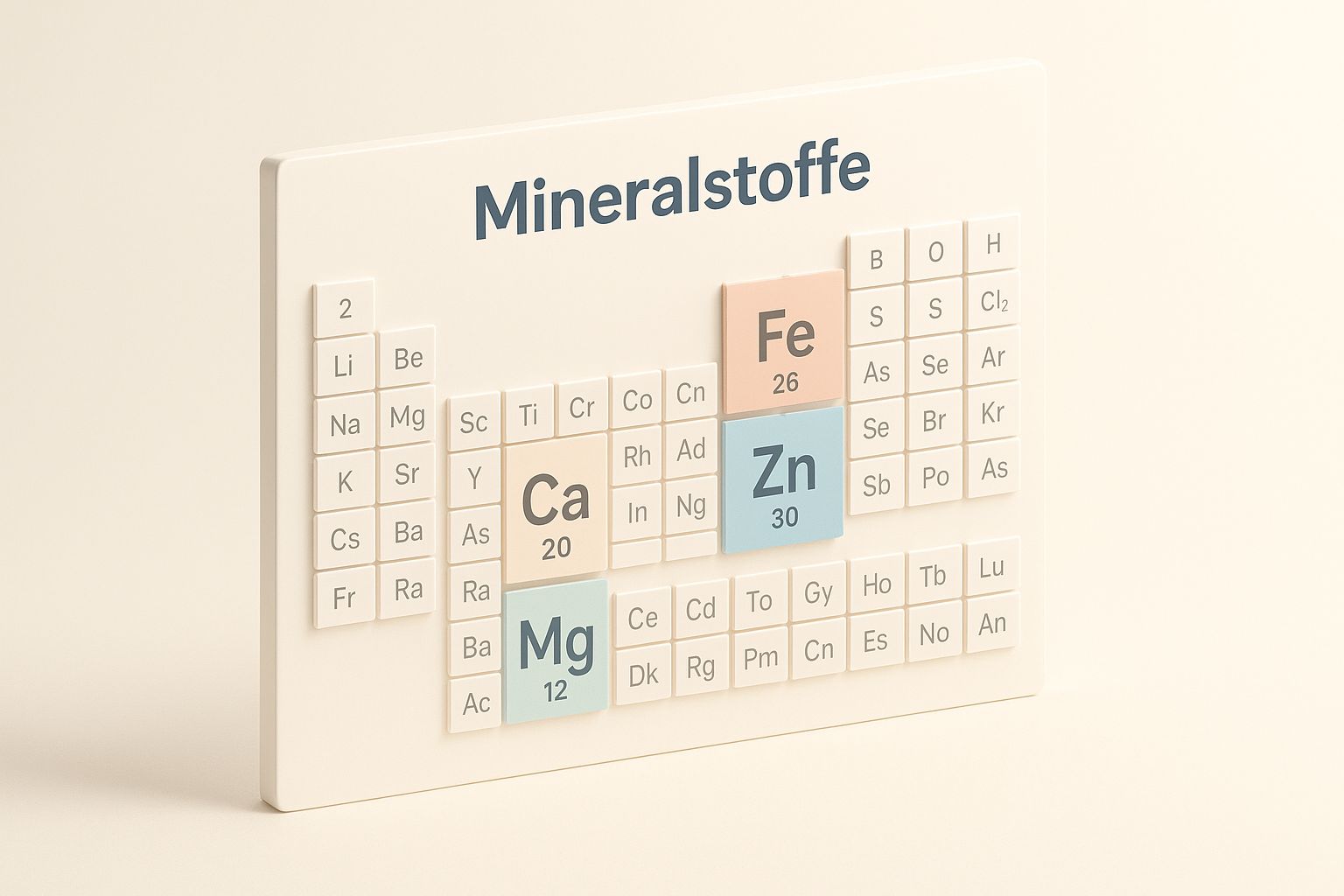
You can see immediately that although they are needed in very different amounts, both groups are essential for a stable overall structure.
The quantity makes the difference
The official dividing line between these two groups is a concentration of 50 milligrams per kilogram of body weight. If the concentration of a mineral is above this level, it belongs to the macrominerals. Anything below it falls into the category of trace elements.
To make this clearer, here is a brief comparison:
Macrominerals vs. trace elements at a glance
This table compares the two main groups of minerals, their definitions and concentrations in the body, and lists important representatives to clearly highlight the differences.
| Characteristic | Macrominerals | Trace elements |
|---|---|---|
| Definition | Minerals with a concentration of more than 50 mg/kg body weight | Minerals with a concentration of less than 50 mg/kg body weight |
| Requirement | Daily in the three-digit milligram to gram range | Daily in the microgram to low milligram range |
| Representatives | Calcium, potassium, magnesium, sodium, chloride, phosphorus, sulfur | Iron, zinc, selenium, copper, iodine, manganese, fluoride |
So one mineral is not more important than another—it is simply a matter of how much of it is needed for everything to run smoothly.
Specialists in tiny doses
Trace elements are the exact opposite of the “building materials.” They are the highly specialized experts on your body’s construction site: the electricians, precision mechanics, and security specialists.
You only need them in tiny doses—often just a few micrograms—but without them, crucial detail work and complex processes grind to a halt. A deficiency in one trace element can have consequences just as serious as a deficiency in a macromineral.
Iron is a classic example. When iron levels are inadequate, many people quickly feel tired and unfocused. If you want to learn more about how a deficiency can make itself known, take a look at our article on the iron deficiency self-test.
This distinction helps you understand why a balanced intake is so important. It is not just about getting enough of something, but about finding the right balance among all the nutrients involved to support your health holistically.
The most important minerals and their roles in the body
We have now distinguished between the major building blocks (macrominerals) and the fine tools (trace elements). Now it is time to get to know the main performers in your body’s orchestra personally. These are precisely the minerals whose importance for our well-being is being recognized by more and more people.
One study shows that around 75% of Germans regularly take dietary supplements to ensure they get enough nutrients. Magnesium supplements alone generated sales of €215 million, making them the highest-revenue category overall. If you want to learn more about this trend, you can find the findings on dietary supplement use here.
But what exactly do these minerals actually do all day? Let’s take a closer look at the four superstars and understand the crucial roles they play in your everyday life.
Magnesium – the relaxation manager
Think of magnesium as your personal manager for relaxation and energy. It is involved in over 300 in enzymatic reactions in the body, which rather clearly underscores its central importance.
Without sufficient magnesium, your muscles could no longer relax properly after tensing. The result? The notorious and often painful calf cramps at night or annoying muscle twitching after exercise. At the same time, it calms your nervous system and helps you cope better with stress.
- Muscle function: It ensures smooth coordination between contraction and relaxation.
- Nervous system: It acts like a natural tranquilizer and promotes inner calm.
- Energy production: It is essential for your cells to produce energy at all.
Calcium – the architect of strong bones
If magnesium is the manager, calcium is your body's indispensable architect. An incredible 99% of the calcium in your body is stored in your bones and teeth. This highlights its fundamental role in stability and structure.
It is the most abundant macromineral and ensures that your skeleton remains strong and resilient. But its role goes far beyond that: Calcium is also crucial for blood clotting and signal transmission between nerve cells.
Iron – the oxygen taxi driver
Every single one of your cells needs oxygen to produce energy. And this is exactly where iron comes in: Imagine it as a huge fleet of tiny oxygen taxis. As a central component of the red blood pigment (hemoglobin), it grabs the oxygen you inhale in your lungs and delivers it to every cell.
An iron deficiency causes this supply chain to grind to a halt. The result: You feel constantly tired, have difficulty concentrating, and look pale. A good iron supply is therefore the absolute foundation for your energy and performance in everyday life.
Each of these minerals has a unique and irreplaceable role. However, they do not work in isolation, but as a perfectly coordinated team to keep you healthy every day.
Zinc – the bodyguard of the immune system
Zinc is your body's watchful bodyguard. As a trace element, it plays a key role in your immune system. It ensures that your immune cells are strong and ready for action to fight viruses and bacteria effectively.
If your zinc stores are well stocked, you are less susceptible to colds and other infections. In addition, zinc is a master of regeneration: It is essential for wound healing and the health of your skin and hair. If you want to learn more about how different nutrients work together, read our article on vitamin and mineral deficiencies in Germany.
How to recognize a mineral deficiency
Do you often feel exhausted for no apparent reason, have trouble concentrating, or suddenly suffer from calf cramps at night? These are not random quirks of your body. Rather, they could be the first subtle signals telling you that it is missing important building blocks.
A mineral deficiency rarely develops overnight. It is usually a gradual process whose initial signs are often nonspecific and easy to overlook. But if you learn to listen to these clues, you can take action early and actively take charge of your well-being.
Common signs and what might be behind them
Your body has quite a clever repertoire of warning signals. Every symptom can be a puzzle piece pointing to a specific deficiency. Here are some of the most common signs you should know:
- Persistent fatigue and paleness: Do you constantly feel low on energy even though you are getting enough sleep? Pale skin and possibly even cracked corners of the mouth may indicate an iron deficiency. Iron is crucial for transporting oxygen in the blood—when it is lacking, you run out of breath.
- Muscle cramps and nervousness: Does your eyelid twitch uncontrollably, or do you wake up at night with painful calf cramps? These are classic signs of a magnesium deficiency. This mineral helps keep muscles and nerves calm and, when deficient, can also intensify inner restlessness and nervousness.
- Increased susceptibility to infections: Do you feel like you catch every wave of colds? A weakened immune system could be due to a zinc or selenium deficiency. These trace elements are practically the bodyguards of your immune defenses.
- Brittle nails and hair loss: The health of your hair and nails also provides valuable clues. If they are brittle and lackluster, this could indicate not only an iron or zinc deficiency, but also a deficiency of calcium or biotin.
It is important to see these symptoms for what they are: clues, not diagnoses. They are your body’s invitation to take a closer look and get to the root of the cause.
Particular stages of life and at-risk groups
Some people naturally have a higher risk of developing a mineral deficiency. Certain stages of life and habits simply increase the need or make it harder for the body to absorb nutrients.
If you belong to one of these groups, you should pay particular attention:
- Athletes and very active people: Those who sweat a lot lose not only water but also valuable minerals such as magnesium, sodium, and zinc. The increased energy expenditure further raises the need.
- Pregnant and breastfeeding women: During this special phase, the mother is nourishing not only herself but also her growing child. The need for iron, calcium, and iodine is significantly increased.
- People following a vegan or vegetarian diet: A purely plant-based diet can be very healthy, but it requires a little more planning. Minerals such as iron, zinc, and calcium are often less readily available to the body from plant-based sources.
- People with chronic illnesses: Certain gastrointestinal conditions can impair the absorption of nutrients. Long-term use of some medications can also disrupt mineral balance.
If you recognize yourself in these descriptions and are unsure whether your nutrient intake is sufficient, it is a good idea to gain certainty. Symptoms alone are often inconclusive. You can read more in our guide about how to reliably test for a nutrient deficiency so you can take targeted and safe action.
Gain certainty with a nutrient deficiency test
When it comes to your health, guessing is not a good strategy. You may feel tired or unfocused, but blindly taking random capsules is like groping around in the dark. In the best-case scenario, nothing happens at all. In the worst case, you may even risk overdosing on certain minerals, which can do more harm than good.
The only sensible and safe way to find out what your body really needs is through a targeted test. It gives you clarity and a scientifically sound basis to build on.
Your path to accurate results
The idea of a nutrient test puts many people off—they immediately think of complicated doctor visits and long waiting times. But it no longer has to be that way. Modern at-home nutrient deficiency tests, like the ones we offer at mybody-x, make the entire process incredibly simple and convenient. You collect the sample discreetly in the comfort of your own home and send it directly to our ISO-certified partner laboratory.
Experts analyze your sample there. Instead of vague assumptions, you receive a detailed report of your results that shows you in black and white how your mineral levels are doing.
The following overview shows you which testing options are available to help identify specific deficiencies.
With this selection of nutrient deficiency tests, you can specifically investigate the causes of your symptoms instead of simply feeling around in the dark.
A test is not an admission of weakness, but an act of personal responsibility. You take control of your health by relying on precise data instead of vague feelings.
From insight to action
As soon as you have a clear result in hand, everything changes. You now know exactly which mineral is lacking and can replenish it specifically—either by consciously adjusting your diet or by taking a tailored supplement. This is particularly important because symptoms such as fatigue can have many different causes. As you can read in our article about the link between nutrient deficiencies, fatigue, and lack of energy, very different deficiencies can cause remarkably similar symptoms.
So a test like this not only protects you from a deficiency, but also from taking too much. You only take what your body actually needs and invest your money and energy in measures that truly make a difference. This turns your preventive healthcare from guesswork into a well-founded strategy for your well-being.
How to replenish your mineral stores
You’ve taken your test and now know where you stand? Perfect, because now comes the most exciting part: putting it into practice. The goal is to restore your mineral balance to a healthy state. The foundation for this is always a conscious, nutrient-rich diet.
Many foods are true powerhouses, packed with essential minerals. Often, a targeted adjustment to your meal plan is all it takes to correct a mild deficiency or prevent an inadequate supply.
Your roadmap to a mineral-rich diet
It really is easier than you might think. Simply focus on deliberately incorporating foods into your daily routine that are rich in exactly the minerals your test showed you need.
Here are a few simple examples that are easy to incorporate:
- For strong bones (calcium): Almonds, green vegetables such as kale or broccoli, as well as quality mineral water and calcium-fortified plant-based drinks are fantastic sources.
- For relaxed muscles (magnesium): Choose whole-grain products, oats, and pumpkin seeds. A handful of dark chocolate or a banana are also popular and delicious sources of magnesium.
- For your immune system (zinc): Lentils, chickpeas, and oats are excellent plant-based sources of zinc. If you eat a mixed diet, meat and cheese also provide a substantial amount.
- For your energy (iron): Red meat and legumes such as lentils are the classics. The trick is to always combine them with foods rich in vitamin C—for example, bell peppers in a lentil salad or a glass of orange juice with your meal. This greatly improves absorption.
But beware: Your individual needs are as unique as you are. Official recommendations provide useful guidance, but factors such as intensive exercise, chronic stress, or your age can significantly increase your needs.
When dietary supplements are truly useful
Sometimes it is difficult to correct an existing, confirmed deficiency through diet alone. That is perfectly normal. In such cases, the targeted use of high-quality supplements can be the crucial step in replenishing your depleted stores.
The motto here is clear: Targeted, not haphazard. Supplements should always be taken based on a test result to avoid a dangerous overdose.
More is not always better. The German Federal Institute for Risk Assessment (BfR) recently updated its proposed maximum levels for minerals in food supplements to protect against precisely such overdoses. Excessive amounts of minerals such as calcium and magnesium can pose health risks, which is why regulation in this area is rightly strict. You can read more about these scientific assessments in the BfR's latest publication.
A precise nutrient deficiency test from mybody-x is your ideal partner here. It not only gives you clarity about your status, but also the confidence to manage your intake effectively and precisely—whether through your diet or a sensible supplement.
Your most frequently asked questions about minerals—answered briefly and clearly
Finally, we’d like to address a few of the questions that come up repeatedly in consultations and emails. Here you’ll find clear and simple answers that resolve any lingering uncertainty and reinforce your knowledge.
Can you overdose on minerals?
Yes, definitely, and it can even be harmful. This risk is particularly high when people start taking supplements without knowing their actual individual needs.
An excess of one mineral can block the absorption of another, creating a new imbalance. That’s why it’s so important to test first and then replenish specific nutrients, rather than taking supplements blindly. A test gives you the confidence you need.
What is the difference between vitamins and minerals?
Imagine your body as a house. Vitamins are the “software”—they control all the complex processes and metabolic functions. Minerals, on the other hand, are the “hardware”—the actual building material.
Minerals are inorganic elements. They serve as building blocks, such as calcium in bones, or as little “spark plugs” for countless enzyme reactions, such as zinc. Vitamins, on the other hand, are organic compounds. Together, they are an unbeatable team and absolutely essential for your health.
Are minerals destroyed during cooking?
We hear this question often, and the answer is a definite yes and no. Let’s start with the good news: Unlike many vitamins, minerals are highly heat-stable. Cooking itself does not destroy them.
The real problem is the water. Many minerals are water-soluble and pass directly from the vegetables into the cooking water. If you pour that water away, you’re essentially tipping the valuable nutrients down the drain.
- Better methods: Steaming, braising, or quickly searing over high heat are ideal for keeping the minerals where they belong: in the food.
- Pro tip: If you do cook your vegetables, simply use the nutrient-rich cooking water as the base for your next soup or sauce.
Are you ready to move your mineral intake from pure guesswork to a solid foundation of knowledge? At mybody-x, you’ll find scientifically backed nutrient deficiency tests that you can easily and conveniently perform at home. Take control and give your body exactly what it really needs.



Share now:
Complete blood count: Which diseases can actually be detected?
Vitamins and minerals – How they can improve my well-being in the long term.