

Understanding celiac disease & gluten intolerance: symptoms & tips
Do you often feel unwell after eating bread, pasta, or muesli? Do you suffer from bloating, fatigue, or headaches? You are definitely not alone. Many people attribute such symptoms to gluten—but what is really behind them can vary greatly. To interpret your body's signals correctly, it is essential to know the two main conditions: celiac disease and non-celiac gluten sensitivity (NCGS).
The terms are often lumped together, but they describe two fundamentally different reactions. While celiac disease is a serious autoimmune disease that attacks your small intestine, gluten sensitivity is an intolerance that does not cause permanent damage.
The crucial difference between celiac disease and gluten sensitivity
Imagine your immune system as an overzealous bodyguard. In celiac disease, this bodyguard mistakenly sees gluten—the sticky protein in wheat, rye, and barley—as a dangerous intruder and launches a massive defensive response.
This graphic illustrates what happens in the body. It shows the stark difference between a healthy small-intestinal lining and one that has already been damaged by celiac disease.
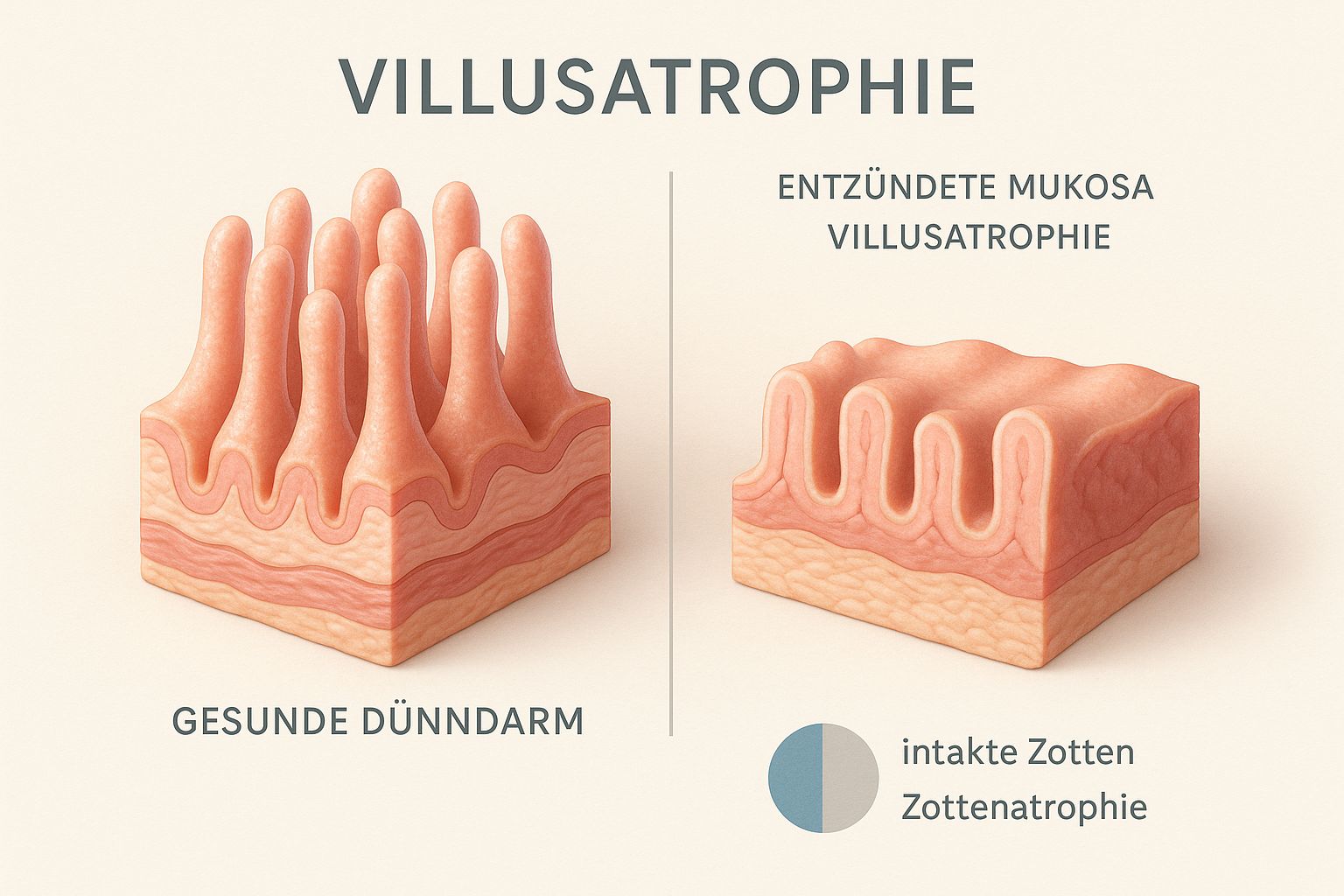
On the left, you can see the healthy, finger-shaped intestinal villi responsible for nutrient absorption. On the right, they have become completely flattened due to constant inflammation. This naturally affects your entire body.
What exactly is celiac disease?
Celiac disease is a chronic autoimmune disease. This means that the attack by your immune system is directed not only against gluten but also against your own tissue—in this case, the lining of your small intestine.
In people with celiac disease, every contact with gluten leads to chronic inflammation in the small intestine. Over time, the so-called intestinal villi recede, severely restricting nutrient absorption.
This process is also called villous atrophy. The consequences are far-reaching, because your body can no longer properly utilize vitamins, minerals, and other vital building blocks. This often leads to deficiency symptoms and symptoms that extend far beyond the abdomen. Untreated celiac disease is no trivial matter and requires a lifelong, strictly gluten-free diet.
If you would like to delve deeper into the topic, you can find more information about celiac disease and gluten intolerance in our health portal.
What Is Non-Celiac Gluten Sensitivity (NCGS)?
NCGS is quite different. Here, your “bodyguard” is also irritated by gluten, but it does not trigger an autoimmune reaction or permanent damage to the intestinal lining. People with NCGS often experience symptoms very similar to those of celiac disease, such as:
- Stomach pain and bloating
- Diarrhea or constipation
- Headaches and “brain fog”
- Chronic fatigue
The key difference: With NCGS, neither the typical celiac disease antibodies can be detected in the blood nor does damage to the intestinal villi occur. It is an intolerance reaction, not an autoimmune disease.
To give you a quick overview, we have summarized the most important differences here:
Celiac Disease vs. Non-Celiac Gluten Sensitivity at a Glance
| Characteristic | Celiac disease | Non-celiac gluten sensitivity (NCGS) |
|---|---|---|
| Type of reaction | Autoimmune disease | Intolerance reaction (sensitivity) |
| Intestinal damage | Yes, villous atrophy (shrinkage of the intestinal villi) | No, no permanent damage to the intestinal lining |
| Diagnosis | Detection of antibodies in the blood and a small-intestinal biopsy | Diagnosis of exclusion (celiac disease/wheat allergy ruled out) |
| Genetic predisposition | Strong genetic component (HLA-DQ2/DQ8) | Unknown; no clear genetic markers |
| Diet | Strictly gluten-free for life; even the smallest amounts cause harm | A gluten-reduced or gluten-free diet depending on tolerance |
This table clearly shows that although the symptoms may be similar, the conditions are fundamentally different.
This clear distinction is the first and most important step toward correctly classifying your symptoms and taking the right measures for your health.
Recognizing Your Body’s Hidden Signals

When you think of celiac disease or gluten intolerance, stomach pain, bloating, or diarrhea probably come to mind immediately. Sure, these are the classic digestive complaints. But the truth is that they are often just the tip of the iceberg.
The reality is much subtler and more complex. Your body may send signals that you would never associate with your diet. It is precisely this variety of symptoms that makes celiac disease a true chameleon among illnesses and explains why so many people affected often remain in the dark for years.
More Than Just Stomach Pain
Gastrointestinal symptoms are often present, but the list of atypical signs is long and surprising. Many of these complaints arise from chronic inflammation in the small intestine and the resulting impaired absorption of nutrients.
Imagine feeling constantly exhausted, no matter how long you sleep. This leaden fatigue is often dismissed as stress or burnout, but it can be a direct result of undiagnosed celiac disease. Your body is fighting inflammation unnoticed while also failing to get enough energy from food.
Other common but often overlooked symptoms include:
- Persistent iron deficiency: Your levels are extremely low even though you eat an iron-rich diet and may even take supplements. The reason: your damaged small intestine simply cannot absorb iron properly.
- Neurological problems: You may barely be able to concentrate, struggle to find words, or feel as though you have a constant fog in your head (Brain Fog). This can severely affect your everyday life. Many people affected report that their mental clarity returns after changing their diet.
- Joint and muscle pain: Unexplained, migrating pain that almost resembles rheumatism can also be triggered by the body’s systemic inflammatory response.
Many people live for years with vague symptoms such as fatigue or headaches without realizing that the cause lies in their gut. Celiac disease does not always show up where you would expect it.
When your skin sounds the alarm
One very specific, though rarer, sign is an intensely itchy rash known as Dermatitis Herpetiformis Duhring (DHD). This rash, with small blisters and wheals, typically appears symmetrically, often on the elbows, knees, buttocks, or scalp.
The curious thing is that almost everyone with DHD also has celiac disease—even when classic gastrointestinal symptoms are completely absent. Here, the skin reacts directly to the autoimmune processes triggered by gluten in your body.
Other skin problems, hair loss, or brittle nails may simply point to nutrient deficiencies caused by the damaged intestinal lining. It is fascinating and concerning at the same time how closely gut health and our outward appearance are linked.
Learn to interpret the signals
The range of possible signs is enormous and varies from person to person. The key is to listen to your body and recognize seemingly unrelated symptoms as a possible pattern.
Here are a few everyday examples that should make you sit up and take notice:
- You come home after a normal day at work and feel so drained as if you had run a marathon.
- Your doctor keeps finding an iron or vitamin B12 deficiency, even though your diet should actually be adequate.
- You constantly feel “detached from yourself” and find it difficult to concentrate even on simple tasks.
Recognizing these diverse symptoms is the first important step toward greater clarity. If you feel that something is wrong, get to the bottom of it. In our follow-up article, you will learn how to identify various intolerances. The aim is to increase your awareness so that you can correctly understand and take seriously the many messages your body is sending you.
Why coeliac disease develops and who should be especially careful

First of all: Coeliac disease does not simply appear out of nowhere. It is neither a matter of your lifestyle nor something you could have prevented. Rather, the development of this autoimmune disease is a complex puzzle in which several pieces must fit together perfectly.
Imagine it as a lock with three keys. Only when all three keys are in the lock and turned at the same time does the door to the disease open. If even one key is missing, the door remains closed.
These are the three “keys” to coeliac disease:
- Genetic predisposition: You must carry a specific hereditary component.
- The trigger gluten: Without gluten in your diet, the reaction cannot start in the first place.
- Additional environmental factors: Additional influences, often not yet fully understood, that ultimately cause your immune system to “tip over.”
So no one is to blame for developing coeliac disease. It is simply an unfortunate combination of circumstances that causes your body to react this way.
Understanding the role of genes
By far the most important factor is genetic predisposition. Virtually all people with coeliac disease carry certain gene variants known as the HLA-DQ2 or HLA-DQ8 genes. These genes essentially provide your immune system with the “blueprint” for receptors that mistakenly classify gluten as a dangerous invader.
But be careful: These genes alone do not make you ill. Around 30 to 40 percent of the entire European population carries one of these risk genes—but only a tiny fraction of them actually develop coeliac disease.
Having a genetic predisposition only means that the door to coeliac disease can potentially be unlocked. It does not mean that it will be. Many people live their entire lives with these genes without ever developing symptoms.
Which risk groups exist
Because genes play such a central role, celiac disease often runs in families. If close relatives are already affected, your own risk increases significantly.
The figures tell a clear story. In Germany, celiac disease is diagnosed in approximately 1 in 200 to 1 in 300 people, although the number of unreported cases is probably even higher. Among first-degree relatives—meaning the parents, siblings, or children of affected individuals—the risk of also developing it is about ten times higher. You can find more about these fascinating findings in the studies by the German Allergy and Asthma Association.
In addition to family history, there is another important risk group: people who already have another autoimmune disease. You could almost speak of a “brotherhood” of diseases. Your immune system is already dysregulated and tends to overreact elsewhere too.
People who should be particularly vigilant include:
- Type 1 diabetes: This autoimmune disease very often occurs together with celiac disease.
- Autoimmune thyroid diseases: These include Hashimoto’s thyroiditis and Graves’ disease.
- Certain chromosomal conditions: Such as Down syndrome (trisomy 21).
For these groups, it is particularly important to watch for possible symptoms and seek medical advice if there is any suspicion. This knowledge helps you better interpret your body’s signals and take proactive care of your health.
The path to a confirmed diagnosis
That vague feeling that something is wrong can be incredibly exhausting. You may question every meal, feel frustrated because you can’t interpret your body’s signals, and simply feel uncertain. That’s precisely why a clear, medically sound diagnosis is the most important key—not only to your health, but also to your peace of mind.
The path to clarity is a clearly structured process. Self-diagnosis based on Google searches is not only unreliable here, but can even be risky.
Why you shouldn’t start a gluten-free diet right away
It sounds incredibly tempting: simply stop eating gluten on your own and see what happens. But that is exactly the biggest mistake you can make before the matter has been medically evaluated. Imagine wanting to catch a burglar but clearing away all the evidence before the police arrive.
Celiac disease testing is very similar: The tests are only reliable if your body is regularly exposed to gluten.
If you already follow a gluten-free diet, the specific antibodies disappear from your blood and the inflammation in the small intestine gradually heals. The medical evidence is then simply gone, even though the disease is still present. This completely distorts the results and makes a reliable diagnosis impossible.
Your doctor will therefore ask you to eat a sufficient amount of gluten every day for several weeks before the tests are performed. This is called a gluten challenge—and it is essential for an accurate result.
The first step: blood tests for antibodies
The diagnostic process almost always begins with a simple blood draw. The laboratory looks for very specific “tell-tale signs” in your blood—the antibodies your immune system produces in response to gluten.
The most important markers being tested for are:
- Transglutaminase IgA antibodies (tTG-IgA): This is the most sensitive and specific marker for celiac disease. If the levels are elevated, this is a very strong indication.
- Endomysial IgA antibodies (EMA-IgA): This test is also highly accurate, but somewhat more complex to evaluate.
- Total IgA level: This is checked to rule out a rare IgA deficiency that could distort the results of the other tests.
A positive result on these tests is a strong indication, but not yet the final confirmation. It is the puzzle piece that justifies the next step. If you would like to know more about how such a test works, our article everything you need to know about celiac disease tests provides a detailed explanation.
Statistically speaking, this issue is particularly relevant for certain risk groups. An estimated 5 to 10 percent of people with type 1 diabetes also have celiac disease. Depending on the study, the overall prevalence in Germany is estimated at between 1 in 1,000 and 1 in 300, with a high number of unreported cases suspected. You can find more information about these figures in the statistics from the Robert Koch Institute.
The gold standard: the small-intestinal biopsy
To conclusively and unequivocally confirm the diagnosis, a tissue sample from the small intestine is necessary in most cases—a so-called small-intestinal biopsy. This may sound intimidating, but it is a brief, low-risk routine procedure performed during a gastroscopy.
You will usually receive light sedation for this, so you briefly fall asleep and feel absolutely nothing during the examination. A gastroenterologist takes tiny tissue samples from your upper small intestine, which are then examined under a microscope.
This is where the true nature of celiac disease becomes clear: The pathologist can clearly determine whether the intestinal villi are flattened or have regressed (villous atrophy). This direct view of the cellular structure is the ultimate proof and is considered the indisputable gold standard in diagnosis.
With this knowledge, you'll be well prepared to speak with your doctor as an equal and approach the path to diagnosis confidently and well informed.
Your Start to a Delicious Gluten-Free Life
The diagnosis is here—and now what? Of course, this moment may initially feel like a huge mountain to climb. But look at it this way: This change isn't the end of enjoying food; it's your greatest opportunity for a whole new level of well-being and energy.
This section is your very practical guide. For celiac disease, there is only one truly effective treatment: a lifelong, completely strict gluten-free diet. That may sound strict at first, but you'll quickly realize how much fantastic food is possible even without gluten.
Uncovering Gluten Traps at the Supermarket
Your first step takes you to the supermarket, and this is where your training as an ingredients detective begins. Gluten isn't just found in obvious foods like bread, pasta, muesli, or cake. No, it's a master of disguise and turns up in places where you would never suspect it.
Pay particular attention to these typical hiding places:
- Ready Meals and Sauces: Many sauce thickeners, instant soups, and ready meals use wheat starch or wheat flour as a base.
- Spice Blends: Gluten-containing carrier substances are sometimes used, or contamination may occur during production.
- Sausage Products and Meat Substitutes: Gluten often serves as a binding agent here, for example in meatballs or vegan schnitzels. A classic!
- Sweets and Snacks: Chocolate with cookie pieces, some gummy candies, seasoned chips, or malt extract in chocolate bars may contain gluten.
- Beverages: Malt beer and most classic types of beer are off-limits because they are brewed from barley.
This list makes it clear how important it is to always take a close look at the ingredients list when buying processed products.
Deciphering Ingredients Lists Like a Pro
From now on, the ingredients list will be your most important tool. At first, reading it may take a little longer, but don't worry—you'll quickly develop a routine. Food law is your friend here: Allergens must be clearly highlighted in the ingredients list, usually in bold, italics, or underlining.
Look specifically for these terms:
- Wheat (and everything made from it, such as wheat starch and wheat protein)
- Rye
- Barley (often disguised as barley malt extract)
- Spelt
- Green spelt
A reliable guide through the shopping jungle is the official Gluten-Free Symbol: a crossed-out ear of grain. Products bearing this seal are certified and completely safe. They are guaranteed to contain less than 20 mg of gluten per kilogram—the legally established limit.
The statement “May contain traces of gluten” is voluntary information provided by manufacturers. It does not mean that the product contains gluten; it merely legally protects the company against possible contamination during the production process. Many people affected tolerate these products well—but you need to carefully determine your own tolerance threshold.
Safe foods and delicious alternatives
Fortunately, there is a huge selection of foods that are naturally gluten-free. They will form the basis of your new diet and are incredibly versatile.
Naturally gluten-free foods are always a safe choice:
- Vegetables and fruit: All fresh and unprocessed varieties.
- Meat and fish: Plain and unbreaded.
- Eggs and dairy products: Plain yogurt, quark, cheese, and milk.
- Legumes: Lentils, beans, and chickpeas are fantastic sources of nutrients and energy.
- Nuts and seeds: Perfect as a snack or as an ingredient in muesli.
- Pseudocereals: Quinoa, amaranth, and buckwheat are brilliant alternatives.
- Other classics: Rice, corn, millet, potatoes, and sweet potatoes.
For everything else, there is now a wealth of delicious substitute products. Bread made from buckwheat flour, pasta made from lentils or corn, and rice- or almond-based cookies often match the originals in flavor.
Tips for a gluten-free kitchen
The final hurdle is so-called cross-contamination in your own kitchen. With celiac disease, even tiny crumbs can trigger a reaction. If you live in a household where foods containing gluten are also cooked and baked, clear rules are essential.
- Dedicated utensils: Get a separate cutting board, toaster, and wooden spoon that are used only for you.
- Separate storage: Store your gluten-free products in tightly sealed containers, preferably on a dedicated shelf.
- Cleanliness is everything: Thoroughly clean work surfaces, your hands, and all equipment before preparing your food.
You will see: With a little practice, a gluten-free diet will become second nature. It is a journey that allows your body to heal and shows you how incredibly varied and delicious food can be. To keep track of the success of your dietary change, it can help to monitor the condition of your gut. A gut test, such as the one offered by mybody-x, can provide valuable insights and make your progress visible.
Frequently asked questions about coeliac disease
You have already learned a lot about coeliac disease and gluten intolerance. But there are often still a few questions that come up in everyday life. That is exactly what we want to clarify here—briefly, clearly and without technical jargon. This way, you can resolve any remaining uncertainties and get started with confidence.
Can coeliac disease go away again, or is it curable?
No, coeliac disease is a chronic autoimmune disorder and, according to everything science knows today, it cannot be cured. You carry the genetic predisposition for it throughout your life.
The only effective treatment is a lifelong, absolutely strict gluten-free diet. If you follow it, the inflammation in your small intestine can heal completely and your symptoms can disappear. You may then be symptom-free, but the disease has not gone away. Even the smallest amount of gluten would immediately trigger the autoimmune reaction again.
What is the difference between coeliac disease and a wheat allergy?
Although the symptoms may sometimes be similar, the causes are fundamentally different. It is incredibly important to distinguish between the two because the dietary treatment is completely different.
- Coeliac disease: This is an autoimmune reaction. Your immune system reacts to gluten (the storage protein in wheat, spelt, rye and barley) and mistakenly attacks the lining of your own intestine. This leads to chronic inflammation.
- Wheat allergy: This is a classic immediate-type allergy. Your immune system produces IgE antibodies against various proteins in wheat—not just gluten. The reaction usually occurs very quickly after eating and can range from a skin rash and breathing difficulties to anaphylactic shock. People with a wheat allergy only need to avoid wheat, but can often tolerate other gluten-containing grains such as rye or barley.
This distinction perfectly shows why an accurate diagnosis is so important. If you want to find out how to identify different intolerances, read our guide on how to test for intolerances correctly.
How much gluten is harmful in coeliac disease?
There is no safe lower limit for celiac disease. Everyone reacts somewhat differently, but the principle is: every bit of gluten can cause harm. Even the tiniest amounts—ones a healthy person wouldn't even notice—can trigger the autoimmune reaction and damage your intestines—even if you don't experience any immediate symptoms.
That's exactly why it's so important to watch out for cross-contamination. A few crumbs from regular bread on the cutting board or a toaster used for both types of bread can already be too much.
Products may officially be labeled “gluten-free” if they contain less than 20 milligrams of gluten per kilogram. This limit is considered safe for most people affected, but it clearly demonstrates how sensitive your system is.
Is a gluten-free diet also better for healthy people?
This myth persists, but the answer is a clear no. For people without a medical reason—that is, without celiac disease, a wheat allergy, or confirmed non-celiac gluten sensitivity (NCGS)—a gluten-free diet has no proven health benefits.
Quite the opposite: it can even have disadvantages. Gluten-free substitute products often contain more sugar, fat, and additives to achieve the right taste and consistency. At the same time, they often lack the fiber, B vitamins, and other minerals found in whole-grain products. A balanced diet containing high-quality whole-grain products is a far better choice for healthy people.
How is celiac disease recorded in Germany?
To better understand celiac disease and gluten intolerance in Germany, an important step was taken in November 2019: the German Celiac Registry was established. Its aim is to collect reliable data for the first time on care, symptoms, and the needs of those affected.
The registry collects data from adults and children and is supported by experts from the Competence Network for Intestinal Diseases and the German Celiac Society. If you're interested in learning more, you can read the results in the annual report of the German Coeliac Registry (GeCer). This work helps raise awareness and establish the scientific basis for better diagnoses and treatments.
Are you ready to take control of your gut health and finally gain clarity? At mybody-x.com, you'll find scientifically backed tests that you can easily carry out at home. Discover what's really behind your symptoms and receive personalized recommendations to specifically improve your well-being.



Share now:
Your IBS diet: 6 smart steps for relief
Celiac disease test: When it’s truly worthwhile and provides clarity