
Measuring Cortisol: Your Guide to Tests & Levels 2026
You wake up in the morning and still don't feel rested. At lunchtime, you're distracted, hungry, or unfocused. In the evening, you're tired, but your mind won't shut down. It's in such phases that the same question often arises: Should I measure my cortisol?
The short answer is: sometimes yes. But only if you do it correctly. With cortisol, an inaccurate quick test won't help much because this hormone doesn't stay the same throughout the day. It's not just the value that's crucial, but the pattern. Understanding this saves a lot of guesswork and allows you to work more precisely on sleep, regeneration, nutrition, and stress levels.
Do you feel constantly tired and stressed?

Many people don't initially realize that their stress system might be out of whack. They only notice their daily routine. The alarm rings, but the body can't keep up. The morning somehow works, but in the afternoon, energy dips. In the evening, there's this strange state: exhausted, but internally on edge.
Often, subtle signals accompany this. You reach for coffee or sugar more often. You're irritable more quickly. Concentration is harder than usual. Or you feel like your body no longer reacts as stably to stress as it used to. Then the thought arises whether measuring cortisol could be useful.
When stress no longer just feels like stress
Cortisol has quickly become a catch-all term for everything related to exhaustion, sleep problems, or inner restlessness. The problem is: symptoms alone are vague. Fatigue can mean many things. Poor sleep too. A feeling doesn't tell you whether your daily rhythm is actually shifted.
That's precisely why measuring is often the better next step than constant interpretation. While others remain in trial-and-error mode, many have long been looking at their values more precisely and then optimizing more accurately. If you want to better understand typical complaints in women, you can find a good overview at Cortisol too high symptoms in women.
Practical thought: Symptoms are a starting signal. Clarity only comes when you combine them with a clean measurement method.
How to know when measuring can be useful
Not every stressful week requires a test. It becomes more useful when a pattern emerges:
- You struggle to get going in the morning: Despite enough time in bed, you feel like you haven't started up.
- You're erratic during the day: Sometimes tense, sometimes tired, often without a clear trigger.
- You can't relax in the evening: Your body is done, your mind isn't.
- You want to optimize specifically: Not just "do something for stress," but know where you should start.
Anyone who wants to understand their body is already on the right track with this thought. Not out of panic. But out of self-responsibility.
Understanding Cortisol Your internal pacemaker
Cortisol controls a large part of your daily rhythm. It helps you activate in the morning, keeps energy available, and influences how awake, resilient, or capable of recovery you feel throughout the day. For practical purposes, therefore, the isolated question of whether cortisol is "high" or "low" is less interesting. What is crucial is whether your rhythm matches your daily life or has gone out of sync.
This is precisely the difference between pure diagnostics and meaningful self-observation. Anyone who wants to specifically improve their stress axis does not just look at a single laboratory value, but at a pattern. This is often the point at which home tests become truly useful. Not as guesswork, but as a basis for concrete adjustments to sleep, stress, training, and recovery.
Cortisol normally follows a clear daily dynamic. After waking up, the level is higher. During the day, it gradually decreases. In the evening, the activation should be significantly lower so that regeneration can occur at all.
If this profile is shifted, you often feel it in everyday life. Typical patterns are a sluggish start in the morning, a slump in the afternoon, or a mind that doesn't calm down in the evening, even though the body has long been tired.
Why a single value often says too little
A single measured value can be correct and still explain little. I see this again and again in practice. Anyone who measures only once gets a snapshot. For fine-tuning lifestyle, this is often not enough.
Cortisol becomes more meaningful only in connection with the time of measurement and your symptoms. Two people can feel similarly exhausted and yet have a completely different cortisol profile. One person doesn't get up properly in the morning. The other is functional during the day but remains in too high an activation in the evening. Both require a different interpretation and usually also a different lever in everyday life.
What often shifts the rhythm
Not only acute stress disrupts cortisol. Often, it is recurring patterns that become ingrained over weeks:
- Poor sleep: Especially when falling asleep, staying asleep, and true recovery no longer come together.
- Constant tension: Less about the individual stressful day, but a nervous system that hardly switches into resting phases anymore.
- Unsuitable routines: Late intensive workouts, irregular meals, too much caffeine at the wrong time, or a lack of recovery breaks.
- Too much trial and error: Those who constantly tinker with diet, supplements, and training without measuring often produce even more unrest instead of clarity.
Cortisol is therefore rarely simply "too much" or "too little." In many cases, it is primarily the course that is shifted.
If you have understood this basic principle, you will use measurements much more intelligently. Then you are not looking for a single problem value, but for a biological pattern that can be specifically improved. You can find a clear basis for this in the article What is cortisol and what role does it play in everyday life.
Blood, saliva, or urine: Choosing the right measurement method
Many people measure cortisol once and hope for a clear answer. In practice, clarity only arises when the method matches the question.

If you only want to know if there's enough activation in the morning, you need something different than someone who wants to understand their daily rhythm or specifically improve their stress axis in everyday life. That's precisely why choosing the right measurement method is worthwhile. It determines whether you get a useful snapshot or a pattern you can truly work with.
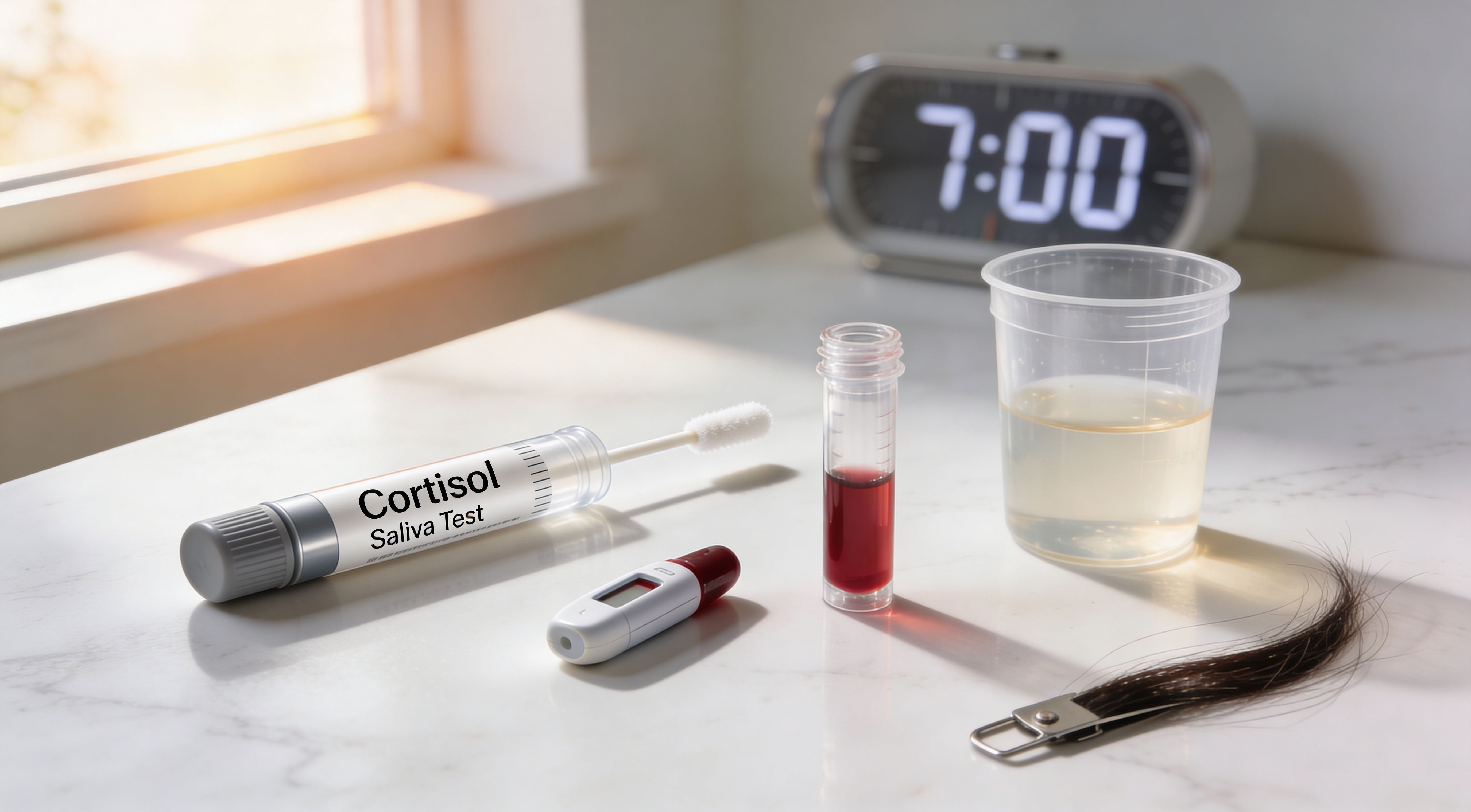
Four ways compared
| Method | What is measured? | Ideal for | Advantages | Disadvantages |
|---|---|---|---|---|
| Blood serum | Free and bound cortisol | Classic snapshot, especially in the morning | Well-established, widely used medically | Stress-prone, invasive, shows only one point in time |
| Saliva | Free, active cortisol | Daily profile and course of the stress axis | Easy to implement at home, possible multiple times a day | Clean timing and precise instructions necessary |
| 24-hour pooled urine | Excretion of free cortisol throughout the day | Certain diagnostic questions | Shows total daily excretion | Complex to perform, prone to errors |
| Hair analysis | Long-term stress over weeks to months | Retrospective view of longer periods | Can depict long-term trends | Limited helpfulness for concrete daily management |
Which method is suitable for what purpose?
Blood works well when classical laboratory diagnostics are in the foreground or a single reference point is needed. The disadvantage lies in the setting. Even the trip to get blood drawn, waiting in a busy practice, or anxiety before the needle can influence the value. Therefore, blood is often too coarse for fine-tuning sleep, training, caffeine, or recovery.
Saliva is more practical for many everyday situations. Free cortisol is measured, meaning the portion that is directly biologically available. This is particularly useful if you not only want to know whether cortisol is present but how your rhythm actually progresses throughout the day. For lab-certified home tests, this is usually the most practical method when the goal is not just diagnosis, but targeted optimization.
24-hour urine can be useful when the total excretion over a day is relevant. However, the method requires discipline. Even small errors in collection can make the result significantly less useful. In everyday life, I often see: well-intentioned, but unnecessarily complicated when a daily profile in saliva would actually provide a better answer.
Hair analyses sound attractive because they promise a long-term perspective. However, for the question of why you don't get going in the morning or can't wind down in the evening, they are significantly less helpful than several precisely timed samples over one or more days.
My practical selection guide
For more energy, better sleep, and a more controllable stress rhythm, saliva is often the best choice. You get a progression pattern that can be directly linked to your daily life. This is precisely what leads to meaningful adjustments in sleep times, training intensity, eating rhythm, or stimulants.
For basic medical diagnostics or a single control value, blood is often suitable.
For special medical questions regarding daily excretion, urine may be considered.
The best method is therefore not the most technically complex one, but the one that accurately answers your actual question. Anyone who wants to proactively improve their stress axis usually doesn't need an isolated laboratory event, but data that can be used in real life.
The key to precision: The right timing of your measurement
You wake up, have been in bed long enough, and still feel foggy. In the evening, the opposite happens. Your body is tired, your mind stays awake. In such cases, it's often not the individual cortisol value that matters, but the correct measurement time.

Why timing determines validity
Cortisol follows a daily rhythm. In the morning, the level should rise significantly to activate circulation, attention, and energy. Over the course of the day, it gradually decreases. In the evening, this value should be clearly lower than in the morning.
That's why I never evaluate cortisol in isolation from the time of day. A value at 7 AM can be completely normal, and the same value at 11 PM can indicate that the stress axis is not regulating down properly.
For practical optimization at home, this is precisely the benefit of a well-planned daily profile. You don't get an abstract number, but a pattern that fits your real daily life.
The morning is the most sensitive measurement point
The first sample after waking up is often the most important. It shows whether your system starts up at all in the morning. If you take this sample too late, you quickly lose the most informative part of the profile.
In practice, I repeatedly see the same mistake. People get up, go to the bathroom, turn on the light, maybe have coffee or brush their teeth, and then measure. This shifts the biological moment you actually want to capture.
If you want to know why you struggle to get going in the morning, every minute counts. The sample therefore belongs right at the start of the day, not at some point during the first free slot.
What I pay attention to during evaluation
A good test is particularly helpful when the daily pattern becomes recognizable:
- Clearly higher in the morning, significantly lower in the evening: This is more consistent with a stable rhythm.
- Too flat in the morning: I often see this in people who don't feel truly rested despite sleeping.
- Still elevated in the evening: This often correlates with inner restlessness, a late feeling of wakefulness, or difficulty falling asleep.
- Strong fluctuations without a clear pattern: This makes it difficult to make targeted adjustments to sleep, training, caffeine, or meal times.
This is precisely the difference between pure diagnostics and true fine-tuning. Anyone who wants to improve their stress axis needs measurement points that make the daily progression visible.
Typical timing errors that invalidate results
Even small deviations can make a profile difficult to interpret. A delayed morning value can miss the natural rise. An evening sample taken after exercise, alcohol, a large meal, or a hectic appointment often reflects the situation rather than the actual rhythm.
Therefore, a simple rule applies in my work. First, carefully plan the daily routine for the measurement, then take the test. Precision is not created in the lab alone, but in the minutes when you take the sample.
This is how easy your at-home cortisol test works
A good home test fits into a normal day. That's what makes it so useful for fine-tuning your stress axis. You don't measure under clinic stress, but in your real rhythm. If the collection is carefully prepared, you get values that allow you to adjust sleep, caffeine, training, and recovery phases much more precisely.

How a saliva test at home actually works
In practice, the process is straightforward. Diligence makes all the difference.
-
Test on as normal a day as possible
Acute infections, fever, or unusual stress can distort the profile. For an assessment close to everyday life, a day that closely matches your usual routine counts. -
Take the morning sample immediately after waking up
Don't go to the bathroom first, don't walk around yet, don't start your day casually. Especially the first sample often determines whether the daily profile will be meaningfully readable later. -
Keep your mouth neutral beforehand
Do not eat anything, drink anything except water, and do not brush your teeth directly before the collection. This seems inconspicuous but quickly changes the sample quality. -
Collect several samples at the specified times
A single value only shows one moment. Multiple time points show the progression. This is exactly what you need if you are not just looking for illness but want to understand why you struggle to get going in the morning or can't wind down in the evening. -
Document and send the samples cleanly
Labeling, times, and storage must be correct. This sounds trivial but is one of the points where I most frequently see unnecessary uncertainty in the evaluation.
These errors quickly make a good test unusable
Typical problems almost never arise in the lab, but in the minutes before collection, as the overview on measuring salivary cortisol correctly at home describes.
- The first sample is taken late
- Food is eaten, coffee is drunk, or toothpaste is used beforehand
- Times are only vaguely remembered instead of precisely noted
- Samples are collected between appointments and under time pressure
My practical advice is simple. Lay out everything the night before, set reminders for each sample, and don't overschedule your test day. A home test is easy to do, but only truly helpful if the collection is disciplined.
What a clean home test specifically brings you
The great advantage is not just comfort. You get a picture of your cortisol progression in your normal environment. This is often significantly more useful for lifestyle optimization than a single snapshot under clinical conditions.
With a good profile, you can more specifically check whether late training, restless sleep, too much caffeine, or constant tension fit your pattern. If your progression is unusual, measures can then be selected much more precisely, for example, strategies to naturally lower cortisol and stabilize your daily rhythm.
For me, this is exactly the practical value of a lab-certified home test. It doesn't provide a vague guess, but a usable basis for concrete decisions in everyday life.
Your result is here, now what?
Your result should give you direction. For practical purposes, one question is most important: Does your cortisol curve match your complaints and your daily life, or do you need a medical assessment?
A single value has limited informative value. Cortisol reacts sensitively to time of day, sleep, acute stress, and physical exertion shortly before collection. Therefore, I never evaluate results in isolation, but always together with the daily profile, your symptoms, and the test procedure.
High value, low value, flat curve
With home tests, it's usually not just interesting whether a value is high or low. The pattern throughout the day is more important.
- Significantly higher in the morning, clearly lower in the evening: This rather indicates a clearly recognizable day-night rhythm.
- Noticeably flat in the morning: This often matches the feeling of struggling to get going in the morning.
- Too high in the evening: I often see this in people who are still under tension late, struggle to switch off, or have restless sleep.
- Little change throughout the day: Then the clean interaction between activation during the day and recovery in the evening is often missing.
This is exactly where a lab-certified home test becomes useful for lifestyle optimization. It not only shows if something is abnormal but also at what point in your daily rhythm you can start making changes.
What you can concretely do with the result
An unusual curve is not a signal for activism. It is a work order for your everyday life.
With elevated evening values, first check the obvious influencing factors: late intensive training, a lot of screen light, alcohol, irregular meals, late caffeine, or constant mental stress. With a weak morning response, I first look at sleep quality, wake-up time, recovery, and whether the body is getting too little real rest for weeks.
Then comes the practical part. Don't change everything at once. Choose two to three levers that are realistically implementable and consistently observe them for a few weeks. Good starting points are fixed sleep times, calm evening routines, better-managed training stimuli, and a clearer approach to caffeine. If your profile fits, you will find concrete approaches here to naturally lower cortisol and stabilize your daily rhythm.
When you shouldn't just optimize
Some findings require medical clarification. This applies to significantly abnormal results, repeatedly implausible progressions, or symptoms that are more severe than your daily life alone would explain.
These include, for example, persistent severe exhaustion, pronounced sleep disturbances, circulatory problems, or a symptom complex that remains the same despite better sleep, less stress, and proper timing. In such cases, the test still helps. You no longer go into the clarification with a vague feeling, but with a concrete data basis.
Thus, a result becomes a sensible next step. Either for a targeted fine-tuning of your lifestyle or for medical clarification if your pattern suggests more than just everyday stress.
Reliable answer only with a certified test
Self-observation is valuable. But it remains limited. Fatigue, nervousness, sleep problems, or a feeling of overload tell you that something is wrong. They don't reliably tell you how your cortisol rhythm actually looks.
This is precisely why a certified laboratory test often saves time. You lose less energy on assumptions and get a more reliable basis for the next steps. This is particularly relevant because, according to a 2025 DGE survey, 68% of affected individuals resort to self-tests due to long waiting times for doctor's appointments. Certified providers like mybody®x achieve a measurement accuracy of over 95% in ISO-certified German laboratories compared to medical measurements, summarized in the article on Cortisol, self-tests, and waiting times.
Self-assessment only helps up to a point
You can ask yourself:
- Am I regularly exhausted in the morning?
- Am I often tense and drained at the same time during the day?
- Do I struggle to relax in the evening?
- Do I finally want to know if my feelings match my values?
These questions are useful. But they don't replace a measurement. Especially for those who actively want to improve their energy, regeneration, and resilience, data usually gets them further faster than gut feeling alone.
Symptoms point the way. A certified test makes the path more precise.
If you recognize yourself in typical patterns of hormonal imbalance, you will find additional guidance on hormonal imbalance symptoms.
Ultimately, it's not about talking yourself into being sick. It's about understanding your body better. You are already on the right track. A short, cleanly evaluated test just makes it clearer.
If you no longer want to guess, but are looking for a reliable basis for your next steps, a lab-certified mybody x blood test is the direct path to more clarity. For a broad health check, you will find suitable options with the Women's Health Test and the Men's Health Test. If you also want to check whether hidden deficiencies are hindering your energy and regeneration, take a look at the Nutrient Deficiency Tests. This way, you save yourself trial and error and optimize specifically, evidence-based, and comfortably from home.
Share:
Allergy test at home: Finally clarity on symptoms
Understanding and Addressing Progesterone Deficiency