

Hormone levels: When is a test really worthwhile for you?
Do you often feel sluggish, gain weight for no apparent reason, or find your mood all over the place? Many people quickly blame such problems on everyday stress. But often it is our hormones pulling the strings in the background and regulating our well-being.
You should pay particular attention if you suffer from persistent symptoms that simply cannot be explained—such as sleep problems, lack of energy, or skin problems. This is especially true if you are going through a typical phase of hormonal change, for example in your mid-30s or during perimenopause.
When checking your hormone levels really makes sense
You may know the feeling: You pay attention to your diet, exercise, but something just does not feel right. Instead of feeling full of energy, you are often exhausted, your concentration fluctuates, and your skin seems to have a mind of its own.
These nonspecific symptoms are quickly dismissed as normal side effects of a stressful life. But your body may be trying to tell you something important.
Checking your hormone levels is therefore an active step toward regaining control over your well-being. It is about not simply accepting symptoms, but finding their cause. A hormonal imbalance can manifest in countless ways and certainly does not affect only women going through menopause. A hormone test from mybody®x gives you clarity and shows you where to start.
Typical signs that you should get your hormones checked
The signals your body sends are often subtle, but all the more persistent. If you recognize several of the following signs in yourself, it may be time to take a closer look at your hormones.
Often, it is not individual symptoms but the combination of several that points to an underlying hormonal issue. The following table gives you a quick overview of which symptoms may be a good reason to get tested.
| Symptom or sign | Possible hormonal cause | Why a test makes sense now |
|---|---|---|
| Persistent fatigue | Cortisol imbalance, underactive thyroid | A test can clarify whether your stress hormone or thyroid is out of balance. |
| Unexplained weight gain | Insulin resistance, estrogen dominance, low testosterone | Instead of trying more diets, a test shows whether your metabolism is being slowed down by hormones. |
| Mood swings, irritability | Fluctuations in estrogen & progesterone | Gives you clarity on whether your emotional roller coaster has a physical cause. |
| Skin problems (e.g., acne) | Elevated androgens (male hormones) | Helps find the root of the problem instead of merely treating symptoms with creams. |
| Sleep disorders | Low progesterone, high cortisol levels in the evening | A test can reveal why you cannot relax and enable targeted measures. |
| Hair loss | Thyroid problems, DHEA deficiency | Provides useful clues before the problem becomes chronic. |
| Loss of libido | Low testosterone or estrogen | A hormone check can reveal the often-overlooked biological component. |
This list is, of course, only a guide. If several of these points apply to you, it is a strong indication that your hormones could be playing a role.
This simple decision tree summarizes when a hormone test—such as the one from mybody®x—is the logical next step.
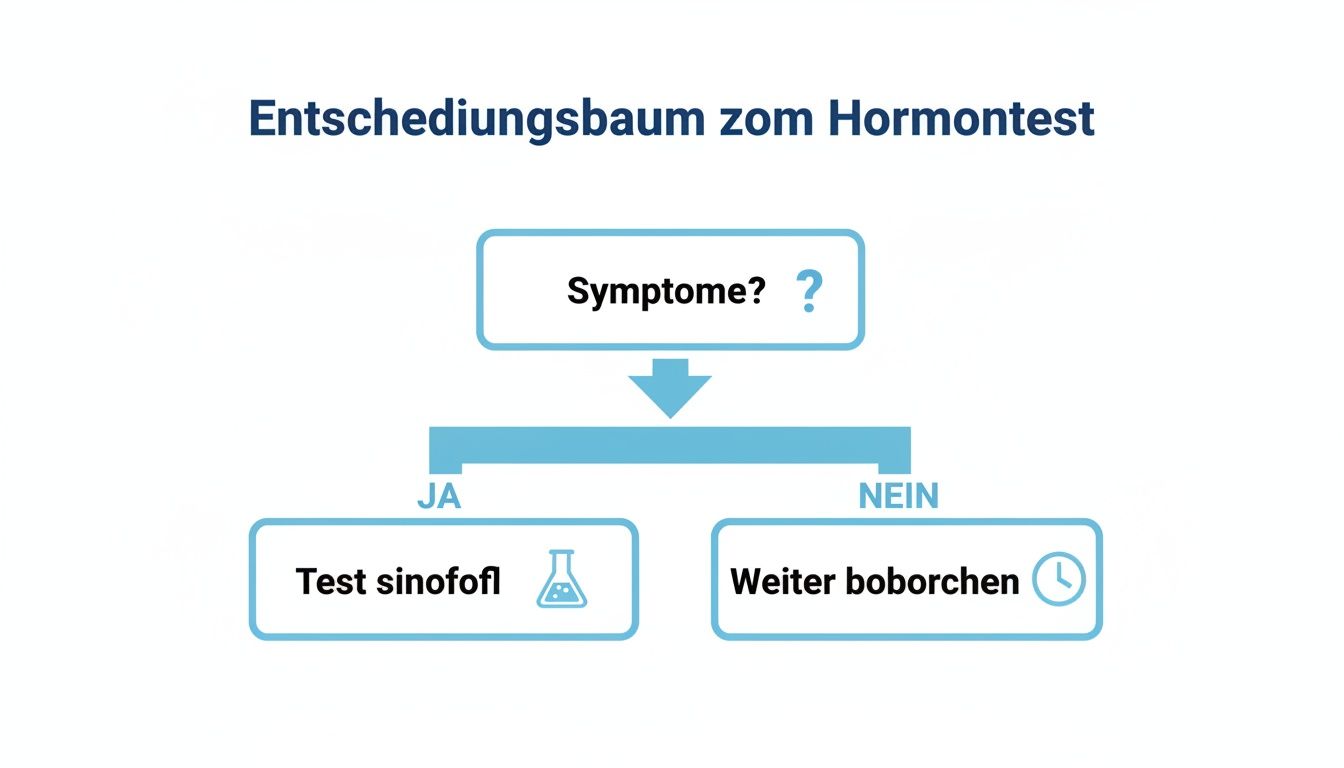
The graphic makes it clear: If you have specific symptoms, a test provides valuable data instead of leaving you groping in the dark.
Instead of guessing what is behind your symptoms, a hormone test gives you clear, measurable facts. It is the difference between speculation and knowledge—and the first step toward targeted improvements.
Acting early means not waiting until the symptoms become entrenched and dictate your everyday life. A test helps you understand the connections and reset the course toward a better quality of life.
Would you like to dive deeper into the topic? Learn more about determining your hormone status in our in-depth guide.
Understanding your inner orchestra—how hormones control everything
Imagine your body as a large, perfectly synchronized orchestra. Each hormone is its own instrument with a very specific role—from the deep bass of testosterone to the gentle melody of estrogen.
When all the instruments are in harmony, a beautiful symphony emerges: your well-being. You feel full of energy, sleep deeply and soundly, and your mood is stable.
But if even a single instrument falls out of rhythm, the entire concert can start to falter. The melody suddenly sounds off. That is exactly what happens with a hormonal imbalance. Just one small “troublemaker” is enough to have major effects on your entire body.

The key players in your hormonal well-being
To understand when a hormone test is useful, we need to get to know the key musicians in your orchestra. Four hormones often play the leading roles in your everyday life:
-
Estrogen: This hormone is essentially the conductor of your cycle, skin elasticity, and mood. If estrogen levels are out of balance, this can manifest as irregular cycles, dry skin, or water retention.
-
Progesterone: You could call it the “calming hormone.” It promotes restful sleep and emotional stability. A progesterone deficiency often leads to sleep disturbances, inner restlessness, and typical premenstrual symptoms (PMS).
-
Testosterone: Although it is known as a male hormone, it is also essential for women. It gives you energy and drive and influences your libido. If you often feel listless or notice a decline in muscle strength, there may be an imbalance here.
-
Cortisol: This is your stress hormone—the drummer of the orchestra. In dangerous situations, it gives you an important boost of energy. However, if cortisol levels remain chronically elevated, they throw the entire system off balance and can lead to exhaustion, weight gain, and a weakened immune system.
However, these hormones do not work alone; they influence one another in a complex interplay. For example, persistently elevated cortisol levels can inhibit progesterone production. This explains why you often sleep worse or your cycle becomes irregular during stressful periods.
A hormone status test is like looking at the score of your inner orchestra. It shows you which instrument is out of tune, allowing you to take targeted action before the entire symphony falls out of rhythm.
A test like the one from mybody®x helps you identify precisely this “troublemaker.” Instead of groping in the dark and treating symptoms only superficially, you gain a clear data basis. With this knowledge, you can understand the connections in your body much better and take targeted steps to restore your inner harmony.
When a hormone check is particularly informative
Your hormonal system is not a rigid clockwork mechanism. It is a living, dynamic system that continually adjusts to the different phases of your life. Some of these transitions are so significant that taking a closer look at your hormone levels can be extremely valuable.
These phases are completely natural processes, but they can be accompanied by symptoms that seriously disrupt your well-being. When you understand what is happening in your body, you can take control instead of simply enduring the discomfort.
Perimenopause—when hormones begin to whisper
Long before your last period begins, a phase starts that many women do not have on their radar at all: perimenopause. It can begin as early as your mid-30s and is the period when the first, often very subtle, hormonal shifts occur. Usually, progesterone is the first to begin declining, while estrogen remains stable or dances up and down.
You may recognize yourself here:
- Your cycle becomes unpredictable: Your period suddenly arrives a few days early, or the intervals become more irregular.
- PMS hits harder: Before your period, you feel more irritable, emotional, or simply “out of sorts”—and more so than before.
- Sleep becomes more restless: Especially during the second half of your cycle, you find it harder to sleep through the night and wake up more often.
- Unexplained weight gain: Even though you have not changed your lifestyle, you suddenly start accumulating more fat, especially around your abdomen.
A hormone profile can act like a compass here. It shows you early on whether these changes really have hormonal causes. With a test from mybody®x, you can support these initial suspicions with solid data and take targeted action.
Menopause and the years that follow
Menopause, also known as the climacteric, is probably the best-known period of hormonal change. Estrogen and progesterone now decline permanently, which can trigger classic symptoms such as hot flashes, night sweats, and mood swings.
It often starts with sleep disturbances or a feeling of constant exhaustion—typical signs of estrogen deficiency. If you would like to explore the topic in more depth, read more here about hormonal changes during menopause.
A hormone check during menopause is not merely a reaction to problems. It is a powerful tool that helps you take proactive action. It gives you the facts you need to make informed decisions about your health and shape your quality of life on your own terms.
Other pivotal moments in life
Besides menopause, there are other situations in which checking your hormone levels can provide clarity:
- After pregnancy: The hormonal roller coaster after giving birth is real. It can lead to profound exhaustion or the dreaded “baby blues.” A test can help you see whether your levels are settling back down or whether you need support.
- For difficulty conceiving: A harmonious interplay of hormones such as estrogen and progesterone is the foundation for fertility. A hormone profile can provide crucial pieces of the puzzle here.
- For chronic stress: Constant stress is toxic to your hormones. It raises your cortisol levels, which in turn can throw other important hormones, such as progesterone, out of balance. A test reveals these hidden connections.
Blood, saliva, or urine – which testing method is right for you?
Have you decided to check your hormone status? Great! Now you face the next question: blood, saliva, or urine? Each method has its strengths and is better suited to certain hormones. Think of it like a toolbox—there is a suitable instrument for every task.
To shed some light on the subject, let’s take a closer look at the differences. After all, choosing the right method is ultimately crucial to how meaningful your result really is.
Blood test – the gold standard for many values
The blood test is the classic and an absolutely reliable method. It measures the total concentration of hormones in the blood—both the freely available (active) hormones and the protein-bound (inactive) hormones.
You can think of it like a taxi system in the body: The bound hormones are essentially sitting in a taxi, on their way somewhere but not yet at their destination. Only the free hormones have already gotten out and can do their work on your cells. A conventional blood test simply counts both those still in the taxi and those who have already gotten out.
For thyroid hormones such as TSH, T3, T4, or follicle-stimulating hormone (FSH), a blood test provides precise, long-established results.
Saliva test – a look at the active hormones
The saliva test has one crucial advantage: It measures almost exclusively the free, biologically active hormones—the ones that actually attach to your cells and have an effect. It shows you what is really happening at the “front line.”
This method is particularly informative for sex hormones such as estrogen, progesterone, and testosterone. Because a blood test also counts the inactive, “bound” components, the result can sometimes distort the true picture slightly.
A saliva test is like a look behind the scenes. It shows not only how many hormones are present overall, but above all how many of them are actually available for use. This often makes it the more precise choice for analyzing sex hormones.
Urine test – measurement over an extended period
The urine test, often performed as a 24-hour urine collection, measures hormone breakdown products. This gives you an average value over an entire day, capturing daily fluctuations particularly well. This is especially useful for assessing the progression of stress hormones such as cortisol, for example. If you would like to learn more about how to measure cortisol levels, you can find further information with us.
To give you a quick overview, we have compared the methods here:
Comparison of hormone testing methods
An overview of the most common methods for determining hormone status, along with their advantages and disadvantages.
| Test method | What is measured? | Advantages | Ideal for |
|---|---|---|---|
| Blood test | Total hormone concentration (bound & free) | Established standard, high precision, validated for many hormones. | Thyroid hormones (TSH, T3, T4), FSH, LH, total testosterone. |
| Saliva test | Free, biologically active hormones | Non-invasive, painless, measures the directly active hormones. | Sex hormones (estrogen, progesterone), daily cortisol profile. |
| Urine test | Hormone breakdown products (metabolites) | Provides an average value over a longer period (e.g., 24 hours). | Daily cortisol profile, certain sex hormone metabolites. |
So every method has its place. The choice depends entirely on what exactly you want to find out.
For your mybody®x home test, we use a fingertip blood test. This modern method combines the precision of a blood test with the convenience you want at home. This allows you to reliably measure many important hormones and gives you a solid basis for deciding what to do next—all from the comfort of your home.
How your at-home hormone test works
The idea of checking your hormone status from the comfort of your home sounds great at first. But how does it work in practice? Don’t worry, the process with a mybody®x test kit is really straightforward and designed so that you can easily fit it into your daily routine. We’ll guide you through it step by step.
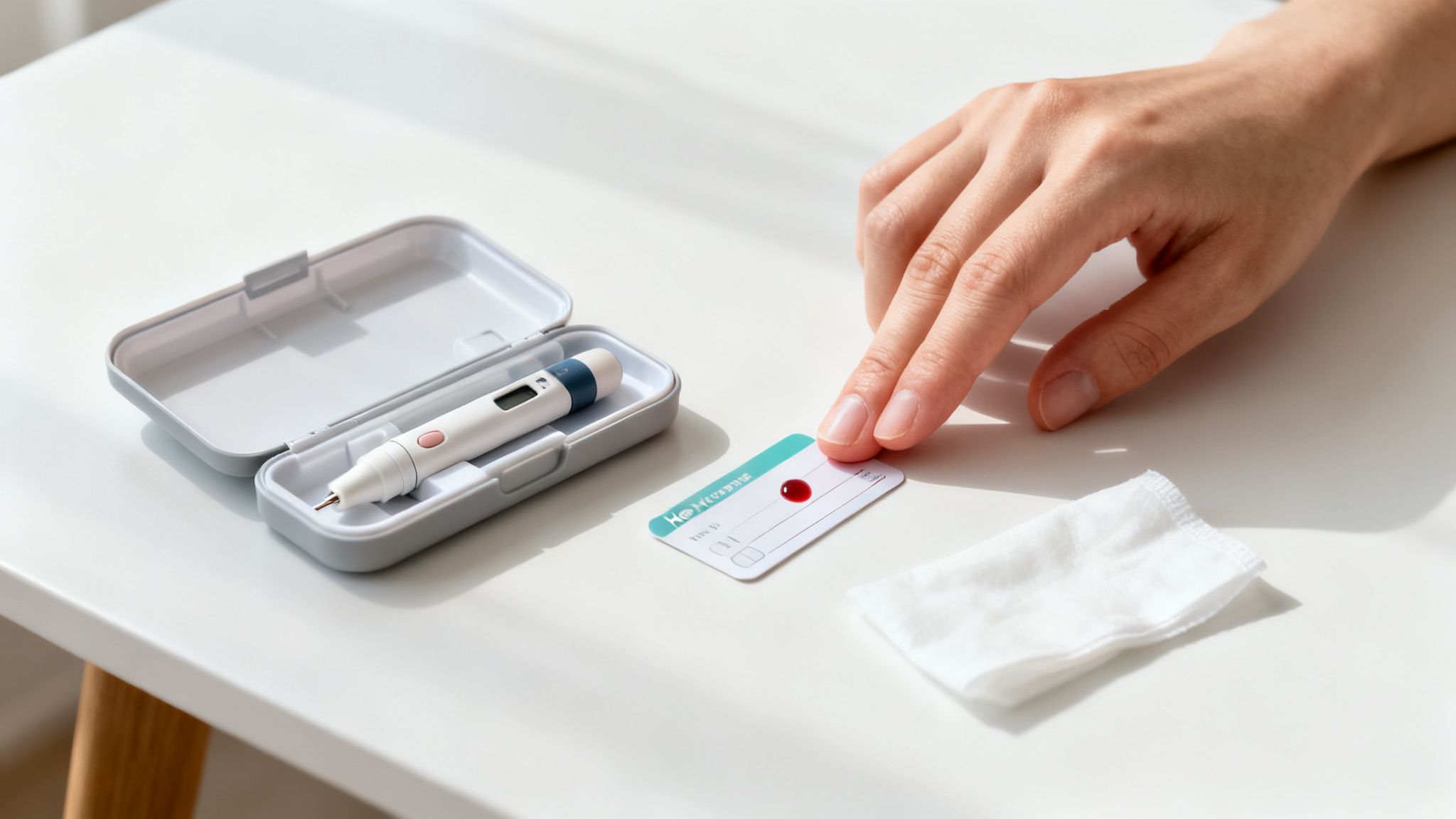
The entire process is designed to give you maximum control with minimal effort. You receive a complete kit with everything you need: from the lancet for a tiny, almost painless prick in your fingertip to the sample tube.
Your path to clear results
So you know exactly what to expect, we have divided the process into a few simple steps:
- Order your test kit and get started: Your mybody®x test kit comes directly to your home.
- Collect your sample—easy as that: Using the enclosed, child-friendly instructions, you collect a few drops of blood from your fingertip yourself. It only takes a few minutes.
- Off to the post: You safely package your sample in the prepaid return envelope and send it to our certified partner laboratory in Germany.
- Professional analysis: Your sample is examined here according to the highest quality standards.
- Your results report—finally, clarity: You’ll receive your personal report digitally after just a few days. Clear, easy to understand, and completely free of medical jargon.
Naturally, protecting your data is our top priority and is handled in accordance with the strictest GDPR standards.
Timing is everything
To obtain truly meaningful results, the timing of sample collection is crucial. Hormones are not static values; they dance to the rhythm of your cycle and the time of day. That’s why every mybody®x test includes detailed instructions explaining when the perfect time is to collect your sample. This is the only way we can correctly interpret the results for you later.
For health-conscious people who value vitality and a long, active life, a test like this is incredibly valuable. With mybody®x, you simply collect a blood sample at home and receive results for hormones such as estrogen and progesterone, as well as important nutrients. Imagine finally finding out whether your poor sleep or constant mood swings are hormonally related—and getting helpful tips right away.
An at-home test takes away the uncertainty and puts you back in control. It’s the simple first step from mere guesswork to concrete knowledge—and to taking your health into your own hands.
This method is ideal if you’re wondering when a hormone status test makes sense but want to avoid the hassle of making a doctor’s appointment for now. If you want to dive even deeper into the topic, read our detailed article on at-home hormone testing.
What your hormone results really mean
You finally have the results report for your mybody®x test in your hands—great! But instead of simple answers, you may now be staring at a page full of numbers, charts, and technical terms. That can feel overwhelming at first, but don’t worry: we’ll go through it step by step together.
Your results report is essentially a map of your hormonal system. It shows you exactly where you currently stand. The most important element is the reference ranges. These are simply the ranges in which hormone levels in healthy people typically fall. If a value is outside this range, it may be an initial indication of an imbalance.
More than just individual numbers
But here’s the crucial point: A single value often doesn’t tell you much. Hormones are team players; it’s always about the bigger picture. Think of it like a puzzle—only when you put the pieces together correctly can you see the complete picture.
The relationship between certain hormones is particularly important. A classic example is the estradiol-to-progesterone ratio. Your progesterone level may be perfectly normal on its own. But if your estradiol is much too high in relation to it, you may still experience the typical symptoms of estrogen dominance, such as water retention or nasty mood swings.
Your hormone results are not a verdict but a tool. They do not provide a diagnosis, but give you valuable data to understand the cause of your symptoms and take the right next steps.
From results to concrete action
The mybody®x results report doesn’t leave you alone with the numbers. It translates your lab results into clear language and gives you specific, personalized recommendations for action. They are your personal roadmap back to balance.
Based on your individual profile, you’ll receive targeted tips on how to actively improve your well-being. These recommendations can cover many different areas of your daily life:
-
Nutrition: You’ll learn which foods specifically support your hormone production. This might include advice to eat more cruciferous vegetables to support estrogen metabolism, or a reminder that healthy fats are important building blocks for your hormones.
-
Nutrients: The results can reveal whether a deficiency in certain vitamins or minerals may be contributing to your imbalance. Targeted recommendations for micronutrients such as magnesium for stress regulation or vitamin B6 to support progesterone production can make a huge difference.
-
Lifestyle: Often, even small adjustments to your daily routine can have a big impact. These include tips for better stress management to lower your cortisol levels, or advice for more restful sleep.
This turns your hormone status from an abstract set of numbers into a practical guide. It shows you not only when checking your hormone levels makes sense – namely right now, so you can finally gain clarity – but also how to put these new insights into practice in your everyday life. You regain control and can take targeted action to increase your energy and well-being.
Your questions, our answers about hormone levels
Do you still have a few questions before you get started? No problem. Here you’ll find the answers so you can begin your test with confidence.
Do I need to fast for a hormone test?
It depends entirely on the test. For many blood tests, it is actually best to take them in the morning on an empty stomach. Why? Because what you eat or drink, as well as the time of day, can affect your levels.
With the mybody®x tests, we make it easy for you: Every kit includes simple, easy-to-follow instructions. They tell you exactly what to do so that your results are truly meaningful.
How often should you have your hormone levels checked?
A first test is always a good idea when you notice that certain symptoms simply won’t go away and are interfering with your everyday life.
If it reveals an imbalance and you start taking action, a follow-up measurement after three to six months makes perfect sense. This lets you see in black and white whether your efforts are paying off. Otherwise, checking in once a year is often enough – especially during phases of life when hormones are on a roller coaster anyway, such as perimenopause.
Does a mybody®x home test replace a visit to the doctor?
A home test is a fantastic tool for taking control of your health and taking preventive action. It gives you valuable insights into your body and specific tips on what you can do better in your everyday life.
A test like ours provides valuable information, but it does not constitute a medical diagnosis. If you have severe symptoms or your levels are significantly outside the normal range, the next step should always be to see a doctor or therapist. Only they can make a final diagnosis and initiate the right treatment.
Are you ready to take control and find out what’s behind your discomfort? Discover the hormone tests from mybody®x now and start your journey toward greater clarity and well-being. Get the answers you deserve – conveniently from home.



Share now:
Nutrient deficiency symptoms – recognize them early, take targeted action
What Are Hormone Levels? Effects on Health and Well-Being