
Comprehensive allergy test: Your path to clarity & well-being
You pay attention to your diet. You may already be trying to find out whether less milk, no wheat, or avoiding certain fruits makes a difference. Yet the questions remain. Why is your stomach sensitive on some days, why does your skin suddenly itch, and why does your nose go haywire even though you eat “a healthy diet”?
This is exactly when many people start looking for a comprehensive allergy test. Not because they are exaggerating, but because constantly trying to figure things out is exhausting. If you manage your symptoms only through elimination, internet lists, and guesswork, it costs you time, energy, and often quality of life. A precise blood test can make this process much clearer.
Constant symptoms? You are on the right path to finding an answer
Maybe you recognize this pattern. In the morning, your stomach is bloated; in the afternoon, your throat feels scratchy; in the evening, your skin feels tight. One day, it seems to be tomatoes; the next, bread; then pollen or the cat at a friend's house. You observe a lot, but the connection remains unclear.

This is not a sign that you are “making a fuss.” Rather, it shows how difficult allergies and intolerances can really be in everyday life. Many people start with trial and error. They eliminate foods, try apps, read forums, and hope to find a pattern.
When symptoms don't fit together neatly
It becomes especially confusing when several things happen at once:
- Digestive and skin symptoms occur together
- Symptoms become stronger seasonally
- Certain foods only sometimes cause problems
- Stress or lack of sleep make everything seem worse
Then your body can feel unpredictable. That is exactly why your desire for clarity makes sense.
In Germany, this issue is far from rare. According to the Robert Koch Institute's DEGS1 evaluation, 30.0% of adults reported having been diagnosed with at least one allergy. Women were affected more often, at 35.8%, than men, at 24.1%. So you are not alone with these questions.
Many symptoms seem like “something to do with food,” even though they can have very different underlying causes.
Why trial and error often isn't enough
Self-observation is helpful. But it has limits. If you change too many things at once, you often end up not knowing what really triggered the reaction. And if you increasingly avoid foods as a precaution, your diet can quickly become unnecessarily restrictive.
That is why a laboratory test is often the next sensible step. Not as a substitute for how you feel, but as a supplement. If you would first like to understand better why allergies and intolerances so often overlap, this article about an intolerance test may also help.
What a comprehensive allergy test really measures
The term comprehensive allergy test sounds like “check everything at once.” In practice, it usually refers to a comprehensive test for specific IgE antibodies against many possible allergens. So it is not simply some nonspecific marker, but a targeted question for your immune system: Do you react to certain triggers through the typical allergy mechanism?

IgE explained simply
IgE is a class of antibodies that plays an important role in classic immediate-type allergies. You can think of it as a lock-and-key system. A specific allergen, such as a pollen protein or a food component, fits like a key into an already “prepared” immune response. When this happens, the body can react quickly.
Typical effects may include:
- Airways, such as sneezing, a runny nose, or coughing
- Skin, such as itching, hives, or redness
- Mouth and throat, such as tingling or a feeling of swelling
- Stomach and intestines, such as nausea or abdominal discomfort
A comprehensive allergy test therefore specifically looks for these specific IgE reactions.
Which laboratory method is used
Modern comprehensive allergy tests use methods such as (F)EIA, meaning a (fluorescence) enzyme immunoassay. According to NetDoktor’s information on allergy diagnostics, these tests measure specific IgE antibodies. The crucial point is: An elevated IgE level alone is only an indication of sensitization. A reliable interpretation is possible only when it is considered together with your actual symptoms.
Key takeaway: A laboratory value combined with symptoms is more informative than a laboratory value alone.
IgE is not IgG
This is where the greatest confusion often arises. IgE is part of conventional allergy diagnostics. On the other hand, IgG is often associated online with “intolerances.” They sound similar, but they are not the same.
A simple classification:
| Marker | What it typically indicates |
|---|---|
| IgE | Immune system response in genuine, typical allergy mechanisms |
| IgG | Not equivalent to a classic allergy diagnosis |
So if you are looking for a comprehensive allergy test, you should first check whether specific IgE is actually being measured. Otherwise, you may be looking for an answer about allergies and receive a completely different type of data.
Why “large” does not automatically mean “conclusive”
A comprehensive panel can identify many possible triggers at the same time. This is practical, especially when your symptoms are mixed. Nevertheless, a large panel does not replace interpreting your symptoms.
Put simply, a test result says: “Your immune system appears unusual here.” But the actual health question is: “Does this match what you actually experience in everyday life?”
The most common allergy triggers at a glance
Many people look for a comprehensive allergy test because they cannot clearly determine what is affecting them. That is understandable. Allergy symptoms often look different in everyday life. Some people mainly notice respiratory symptoms, while others experience more skin or digestive symptoms.

Inhalant allergies in everyday life
These are allergies to substances you inhale. Typical examples include pollen, house dust mites, or animal dander.
A typical picture: You wake up with a stuffy nose, sneeze frequently, or have watery eyes. For others, it is more noticeable that symptoms get worse outdoors during certain seasons. Still others react especially indoors, such as in the bedroom or when in contact with animals.
Food allergies
Here, the immune system reacts to components of certain foods. People often immediately think of milk, nuts, or wheat. In everyday life, this often appears as tingling in the mouth, a skin reaction, gastrointestinal symptoms, or significant discomfort after eating.
The important thing is this: Not every reaction after eating a food is automatically an allergy. That is exactly why a proper test is so helpful.
Cross-allergies
This is one of the most common sources of confusion. You may not tolerate an apple well, but only at certain times of year. Or nuts may not always cause the same problems. This can be due to cross-reactions, in which the immune system confuses similar protein structures.
A classic pattern is the connection between pollen and certain foods. If you would like to learn more, you can find an easy-to-understand explanation of cross-allergies here.
Some foods are not “the main problem” but merely the second contact with an already sensitized immune system.
Animal allergies and contact reactions
Not every animal allergy immediately means that you react to fur. Often, the triggers are proteins from skin flakes, saliva, or other particles. Here too, symptoms can vary greatly. For some people, nasal symptoms predominate; for others, it is the skin.
These everyday patterns can help with a quick assessment:
- Worse outdoors than indoors points more toward pollen
- In the morning after waking up may be more consistent with dust mites
- Symptoms directly after eating certain foods make food allergens more relevant
- Reactions around animals or in certain homes point toward animal allergens or indoor triggers
This classification is useful. However, it remains an initial hypothesis, not a definitive diagnosis.
Allergy or intolerance – the crucial difference
This is where many people understandably get confused. You eat something and then do not feel well, so you call it an “allergy.” But the body distinguishes much more precisely.
Two similar words, two different mechanisms
An allergy is a reaction of the immune system. A comprehensive allergy test looks for IgE-mediated reactions.
An intolerance is something different. It typically does not arise through the same allergy mechanism, but rather through digestion, metabolism, or other processes. Therefore, an IgE blood test can detect allergies, but it cannot prove classic lactose intolerance or a histamine-related problem.
A direct comparison for everyday life
| Question | Allergy | Intolerance |
|---|---|---|
| What happens in the body | The immune system reacts | The cause typically does not involve the same immune mechanism |
| What does a comprehensive allergy test measure | Specific IgE | Not the typical basis for intolerances |
| What does it feel like | It can affect the skin, airways, mouth, or gastrointestinal tract | Often more like digestive problems, a feeling of fullness, bloating, or nonspecific discomfort |
| What brings clarity | Allergy diagnostics using IgE and symptom correlation | The right test for the specific question, not simply the same allergy test |
According to Barmer's classification of allergy tests, around 20 to 25% of Germans have digestive complaints that they attribute to an allergy, although only 2 to 3% have genuine IgE-mediated food allergies. It also points out that a positive IgE test only shows sensitization, which is actually associated with clinical symptoms in only 30 to 40% of cases.
An abnormal allergy result is not a free pass to impose strict lists of prohibited foods. It must match your symptoms.
Why this distinction is so important
When you confuse allergies and intolerances, the following often happens:
- You avoid too much and unnecessarily restrict your diet
- you look for the cause using the wrong test
- you overinterpret every day with symptoms and lose track
If you want to clearly distinguish the terms, this article on the difference between allergies and intolerances can also help.
A reliable answer instead of trial and error – Your at-home blood test
A food diary can be useful. It sharpens your awareness of patterns. But it does not reliably answer whether your immune system is actually reacting to specific allergens. That is exactly where a blood test becomes interesting.

How the home test makes a practical difference
The major advantage lies in the clarity and reduced effort. You do not have to eliminate individual foods at random for weeks and hope that your guess is correct. Instead, you work with a measurable indicator.
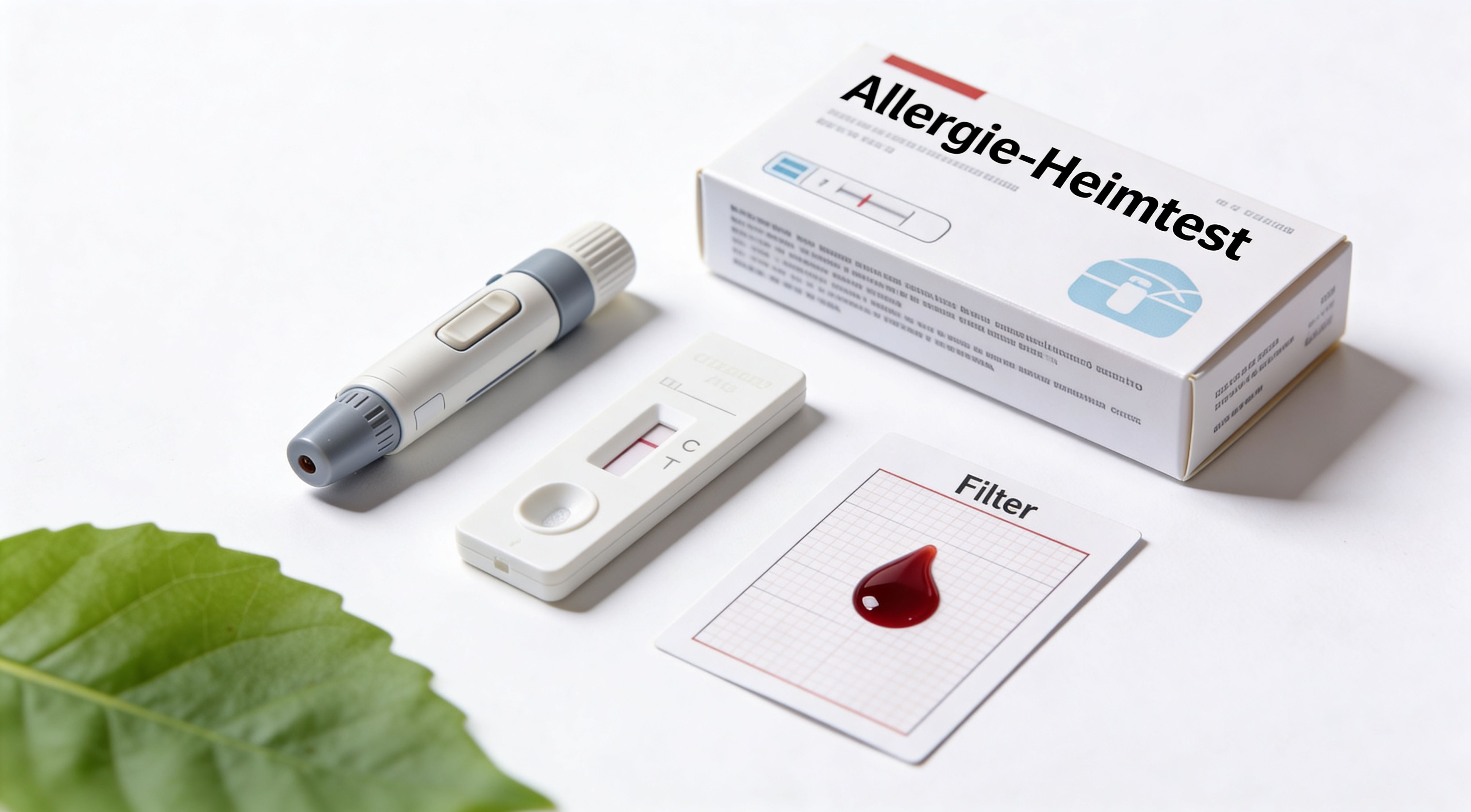
According to the description of capillary blood analysis in the specialist laboratory, the sample for the comprehensive allergy test is collected simply through capillary blood collection at home. The sample is analyzed in ISO-certified specialist laboratories in Germany. This lowers the barriers to regular health screenings and supports evidence-based optimization of your diet and lifestyle.
This is how it typically works
The process is simpler than many people think:
-
Select a test
You decide whether you want to specifically check for allergies or whether intolerances might also be relevant. -
Collect the sample at home
This is usually done with a finger prick using capillary blood. -
Send in the sample
The laboratory performs the analysis in a standardized manner. -
Reading and interpreting results
What matters is not only the finding, but how well it matches your actual symptoms.
Who this is especially useful for
A home test is often a good fit if one of these points applies to you:
- You want to proceed more efficiently instead of constantly starting new elimination diets
- your symptoms are mixed and you need a better starting point
- you want laboratory data before restricting your diet further
- you are looking for a solution for home use because your daily life and schedule are already full
If you are looking for a specific option, you can take a look at the IgE allergy blood test for home use or use the overview of intolerance and allergy tests. The mybody x blood test range includes tests that specifically address IgE-based allergy questions and, depending on the question, can be combined with further analyses.
Practical rule: If you have already observed a lot but your actions are still based on assumptions, a blood test is often the more sensible next step than starting yet another blanket diet.
Understand your result and take the next steps
A laboratory report is not a verdict on your body. It is an indicator. It is most useful when you read it together with your everyday life.
The simple way of thinking
This framework is helpful:
- result without matching symptoms does not automatically mean that you have to strictly avoid something
- result plus clear symptoms after contact is significantly more relevant
- no notable finding, but symptoms persist suggests continuing to consider intolerances or other causes
This is how a result becomes an action.
What you can do with a notable result
If an allergen stands out and matches your symptoms, you can respond in a targeted way:
| Situation | Next step |
|---|---|
| Pollen or house dust stands out | Observe your daily life and surroundings more purposefully, and avoid triggers in a more structured way |
| Food stands out and symptoms clearly match | Adjust your diet consciously, but no more than necessary |
| Unclear mixed picture | Interpret the results with professional advice or medical guidance |
The importance of precise diagnostics continues to grow. According to the market assessment of allergy diagnostics, the global market is expected to grow to 13.4 billion US dollars by 2034. The same source also states that mybody®x has already supported more than 11,314 customers.
When you should definitely seek further medical evaluation
A home test is a good starting point. However, it does not replace every medical evaluation. Please seek further medical advice if you have severe reactions, notice breathing problems, develop significant swelling, or your symptoms are generally difficult to interpret.
Even when results are abnormal, the best decision comes from the findings, symptoms, and professional interpretation. This is exactly how you avoid unnecessary restrictions and instead get a plan that truly works in everyday life.
Frequently asked questions about the comprehensive allergy test
Can antihistamines distort the results
A specific IgE blood test does not focus on exactly the same question as a skin test. If you take medication or are unsure, it is best to clarify the details with the provider or a doctor beforehand. This is particularly important if you use several medications at the same time.
What is the difference between a blood test and a skin test
A skin test shows reactions directly on the skin. A blood test measures specific antibodies in a laboratory. Many people appreciate blood tests because the sample can be collected at home and then evaluated in a standardized laboratory process.
Can a comprehensive allergy test also detect celiac disease
No. A comprehensive allergy test typically checks for IgE-mediated allergic reactions. Celiac disease is a different medical issue and requires its own diagnostic testing.
Do I have to eliminate everything immediately after a positive result
Not automatically. A positive result initially indicates possible sensitization. What matters is whether it matches your symptoms and how clear the connection is in everyday life.
If you would also like to know what costs may be involved with different testing options, you can find more information here about how much an allergy test costs.
If you want to get answers about possible allergies that are not merely approximate, but precise and from home, take a look at the options available with the mybody x blood test. A clear blood value does not replace every conversation with a doctor. However, it can help you take the next step in a much more targeted way.



Share now:
Food allergy test: Food Allergy Test:
Allergy test at home: Finally, clarity about your symptoms