
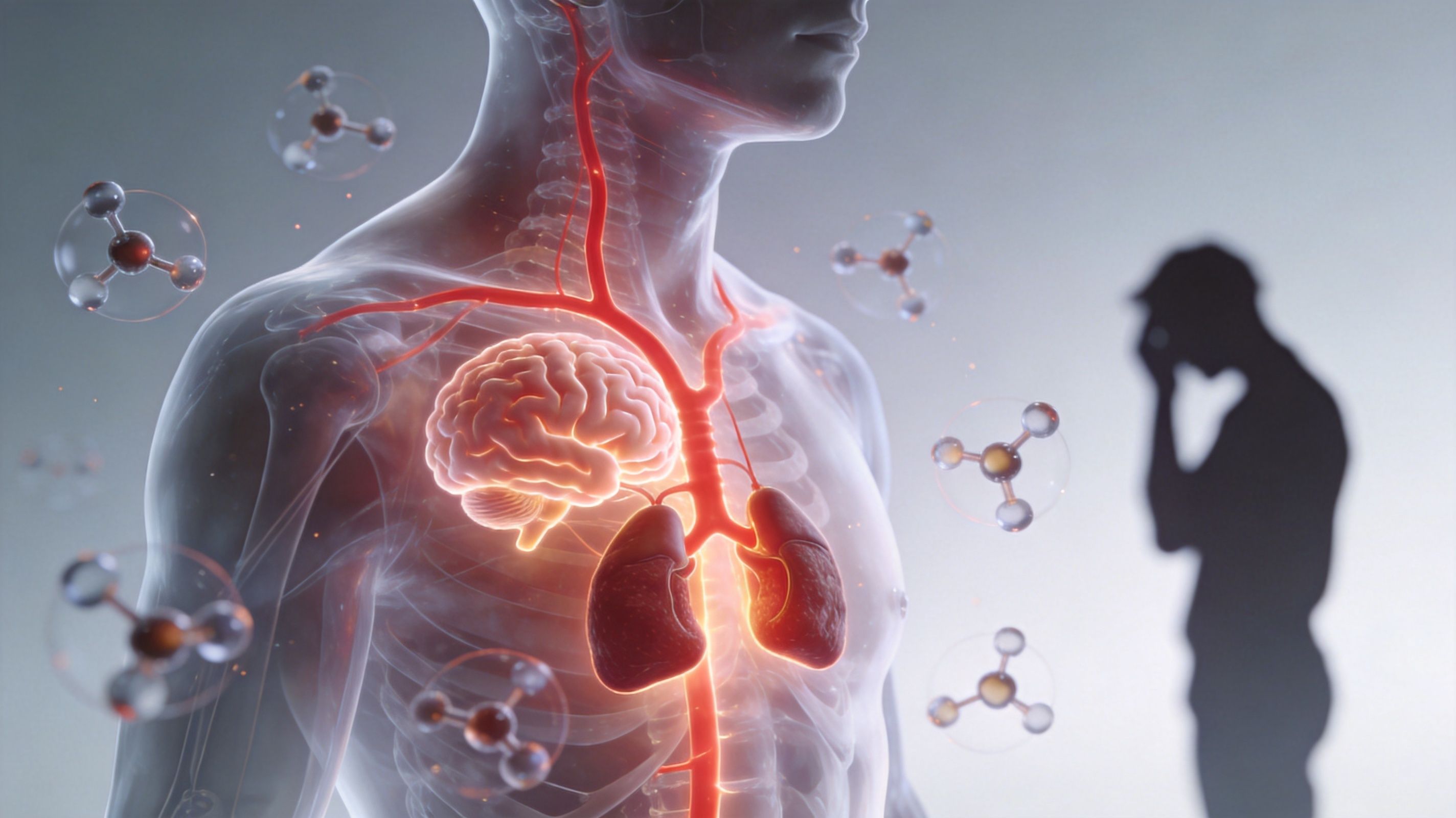
What Does Cortisol Do in the Body During Stress? Expert Check 2026
You somehow function during the day. In the evening, you're exhausted, but your mind won't switch off in bed. Perhaps you reach for sweets more often, feel irritable more quickly, or wonder why your body isn't cooperating as you expect, despite healthy intentions.
This is precisely where the question becomes relevant: what does cortisol actually do in the body during stress? Because cortisol isn't just "the evil stress hormone." It's a messenger that's supposed to help you. Only when the alarm system remains active for too long does its benefit turn into a burden.
Stressed, Tired, Gained Weight? Your Body Sends Signals
Many people know this contradictory feeling: tired, yet inwardly tense. You want to sleep, but your system remains on alert. In the morning, it's hard to get up; during the day, you push through with coffee, snacks, or sheer willpower, and in the evening, your body feels both drained and wired.

This is not a weakness, nor a sign that you "just need to relax better." Your body reacts very specifically to stress. It assesses appointments, sleep deprivation, constant tension, conflicts, overwhelm, and insufficient recovery as relevant signals. Then it switches into a mode designed to keep you performing.
When Everyday Life Feels Like a Marathon
Typical situations often seem harmless:
- Already wired in the morning: You wake up and immediately think of to-do lists.
- You function during the day: Concentration works, but more under pressure than with ease.
- No real recovery in the evening: The body feels heavy, the mind remains loud.
- Your appetite changes: You crave quick energy more often or eat irregularly.
- You don't quite recognize yourself: More irritability, less patience, less resilience.
Your body is not overreacting. It's trying to get you through a demanding phase.
This is where cortisol comes in. This hormone helps you provide energy, stay awake, and function short-term in demanding moments. That makes sense. It only becomes problematic when individual stressful moments turn into a permanent state.
Why Symptoms Often Feel So Vague
Stress hormones rarely cause just one symptom. They simultaneously affect sleep, energy, blood sugar, mood, appetite, and regeneration. That's why many first think of "lack of discipline," "too much work," or "age." However, a hormonal reaction can indeed be behind this diffuse feeling.
If you recognize yourself here, you're already on the right track. Not because you should think you're sick, but because you're starting to take your body's signals seriously.
Cortisol Your Body's Own Alarm System
Cortisol is produced in the adrenal cortex and is one of the most important hormones in your stress response. Its job is not to harm you. Its job is to make you capable of acting in a challenging situation.
How the Alarm Chain Works in the Body
You can imagine it like an internal emergency chain. A stimulus is perceived as stress. Then the hypothalamic-pituitary-adrenal axis, or HPA axis, starts up.
The sequence is as follows:
- The hypothalamus in the brain releases CRH.
- The pituitary gland responds with ACTH.
- The adrenal glands then secrete cortisol.

If you want to read more about the role of the hormone itself, you can find a good supplement in the article what cortisol actually is.
What Cortisol Changes in Minutes
Under acute stress, the cortisol level in the blood can increase by up to 50 to 100% within minutes, as described by the LMU Klinikum Munich on the stress hormone cortisol. This increase is not abstract. It has direct physical consequences.
In the short term, the following happens, among other things:
- More energy for the brain: Blood sugar increases by 20 to 30 mg/dL.
- Increased oxygen intake: Breathing rate accelerates by 10 to 20 breaths per minute.
- Increased circulatory performance: Blood pressure rises by 10 to 20 mmHg.
This explains why you suddenly become more focused, awake, or physically "activated" in a tense situation. Before an exam, a presentation, or physical exertion, this can be useful.
Practical Rule: Acute stress is not automatically bad. Your body uses cortisol to provide performance for the moment.
Why This Mechanism Is So Useful
Without cortisol, you would react much worse to stress. The hormone helps you make reserves available, prioritize, and not fall into energy-saving mode in an acute situation.
Many therefore confuse the existence of cortisol with a problem. That is not true. It is not cortisol itself that is the issue, but its pattern, timing, and duration. Your body needs this signal. It just also needs to return to rest.
Friend and Foe The Two Faces of Cortisol
Cortisol has two sides. In short-term stress, it's a helper. In chronic stress, the same reaction can throw the body off balance.
So the question is not just, "Is cortisol high?" The more important question is: Does this happen situationally or constantly?
The Helpful Side in Acute Stress
At the right moment, cortisol is a clever solution from the body. It mobilizes energy, sharpens attention, and helps you respond to demands. The short-term dampening of inflammatory processes is also part of this. This is practical when your organism temporarily needs to reallocate resources.
In short: Cortisol is ideal for a sprint.
The Burdensome Side in Chronic Stress
However, if the alarm state never ends, support turns into wear and tear. According to the AOK health study on cortisol and stress, about 27% of the population in Germany have chronically elevated cortisol levels. This is accompanied by sleep disorders in 35% and weight gain in 28%.
In addition, there are other consequences that many underestimate:
- Muscles come under pressure: Cortisol promotes the breakdown of protein stores in muscles by up to 20%.
- Bones build up more poorly: Bone formation is inhibited, and the risk of osteoporosis increases by 30%.
- Immunity weakens: The activity of T-cells is long-term reduced by 50%.
This explains why chronic stress not only feels "mental" but also manifests physically. You regenerate more poorly, sleep more restlessly, feel more vulnerable, and sometimes don't make progress despite healthy efforts.
Acute vs. Chronic Cortisol Effect at a Glance
| Body Area | Acute Effect (helpful in short-term stress) | Chronic Effect (harmful in chronic stress) |
|---|---|---|
| Energy Supply | Provides rapid energy | Promotes long-term weight gain |
| Brain and Focus | Makes you awake and alert | Can contribute to exhaustion and inner restlessness |
| Sleep | Keeps you capable of performing in demanding moments | According to AOK study, associated with sleep disorders in 35% |
| Muscles | Reserves are mobilized short-term | Protein stores in muscles are broken down by up to 20% |
| Bones | In acute cases, bone health is not a priority | Inhibited bone formation, 30% higher osteoporosis risk |
| Immune System | Inflammatory reactions are temporarily dampened | T-cell activity is reduced by 50% |
Where Readers Often Get Confused
Many think: if cortisol rises with stress, then every form of stress must automatically cause harm. It's not that simple. Intensive training, an important presentation, or a demanding phase at work initially activate your system quite normally.
What's crucial is whether your body can calm down afterwards. If sleep, recovery, food, exercise, and mental breaks are no longer sufficient, the regulator tends to stay up. Then cortisol turns from a useful messenger into a disruptive factor.
High performance demands are not the problem. Lack of recovery between stressors is often the tipping point.
What This Means for Your Daily Life
If you only morally judge your stress, you quickly end up with guilt. If you understand it biologically, you gain room to maneuver. Then it's no longer about "I'm too sensitive," but about a specific question: How is my body reacting right now, and how can I counteract it effectively?
That's exactly the interesting change in perspective. Cortisol is not an adversary. It's a signal giver. Whoever understands their stress reaction can adapt training, nutrition, sleep, and regeneration much more precisely.
Listen to Your Body Symptoms of a Cortisol Imbalance
Your body often provides clues long before you can clearly interpret them. The only problem is: these clues are non-specific. They might fit cortisol, but they don't have to.

Typical Daily Clues
Perhaps you experience several of these points simultaneously:
- You're tired but can't relax: Especially in the evening or at night.
- Your eating habits shift: More cravings for sweets, salty snacks, or quick energy.
- You feel overwhelmed more easily: Things that used to be easy now take more effort.
- Your regeneration is poorer: After work, training, or little sleep, you need longer to recover.
- You get sick more often or feel "vulnerable": Your body seems less stable.
- Digestion and skin react more sensitively: Not necessarily due to cortisol, but often noticeable in the overall picture.
- Libido and general drive decrease: You function, but with less ease.
If you specifically want to know which symptoms in women are often associated with high cortisol, you can find a detailed overview under Cortisol Too High Symptoms in Women.
Why Self-Observation Alone Is Often Not Enough
The difficult thing is: almost every one of these signals can also have other causes. A nutrient deficiency, poor sleep rhythm, high mental pressure, hormonal shifts, or simply too little recovery can look similar.
Therefore, pure guesswork is often frustrating. You might try magnesium, meditation, less coffee, more exercise, less exercise, or new routines. Some things help a little, but you don't know if you're really addressing the root cause.
Symptoms are clues. They are not a definitive answer.
Three Questions for Your Quick Self-Check
These questions do not replace a test, but they help you assess your situation soberly:
- Have I been in a mode of tension and functioning for weeks or months?
- Do I have several non-specific complaints simultaneously, such as sleep, weight, energy, and susceptibility to infection?
- Am I currently relying more on trial and error than on actual data?
If you inwardly nod at several points, there's no need to panic. It's more a sign that your body deserves more precision.
From Suspicion to Certainty How to Measure Your Cortisol
If you want clarity, there's hardly a sensible way around a measurement. Symptoms can point you in the right direction. But only a test will show if cortisol is actually involved.
Why a Single Assumption Is Not Enough
Cortisol is not a fixed value. It follows a daily rhythm and reacts to stress, sleep, food, and the context of the measurement time. That's precisely why "I feel stressed, so my cortisol is certainly too high" is too imprecise.
There are various ways to measure cortisol, for example, via blood or saliva. Which method makes sense depends on the question. For many people, it's particularly crucial to move from assumptions to actual values.
The Advantage of Measuring Instead of Guessing
A clean test saves you detours. Instead of tinkering with individual screws for weeks, you get a more objective basis for decisions. This is not only more efficient but often also more reassuring. Because sometimes a test confirms the suspicion. Sometimes it also shows that you should look in a different direction.
Those who want to delve deeper into the topic can get a good overview of the practical classification in the article Measuring Cortisol.
How to Recognize a Sensible Approach
Focus less on quick promises and more on these points:
- Measurement with a clear purpose: Don't test to find anything, but to answer a specific question.
- Clean laboratory analysis: Values are only helpful if the evaluation is reliable.
- Interpretation instead of raw data: A number alone is of little use if you don't know what it means for your daily life.
- Consequences for your lifestyle: Good diagnostics help you adapt your nutrition, sleep, and regeneration more specifically.
Others have long been optimizing their blood values based on data rather than feeling. This is not an exaggeration of health, but a pragmatic shortcut. You save yourself trial and error and work with what your body actually shows.
Your Path to Balance Test Your Values and Optimize Your Health
Health becomes easier when you don't work against your body, but understand its signals. That's the difference between general stress management and true optimization. You don't have to turn everything upside down. Often, it's enough to know the right values and react more intelligently to them.

If you're struggling with poor sleep, energy dips, weight fluctuations, or diffuse stress symptoms, a precise look at your blood values is often the more logical next step than yet another self-experiment. This is especially true if you live health-consciously but feel like your body is stuck.
Why Data Is Often More Relaxing Than Overthinking
A test doesn't replace good self-awareness; it complements it. And that's exactly what makes it so valuable. You get a reliable basis for decisions instead of constant question marks.
Especially with topics like hormones and nutrients, this is a real advantage:
- You gain orientation: What is actually abnormal, and what is just a guess?
- You target more precisely: Nutrition, daily routine, and regeneration can be adjusted more accurately.
- You remain efficient: Less trial and error, more focus.
- You strengthen personal responsibility: Not blindly optimizing, but being informed.
Knowing your values doesn't magically make stress disappear. It makes your next steps much smarter.
Start Your Plan for Better Stress Management Today
Cortisol reacts to your life. That's why good stress management doesn't just work in your mind but throughout your body. The best plan is usually not a perfect fresh start, but a series of realistic habits that bring your nervous system back to safety more often.
Four Levers That Prove Effective in Everyday Life
Prioritize sleep first. If you constantly wind down too late, your body remains in alarm mode more easily. Consistent evening routines, less overstimulation, and a clear sleep rhythm are often more effective than the next supplement idea.
Food that creates stability. Irregular meals and constant "pushing through" often feel like additional stress for the body. Regular, nutrient-conscious meals can help you get through the day more calmly.
Dose exercise appropriately. Exercise is helpful, but not every form of training is the best choice at every stage. If you're already at your limit, a gentler session might sometimes be more sensible than even more intensity.
Consciously incorporate mental relief. Breathing exercises, screen-free breaks, nature, journaling, or clear boundaries in your work-life often seem unspectacular. But in total, they make a real difference. If you work a lot from home, you'll find practical impulses that fit this topic well in Mentale Balance im Homeoffice finden (Finding Mental Balance in the Home Office).
How to Implement It Without Overwhelm
Don't try to optimize everything at once. Instead, pick a small combination that you can truly stick to.
For example:
- Aim for a consistent bedtime
- Don't skip lunch
- Three times a week conscious movement
- A short relief routine daily
If you also want to know which everyday approaches are often used to calm the stress system, check out the article Naturally Lower Cortisol.
You don't have to relax perfectly to help your body. You just have to show it more often that it's not constantly on alarm.
Ultimately, it's not about fighting cortisol. It's about understanding its message. If you recognize how your body reacts to stress, you can eat smarter, train more appropriately, regenerate better, and structure your daily life so that performance and well-being go hand in hand.
If you no longer want to guess but are looking for a reliable answer to possible hormone or nutrient issues, a precise mybody x blood test is worthwhile. For a targeted look at hormones, the Women's Health Test and the Men's Wellness Check are suitable. If you also want to check whether your energy or regeneration is hampered by micronutrients, you'll find suitable options in the Nutrient Deficiency Tests. This way, you save yourself trial and error and make decisions based on real values.
Share:
Comprehensive Allergy Test: Your Path to Clarity & Well-being
Allergy test at home: Finally clarity on symptoms