
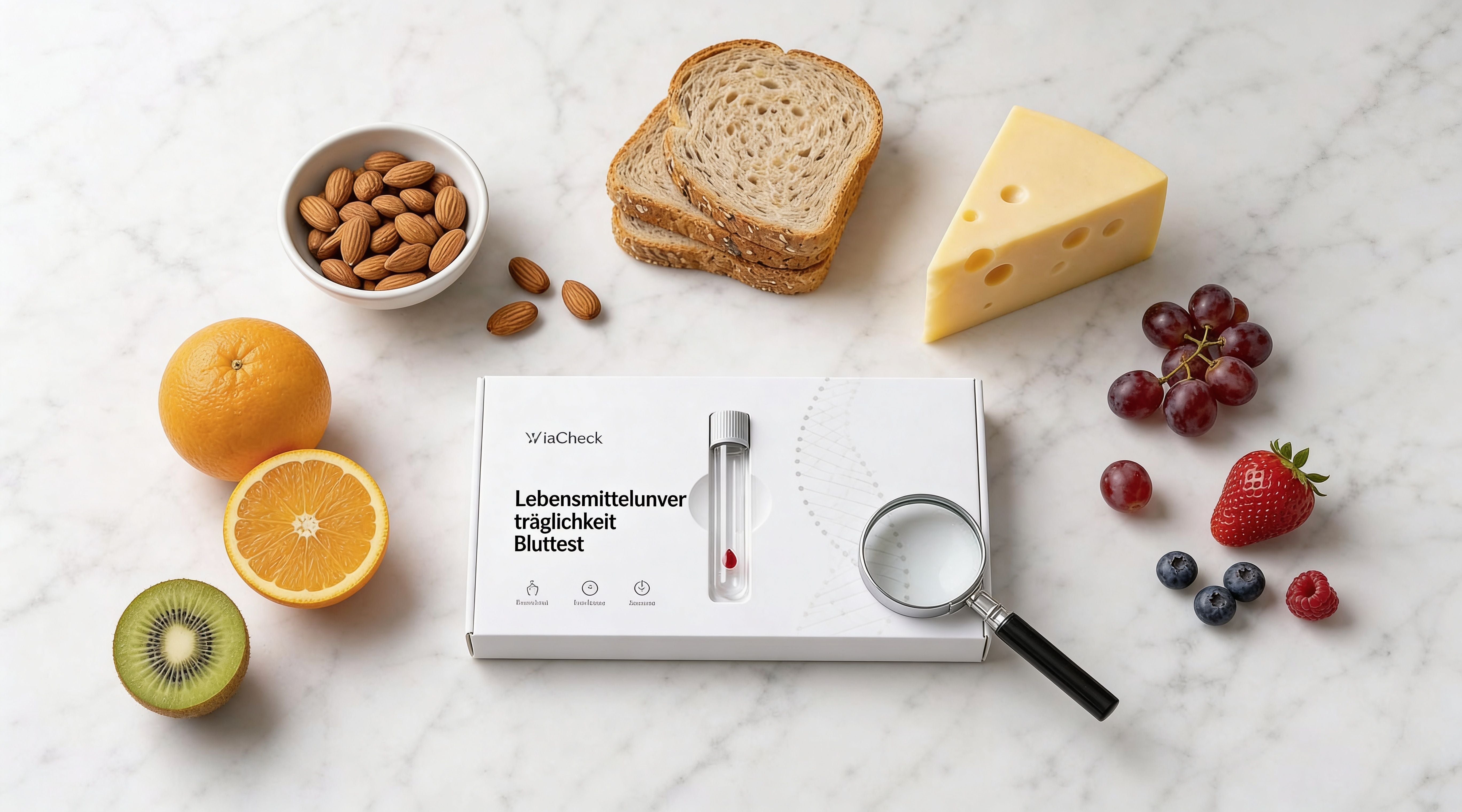
Food Intolerance Test: Which One Is Right?
You pay attention to your diet and may already be trying gluten-free or low-lactose options, or avoiding sugar. Yet your stomach still rumbles, your energy drops, or your skin acts up. Then the question naturally arises: Do I need a food intolerance test?
This is exactly where things often become confusing. The term encompasses many very different things. Some tests look for a genuine allergy. Others are intended to detect intolerances. Still others advertise extensive lists of foods but do not provide a clear medical answer. If you want clarity, it is worth understanding the differences properly before investing money, time, and energy in the wrong test.
Stomach rumbling, fatigue, and more—when your own body becomes a mystery
Maybe you know the feeling: In the morning, everything is still fine, but after lunch your stomach starts to ache. On other days, it is not your stomach—you simply feel tired, bloated, or somehow “not quite yourself.” Then the usual guessing game begins. Was it the bread, the milk, the coffee, or perhaps the stress?
Many people then end up in an endless cycle of elimination, reintroduction, and Googling. First, no more dairy products. Then less wheat. Then a low-histamine diet. For a short time, it feels like control, but often there is no real certainty. This is frustrating because you invest a lot of energy and still end up unsure what your body actually needs or does not tolerate well.
Why self-observation is often not enough
The problem is not that you are bad at perceiving your body. The problem is that symptoms after eating often occur with a delay or are influenced by several factors at the same time. A stressful day, too little sleep, large portions, or digestion that is already sensitive can further distort the picture.
In addition, not every reaction to food is automatically an intolerance. Sometimes it is a genuine allergy. Sometimes an intolerance. Sometimes something entirely different. Nutrient-related issues can also play a role. If you frequently notice nonspecific symptoms, it may also be worth looking at typical signs of possible nutrient deficiencies.
Practical rule: The more diffuse the symptoms, the more important a structured rather than spontaneous approach becomes.
Clarity saves time and prevents unnecessary restrictions
Many people make the mistake of cutting out entire food groups right away. This may sound healthy, but it can quickly become burdensome in everyday life. Eating becomes complicated, socially challenging, and sometimes even unbalanced.
A targeted test does not replace every medical evaluation. However, it can help you move beyond mere guesswork. And that is precisely what a good food intolerance test is about: not trying things blindly anymore, but making more informed decisions.
Intolerance, intolerance, or allergy—which is the difference?
Before you test, you need to know what is actually being looked for. After all, “I can’t tolerate something” can mean very different things medically. The umbrella term sounds simple, but it encompasses various mechanisms.

Intolerance as an umbrella term
Food intolerance is initially a collective term. It describes the fact that your body reacts to a food with symptoms. However, it does not yet explain why this happens.
This distinction is particularly important. Techniker Krankenkasse emphasizes that, when a food intolerance is suspected, the diagnostic distinction between intolerance, allergy, and functional symptoms is crucial because the testing strategy varies greatly depending on the mechanism. If lactose or fructose intolerance is suspected, the H2 breath test is routinely used in Germany, while intolerances to additives can generally only be narrowed down through elimination and challenge tests under medical supervision. TK also points out that symptoms such as bloating or diarrhea often occur only hours after eating and that assessing symptoms alone is unreliable, as explained by Techniker Krankenkasse in its information on diagnosing food intolerances.
Four typical types of reactions
-
The true allergy
Here, the immune system reacts to an actually harmless substance in the food. These are often IgE-mediated reactions. Symptoms tend to appear quickly, for example in the mouth, on the skin, in the respiratory system, or in the circulatory system. -
The intolerance
The immune system is not the main focus here; digestion is often the issue instead. A classic example is lactose. The body cannot process one component of the food properly, which can then lead to bloating, abdominal pain, or diarrhea. -
Functional symptoms
Some people react noticeably to certain foods without a classic allergy or intolerance being detectable. This does not mean that the symptoms are “imagined.” It simply means that the cause cannot be detected by every test. -
Nonspecific sensitivities
This is the area where many people encounter terms online that are not always used accurately in medicine. That is precisely why it is worth taking a closer look at the difference between an allergy and an intolerance explained clearly.
If two people get a stomachache after eating the same food, the cause does not necessarily have to be the same.
Why this distinction is so important for testing
A food intolerance test is useful only if it matches the suspected mechanism. A digestive problem is tested differently from an immune reaction. This is exactly where many poor purchases arise: people look for “the one test,” even though there are actually several very different diagnostic approaches.
The most common testing methods put to the test
Not every test answers the same question. Some methods are useful for assessing the situation. Others provide only general indications. And some are popular even though their diagnostic value for the actual diagnosis is limited.
What you can expect from each test
| Test method | Use when there is a suspicion of | Reliability & scientific basis | Advantages | Disadvantages |
|---|---|---|---|---|
| food diary | nonspecific symptoms, initial guidance | helpful for identifying patterns, but subjective | inexpensive, immediately actionable, a good starting point | prone to minor errors, with delays difficult to detect |
| H2 breath test | lactose or fructose intolerance | clinically established for the appropriate clinical question | targeted assessment, clear focus | requires a doctor's appointment and is not suitable for every cause |
| elimination and challenge test | suspected reactions to specific foods or additives | useful when medically supervised and carried out properly | can help narrow down potential triggers | time-consuming and often inaccurate when done independently |
| IgG test | often advertised for “intolerances” | not recommended for diagnosing a food allergy | readily available | results can be misleading |
| IgE blood test | suspected true food allergy | medically relevant when symptoms are consistent | objective laboratory data, conveniently obtained | does not replace a complete medical diagnosis |
The key point about IgG tests
IgG tests are often presented online as a simple answer to almost all symptoms. That sounds appealing, but medically it is not so clear-cut. Barmer points out that IgG antibodies against foods can also be detected in people without allergies, and European allergy societies therefore warn against using IgG tests to diagnose food allergies. AOK also reports that certain foods should only be avoided in cases of intolerance diagnosed by a doctor, because unnecessary elimination diets can lead to nutrient deficiencies. You can read more about this assessment of food intolerance tests from Barmer.
This does not mean that every reaction to food is imagined. It only means: An IgG value alone is not a reliable diagnosis of an allergy.
When blood tests are useful
When it comes to a true allergy, IgE-based blood tests are significantly more relevant than nonspecific trend tests. They look for a marker that corresponds to the allergic reaction. That is an important difference.
Important in everyday life: A convenient test is not automatically a useful test.
That is why it is worth asking before buying: Is this test really looking for the mechanism that fits my symptoms?
When medical advice is essential
There are situations in which you should not spend a long time analyzing things yourself first. If symptoms are severe, appear suddenly, or go beyond mere digestive problems, they should be evaluated by a medical professional.

You should take these warning signs seriously
- Shortness of breath or severe swelling after eating
- Circulatory problems or severe reactions shortly after eating a food
- Suspected gluten intolerance in the medical sense, meaning possible celiac disease
- Blood in the stool, persistent severe pain, or significant weight loss
- Symptoms in children, during pregnancy, or in people with existing medical conditions
AOK explicitly warns against viewing self-tests as a reliable diagnosis. According to AOK, commercially available self-tests provide “no reliable information” about a food intolerance. At the same time, Techniker Krankenkasse identifies the H2 breath test as the standard diagnostic test when lactose or fructose intolerance is suspected, while antibody testing plus gastroscopy is used for gluten intolerance. You can find this assessment in the AOK’s information on the diagnostic value of self-tests for food intolerance.
Self-testing is fine, but it needs the right role
An at-home test can be useful if you want to take a health-conscious approach and are looking for an initial, well-founded assessment. However, it should not take on the task of clarifying acute or serious symptoms on its own.
Medical diagnostics and smart self-responsibility are not mutually exclusive. Ideally, they complement each other. You use data to act more purposefully and seek medical help where it is needed.
The smart alternative – evidence-based at-home blood tests
Many people do not want to keep guessing, but they also do not want to arrange several appointments immediately for every question. This is exactly where evidence-based at-home blood tests can be useful. Not as a replacement for every diagnosis, but as a pragmatic way to obtain a clearer data basis.

Why the marker matters
What matters is not only whether testing is carried out, but what is tested. If you want to investigate a genuine allergy, an IgE test is medically different from a generally advertised IgG check. Confusing the two can quickly give you data without necessarily providing a useful answer.
That is why it makes sense to look closely at a food intolerance test: Is it about an allergy, an intolerance, or general dietary optimization? For a sound assessment, this distinction is more important than any advertising promise.
What a modern at-home test should offer
A useful at-home blood test should primarily meet the following criteria:
- It matches the question. Different markers are relevant when an allergy is suspected than when digestive problems are involved.
- The analysis is carried out professionally. According to the provider profile, mybody®x works with ISO-certified laboratories in Germany and cites GDPR and ISO 27001 standards for handling health data.
- The results are presented clearly. Data only helps if you can apply it in everyday life.
- The process is realistically practical for everyday life. Otherwise, the test will just sit in the cupboard.
Anyone who wants to read more in depth will find a good foundation in the article on blood tests for food intolerance to better understand the areas where such tests can be used.
The real advantage of a good home test is not just convenience. It is the combination of structure, laboratory analysis, and a clear next decision.
In the right context, at-home blood tests can therefore be a sensible bridge—between blindly eliminating foods and feeling stuck in the medical system for every question.
Your path to clarity – this is how the mybody-x test works so simply
If you have never taken a home test before, the process often seems more complicated than it is. In practice, the main thing is to keep the hurdle low. You order, collect the sample at home, send it to the lab, and review the results report at your leisure.

How it works in everyday life
-
Choose the right test
First, consider what you want to know. Is it about a possible allergy suspicion, or are you looking for broader guidance on food reactions? -
Order a test kit for home delivery
The kit comes to you. You do not have to coordinate an appointment or rearrange your week first. -
Collect the sample
The blood sample is generally collected with a small finger prick. For many people, this is more comfortable because they can choose the moment themselves. -
Send in the sample and have it analyzed
The lab takes over from there. So you do not have to interpret for yourself what a strip or color change might mean. -
Use results instead of just collecting them
It is important to derive concrete steps from the report. Otherwise, even a good test remains information without impact.
Which tests are particularly relevant to this topic
If you want to check for a true food allergy, the at-home allergy IgE blood test is the obvious option. If you want an overview of the entire range, you will find the relevant categories in the overview of intolerance and allergy tests.
The point is simple: You save yourself a lot of trial and error. Others have long been optimizing their blood values, diet, or symptoms based on data rather than gut feeling. If you want to understand how your body reacts, a properly selected test is often a faster route than spontaneously eliminating yet another food.
Conclusion – take control of your health
Unexplained symptoms after eating can be exhausting. Not only physically, but mentally as well. You are constantly thinking about it, rearranging meals, removing things from your diet, and still not getting a clear answer.
The most important point is: Not every food intolerance test measures something that is equally meaningful from a medical perspective. A true allergy is different from an intolerance. And both are different from nonspecific symptoms that cannot be clearly explained by a single trendy test.
What you can take away
- Taking symptoms seriously does not mean immediately eliminating everything.
- Self-observation helps, but it is often not enough for a reliable assessment.
- IgE and IgG are not the same. This difference often determines whether a test is actually appropriate for the question at hand.
- Medical evaluation remains important if warning signs or severe reactions occur.
- Well-chosen at-home blood tests can be a useful first or supplementary step.
If you want to improve your well-being, you do not need perfection. You need better decisions. And those are easier to make when you stop guessing and start working with understandable information.
Your digestion, energy levels, and overall physical well-being are often more closely connected than they may initially seem. If you want to approach the topic holistically, it is also worth taking a look at the importance of a healthy gut flora.
If you want to do more than simply observe your symptoms and instead assess them with a sounder basis, take a look at the mybody x blood test. This lets you get started systematically at home and base your next nutrition decisions on clearer information.



Share now:
Vitamin B Complex Vitamins: Effects, Dosage and Benefits
What happens with a vitamin B deficiency: symptoms and help