

Vitamin B Complex Vitamins: Effects, Dosage, and Benefits
TL;DR:
- A B complex contains all eight water-soluble B vitamins, each with different functions in the body, and needs to be replenished regularly. At-risk groups such as vegans, older people, and pregnant women benefit particularly from targeted supplementation, while people with a healthy diet generally do not need supplements. A blood test before taking them helps identify a true deficiency and avoid unnecessary overdosing.
Vitamin B complex vitamins are found on almost every drugstore shelf, marketed as energy boosters, yet most people buy them without really knowing what they are swallowing. Is a B complex the same as vitamin B12? Does it really help with fatigue? And what happens if you take too much? This article clears up the most common misconceptions, explains the functions of the individual B vitamins, shows who can genuinely benefit from supplementation, and helps you assess products on the market objectively.
Table of Contents
- Key Takeaways
- What Are Vitamin B Complex Vitamins?
- Who can benefit from a B-complex supplement?
- Dosage and Common Sources of Error in B-Complex Supplements
- When does a B-complex really help?
- Choosing the right B-complex supplements
- My assessment of B-complex supplements
- How Mybody-x Supports You with B Vitamins
- FAQ
Key Takeaways
| Point | Details |
|---|---|
| Eight Vitamins, One Complex | A B complex contains all 8 water-soluble B vitamins, each with different functions in the body. |
| Regular Intake Required | Because B vitamins are water-soluble, the body must obtain them daily through food or supplements. |
| At-Risk Groups Benefit Most | Vegans, older people, and those taking long-term medication often have an increased need for B vitamins. |
| Dosage Determines the Benefits | High-dose supplements are not automatically better and can pose health risks with B6 and folic acid. |
| Blood Test Before Supplementation | Anyone who really wants to know whether they have a deficiency should have their status tested first. |
What Are Vitamin B Complex Vitamins?
The term “Vitamin B complex vitamins” describes a group of 8 essential B vitamins combined in a single supplement. These vitamins differ chemically but share an important characteristic: they are all water-soluble. This means the body cannot store them in large amounts and excretes excess quantities in the urine.
The only exception is vitamin B12. It can be stored in the liver for months to years, which is why a deficiency often goes unnoticed until late. All other B vitamins require regular intake for the body to function smoothly.
The 8 B vitamins at a glance
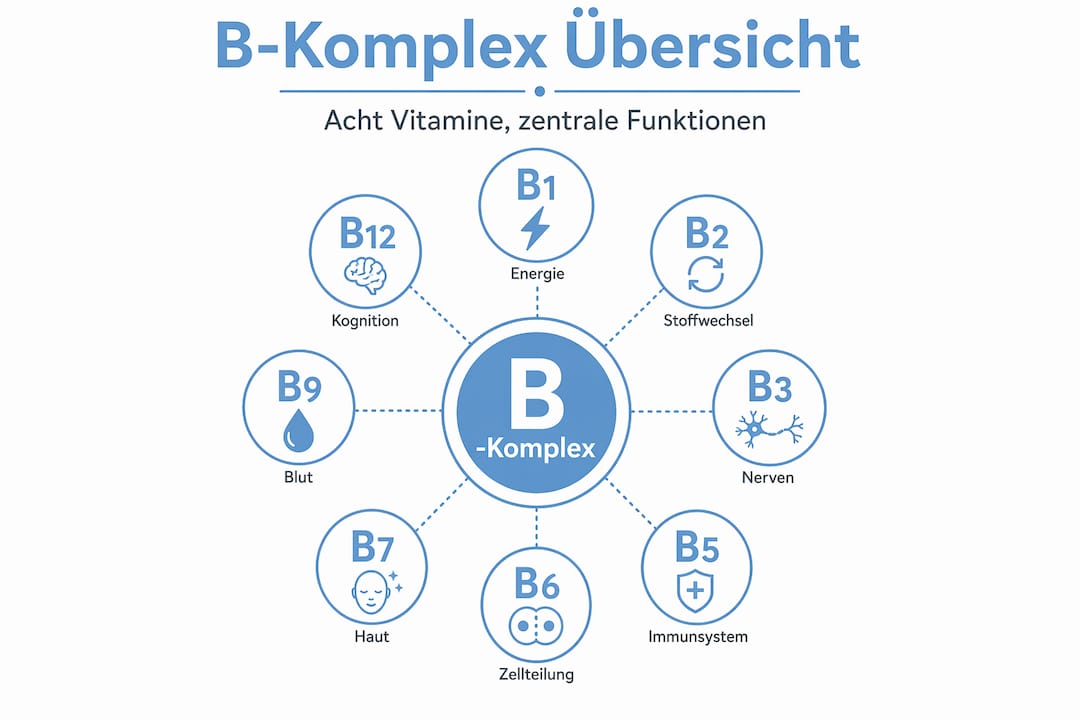
Each B vitamin has its own role. Here is a concise overview:
- B1 (thiamine): Supports carbohydrate metabolism and nerve function. Found in whole-grain products, legumes, and pork.
- B2 (riboflavin): Involved in energy production and protecting cells from oxidative stress. Good sources include dairy products, eggs, and liver.
- B3 (niacin): Important for energy metabolism and DNA repair. Found in meat, fish, and peanuts.
- B5 (pantothenic acid): A component of coenzyme A, which plays a central role in fat metabolism. Widely found in almost all foods.
- B6 (pyridoxine): Regulates protein metabolism and is involved in the production of neurotransmitters. Sources: poultry, potatoes, bananas.
- B7 (biotin): Known for its role in skin, hair, and nails, as well as fat metabolism. Found in eggs, nuts, and liver.
- B9 (folic acid): Essential for cell division and particularly important during pregnancy. Sources: leafy green vegetables, legumes, liver.
- B12 (cobalamin): Essential for blood formation, nerve function, and DNA synthesis. Found exclusively in animal products.
Key functions at a glance
| B vitamin | Main function | Important sources |
|---|---|---|
| B1, B2, B3, B5 | Energy metabolism | Whole grains, meat, milk |
| B6, B12 | Nerve function, neurotransmitters | Poultry, fish, eggs |
| B9, B12 | Blood formation, cell division | Leafy greens, liver, meat |
| B7 | Skin, hair, fat metabolism | Eggs, nuts, liver |
Anyone who follows a balanced diet rich in B vitamins gets most of these nutrients from food. Problems arise when certain food groups are consistently missing or intestinal absorption is impaired.
Who can benefit from a B-complex supplement?
A healthy diet rich in vegetables, whole grains, legumes, and moderate amounts of meat adequately covers most people’s B-vitamin requirements. A B-complex supplement is not essential for everyone. However, there are clear situations in which supplementation provides genuine benefits.
Typical risk groups
Increased requirements for B vitamins occur especially among:
- Vegans and vegetarians: Vitamin B12 is found exclusively in animal products. Anyone who avoids these must supplement B12.
- People over 50: The absorption of B12 from food decreases with age because stomach acid production declines.
- Pregnant and breastfeeding women: The need for folic acid and B12 increases significantly.
- People taking long-term medication: Metformin (for diabetes) and proton pump inhibitors (for heartburn) have been shown to block B12 absorption.
- People under chronic stress: Stress increases the consumption of certain B vitamins, especially B5 and B6.
- People with gastrointestinal diseases: Crohn’s disease, celiac disease, or stomach surgery significantly impair nutrient absorption.
B-Complex or Targeted Single Supplement?
This is where a common misconception arises. People with a diagnosed B12 deficiency often benefit little from a standard B-complex supplement. The reason: Many B-complex products contain moderate amounts of B12 that are insufficient to correct a true deficiency. In this case, a targeted B12 supplement with a higher dosage or even medical treatment is necessary.
Vitamin B deficiency symptoms can be varied: persistent fatigue, tingling in the hands or feet, difficulty concentrating, pale skin, or depressive moods. These signs are nonspecific and can have many causes. Therefore, anyone who notices such symptoms should first have their vitamin B status measured before randomly buying supplements.
Pro tip: Have your blood levels checked before taking a B-complex supplement. This will tell you whether you have a deficiency at all and which B vitamin is actually lacking.
Dosage and Common Sources of Error in B-Complex Supplements
The market for B-vitamin supplements is huge and confusing. Products range from simple multivitamin supplements containing 100 percent of the daily requirement to high-dose therapeutic formulas containing 10 times that amount or more. These differences are not trivial.

High-Dose versus Standard Dosage
Typical dosages vary widely, from 100 percent of the daily requirement in all-purpose supplements to significantly higher therapeutic doses in specialized products. For healthy people without a confirmed deficiency, a standard dosage is entirely sufficient. High-dose formulas are not automatically more effective, but they can pose risks with certain vitamins.
| Vitamin | Standard dose in B-complex | High-dose supplement | Risk of overdose |
|---|---|---|---|
| B6 | 1.4 mg (100% NRV) | 50 to 200 mg | Peripheral neuropathy |
| Folic acid (B9) | 200 µg (100% NRV) | 400 to 1,000 µg | Masking of B12 deficiency |
| B12 | 2.5 µg (100% NRV) | 500 to 1,000 µg | Virtually no risk |
| B3 (Niacin) | 16 mg (100% NRV) | 500 to 1,000 mg | Flushing, liver damage |
The B6 problem: An underestimated danger
High-dose vitamin B6 can cause peripheral neuropathy and sensory disturbances. This sounds dramatic, but it is real: Tingling, numbness, and coordination problems have also been documented at doses below the official upper limit of 100 mg per day. The insidious aspect is its cumulative effect. Anyone who consumes a B-complex supplement, a multivitamin, and an energy drink at the same time may be taking in significantly more B6 than they realize.
The total intake from all sources is what matters, not just the dose of a single product. Anyone who notices B6 deficiency symptoms or neuropathy-like symptoms should check the B6 content of all supplements they take.
Folic acid and masked B12 deficiency
High doses of folic acid can mask a vitamin B12 deficiency. This is clinically relevant: Blood test results may appear normal while neurological damage develops in the background. The recommended upper limit for folic acid from supplements is 1,000 µg per day. Many high-dose B-complex supplements are already approaching this limit.
Which form of B12 is the better choice?
Forms such as cyanocobalamin and methylcobalamin are common in supplements. Methylcobalamin is the biologically active form and is preferred by some people because the body can use it directly. Cyanocobalamin is less expensive but must first be converted into active forms. For people with certain genetic variants (MTHFR mutation), methylcobalamin may be the more sensible choice.
Pro tip: For every B-complex supplement, check the total amounts of vitamin B6 and folate. If you take several dietary supplements at the same time, add up the amounts from all sources.
When does a B-complex really help?
Here is the uncomfortable truth: A B-complex is not an energy drink in capsule form. People who are well supplied with these vitamins will not feel an energy boost after taking it. This is not a product malfunction, but physiology.
Effects in cases of genuine deficiency
The situation is different when a deficiency has been confirmed. Typical vitamin B deficiency symptoms often improve noticeably with targeted treatment:
- Tiredness and exhaustion improve when a vitamin B12 deficiency was the cause. Blood formation returns to normal, and the oxygen supply to the cells improves.
- Neurological symptoms such as tingling or numbness may subside, but this takes time. Nerve damage heals slowly.
- Concentration and mood stabilize when sufficient amounts of vitamins B6 and B9 are available again, as both vitamins are involved in neurotransmitter synthesis.
- Skin problems and hair loss may improve if a biotin deficiency was the cause, although this is rarely the case.
- Anemia caused by a vitamin B12 or folate deficiency responds well to supplementation, although injections may be necessary in severe cases.
Realistic expectations
Anyone who buys a B-complex as a B-complex for energy without having a deficiency will be disappointed. The supplement cannot do anything the body is not already doing. In other words: B vitamins are like gasoline in the tank. If the tank is full, more gasoline does nothing. If it is empty, the engine runs again.
Patience is also necessary. Correcting a deficiency takes weeks to months, not days. If you notice no change after a week, do not immediately increase the dose; wait and test again after 6 to 8 weeks.
Choosing the right B-complex supplements
Buying a B-complex supplement requires more than looking at the price. Here are the key points to look for on the label:
- Dosage per vitamin: Compare the stated amounts with the reference values of the German Nutrition Society. One hundred percent of the daily requirement is sufficient for most people.
- Form of B12: Methylcobalamin or adenosylcobalamin are biologically more active than cyanocobalamin. When choosing the best B vitamin for specific purposes, this is worth considering.
- Additives: Some products contain fillers, colorants, or sweeteners. Anyone who reacts sensitively should look for pure formulations.
- Total B6 amount: If it exceeds 10 mg per daily dose, check whether you are also getting B6 from other sources.
- Folic acid content: More than 400 µg per day from supplements is unnecessary for most people and can be problematic in cases of B12 deficiency.
When is medical advice advisable? Whenever you have specific symptoms, take long-term medication, or belong to a risk group. Self-medicating with high-dose supplements without a diagnosis is not a good idea. Supplementing this with a conscious vitamin B diet containing whole grains, legumes, green vegetables, and, if desired, animal products remains the best foundation.
Recognizing nutrient deficiency symptoms specifically and taking action before deficiencies become established is the smartest approach. A vitamin B test provides the data needed to make an informed decision in the first place.
My assessment of B-complex supplements
Every day, I see people buying vitamin B-complex supplements because they feel tired and have heard that B vitamins provide energy. That’s understandable. But in many cases, it leads to disappointment or, worse, unnecessary overdosing.
What I’ve learned: A B-complex is not a cure-all. It is a tool. And like any tool, it only works well when used for the right purpose. Anyone with a genuine deficiency benefits significantly. Those who are well supplied simply notice nothing.
The most common mistake I see is reaching for high-dose formulas because “more can’t hurt.” That is largely true for B12. It is not true for B6 and folic acid. That’s why I always recommend: test first, then supplement. Anyone who wants to understand their B12 deficiency and address it specifically is better served by a dedicated test than by a shelf full of supplements.
My conclusion: Don’t buy the most expensive or highest-dosed product. Buy what suits your actual needs. And if you don’t know those needs, find them out.
— MYBODY
How Mybody-x Supports You with B Vitamins
Those who really want to know whether they need B complex vitamins should not guess but measure. Mybody-x offers ISO-certified blood analyses that precisely determine your vitamin B status, including B12, folic acid, and other relevant markers. The results come with personalized dietary recommendations and specific guidance, not generic advice.
More than 11,300 customers have already analyzed their nutrient status with Mybody-x and based their supplementation on real data. All tests can be conveniently completed at home, and the samples are pseudonymized in compliance with the GDPR and destroyed after analysis. If you are ready to truly understand your body, you can find the right starting point at mybody-x.com.
FAQ
What Does a Vitamin B Complex Supplement Contain?
A vitamin B complex contains all 8 water-soluble B vitamins: B1, B2, B3, B5, B6, B7, B9, and B12. Some products also contain choline or inositol.
When Should I Take a B Complex?
It is best to take a B complex in the morning with a meal, as this improves tolerance and helps the water-soluble vitamins absorb well.
Can You Overdose on B Vitamins?
An overdose of B12 is practically impossible. However, excessive doses of B6 and folic acid can cause health problems, especially when taken long term.
Does a B Complex Help with Fatigue?
Only if fatigue is caused by a deficiency in B vitamins. With adequate intake, a B complex has no noticeable effect on energy levels.
Do Vegans Necessarily Need B12 Supplements?
Yes. Vitamin B12 is found exclusively in animal products. Vegans must supplement B12, as a deficiency can lead to serious neurological damage in the long term.



Share now:
Food intolerance test: Your guide to clarity
Food Intolerance Test: Which One Is Right?