

Slow Metabolism: What to Do When Diet and Exercise Produce No Results?
When diet and exercise produce no results, it is only rarely due to a pathologically slow metabolism. More often, the reasons are underestimated energy intake, less everyday movement, lost muscle mass, or lack of sleep—and in some cases, a treatable cause such as hypothyroidism or iron deficiency.
Basal metabolic rate varies less than assumed among people of similar weight and age; fat-free mass explains most of the differences. That does not mean you are imagining your plateau—but that the cause usually lies elsewhere.
This article sorts through the possible causes: the most common causes compared, three myths examined against the facts, what you can check yourself—and what belongs in the hands of a doctor.
What to expect in this article
Is there really such a thing as a slow metabolism?
What it usually really comes down to: five causes compared
Three Metabolism Myths Fact-Checked
What can you check yourself?
When does it require medical attention?
Self-test or get medical clarification?
Get clarity with mybody®
Context: What a test can—and cannot—do
Conclusion
Frequently asked questions (FAQ)
Sources
The short answer: What is really behind it?
You eat less, move more, and still nothing happens. The obvious conclusion is almost always: “I have a slow metabolism.” The feeling is real—but the explanation usually is not.
Four points explain most cases: People systematically underestimate how much they eat. When someone eats less, they unconsciously move less in everyday life. Weight loss involves losing muscle mass as well as fat—the strongest individual factor affecting basal metabolic rate. And lack of sleep subtly shifts appetite and eating behavior.
According to Lichtman and colleagues (New England Journal of Medicine, 1992), people who failed to lose weight despite dieting underestimated their energy intake by 47 ± 16 percent and overestimated their physical activity by 51 ± 75 percent. This was measured using doubly labeled water. The participants were not lying—they were mistaken.
That leaves the fifth possibility: a medical cause. Hypothyroidism, iron deficiency, or a medication side effect can be genuine obstacles. They are less common than the four points above—but they need to be diagnosed, not trained away.
The takeaway: Gain clarity about your starting point before beginning the next program. First check what can be measured—then take action.
What this article is not about—and where to find that information
This article answers what is causing it and what the first sensible step is—not the biochemistry of fat burning or a weekly plan.
The article Metabolism and Fat Burning explains how the body actually metabolizes fat.
If you know the cause and are looking for step-by-step guidance on putting it into practice, How do I activate my metabolism? is the right article.
Is there really such a thing as a slow metabolism?
Yes, differences exist—but they are smaller than the term “slow metabolism” might suggest. Basal metabolic rate is the energy your body uses at rest—for heartbeat, breathing, body temperature, and cell renewal. It makes up the largest share of daily energy expenditure.
Fat-free mass is decisive: muscles, organs, and bones use energy, while adipose tissue uses considerably less. Two people weighing 90 kilograms can therefore have very different basal metabolic rates.
According to Johnstone and colleagues (American Journal of Clinical Nutrition, 2005), fat-free mass explained around 63 percent of the differences in basal metabolic rate among 150 adults studied; fat mass and age accounted for a few additional percentage points. About one quarter of the variation remained unexplained—the scope in which individual predisposition actually plays a role.
“Excessive weight gain is the long-term consequence of an unbalanced energy balance.”
This variation explains why two people following the same plan may progress at different speeds—not why nothing changes over several months. If nothing happens in eight to twelve weeks, it points to energy balance or a medical cause.
There is also adaptive thermogenesis: With a sustained calorie deficit, energy expenditure decreases somewhat more than weight loss alone would suggest. The body conserves energy. This effect is real but limited—and not permanent damage.
Key message: Basal metabolic rate varies only within limits among people with similar body types and is determined mainly by fat-free mass. A “slow metabolism” as the sole explanation for a plateau lasting several months is unlikely—energy balance, daily movement, muscle loss, sleep, or a treatable condition are more likely.
What it usually really comes down to: five causes compared
A few explanations account for most cases—the key question is whether you can check them yourself or whether they belong in a medical practice.
| Possible cause | Typical sign | How quickly did it develop? | Can you check it yourself? | Where to go |
|---|---|---|---|---|
| Underestimated energy intake | Weight remains stable despite portions that seem small | Gradually, often over several months | Yes – a complete log over 7–14 days | Self-monitoring, with nutritional counseling if needed |
| Less daily movement (NEAT) | Step count drops as soon as the deficit takes effect | Weeks after starting a diet | Yes—compare step counts | Self-monitoring |
| Loss of muscle mass | Strength declines, body shape stays the same | Months to years, accelerated by dieting | Partly—track strength levels and body measurements | Self-monitoring, training |
| Sleep deprivation | Less than six hours, evening cravings | Takes effect after just a few nights | Yes—record sleep duration for two weeks | Self-monitoring; medical evaluation if breathing pauses occur |
| Underactive thyroid | Fatigue, sensitivity to cold, dry skin, constipation | Slow, often unnoticed | No—TSH, fT3, and fT4 are not suitable for self-testing | Medical evaluation |
| Iron deficiency | Fatigue, paleness, shortness of breath on exertion | Gradual over several months | Ferritin measurable—medical assessment | Medical evaluation |
The distinction is clear: You can observe the first four points yourself. The last two require laboratory testing—if an underactive thyroid is suspected, there is no substitute for seeing a doctor.
According to IQWiG (gesundheitsinformation.de, 2023), approximately 5 in 100 people in Germany have an underactive thyroid, with higher rates among women and older people—rare enough not to be the first suspicion, but common enough to warrant evaluation when symptoms fit.
Why Everyday Movement Is the Overlooked Factor
Everyday movement—experts call it NEAT, non-exercise activity thermogenesis—is everything that is not exercise: taking the stairs, shopping, cooking, fidgeting. It responds sensitively to a calorie deficit.
According to Levine and colleagues (Science, 1999), everyday movement accounted for around two-thirds of the increase in energy expenditure in 16 adults who ate an additional 1,000 kilocalories every day for eight weeks; fat storage differed by as much as tenfold between participants. Anyone who unconsciously downshifts while in an energy deficit loses part of that deficit without noticing.
Three Metabolism Myths Fact-Checked
Three assumptions are particularly persistent. All three cause people to give up or spend energy on measures that achieve nothing.
The idea that you can adjust a faulty setting through meal timing or metabolism cures does not stand up to scrutiny. The settings you can adjust are energy intake, daily activity, muscle mass, and sleep.
The good news is in the third point: If you followed strict diets in the past, you are not starting with a damaged system, but with less muscle mass – and that can be built up.
What can you check yourself?
The first useful step costs nothing and takes two weeks: honestly document four areas before changing anything.
What actually ends up on your plate
Track everything continuously for seven to fourteen days – including drinks, oils, and weekends.
Daily activity over time
Compare your step count before and during the deficit. If it falls, your deficit shrinks on its own.
Strength and measurements
Record repetitions and waist circumference. Declining strength indicates muscle loss.
Duration and regularity
Track bedtime and sleep duration for two weeks, along with evening hunger.
According to Al Khatib and colleagues (European Journal of Clinical Nutrition, 2017), adults with restricted sleep consumed an average of 385 more kilocalories per day (95% CI 252 to 517) – with no change in total energy expenditure. The effect occurs on the intake side.
Your assessment after two weeks
- ✓ Record everything that contains calories – including coffee drinks, cooking oil, and bites while tasting food
- ✓ Measure your weight under the same conditions and look at the weekly average
- ✓ Track your step count and compare it with the week before the change
- ✓ Record strength levels and waist circumference to distinguish muscle loss from fat loss
- ✓ Track sleep duration, including weekends
- ✓ Write down symptoms: fatigue, sensitivity to cold, hair loss, shortness of breath, low mood
- ✓ List medications and supplements – some affect weight and appetite
If you implement only one thing, make it this assessment: in two weeks, it will show whether your problem lies on the intake or expenditure side.
In brief
Four areas can be checked independently at no cost: energy intake, everyday physical activity, muscle mass, and sleep. Two weeks of honest documentation usually show where the gap lies. If symptoms such as persistent fatigue, sensitivity to cold, or shortness of breath come to light, the next step is a medical evaluation.
When does it require medical attention?
For three issues, self-monitoring only costs time: the thyroid, blood formation, and medication side effects. They should be addressed by a medical practice from the outset.
Thyroid: not a topic for self-testing
An underactive thyroid really does slow down many bodily functions. Typical symptoms include fatigue, sensitivity to cold, dry skin, constipation, and moderate weight gain. It is assessed using TSH and, if necessary, the free hormones fT3 and fT4, often supplemented by antibody tests and an ultrasound.
A single TSH value is difficult to assess without clinical context: It fluctuates over the course of the day and changes during acute illnesses, pregnancy, and when taking medication.
Iron deficiency and anemia
Iron deficiency does not make you fat, but it does cause fatigue and reduced performance—and this can lead to less everyday physical activity, often unnoticed. According to IQWiG (gesundheitsinformation.de, 2022), iron deficiency is the most common nutritional deficiency worldwide; in Europe, an estimated 5 to 10 percent of people are affected.
The storage protein ferritin can be measured. The crucial question is what lies behind it: Why is there an iron deficiency? Possible causes include blood loss, heavy menstrual bleeding, and absorption disorders. Ferritin also rises during inflammation—interpreting the result is a medical task.
Medication as an overlooked cause
According to IQWiG (gesundheitsinformation.de, 2022), some medications cause weight gain, which is generally between 2 and 5 kilograms—including certain psychiatric medications, antiepileptic drugs, corticosteroid preparations, and diabetes medications.
Important: Never stop taking medication on your own—bring your medication list to the appointment.
These signs indicate that medical evaluation is needed
- ✓ Persistent fatigue that does not improve with sleep
- ✓ Sensitivity to cold, dry skin, brittle hair, constipation
- ✓ Shortness of breath or a racing heart during light exertion, paleness
- ✓ Weight gain without changes in eating habits or physical activity
- ✓ Long-term medication that coincides in timing with the increase
- ✓ Heavy menstrual bleeding or signs of blood loss
- ✓ Snoring with pauses in breathing and daytime sleepiness
Key message: Thyroid levels, investigating anemia, and assessing medication side effects belong in the hands of a doctor—as these questions require an examination, medical history, and treatment decisions. A lab value alone cannot answer them.
Self-test or get medical clarification?
Between “just monitoring yourself” and “going straight to a doctor’s office” lies a third option: an at-home blood test analyzed in a certified laboratory. Not a substitute for a diagnosis, but a snapshot of your status—if it addresses the right question.
A self-test can be useful if …
… you want to know your ferritin, vitamin D, and vitamin B12 levels before taking supplements on suspicion.
… you have felt exhausted for months and want to bring specific figures to your doctor’s appointment.
… you have made major changes to your diet and want to see how they affect your nutritional status.
Rather not, but seek medical attention directly, if …
… you suspect an underactive thyroid: TSH, fT3, and fT4 are not included in at-home self-tests and cannot be assessed without an examination.
… you have significant symptoms: shortness of breath, a racing heart, or a severe drop in performance. In that case, speed matters, not shipping logistics.
… you have a pre-existing condition, are pregnant, or take long-term medication: values must be interpreted in context.
In short: A self-test describes your nutritional status; it does not rule out an illness. Those who understand this limitation can benefit from it—those who ignore it lose time.
Get clarity with mybody®
If you want clarity about your nutrient levels, you can collect a blood sample at home and send it in. Check three points with every provider: a certified laboratory, clearly stated reference ranges, and GDPR-compliant handling of your data.
According to its own information, mybody® (MYBODY Lab GmbH) meets these criteria: analysis in an ISO-certified laboratory in Germany, encrypted transmission, and pseudonymized processing. For an overview of your nutrient status, the Nutrient | The right test: VitalCheck Complete.
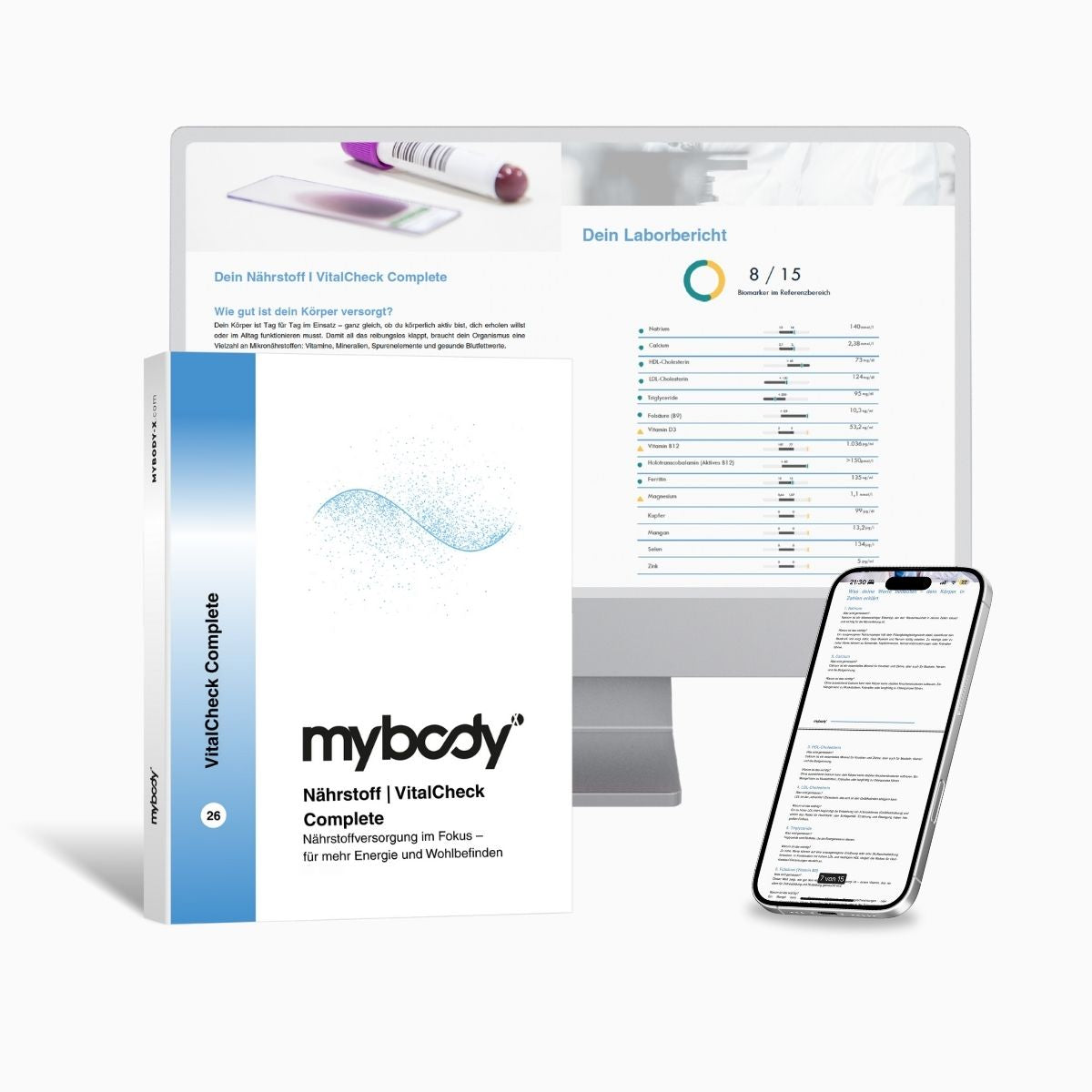
Nutrient | VitalCheck Complete
15 blood values from a capillary blood sample collected at home: Ferritin, 25-OH vitamin D3, vitamin B12, transcobalamin, folic acid, calcium, magnesium, sodium, zinc, selenium, copper, manganese, as well as HDL, LDL, and triglycerides.
Price: €169.00 (instead of €199.00) · Sample type: Capillary blood (at home) · Processing time: Evaluation 4–8 days after the sample is received · Laboratory: ISO-certified in Germany, GDPR-compliant
View the Nutrient CheckTo be clear—and this is the most important paragraph in this chapter: This test does not measure thyroid levels. TSH, fT3, and fT4 are not included. If you suspect an underactive thyroid, this test will not provide an answer, and you should consult a medical practice. The same applies to ferritin: it can be measured, but its interpretation and the search for underlying causes belong in the hands of a doctor.
A self-test does not replace medical evaluation and does not provide a diagnosis. It offers a snapshot of your nutrient status—it is most useful as a basis for discussion, not as a final result.
You can find more blood tests in the Nutrient Deficiency Tests Collection from mybody®.
Details about price, sample type, processing time, and markers are taken from the mybody® product page (as of July 2026) and may change.
Context: What a test can—and cannot—do
A nutrient test provides a baseline assessment: It shows whether values such as ferritin, vitamin D, or B12 are within the reference range—and prevents supplementing based on guesswork.
What it cannot do: tell you how quickly your metabolism is working. No blood test measures basal metabolic rate—for that, you need indirect calorimetry or doubly labeled water. Online formulas provide only rough estimates.
It also does not identify a cause: Low ferritin does not show whether the underlying issue is low intake, impaired absorption, or blood loss. And an unremarkable result does not rule out illness because thyroid values are not included.
The greatest benefit comes from combining your two-week assessment, your test results, your medication list, and an honest description of your symptoms.
Conclusion
A pathologically slow metabolism is rare. Basal metabolic rate is largely determined by lean body mass and varies only to a limited extent among people with a similar build. If diet and exercise have no effect, the explanation is almost always energy balance.
The four most common causes: underestimating energy intake, less everyday movement, lost muscle mass, and too little sleep. You can document all four yourself over two weeks—that’s exactly where you should start.
If symptoms such as persistent fatigue, sensitivity to cold, or shortness of breath continue, you should see a doctor—especially if an underactive thyroid, anemia, or a medication side effect is suspected.
Frequently asked questions (FAQ)
Know first, then act
The nutrient | VitalCheck Complete shows you 15 blood values from a sample taken at home—including ferritin, vitamin D3, and vitamin B12. Analyzed in an ISO-certified laboratory in Germany and GDPR-compliant. Thyroid values are not included.
View VitalCheck Complete All nutrient testsYou might also be interested in this
→ Nutrient Deficiency Test: When It Makes Sense
Which values actually help with persistent fatigue—and which do not.
→ Vitamin and Mineral Test: What It Really Shows You
How to correctly read your test results and interpret reference ranges.
Sources
- Institute for Quality and Efficiency in Health Care (IQWiG) / gesundheitsinformation.de: “Causes of obesity” (2022), “Underactive thyroid” (2023), and “Iron deficiency and iron deficiency anemia” (2022). gesundheitsinformation.de
- Pontzer, H. et al. (2021): Science 373(6556):808–812 – Energy expenditure over the course of life. repository.lsu.edu
- Johnstone, A. M. et al. (2005): American Journal of Clinical Nutrition 82(5):941–948 – Factors influencing basal metabolic rate. abdn.elsevierpure.com
- Lichtman, S. W. et al. (1992): New England Journal of Medicine 327(27):1893–1898 – Reported versus measured energy intake. pubmed.ncbi.nlm.nih.gov
- Levine, J. A. et al. (1999): Science 283(5399):212–214 – Daily activity and fat accumulation. pubmed.ncbi.nlm.nih.gov
- Al Khatib, H. K. et al. (2017): European Journal of Clinical Nutrition 71:614–624 – Sleep deprivation and energy balance. nature.com
- Nunes, C. L. et al. (2022): British Journal of Nutrition 127(3):451–469 – Adaptive thermogenesis after weight loss. cambridge.org
- Blazey, P. et al. (2023): International Journal of Behavioral Nutrition and Physical Activity 20:133 – Meal frequency and body composition. link.springer.com
Quote, thyroid, iron deficiency, and medications according to [1]; age-related changes [2], fat-free mass [3], energy intake [4], daily activity [5], sleep [6], adaptive thermogenesis [7], meal frequency [8]. All figures are group averages. Product information from the product page on mybody-x.com; subject to change.

mybody® Editorial & Expert Team
This article was created by the mybody® editorial and expert team, which brings together expertise in laboratory diagnostics, blood analysis interpretation, nutritional science, and nutrigenetics. Learn more about our team on our editorial and author page.
Published on July 28, 2026 · Last updated on July 28, 2026
Medical notice: This article is intended for general information and does not replace medical advice, diagnosis, or treatment. Persistent fatigue, unintentional weight changes, sensitivity to cold, or shortness of breath should be medically evaluated. Never discontinue or change medication without consulting a doctor.




Share now:
Lactose Intolerance Self-Tests: 7 Methods Compared
Naturally Boost Your Metabolism: What Works—and What’s Merely Claimed