

Boosting the metabolism naturally: What works—and what is merely claimed
The key points at a glance
Yes, you can naturally boost your metabolism—but the magnitude matters. Four levers have been shown to be effective: everyday movement, muscle mass, protein intake, and sleep. Metabolism boosters, ginger shots, and cold showers, on the other hand, have effects in the range of a few dozen kilocalories per day or have not been substantiated at all.
This article categorizes the best-known methods by strength of evidence and gives a documented figure for each, along with the institution and year. It also shows where a lab test makes sense—and where it does not: the Nutrient | VitalCheck Complete from mybody® (MYBODY Lab GmbH) measures 15 markers in capillary blood for €169.00 (instead of €199.00), analyzed 4–8 days after the sample is received at an ISO-certified laboratory in Germany. It does not measure metabolism or calorie expenditure.
Read Chapter 2 for a quick overview of all the levers, Chapter 6 for the myth check, and Chapter 9 if you are considering whether a test is suitable for you at all.
What to expect in this article
2. What levers are available—and how much difference do they really make?
3. How much difference does having more muscle mass actually make?
4. What should we make of metabolism cures and detox programs?
5. What does nutrition offer: protein, meal timing, caffeine?
6. Which claims do not stand up to scrutiny?
7. Why sleep and everyday movement are more beneficial than any booster
8. What happens if you eat very little?
9. Is a test worthwhile—and who is it less suitable for?
10. How mybody® can help
11. Putting it into perspective: What a nutrient test can—and cannot—do
12. Conclusion
Frequently asked questions
Sources
What does “boosting the metabolism” actually mean?
“Boosting the metabolism” almost always means one thing in everyday language: increasing daily energy expenditure. Energy expenditure is the sum of all calories your body burns in a day—while lying down, digesting, and moving.
According to the Institute for Quality and Efficiency in Health Care (IQWiG, 2022), resting energy expenditure accounts on average for about 70% of total calorie needs. Energy expenditure from physical activity accounts for around 20%, and the thermic effect of food for the remaining roughly 10%.
This breakdown already explains why most “boosters” disappoint. Almost all of them target the smallest of the three components: the work of digestion. The German Nutrition Society (DGE) puts it this way in its FAQ on energy intake (as of 2025): the thermic effect of food generally accounts for around 10% of total energy expenditure.
It is also important to distinguish between basal metabolic rate and resting metabolic rate. According to the DGE (as of 2025), resting energy expenditure is about 10% higher than basal metabolic rate because it is not measured under strict fasting and resting conditions. Anyone who conflates the two terms is comparing figures that do not match.
What magnitude is realistic in the first place?
The DGE reference values (as of 2015) give adults aged 25 to under 51 with PAL values of 1.4 / 1.6 / 1.8 reference values of 2,300 / 2,700 / 3,000 kcal per day for men and 1,800 / 2,100 / 2,400 kcal per day for women. There are therefore several hundred kilocalories between the sedentary and active versions of the same person.
The PAL value describes physical activity throughout the day. According to the DGE (as of 2025), a PAL of 1.4 to 1.5 corresponds to exclusively sedentary work, while a PAL of 2.0 to 2.4 corresponds to physically demanding occupational work. Regular exercise adds approximately 0.3 PAL units per day.
This article evaluates the individual methods according to the strength of the evidence and dispels common claims. It is deliberately not a day-in-the-life article—how to incorporate the levers into your daily routine is explained in How do I activate my metabolism?. The biological processes behind fat burning are explained in Metabolism and fat burning. And if your starting point is more along the lines of “nothing has changed for me in months,” Slow metabolism: What can I do? is the right place to start.
What levers are there—and how much do they really achieve?
The seven best-known levers differ less in whether they work than in how strongly and how well-established their effects are. The following overview compares them according to the same three criteria: established magnitude, reliability of the evidence, and effort.
All figures in the table come from the sources cited in the references. Values without reliable evidence have deliberately not been included—even when they are frequently circulated online.
| Lever | Established magnitude | How well established is it? | Effort |
|---|---|---|---|
| Everyday movement (NEAT) | 6–10% of total energy expenditure with a sedentary lifestyle, 50% or more in very active people; the difference between two people of the same size can be up to 2,000 kcal per day (Endotext, 2022) | Well documented, but with very large individual variation | Low, but distributed throughout the day |
| Muscle building | Resting energy expenditure increased from 1,653 to 1,726 kcal per day, or by around 73 kcal (about 5%) (Aristizabal et al., 2015) | Well documented—the effect is real, but smaller than often claimed | High: several months of regular strength training |
| Protein content of the diet | Thermic effect: protein 20–30%, carbohydrates 5–10%, fat 0–3% of ingested energy (after Tappy, 1996, cited in Mustafa et al., 2024) | Well documented for the individual nutrient; effective only within the 10% share attributable to digestion | Low: redistribution within meals |
| Sleep duration | With 4 instead of 10 hours in bed, leptin fell by 18%, ghrelin rose by 28%, and hunger increased by 24% (Spiegel et al., 2004) | Well documented for appetite hormones—not as a direct increase in calorie expenditure | Low to moderate, depending on life circumstances |
| Caffeine | Around 4.8% higher energy expenditure over 24 hours (Hursel et al., 2011) | Demonstrated, but measured as a short-term effect over around three hours (Astrup et al., 1990) | Very low |
| Spicy spices and ginger | Capsaicin around 70 kcal per day, dihydrocapsiate around 50 kcal per day (Szallasi, 2022); ginger +42.7 kcal per day (Mansour et al., 2012) | Weak: small effects; for ginger, only a pilot study with ten men | Low |
| Cold and cold showers | Around 188 kcal more per day at a constant ambient temperature of 16–19 °C instead of 24 °C (Huo et al., 2022) | Demonstrated only for a consistently cool environment—not for extrapolation to brief cold showers | High: living and working in a consistently cool environment |
The table reveals a pattern: The more convenient a lever is, the smaller its documented effect usually is. The two levers with the widest range—everyday movement and muscle building—are also the ones that take time.
How much does having more muscle mass actually help?
Muscle mass measurably increases resting energy expenditure—but significantly less than the commonly quoted rules of thumb suggest. The IQWiG (2022) states verbatim: “A person’s resting energy expenditure depends primarily on the proportion of muscle mass in their body weight.” The statement is correct. It simply says nothing about the magnitude.
The scale is illustrated by a tissue analysis by Wang and colleagues (American Journal of Clinical Nutrition, 2010): Skeletal muscle consumes around 12.6 kcal per kilogram per day, while adipose tissue consumes around 4.4 kcal per kilogram per day. So, mathematically, an additional kilogram of muscle mass burns around eight more kilocalories per day than the same kilogram of adipose tissue.
For comparison, the same analysis gives the following figures for organs: the liver uses around 194 kcal per kilogram per day, while the brain uses around 233 kcal per kilogram per day (Wang et al., 2010). Resting energy expenditure is therefore determined overwhelmingly by tissues whose mass you cannot increase through training.
Key point: According to Wang et al. (2010), skeletal muscle uses around 12.6 kcal per kilogram per day. The widespread claim that one kilogram of muscle burns 50 to 100 kilocalories per day overestimates the figure by four- to eightfold.
The practically measurable overall effect of a training program is nevertheless greater than these eight kilocalories—because training changes more than just the amount of tissue. In a training study by Aristizabal and colleagues (European Journal of Clinical Nutrition, 2015), resting energy expenditure increased from 1,653 to 1,726 kcal per day, or by around 73 kcal per day, equivalent to about 5%—with considerable individual variation.
Seventy-three kilocalories per day are no reason to give up strength training. But they are not a shortcut either. The real benefit lies elsewhere: preserving muscle during weight loss, improving resilience in everyday life, and the fact that people who train often move more outside their workouts.
In its Guidelines on Physical Activity and Sedentary Behaviour (2020), the World Health Organization (WHO) recommends that adults engage in 150 to 300 minutes of moderate or 75 to 150 minutes of vigorous aerobic activity per week, along with muscle-strengthening activity on at least two days. This recommendation is the most reliable framework available on this topic.
And what about age?
The often-heard claim that metabolism “slows down after 30” does not stand up to scrutiny. An analysis by Pontzer and colleagues (Science, 2021) shows that energy expenditure relative to fat-free mass is stable from ages 20 to 60 and only then declines by around 0.7% per year.
What actually changes between the ages of 30 and 60 is usually body composition and everyday movement—not the metabolic rate per kilogram of active mass. That is good news, because both can be influenced.
What should we make of metabolic cures and detox programs?
Metabolic cures, detox weeks, and detox programs almost always promise the same thing: a “reset” of the metabolism within a few days. The German Nutrition Society (DGE) has a clear assessment of this product category.
Important for context: In the following passage, the DGE explicitly refers to detox and cleansing diets—not to exercise, nutrition, or forms of training in general. The same publication previously states verbatim: “There is currently no scientific evidence for the effects of so-called cleansing or detox diets.” The quoted sentence refers specifically to this type of diet.
“
“The extent to which such a diet boosts metabolism is questionable.”
German Nutrition Society (DGE)
“Detox diets,” DGEinfo 3/2018, pp. 39–45, 2018
Why do such diets nevertheless often work in the short term? Because they generally reduce energy intake significantly. The weight lost during the first few days comes primarily from water and depleted glycogen stores, not fat tissue.
There is also an effect that never appears in advertising: After weight loss, resting energy expenditure falls in addition to the expected amount. Martin and colleagues (International Journal of Obesity, 2022) quantify this metabolic adaptation at around 40 kcal per day; with a 50% energy deficit over seven days, it was around 70 kcal per day.
A diet intended to “boost” the metabolism therefore tends to lower resting energy expenditure—the exact opposite of what it promises. Anyone looking for a more in-depth overview of individual foods and their effects can find it in the existing article What boosts the metabolism? in the mybody® Science Portal.
What does nutrition contribute: protein, meal timing, caffeine?
Of the three levers mentioned, only one is truly well supported: the proportion of protein. Based on current evidence, meal timing does not alter total energy expenditure, and caffeine has a brief and weak effect.
Protein: the only macronutrient with a noticeable thermic effect
Every meal requires energy to process. This thermic effect varies considerably depending on the nutrient: protein 20 to 30%, carbohydrates 5 to 10%, fat 0 to 3% of the energy consumed (according to Tappy, 1996, cited in Mustafa et al., 2024).
That sounds like a lot, but it only affects a small component: According to the DGE (as of 2025), the overall thermic effect of food is approximately 10% of total energy expenditure. Increasing the proportion of protein therefore shifts part of one-tenth—not more, but not nothing either.
The second, often more important point in practice: Protein-rich meals generally keep you feeling full for longer. This makes it easier to maintain a consistent energy intake without constantly feeling hungry—and at the same time supports muscle retention while losing weight.
Meal timing: no effect on total energy expenditure
Whether you eat three or six meals does not change daily energy expenditure. Bellisle, McDevitt and Prentice summarized the evidence in the British Journal of Nutrition (1997) as follows: “These studies provide a very strong consensus that there is no effect of meal pattern on total energy expenditure."
The reason is simple: the thermic effect depends on the total amount and composition of food, not on how it is divided. Six small meals produce six small digestive effects instead of three large ones—the total remains the same.
Caffeine and green tea: small, short-lived, and often overestimated
Caffeine measurably increases energy expenditure. In the review by Hursel and colleagues (Obesity Reviews, 2011), caffeine increased 24-hour energy expenditure by around 4.8%, while catechin–caffeine mixtures increased it by around 4.7%.
These two figures are the actual finding: The combination of catechins and caffeine was no more effective than caffeine alone. An effect of catechins on energy expenditure independent of caffeine has therefore not been demonstrated. Green tea is consequently not an additional lever beyond the caffeine it already contains.
There is also the time limitation. Astrup and colleagues (American Journal of Clinical Nutrition, 1990) measured the thermogenic effect of caffeine as a short-term effect lasting three hours. It does not produce a sustained state.
Which claims do not stand up to scrutiny?
Four claims appear particularly persistently in advice articles and training plans. All four can be tested against published data—and all four either fail the test or turn out to be considerably smaller.
Two further claims deserve a nuanced answer rather than a blanket no. The first concerns ginger shots and spicy spices: An effect is indeed measurable here; it is simply small. Ludy, Moore, and Mattes summarize it in Chemical Senses (2012) with the sentence: “The magnitude of these effects is small.”
Quantitatively, this amounts to around 70 kcal per day for capsaicin and around 50 kcal per day for dihydrocapsiate (Szallasi, Pharmaceuticals, 2022). For ginger, there is an increase in the thermic effect of food of 42.7 kcal per day—but this comes from a pilot study with only ten men (Mansour et al., Metabolism, 2012). A ginger shot is therefore a drink, not a fat burner.
The second concerns “negative-calorie foods.” Clegg and Cooper (Proceedings of the Nutrition Society, 2012) examined this using celery: 100 grams contain 16 kcal, around 86% of which was used up by digestion. No negative energy balance resulted—in the end, a small surplus remained.
Four Questions to Check Every Metabolism Claim
- ✓ Is a figure provided? – Without an indication of magnitude, an effect can be neither assessed nor refuted.
- ✓ Where does the figure come from? – The institution, study, and year must be named, not just “studies show.”
- ✓ How large was the study? – A pilot study with ten people does not support a general recommendation.
- ✓ Do the measurement conditions match the recommendation? – An effect at a constant 16 °C says nothing about a three-minute cold shower.
Why Sleep and Everyday Movement Do More Than Any Booster
Everyday movement is the lever with the widest documented range of effects. This does not mean exercise, but everything else: walking, standing, climbing stairs, housework, fidgeting. In the scientific literature, this is referred to as NEAT—non-exercise activity thermogenesis.
According to von Loeffelholz and Birkenfeld (Endotext, as of 2022), the NEAT difference between two people of the same size can be up to 2,000 kcal per day. Its share of total energy expenditure is 6 to 10% for a predominantly sedentary lifestyle and 50% or more for very active people.
How strongly the body regulates this channel itself is shown by a classic overfeeding study: With an additional 1,000 kcal per day, total energy expenditure increased by 554 kcal per day, of which around 60% came from NEAT. The individual range extended from −98 to +692 kcal per day (Levine et al., 1999, cited in Endotext, 2022).
The biggest lever is not what you take in addition, but what you do throughout the day.
The biggest lever is not what you take in addition, but what you do throughout the day. None of the substances examined comes even close to the range between a sedentary day and an active day.
Sleep affects appetite, not expenditure
Sleep deprivation does not increase calorie expenditure—it shifts the hormones that regulate appetite. Spiegel and colleagues (Annals of Internal Medicine, 2004) found that, with four rather than ten hours in bed, there was 18% lower leptin, 28% higher ghrelin, and 24% stronger feelings of hunger.
The same pattern appears in the population. In a cohort analysis by Taheri and colleagues (PLOS Medicine, 2004), five rather than eight hours of sleep was associated with 15.5% lower leptin and 14.9% higher ghrelin; the BMI minimum occurred at a sleep duration of 7.7 hours.
That is why sleep is among the major levers in this article, even though it does not directly increase energy expenditure. People who chronically sleep too little are battling a hormonal state that systematically drives appetite upward.
The following overview shows the order in which these efforts are worthwhile. It is deliberately sorted by impact per unit of effort invested—not by popularity.
Maintain sufficient sleep
The BMI minimum in the cohort studied by Taheri et al. (2004) occurred at 7.7 hours of sleep. Short sleep measurably shifts leptin and ghrelin.
Increase everyday movement
According to Endotext (2022), NEAT accounts for 6–10% of total energy expenditure in a sedentary lifestyle—and 50% or more in very active people.
Strengthen your muscles
The WHO (2020) recommends muscle-strengthening activity on at least two days per week, in addition to aerobic activity.
Distribute protein
The thermic effect is 20–30% for protein, compared with 0–3% for fat (according to Tappy, 1996, cited in Mustafa et al., 2024).
What happens when you eat very little?
Very low energy intake lowers resting energy expenditure more than weight loss alone would explain. Technically, this phenomenon is called metabolic adaptation or adaptive thermogenesis.
Martin and colleagues (International Journal of Obesity, 2022) quantified this additional decline at around 40 kcal per day after weight loss. With an energy deficit of 50% over seven days, the figure was around 70 kcal per day.
The often-heard term “starvation mode” does describe something real—just on a different scale than commonly assumed. Forty to 70 kilocalories per day are no reason to demonize every calorie reduction, but they do explain why very strict diets often disappoint in the end.
A second point is more practically relevant: Very low energy intake also leads to muscle loss. Since skeletal muscle consumes around 12.6 kcal per kilogram per day according to Wang et al. (2010), this loss additionally affects resting metabolic rate—and does so permanently until the muscle is regained.
A third point concerns nutrient supply. Anyone who eats significantly less for weeks also takes in fewer vitamins, minerals, and trace elements. Whether this actually leads to a deficiency cannot be determined by how you feel—you need a blood test for that.
Is a test worthwhile—and who is it less suitable for?
A nutrient test answers a different question than “How fast is my metabolism?” It shows whether the building blocks the body uses are present—not how many calories it burns. This distinction determines whether a test makes sense for you.
A good fit for you if …
… you have felt tired and lacking in energy for months despite getting enough sleep and maintaining proper exercise and nutrition, and want to know whether an underlying deficiency may be contributing.
… you follow a vegetarian or vegan diet and want to know your current vitamin B12, transcobalamin, ferritin, and zinc status.
… you have recently changed your diet significantly or reduced your energy intake for an extended period and need a baseline value.
… you prefer a measured value over a guess before taking supplements.
Probably not if …
… you are looking for a number for your calorie expenditure. Blood values do not measure energy expenditure or basal metabolic rate—so a nutrient test is the wrong tool for that.
… you have acute or unexplained symptoms: severe unintentional weight loss, persistent rapid heartbeat, or blood in your stool require medical evaluation and should not be addressed with a self-test.
… you suspect a thyroid disorder. Thyroid values are not among the 15 markers and are not measured by this test.
… you are already receiving medical treatment and your laboratory values are regularly monitored there. In that case, an additional self-test will not provide any new insights.
The honest conclusion from this comparison: A test does not replace any of the four major levers. However, it can prevent you from spending months adjusting your exercise and diet while an underlying deficiency goes unchecked.
How mybody® can help
For the purpose described, mybody® offers an at-home blood test that determines the levels of 15 markers. The results are analyzed in an ISO-certified laboratory in Germany, and the data processing complies with the GDPR.
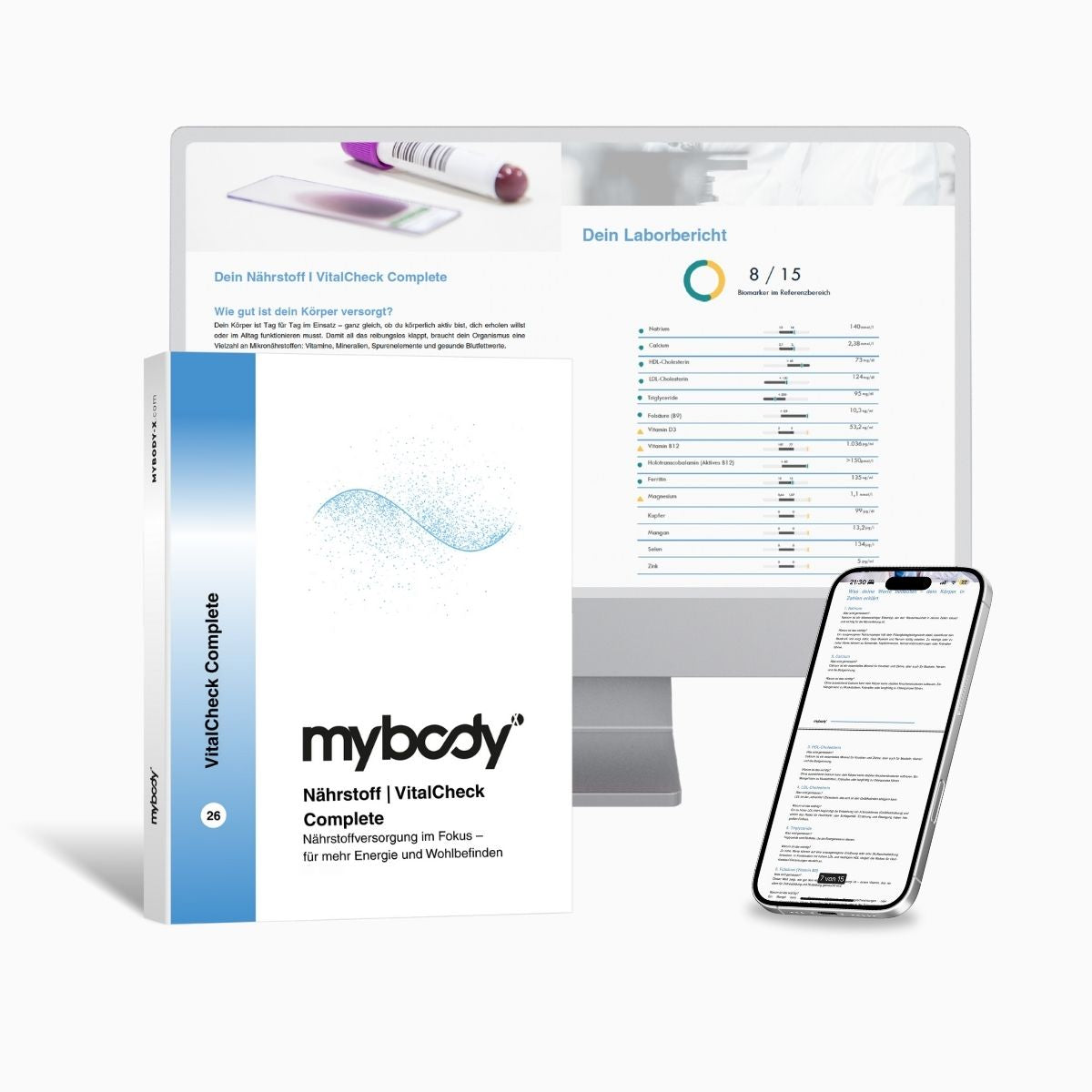
Nutrient | VitalCheck Complete
VitalCheck Complete measures 15 markers from capillary blood collected at home via a finger prick: 25-OH vitamin D3, calcium, magnesium, ferritin, folic acid, sodium, transcobalamin, vitamin B12, HDL, LDL, triglycerides, selenium, manganese, copper, and zinc.
Potassium and thyroid values are expressly not included. Nor does the test provide any information about your energy expenditure or basal metabolic rate.
Price: €169.00 (instead of €199.00) · Sample type: Capillary blood collected at home · Processing time: 4–8 days after sample receipt · Laboratory: ISO-certified, in Germany
For the nutrient | VitalCheck CompletePrice information as of July 28, 2026. Prices, marker coverage, and processing times may change—the linked mybody® product page (MYBODY Lab GmbH) is always authoritative.
For context on the brand: mybody® belongs to MYBODY Lab GmbH, works with an ISO-certified partner laboratory in Germany, and processes samples pseudonymously. Results are transmitted using SSL encryption.
Context: What a nutrient test can—and cannot—do
A nutrient test does not measure metabolism. It measures concentrations in the blood at a specific point in time. This distinction is the most important sentence in this chapter—and the one most often overlooked.
Specifically, this means that VitalCheck Complete does not tell you how many kilocalories you burn per day. The DGE reference values (as of 2015) are intended as a guide for this; depending on the PAL value, they range from 1,800 to 3,000 kcal per day.
Nor does a self-test provide a diagnosis. An abnormal result is an indication that should be medically evaluated—especially in the case of markers such as ferritin, which depend not only on iron stores but also on inflammatory processes.
The time perspective is limited as well. A blood value is a snapshot. It becomes particularly meaningful over time, through a second measurement after changing your diet or taking supplements.
And ultimately, no test replaces the levers discussed in this article. If you sleep too little, exercise hardly at all, and eat little protein, a blood draw will not change that—regardless of how good the results are.
Conclusion
Naturally stimulating your metabolism is possible—but the effective methods are unremarkable. Everyday movement, muscle mass, protein intake, and sleep contribute to the effect; everything else plays in a smaller league.
The figures make that clear: NEAT differences of up to 2,000 kcal per day (Endotext, 2022) on the one hand, around 4.8% from caffeine (Hursel et al., 2011), and around 42.7 kcal per day from ginger in a pilot study with ten men (Mansour et al., 2012) on the other.
Specifically, over the next few weeks: Keep your sleep duration stable, incorporate walking and standing into your day, include muscle-strengthening activity on at least two days per week (WHO, 2020), and distribute protein across your meals. These four points make up the entire evidence-based toolkit.
If you also want to know whether an underlying nutritional deficiency exists, a blood test is the sensible next step—with the clear expectation that it shows nutritional status, not calorie expenditure.
Frequently asked questions about boosting metabolism
Do you want to know what your current nutritional status looks like?
The nutrient | VitalCheck Complete measures 15 markers from capillary blood collected at home. Results are available 4–8 days after the sample arrives at an ISO-certified laboratory in Germany. The test measures nutritional status—not your calorie expenditure.
VitalCheck Complete View all nutrient testsYou might also be interested in
→ How can I activate my metabolism?
Implementing it in your daily routine: when each lever can realistically take effect in everyday life.
→ Sluggish metabolism: What to do when diet and exercise do not help?
The problem and possible causes when nothing changes despite making adjustments.
Sources
- German Nutrition Society (DGE): Detox diets. DGEinfo 3/2018, pp. 39–45 (2018)
- German Nutrition Society (DGE): FAQ on energy intake (as of 2025)
- Institute for Quality and Efficiency in Health Care (IQWiG): Causes of obesity (2022)
- Wang Z. et al.: Specific metabolic rates of major organs and tissues across adulthood. Am J Clin Nutr 92(6) (2010)
- von Loeffelholz C., Birkenfeld A. L.: Non-Exercise Activity Thermogenesis in Human Energy Homeostasis. Endotext (as of 2022)
- World Health Organization: Guidelines on Physical Activity and Sedentary Behaviour (2020)
The information on resting metabolic rate, activity energy expenditure, and the thermic effect of food is based on [3] and [2], while the reference values for energy intake and the PAL values are based on [2]. The values for muscle and adipose tissue come from [4], the information on everyday movement and NEAT from [5], and the exercise recommendations from [6]. The institute quotation comes from [1]. All other studies mentioned in the text are identified directly at the relevant point with the authors, academic journal, and year, and can be found there. All product information on mybody® (MYBODY Lab GmbH) comes from the official product pages at mybody-x.com, as of July 28, 2026.

mybody® editorial & expert team
Energy metabolism Nutritional science Blood analysis interpretation Laboratory diagnostics Nutrigenetics
This article was created and professionally reviewed by the mybody® editorial and expert team at MYBODY Lab GmbH. The team combines expertise in nutritional science, laboratory diagnostics, blood analysis interpretation, microbiome research, and nutrigenetics. Learn more about the people behind it on the mybody® authors' page.
Published on July 28, 2026 · Last updated on July 28, 2026
Medical notice: This article is intended for general information and is not a substitute for medical advice, diagnosis, or treatment. Self-tests provide indications, not diagnoses. If you experience persistent fatigue, unexplained weight loss, a racing heart, or other unclear symptoms, please consult a doctor. If you take medication, are pregnant, or are breastfeeding, discuss dietary changes and nutritional supplements with a doctor beforehand.




Share now:
Slow metabolism: What to do when diet and exercise don’t help?
Nutrition Testing: What Types There Are and What They Really Measure