

Bloated belly that looks pregnant: when it is harmless and when it is not
The essentials at a glance
A belly that looks five months pregnant in the evening and is flat again in the morning does not consist of fatty tissue. What visibly changes within a day is gas, fluid, or intestinal contents. A single observation therefore sharply narrows down the possible causes: whether the circumference fluctuates over hours or grows over weeks.
This article separates the causes for which German institutions provide figures from explanations that have spread online without anyone substantiating them. Where a figure is available, it is given here together with the institution and year. Where none is available, that is stated as well.
You will first read about what causes the increase in circumference, followed by the signs that belong in a doctor's office and the documented causes along with their frequency. Next comes the special case of a distended belly without flatulence and the case in which the bulge remains after giving birth. The final section covers common misconceptions, the role of hormones, the four steps to assessing your own situation, and the limitations.
What to expect in this article
1. What a belly that looks pregnant consists of
2. When your belly no longer belongs in the kitchen
3. How often irritable bowel syndrome is actually behind it
4. The causes for which documented figures are available
5. Bloated belly without flatulence: what could be behind it
6. When the bulge remains after giving birth
7. Four explanations from the internet—and what remains of them
8. What hormones and the thyroid have to do with waist circumference
9. How to know what is behind your symptoms
10. What you can have measured at home for this set of symptoms
11. Which approach fits which question
12. Limitations: what a test cannot clarify about this symptom
13. Who should consider a measurement—and who should not
14. What matters in the end
Frequently asked questions
Sources
What a belly that looks pregnant consists of
Fatty tissue builds up over weeks and breaks down over weeks. A belly that is flat in the morning and extends over the waistband in the evening can therefore hardly consist of fat. What visibly changes within a day is gas, fluid, or intestinal contents.
The medical term for gas accumulation in the gastrointestinal tract is meteorism. It describes a condition, not a disease. That is why the starting point is not a diagnosis but an observation.
Key message
A waist circumference that visibly changes within a day is not caused by fatty tissue. Whether the circumference has increased over hours or over months determines which causes are even possible.
Why your waist circumference increases throughout the day
Over the course of the day, the digestive tract accumulates what was not there in the morning: swallowed air, gases from bacterial breakdown, and the contents of meals. This influx does not continue at night, which is why the next morning starts out flatter.
This has a practical consequence for you. If you want to measure your waistline, measure it twice on the same day: once immediately after getting up and once late in the evening. The difference tells you more than any individual number.
A waistline that remains the same in the morning and evening and slowly increases over months points in a different direction than a daily fluctuation.
What the comparison with pregnancy describes
The comparison describes the shape, not the cause. A bloated belly bulges forward and is difficult to pull in. Many people recognize this from everyday life, which is why they reach for that explanation.
For many people, this conceals a second, unspoken question: Could I actually be pregnant? A pregnancy test answers this reliably, and it does so more cheaply and quickly than any other evaluation. That is why it belongs at the beginning, not the end.
If the test is negative and your belly remains distended, the real search begins. It leads either through the digestive system or through the organs in the pelvis, and hormones affect both. Which direction applies to you depends on observations you can make yourself.
When your belly no longer belongs in the kitchen
Before you read on, it is worth comparing your symptoms with the following list. If any of these points applies to you, making an appointment at a medical practice is the next step—not searching for the right home remedy.
According to the Institute for Quality and Efficiency in Health Care (IQWiG, 2023), additional symptoms such as significant weight loss, blood in the stool, fever, or paleness are more indicative of another intestinal disease than of irritable bowel syndrome. According to the same source, blood in the stool should always be medically examined to determine its cause.
These signs should be evaluated by a doctor
Blood in the stool
light or dark, once or repeatedly—always have it evaluated
Significant unintentional weight loss
although you are neither eating less nor exercising more
Fever or noticeable paleness
together with the abdominal symptoms, not as an isolated infection
A waistline that persists and continues to increase
over weeks, without the daily fluctuation between morning and evening
Lower abdominal pain with changes in your menstrual cycle
such as bleeding that is clearly heavier or irregular
Feeling full unusually early
when even small portions cause a feeling of pressure, and this persists for weeks
This list does not replace a medical examination, nor is it a diagnostic checklist. It marks the point at which changing your diet would be the wrong answer to the right question.
Two points on this list stand on their own: blood in the stool and a waistline that continues to increase without daily fluctuations. Each requires medical evaluation on its own, without waiting and without a second sign.
For the remaining points, it is the combination that matters. The picture becomes noteworthy when several of these signs occur at the same time and persist for weeks.
Many people researching this topic have already visited a medical practice. What they lack is a data point, not a promise. If you recognize yourself in this, a second appointment with a specific question often yields more than the first one without one.
How often irritable bowel syndrome is actually the cause
Among the explanations for a recurring distended abdomen, irritable bowel syndrome is the most widespread in the population. At the same time, it is the explanation that is mentioned least often because it does not identify a single cause.
Documented source
“Estimates suggest that about 10 to 20 out of every 100 people have irritable bowel syndrome.”
Institute for Quality and Efficiency in Health Care (IQWiG)
Irritable bowel syndrome, 2023 edition
Ten to twenty out of every hundred people (IQWiG, 2023) is a lot. This explains why so many searches are made about this abdominal sensation and why so few answers can name a clear cause.
Why irritable bowel syndrome is not a second-class diagnosis of exclusion
According to the IQWiG (2023), a feeling of fullness, bloating, or slimy discharge may be additional signs of irritable bowel syndrome. The distended abdomen is therefore not an incidental finding but a described feature of the condition.
The objection is justified: A diagnosis made by ruling out other diseases can feel like a diagnosis of convenience. Nevertheless, something else is decisive. It rules out the causes for which waiting could be harmful, thereby clearing the way to focus on everyday factors.
For personal observation, this means: Anyone who has been told that irritable bowel syndrome is the explanation does not keep searching for the one cause. They look for the triggers that personally increase the fluctuations.
The causes for which documented figures are available
In addition to irritable bowel syndrome, there are three other causes for which a German institution provides prevalence figures. All three can manifest as a distended abdomen, and all three are investigated differently.
Prevalence in figures
5–15 %
of people from Europe cannot digest lactose. Symptoms explicitly include a bloated abdomen
1–2 %
of people in Europe have confirmed celiac disease, meaning an intolerance to gluten
40–80 %
of all women are estimated by experts to have uterine fibroids, usually without symptoms
Source: Institute for Quality and Efficiency in Health Care (IQWiG); lactose intolerance, 2024 edition; celiac disease, 2022 edition; uterine fibroids, 2025 edition
Lactose intolerance: the cause with the clearest test
The IQWiG lists a bloated abdomen, feeling of fullness, lower abdominal pain, severe flatulence, diarrhea, nausea, and vomiting as symptoms of lactose intolerance (2024). The bloated abdomen comes first in the list.
It is diagnosed using a hydrogen breath test. After drinking a lactose solution, the hydrogen content in the exhaled air is measured several times (IQWiG, 2024). This procedure is the medical standard and cannot be replaced by any self-test.
Before that, there is an observation that costs nothing: two weeks without dairy products, followed by a deliberate serving, while recording both periods. If the symptoms change in this pattern, it is a clue to discuss at the medical practice. It is not a substitute for a breath test.
Celiac disease: why avoiding gluten before the test is a mistake
According to IQWiG (2022), gastrointestinal symptoms of celiac disease include abdominal pain, persistent diarrhea or constipation, and a distended abdomen. At one to two in every hundred people, its prevalence is considerably lower than that of irritable bowel syndrome.
One point determines the order of testing. According to the same source, the celiac disease test is only meaningful if sufficient gluten has been consumed beforehand. Anyone who gives up bread on their own and only gets tested afterward makes the result unusable.
Fibroids: the cause no digestive test can find
Fibroids are benign muscle nodules in the uterus. Experts estimate that about 40 to 80 percent of all women have them (IQWiG, 2025). Most do not notice them.
Where they cause symptoms, IQWiG describes them as unclear pain and feelings of pressure in the lower abdomen. A larger fibroid can push the lower abdomen forward, and this bulge does not fluctuate throughout the day.
For assessing the situation, this is the most important point in this chapter: A constant abdominal circumference without daily fluctuations should be evaluated by a gynecologist, and no digestive or blood test can explain it. An ultrasound at a medical practice takes minutes.
Distended abdomen without gas: what might be behind it
Many people describe exactly this combination: The abdomen is taut and distended, but hardly any gas escapes. It seems contradictory, but it is not.
Gas in the intestine creates bulk, regardless of whether it leaves the body. If it spreads along longer sections of the intestine instead of collecting in one place, it creates pressure without audible release. The volume is the same.
Stool volume and transit speed
Slow intestinal transit fills the large intestine, and its contents need space. Anyone who simultaneously eats more fiber to address the symptoms initially increases the volume in the intestine even further.
In practice, this means increasing fiber gradually and accompanying it with sufficient fluids. Anyone who increases it abruptly often notices their waistline increasing at first, even though the overall approach was not wrong. How long this transition takes varies from person to person; there is no established timeframe for it.
Fluid in the tissue instead of gas in the intestine
Fluid retention in the abdominal cavity and abdominal wall also increases abdominal circumference, and it does so without any digestive sounds. It often follows the menstrual cycle, a salty meal, or a long day spent sitting.
A clue can be found elsewhere on the body: If sock marks also appear around your ankles in the evening, this suggests a shift of fluid throughout the body rather than a purely intestinal issue.
There is no documented figure from a German institution for how often a distended abdomen without bloating is due to fluid rather than gas. That is why none is given here. An estimate would be the worse error.
When the bulge remains after giving birth
There is one case in which the abdomen actually looks pregnant because it was pregnant once. It has nothing to do with gas or fluid, and diet cannot influence it.
In the German Journal of Sports Medicine (2024), Taylan and Hutterer describe diastasis recti abdominis as a condition “characterized by the separation of the rectus abdominal muscles at the median linea alba.” In German, this is called Rektusdiastase: The two bands of the rectus abdominis muscles move apart, and the connective tissue between them is stretched.
How common diastasis recti actually is
According to the same overview, the separation occurs in two-thirds to 100 percent of pregnant women in the third trimester, depending on the study. Twelve months after giving birth, it is still present in 36 percent of women (Taylan and Hutterer, German Journal of Sports Medicine, 2024).
These two figures put two things into perspective. During pregnancy, the stretching is normal and not a finding. One year later, it still affects just over one in three women, and then it is a separate issue.
How to distinguish it from a bloated abdomen
The pattern differs in one respect: The bulge runs lengthwise down the middle of the abdomen and becomes more pronounced when you tense your muscles instead of disappearing. When getting up while lying down, you may sometimes see a narrow ridge along the middle.
You can feel for it as follows: lie flat on your back with your legs bent and your fingertips across the middle of your abdomen next to your navel. Then lift your head and shoulders a few centimeters. If you feel a soft gap between the firm muscle bands, that is the separation.
This is guidance, not an examination. How wide a gap may be depends on body type and the measurement site, and its assessment belongs in a medical practice.
What helps—and what does not
Taylan and Hutterer identify physiotherapy as the gold standard for diastasis recti in the same overview (2024). The way forward is therefore exercise under professional guidance, not diet and not a test.
No blood test and no intestinal test detects diastasis recti. If your bulge has remained after giving birth and you can feel a gap when palpating it, physiotherapy assessment is the next step. The remaining chapters of this article do not apply to you, or apply only afterward.
Four explanations from the internet and what remains of them
The following four statements appear in many advice articles on this topic. All four sound plausible, and all four stand up to scrutiny only partially.
Checked against the evidence
Widespread
“A fifth-month pregnant-looking belly is caused by belly fat.”
Supported by evidence
Fat tissue changes over weeks. A circumference that visibly fluctuates between morning and evening is caused by gas, fluid, or intestinal contents. The daily fluctuation is the distinguishing feature.
Widespread
“If no gas comes out, it isn’t a bloated abdomen.”
Supported by evidence
IQWiG (2023) lists a feeling of fullness and bloating separately as possible signs of irritable bowel syndrome. Abdominal distension is caused by volume in the intestine, not by the audible release of gas.
Widespread
“I’ll stop eating gluten, then I’ll see whether I tolerate it.”
Supported by evidence
Celiac disease testing is informative only if sufficient gluten has been consumed beforehand (IQWiG, 2022). Avoiding gluten before the evaluation prevents the result instead of producing it.
Widespread
“A colon cleanse flushes out a bloated abdomen.”
Supported by evidence
There is no supporting source from a German institution for flushing out excess fluid. The diagnostic approaches that are supported are the hydrogen breath test for lactose intolerance and celiac disease testing while continuing to consume gluten (IQWiG, 2022 and 2024).
When people want to “detox” or flush out excess fluid, they are referring to something real: They feel heavy, tired, and bloated. The need is legitimate, but the explanation does not hold up. The evidence-based approach is to investigate intolerances and observe your own triggers.
What hormones and the thyroid have to do with abdominal circumference
Hormones affect abdominal circumference in two indirect ways: through fluid balance and through the speed of intestinal transit. Both mechanisms can increase circumference without any change in diet.
An underactive thyroid slows many processes in the body, including digestion. There is no established figure for how often it explains a bloated abdomen. That is why there is no figure here, only the note that the suspicion can be checked with a few blood values.
Which values actually test for suspected thyroid problems
The value first measured in a standard laboratory is TSH. It describes the control signal from the pituitary gland, not the thyroid hormones themselves. Only the free hormones fT3 and fT4 show what is actually available.
This has a consequence for your preparation: If your report lists only one TSH value, you have only part of the picture. This distinction belongs in the conversation at the doctor’s office because it determines the next test.
The cycle is a separate topic, not the subject here
If your abdomen swells in the days before your period and then subsides afterward, it follows the cycle. This is a distinct pattern with its own triggers, and it is described elsewhere: Bloated Stomach Before and During Your Period.
This article addresses abdominal swelling that occurs independently of the cycle or lasts throughout the month. The distinction is important because the two patterns lead to different next steps.
Chapter at a glance
Hormones affect waist circumference through fluid balance and the speed of intestinal transit, not through the amount of food. Suspected hypothyroidism can be checked using TSH and the free hormones fT3 and fT4; a TSH value alone shows only part of the picture. If your abdomen swells and then subsides in relation to your cycle, that is a distinct pattern with its own triggers.
How to find out what is behind your symptoms
Up to this point, we have focused on causes. Now it is about the order in which you narrow them down for yourself. The following four steps prepare you for a conversation at a medical practice; they do not replace it.
Measure twice a day
Measure your waist circumference in the morning after getting up and in the evening for two weeks. The difference is what matters.
Record your meals
What, when, and how much. Without evaluation, without making changes. Just observe at first.
Mark cycle days
Only when viewed side by side can you see whether the circumference follows the cycle or increases independently of it.
Taking your records into the conversation
Two weeks of data shorten the medical history and make the next examination more targeted.
The order is no coincidence. If you make changes first and observe afterward, you ultimately will not know what caused the change. If you record your symptoms for two weeks first, you have a baseline against which you can compare everything else.
What you can have measured at home for this set of symptoms
If your records show day-to-day variation, the route leads through digestion. Two tests from mybody®x (MYBODY Lab GmbH) start there: one examines the composition of the gut flora, and the other examines blood values related to the thyroid and iron stores. You collect the sample at home.
The caveat that applies to both: neither measures waist circumference, and neither detects a change in the pelvis. They provide values that you can bring to a conversation together with your records. The bacteria and markers you can look up in the gut encyclopedia are fully disclosed.
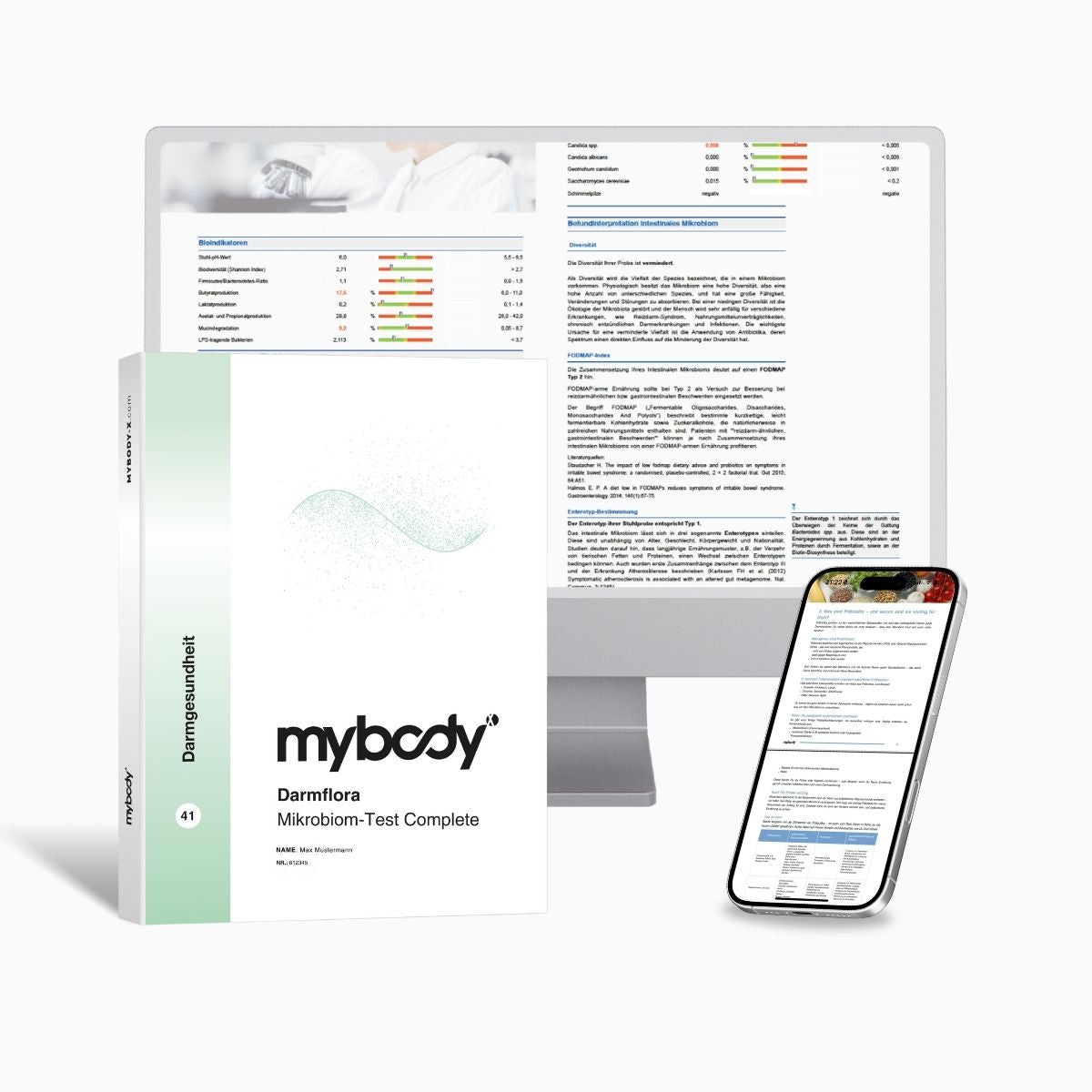
Gut test from a stool sample
Microbiome gut test | Complete
Using DNA sequencing, it records more than 1,500 bacterial species in the gut flora and assesses their composition. What the test does not do: The product page lists nutrition and digestion as areas of application, but has no section on bloating or abdominal circumference. It does not identify a cause of your symptoms, replace testing for lactose intolerance or celiac disease, or provide a medical assessment, according to its own information.
Laboratory analysis 5–10 business days after sample receipt
Information from the product page without a location, accessed 27 August 2026

Capillary blood test
Women’s Wellness Check
18 values from a blood sample, including the thyroid profile with TSH, fT3, and fT4, as well as ferritin, vitamin B12, and vitamin D3. What the test does not do: According to the product page, it does not measure cycle hormones, meaning neither estradiol nor progesterone or FSH. The product page has no section on abdominal circumference itself, and an abnormal value should be assessed by a doctor.
Laboratory analysis 3–5 business days after sample receipt
accessed 27 August 2026
Which option fits which question
There are four ways to address a belly that looks pregnant. They are not mutually exclusive, but they answer different questions. The table compares them according to the same four criteria.
| Criterion | Gynecological evaluation | Breath test at a medical practice | At-home test | Observation only |
|---|---|---|---|---|
| Answers the question | Could a change in the pelvis be behind this, such as a fibroid? | Can I tolerate lactose? | Where do my gut flora and blood values currently stand? | What pattern does my abdominal circumference follow over the course of the day and month? |
| Provides a diagnosis | Yes, that is its purpose | Yes, for this one question | No, explicitly not | No |
| Time required | Appointment, ultrasound in a few minutes | Appointment, several measurements over a few hours | Kit shipping: 1–3 business days; laboratory analysis: 3–5 business days for the blood test, 5–10 business days for the stool test | Two to four weeks of recording |
| Explains a consistently unchanged abdominal circumference | Yes, that is its strongest point | No, it focuses on daily fluctuations | No, none of the values measures abdominal circumference | Observation only, without identifying a cause |
The first column is not at the front by accident. A consistently unchanged abdominal circumference without daily fluctuations is the only finding in this table where waiting can come at a cost.
Limitations: what a test cannot clarify about this symptom
No stool or blood test reflects abdominal circumference. This limitation is not merely formal: the symptom at issue here is an observation of yourself, and no laboratory value can replace it.
The second limitation concerns attribution. An abnormality in the gut flora or a blood value outside the reference range shows a condition. The result does not say whether that exact condition is causing your abdominal circumference.
The third limitation is the most important. Fibroids, changes in the ovaries, and fluid in the abdominal cavity are detected through imaging, not through markers. Anyone whose circumference is steadily growing cannot avoid an examination at a medical practice.
And one caveat concerning your own results: Reference ranges depend on the laboratory, method, and age. The information on your own report is always decisive, not the numbers in an article.
This is not an argument against taking a measurement, but against expecting a number to replace your own observations.
Who a measurement is useful for—and who it is not
Useful for you if …
your circumference fluctuates significantly between morning and evening and you want to know the composition of your gut flora.
you have been medically evaluated, nothing requiring treatment was found, and you are now looking for a starting point for your own observations.
you are planning a dietary change and want to monitor the progression with a measurement beforehand and a follow-up check.
Probably not if …
you notice one of the signs from Chapter 2 in yourself. In that case, scheduling an appointment is the right order of action, not taking a test.
your circumference is steadily increasing without daily fluctuations. No stool or blood test can clarify this finding.
your bulge has remained after giving birth and you can feel a gap in the middle of your abdomen. In that case, the path leads through physiotherapy.
you are looking for an answer to the question of lactose intolerance. The hydrogen breath test is the medical standard for this.
What matters in the end
If you take away just one action from this article, let it be this: Measure your abdominal circumference for two weeks, morning and evening, and write down both numbers. Two values per day, nothing more.
The reason is unremarkable. This difference is the only information that puts everything else into perspective. If the circumference fluctuates, the path leads through digestion. If it stays the same and slowly continues to grow, the path leads to a gynecological practice. Before that, everything else is only guesswork.
It began with the question of why the abdomen looks pregnant even though the test is negative. The most honest answer is: because its appearance reveals nothing about the cause, while the course over time reveals a great deal. That is less than the search query hopes for. And it is more than any list of home remedies can provide.
Frequently asked questions
Why does my stomach look pregnant even though the test is negative?
Because its shape reveals nothing about the cause. A distended, protruding stomach can result from gas, fluid, or intestinal contents, and all three can fluctuate within a day. The most common explanation is irritable bowel syndrome: Estimates suggest that about 10 to 20 out of 100 people have it (IQWiG, 2023). If the circumference remains the same for weeks and slowly increases, however, it should be evaluated gynecologically.
Can my stomach be bloated even if I am not passing gas?
Yes. Abdominal distension is caused by volume in the abdominal cavity, not by the audible passage of gas. If gas spreads through longer sections of the intestine, it can create pressure without flatulence. Two other possibilities also produce no sound: sluggish intestinal transit with corresponding contents and fluid in the tissue. Evening sock marks around the ankles are one sign of the latter.
When should I have a bloated stomach medically evaluated?
If there is blood in the stool, significant unintentional weight loss, fever, or noticeable paleness. IQWiG (2023) classifies these signs as indicating a different intestinal disease than irritable bowel syndrome. Other warning signs include an abdominal circumference that increases over several weeks without day-to-day fluctuations, lower abdominal pain with changed bleeding, and an early feeling of fullness that persists for weeks. In such cases, a self-test is the wrong order of action.
Can a microbiome test find the cause of my bloated stomach?
No. The microbiome gut test | Complete uses DNA sequencing to identify more than 1,500 bacterial species, thereby describing the composition of your gut flora. It does not identify the cause of a symptom, does not provide a medical assessment according to the product page, and replaces neither a hydrogen breath test for lactose intolerance nor a celiac disease evaluation. It provides a baseline for your own observations.
Should I avoid gluten to see whether it gets better?
Not before an evaluation. A celiac disease test is only conclusive if sufficient gluten was consumed beforehand (IQWiG, 2022). Anyone who first avoids gluten and then gets tested makes the result unusable and may have to eat gluten again for weeks. About 1 to 2 percent of people in Europe have confirmed celiac disease (IQWiG, 2022). So the path leads first through testing and then through diet.
Next step
A baseline instead of a guess
If your two-week log points to digestion, the microbiome test provides a baseline for your gut flora. If it points more toward exhaustion and hormones, the Women’s Wellness Check results provide the next step. Neither replaces a medical evaluation.
Microbiome gut test | Complete Women’s Wellness CheckRead more
You might also be interested in
If your waist circumference follows your cycle and decreases again after your period.
The classification of a bacterium in the stomach when pressure and fullness in the upper abdomen are the main symptoms.
For looking up which bacterial species and markers appear in the report and what they mean.
Sources
- Institute for Quality and Efficiency in Health Care (IQWiG): Irritable bowel syndrome (as of 2023) – gesundheitsinformation.de
- Institute for Quality and Efficiency in Health Care (IQWiG): Lactose intolerance (as of 2024) – gesundheitsinformation.de
- Institute for Quality and Efficiency in Health Care (IQWiG): Celiac disease (gluten intolerance) (as of 2022) – gesundheitsinformation.de
- Institute for Quality and Efficiency in Health Care (IQWiG): Uterine fibroids (as of 2025) – gesundheitsinformation.de
The verbatim quotation on the prevalence of irritable bowel syndrome, as well as the information on warning signs, feelings of fullness, and bloating, comes from source [1]. The figure on lactose intolerance, the list of symptoms including a bloated abdomen, and the description of the hydrogen breath test are based on [2]. The information on celiac disease and the note about continuing to consume gluten before testing comes from [3], while the figures and symptoms relating to fibroids come from [4]. The information on diastasis recti comes from a review article by Taylan and Hutterer in the German Journal of Sports Medicine (2024); it is attributed in the main text with the authors, journal, and year and is therefore not included in this list. Information on prices, markers, sample type, and laboratory comes from mybody®x product pages, accessed on 27 August 2026; processing times follow the central guideline for blood and gut tests. All sources were accessed and checked on 27 August 2026.

mybody®x Editorial & Specialist Team
Microbiome and gut science Laboratory diagnostics Blood analysis interpretation Nutritional science
This article was created by the mybody®x editorial and specialist team. The team combines microbiome and gut science, laboratory diagnostics, and the interpretation of blood analyses. Contributors are listed on the authors’ page.
Published on 13 February 2026 · Last updated on 27 August 2026
The content is intended for general information and does not replace medical advice, diagnosis, or treatment. Reference ranges depend on the laboratory, method, and age—the information on your report is always authoritative.




Share now:
Why am I always tired? Causes, symptoms, and how to regain your energy
Why test mineral levels: Strengthen your health in a targeted way