

Why Test Minerals: Targeted Health Improvement
Many people in Central Switzerland feel the effects of mineral deficiencies and wonder how they can truly improve their diet. Minerals such as calcium and zinc are essential micronutrients that the body cannot produce itself and therefore must obtain daily through food. Individual factors such as age, health status, and lifestyle significantly influence actual requirements. In this article, you will learn how scientific health analyses can help you specifically optimize your mineral status and sustainably improve your lifestyle.
Table of contents
- Minerals in the Body: Definition, Misconceptions
- Types and functions of minerals
- Process of scientific at-home mineral tests
- Recognize the consequences of deficiency or overdose
- Comparison: Alternative analysis methods
- Practical tips for optimizing intake
Key findings
| Point | Details |
|---|---|
| Minerals are essential for health | Macrominerals and trace elements are essential for life and must be obtained through food. |
| Individual needs assessment required | Factors such as age and health status can influence mineral requirements. |
| Professional testing recommended | Regular blood tests help detect deficiencies early and treat them specifically. |
| Dietary strategies for optimization | A conscious and varied diet supports mineral absorption and overall health. |
Minerals in the Body: Definition, Misconceptions
Minerals are essential inorganic nutrients that our bodies cannot produce themselves and that we must obtain through our diet. Essential micronutrients for the body play a crucial role in our health and proper functioning.
There are two main groups of minerals:
- Macrominerals such as calcium, potassium, sodium, and magnesium
- Trace elements such as zinc, iron, copper, and iodine
The main difference lies in the required daily intake: while macrominerals are needed in larger amounts, trace elements are required only in minimal concentrations. However, both are equally important for our health.
Common misconceptions about minerals concern their complexity and how they work. Many people mistakenly believe that a balanced diet is always enough to meet their mineral needs. In fact, scientific studies show that individual factors such as age, sex, health status, and lifestyle significantly influence actual requirements.
Pro tip: Have your mineral levels checked regularly through professional blood tests to detect deficiencies early and treat them specifically.
Types and functions of minerals
Minerals are complex nutrients that are essential for our health. Essential micronutrients in the body can be divided into two basic categories: macroelements and trace elements.
Macroelements include minerals that we need in larger quantities:
- Calcium for bone health
- Magnesium for muscle and nerve function
- Sodium for fluid balance and electrolyte balance
- Potassium for heart rhythm and muscle contraction
Trace elements are needed only in minimal concentrations, but they play crucial roles in various bodily functions. The complex functions of trace elements include:
- Iron for oxygen transport in the blood
- Zinc for the immune system and wound healing
- Iodine for thyroid hormones
- Selenium as an antioxidant
The importance of these micronutrients cannot be underestimated. They regulate numerous metabolic processes, support cell function, and contribute to keeping our bodies healthy.
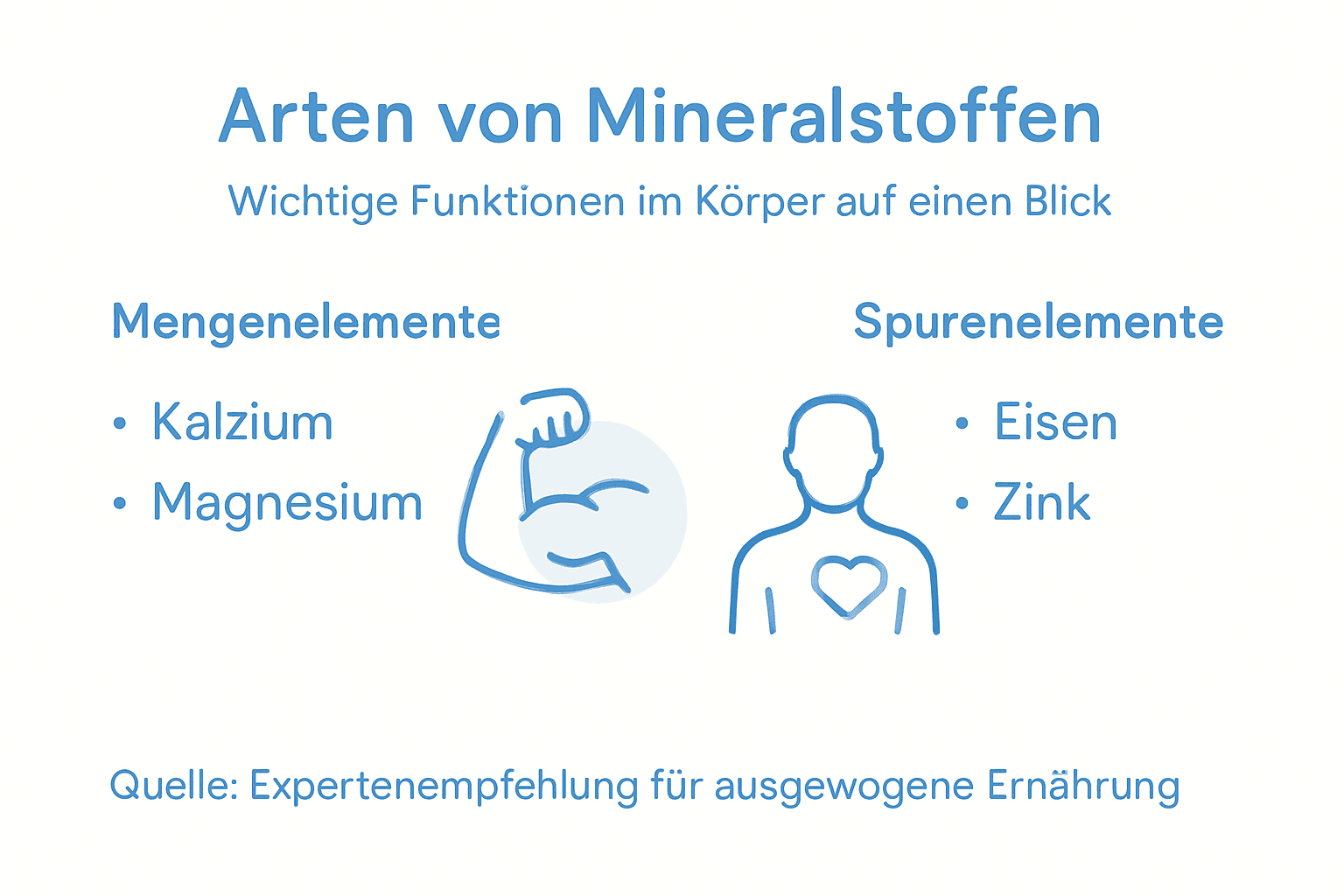
Here you will find an overview of the most important macroelements and trace elements in the body:
| Mineral type | Example substances | Typical functions |
|---|---|---|
| Macroelements | Calcium, potassium | Bone formation, muscle function |
| Macroelements | Magnesium, sodium | Nerve conduction, fluid balance |
| Trace elements | Iron, zinc | Oxygen transport, immune defense |
| Trace elements | Iodine, selenium | Thyroid function, cell protection |
Pro tip: Consult a nutritionist to analyze your individual mineral intake and identify possible deficiencies at an early stage.
Process of scientific at-home mineral tests
Modern at-home mineral tests offer a precise and straightforward way to check your individual nutrient status. The scientific process is systematic and easy for laypeople to understand.
The typical process of a mineral test comprises the following steps:
- Ordering the test kit online
- Collecting a sample at home via a finger prick
- Shipping the sample to an accredited laboratory
- Digital analysis and delivery of results
You only need the following to collect the sample:
- Sterilized test lancet
- Blood collection card
- Disinfectant wipe
- Adhesive patch
The laboratory analysis examines various mineral concentrations and creates a detailed report on your individual nutritional status. Values such as calcium, magnesium, iron, and zinc are measured and evaluated precisely.
The results provide information about possible deficiencies and help develop targeted dietary recommendations or supplementation strategies.
Pro tip: Ideally, perform the test in the morning while fasting and document your results for long-term health comparisons.
Recognize the consequences of deficiency or overdose
Mineral imbalances can have significant health effects that are often underestimated. An unbalanced metabolism can quickly lead to complex symptoms that impair your quality of life.
Possible symptoms of a mineral deficiency include:
- Persistent fatigue
- Muscle weakness
- Concentration problems
- Weakened immune system
- Heart rhythm disorders
- Hormonal imbalances
Critical overdose risks can be just as dangerous. Excessive mineral intake can lead to serious side effects:
- Kidney damage
- Cardiovascular problems
- Electrolyte imbalances
- Muscle dysfunction
- Organic disorders
Overdoses of potassium and calcium are particularly critical, as they can quickly trigger life-threatening situations. The mechanisms behind this are complex and vary greatly from person to person.

Pro tip: Have your mineral levels professionally tested regularly to detect deficiencies or excess levels at an early stage and correct them in a targeted manner.
Comparison: Alternative analysis methods
At-home mineral analyses offer various ways to check individual nutrient status. The methods differ significantly in accuracy, scope, and reliability.
The most important analysis methods at a glance:
- Blood test:
- Measures mineral concentrations in serum
- Quick and straightforward to perform
- Limited informative value
- Hair mineral analysis:
- Long-term overview of metabolism
- Detects chronic deficiencies
- Less precise than blood tests
- Urine test:
- Measures excreted mineral amounts
- Provides indications of absorption and metabolism
- Not as comprehensive as laboratory analyses
Professional laboratory analyses offer the most detailed and precise examination method. Modern techniques such as ICP-MS enable highly precise determination of various minerals and trace elements.
Every method has advantages and disadvantages. The choice depends on individual health goals and specific questions.
The following comparison chart shows the advantages and disadvantages of various mineral analyses:
| Method | Advantages | Disadvantages |
|---|---|---|
| Blood test | Precise measurement of current levels | Only a short-term snapshot |
| Hair analysis | Long-term assessment of metabolism | Lower accuracy, influenced by environmental factors |
| Urine test | Easy to perform | Limited information about overall intake |
| Laboratory analysis | Highly detailed findings | Higher costs and specialized analysis |
Pro tip: Consult a nutritionist to determine the analysis method that is optimal for you and to professionally interpret the results.
Practical tips for optimizing intake
Improving mineral intake effectively requires a strategic and conscious approach to nutrition. Optimization is an individual process that requires attention to and understanding of your body's needs.
Recommended strategies for mineral intake:
- Make use of a varied selection of foods
- Combine plant-based and animal-based protein sources
- Use gentle food preparation methods
- Pay attention to synergistic effects between nutrients
Additional nutrition tips for optimal mineral intake:
- Pay attention to vitamin-mineral combinations
- Prefer fresh, unprocessed foods
- Choose seasonal and regional products
- Drink enough water
A nutrition strategy for mineral balance also means taking individual needs into account. People in special life situations, such as pregnancy, athletic training, or chronic illness, often have specific requirements.
Pro tip: Keep a food diary to document your mineral intake and identify patterns.
Test minerals specifically and strengthen your health sustainably
A mineral test is key to understanding your personal nutrient status accurately. Many people do not know that mineral deficiencies or excesses, such as those involving potassium or calcium, can have serious health consequences. If you experience fatigue, muscle problems, or difficulty concentrating, it is important to identify these risks early and take targeted action. A professional test provides precise results that you can use to optimally adjust your diet.
Discover on Recognize & Prevent Nutrient Deficiencies – At-Home Tests | mybody® – mybody®x how easy and reliable it is to detect mineral deficiencies yourself. Take advantage of ISO-certified laboratory analyses combined with personalized dietary recommendations. Start your journey toward greater vitality and well-being with At-Home Health Tests – Discover All Tests - mybody®x and learn how you can regain control of your health using scientifically validated methods. Visit https://mybody-x.com for more information and secure your mineral test today for strong, balanced health.
Frequently Asked Questions
How can I test my mineral status at home?
To test your mineral status at home, you can order a test kit online, collect a blood sample via a finger prick, and send it to an accredited laboratory. The results will be sent to you digitally.
What are the main symptoms of mineral deficiency?
The most common symptoms of mineral deficiency include persistent fatigue, muscle weakness, difficulty concentrating, and a weakened immune system. These symptoms should be taken seriously and, if necessary, checked with a test.
What are the differences between blood tests and hair mineral analyses?
Blood tests measure mineral concentrations in serum and provide a precise snapshot of current levels. Hair mineral analyses, on the other hand, provide a long-term overview of metabolism but tend to be less precise than blood tests.
What are the benefits of professional laboratory analysis for determining mineral levels?
Professional laboratory analyses provide the most detailed and precise assessment of various minerals. Modern techniques such as ICP-MS enable accurate measurement and help develop targeted dietary recommendations or supplementation strategies.
Recommendation
- Vitamins and Minerals – How They Affect My Well-Being in the Long Term – mybody®x
- What Are Minerals and How Can They Help Me? – mybody®x
- 8 Common Vitamin Deficiency Symptoms You Should Know – mybody®x
- What Is a Nutrient? Simply Explained for Your Health – mybody®x
- Magnesium Deficiency in Plants: Complete Guide - Lushy Gardens
- Eco-Friendly Mattress Materials – How They Affect Children’s Health | Afrokoptiki



Share now:
Bloated belly that looks pregnant: when it’s harmless and when it’s not
How long before a blood test should I avoid drinking anything for accurate results?