
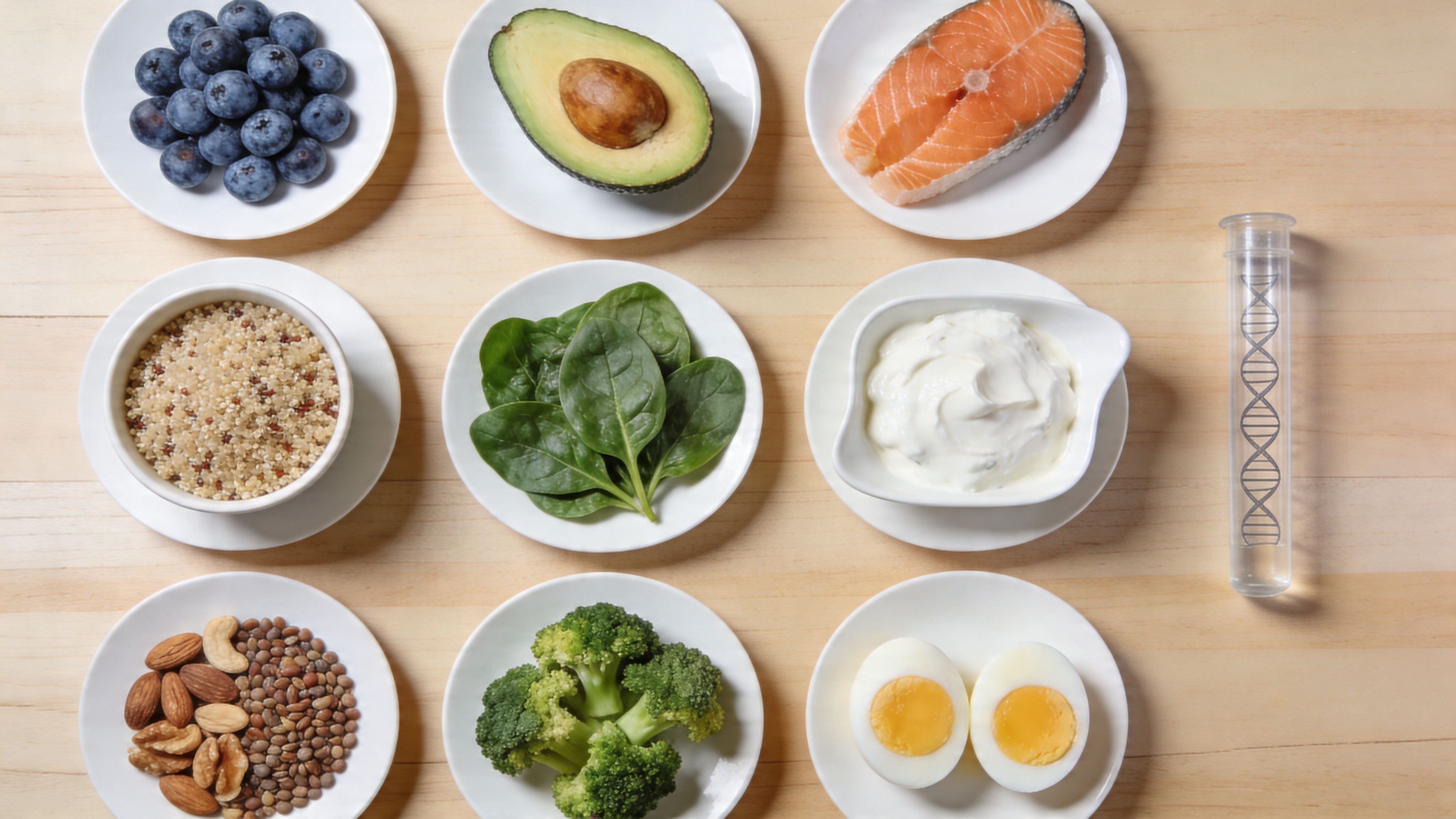
Which foods? The 10 best for your health
Confused at the supermarket? You are not alone. Between protein bread, oat drinks, organic eggs, snack bars, and “healthy” ready-made bowls, the question “which foods are good for me?” can quickly become exhausting. Then there are contradictory trends. Sometimes it is low-carb; then again, more complex carbohydrates. Sometimes fats are demonized, and sometimes they are celebrated.
The honest answer is simple: There is no single perfect diet for everyone. What gives you energy, keeps you full for a long time, and agrees with you also depends on your biology. Your DNA influences, for example, how you process fats, carbohydrates, caffeine, or certain micronutrients. Your microbiome—the community of bacteria in your gut—also plays a role when it comes to digestion, tolerance, and suitability for everyday life.
That is precisely why, when considering “which foods,” it is worth thinking not only in terms of healthy or unhealthy, but also in terms of what is suitable or unsuitable for you. This article shows you 10 important food groups that often play a major role in a good diet. For each group, it also shows you how to make your choices more personal using DNA and microbiome insights.
A brief aside that fits surprisingly well: Purchasing decisions at the shelf are also strongly influenced. This is nicely illustrated by the article Packaging Design That Buys in the Gut. Just because something looks healthy does not mean it is the best choice for your body.
1. High-quality protein sources

If “which foods” often makes you think about losing weight, building muscle, or reducing cravings, start with protein. For many people, that is the biggest lever in everyday life. Not complicated, but often poorly implemented.
Fish, poultry, and eggs are practical because they can easily be incorporated into regular meals. A breakfast with eggs keeps many people full longer than sweet pastries. A lunch with salmon or chicken is usually easier to plan than a sandwich bought in a hurry that leaves you hungry again after a short time.
What works in everyday life
Good examples include wild salmon, mackerel, sardines, organic poultry, and pasteurized eggs. What matters is not perfection, but consistency.
- For stressful days: Boiled eggs, smoked fish, or prepared chicken strips reduce the number of decisions you need to make.
- For greater satiety: Combine protein with vegetables and a source of fat instead of just white bread.
- For better digestibility: Prepare protein sources steamed, boiled, or grilled rather than fried.
Anyone who wants to better estimate their needs will find a solid basis in the article about daily protein requirements.
Practical rule: If your meal contains hardly any protein, it is often forgotten faster than it is digested.
Personalization is where things get interesting. According to Genosalut, DNA-based nutrition tests analyze more than 20 scientifically validated genetic markers, including fatty acid metabolism, vitamin D metabolism, lactose intolerance, and caffeine sensitivity, and assess the suitability of more than 900 foods based on the genetic profile (details on genetic markers and food assessment). This helps you choose protein not just in large amounts, but in a way that suits you better.
People who train can also consider how timing fits into their daily routine. The article Protein Before or After Training is also relevant here.
2. Fermented foods

Many people search for “which foods” when they want more energy and better digestion. They often start by cutting things out: less sugar, less wheat, fewer snacks. That can be useful, but it is often not enough. You also need to give your gut something to work with.
Fermented foods such as kefir, sauerkraut, tempeh, and miso add flavor, acidity, and often more complexity to the plate. They are a practical way out of routine, especially for anyone who eats a very limited range of foods.
How to use them effectively
The problem is usually not the food itself, but the pace. Anyone who eats large amounts right away may notice bloating or rumbling and then say, “I can’t tolerate this.” A slow introduction is better.
- Start gently: Begin with small amounts of sauerkraut or a few spoonfuls of kefir alongside a regular meal.
- Pay attention to quality: Unpasteurized varieties are often more interesting than highly processed products.
- Keep an eye on salt: Especially with sauerkraut and miso, it is worth consuming them mindfully.
If you want to specifically support your gut, the article Building a healthy gut flora through nutrition is a good next step.
The bigger picture matters: Ultra-processed foods are often underestimated, even though they can burden the microbiome and metabolism. In Germany, ultra-processed foods account for around 50 to 60 percent of calorie intake according to the classification mentioned in the background, and this is exactly where the question “which foods” quickly becomes very practical. Eating fewer highly processed foods and more fermented foods instead is a sensible swap for many people (classification of ultra-processed foods and the microbiome).
Some people tolerate kefir extremely well but react to kombucha or large amounts of sauerkraut. This is not a contradiction, but individuality.
A microbiome test can be particularly useful here. It not only shows that your gut is sensitive, but often also indicates which direction you can take.
3. Cruciferous vegetables and green leafy vegetables
You buy broccoli, spinach, or kale with good intentions. Three days later, half of it is still in the refrigerator, and the rest ends up overcooked on your plate. The problem is rarely the vegetables themselves. Usually, the preparation does not fit your daily routine or your digestion.
Cruciferous vegetables such as broccoli, Brussels sprouts, cauliflower, and arugula provide plant compounds containing mustard oils, which the body uses in its normal detoxification processes. Green leafy vegetables such as spinach, Swiss chard, and kale also provide folate, potassium, magnesium, and fiber. For many meals, these vegetable groups are the easiest way to increase nutrient density without having to cook complicated dishes.
The challenge lies in tolerability and selection.
Some people tolerate raw arugula and large salads perfectly well. Others tend to experience bloating or a feeling of pressure in their stomach after eating a lot of cabbage, onions, and raw leafy greens. This does not mean that vegetables are “not for you.” Often, it is simply the form that does not suit you yet. Steamed broccoli, briefly pan-fried bok choy, or oven-roasted Brussels sprouts often work better in everyday life than yet another plate of raw vegetables.
Some practical options that have proven effective include:
- Oven-roasted broccoli with egg or salmon: easy to plan, filling, and low-effort
- Arugula mixed into warm potatoes: more flavorful than a classic salad and often easier to digest
- Spinach or Swiss chard in skillet dishes: quick, affordable, and easy to incorporate into everyday cooking
Personalization is where things get interesting. DNA tests can provide clues about how strongly you respond to oxidative stress, inflammatory processes, or certain fatty acids. In that case, choosing what goes on your plate makes more sense than following generic dietary advice. For example, people who benefit from a diet that promotes lower inflammation can often pair green vegetables particularly well with fatty fish, flaxseeds, or walnuts. You can find more information in the article on omega-3 fatty acids and genetic differences.
A microbiome test can also help narrow down the selection. If your gut reacts sensitively to highly gas-forming fibers, it is better to start with small portions of cooked vegetables rather than large amounts of raw vegetables. If the test indicates a greater need for a diverse, fiber-rich diet, it is worth regularly rotating cruciferous vegetables into your meals instead of always eating just tomatoes and cucumber.
In practice, I rarely recommend “more vegetables” as a general formula. It makes more sense to choose varieties that you tolerate, can realistically prepare, and actually eat several times a week. Broccoli is not beneficial simply because it is considered healthy. It is beneficial when it ends up on your plate and agrees with you.
4. Healthy fats and oils

You eat a large salad for lunch and are hungry again two hours later. In practice, this is often not due to the vegetables, but to a meal that lacks a sensible source of fat. Healthy fats slow gastric emptying, make food taste more rounded, and help the body absorb fat-soluble vitamins from the meal more effectively.
The source is crucial. Extra-virgin olive oil, avocado, nuts, seeds, and, depending on your goals, fatty fish fit well into everyday life for many people. Highly processed fat sources from pastries, chips, sausage, or ready-made products also provide energy, but they rarely offer the same benefits for satiety, fatty acid patterns, and meal quality.
Using healthy fats correctly
For many kitchens, olive oil is the best base, especially for salads, cooked vegetables, and mild hot dishes. Avocado or avocado oil is practical when you need to be quick and want to enhance a meal without much preparation. MCT oil has a specific area of use. It may be interesting for some people, but it is not a standard everyone needs, and too much can quickly cause gastrointestinal discomfort.
In everyday life, this simple selection often works:
- Extra-virgin olive oil: for dressings, roasted vegetables, and finished hot dishes
- Avocado: for breakfast, bowls, or as a quick addition to cold meals
- Nuts and seeds: if you want to increase satiety without having to cook anything extra
- MCT oil: test only with a specific purpose and start with small amounts
Personalization is where things get interesting. DNA tests can provide clues about how your body responds to different fatty acids and whether certain inflammation or fat-metabolism patterns deserve more attention. This does not mean that a gene determines what you have to eat. Rather, it shows where general recommendations might be too broad for you. If this interests you, you’ll find concrete examples in the article on omega-3 fatty acids and genetic differences.
Microbiome data can also help refine your choices. Some people tolerate high-fat meals well as long as they are well balanced. Others experience bloating, sluggish digestion, or cravings later in the day when the amount of fat and the quality of the food do not match. In that case, it is often more sensible to distribute fat sources more deliberately rather than eating a large amount all at once in the evening.
I rarely simply recommend “more healthy fat.” A better approach is to choose one or two fat sources that you genuinely use regularly, fit your budget, and measurably improve your meals. A good olive oil offers more value than five specialty products in the cupboard that end up barely being used.
5. Complex carbohydrates with a high fiber content
Oats, quinoa, lentils, chickpeas, barley, and sweet potatoes have an image problem. Many people lump them together with bread, cookies, or breakfast cereals and then make a blanket statement: carbohydrates do not agree with me. It is rarely that simple.
Complex carbohydrates are very well tolerated by many people when the amount, time of day, and combination are right. The problem is often not the oatmeal. The problem is the huge portion plus honey plus juice plus lack of exercise.
What really matters
Three things make the difference: processing, portion size, and context. A plate of lentils with vegetables and protein affects the body differently than a sweet snack. Oats with nuts and yogurt are different from a croissant eaten on the go.
What often works well in practice:
- Oats instead of a sweet breakfast: keep you full longer and are easier to plan
- Lentils or chickpeas as a side dish: more fiber than many classic starchy side dishes
- Cooked and cooled potatoes or sweet potatoes: often more practical for everyday eating than constantly relying on bread
If you quickly get hungry again after eating carbohydrates, first check how they are combined with protein and fat—not just the carbohydrates themselves.
Personalization is especially helpful here. In Germany, DNA-based nutrition and metabolism tests analyze around 100 to 200 SNPs, depending on the provider—that is, genetic variants—to assess differences in carbohydrate, fat, and protein metabolism (Overview of DNA-based nutrition analyses). In practical terms, this means that not every “low-carb” recommendation is automatically right for you. Some people benefit more from choosing carbohydrates more wisely rather than cutting them drastically.
6. Polyphenol-rich foods
Berries, cocoa, and green tea are not miracle cures. But they are often small levers with surprisingly good everyday practicality. Especially if you want to improve your diet without overhauling everything, they make sense.
Polyphenols are plant compounds found mainly in strongly colored or aromatic foods. You don’t need to be a biochemistry fan for this. In practical terms, it simply means that color and bitterness are often not drawbacks, but indicators of interesting compounds.
Small amounts, big routine
A few examples that are easy to incorporate into everyday life:
- Berries with breakfast or quark: much more sensible than sweet toppings
- Unsweetened cocoa powder: works well in porridge, yogurt, or shakes
- Green tea instead of constantly drinking sweet beverages: a simple habit with little effort
Tolerance is important. Some people become nervous after green tea, while others experience stomach sensitivity from large amounts of cocoa. That doesn’t mean the foods are bad. They may simply suit you better in a different form or amount.
The microbiome also plays a role here. Part of what you “get out” of plant-based foods depends on how your gut handles them. That’s why the question “which foods” is often much more helpful than “which superfoods.” Berries in everyday meals beat exotic powders that you ultimately don’t use regularly.
If you’re unsure, don’t start with ten new foods at once. Add two or three to your week and observe your energy, digestion, and satiety. That is often more honest than any trend.
7. Functional mushrooms
You may know shiitake from the kitchen. Reishi or lion’s mane, more from the supplement aisle. Functional mushrooms initially seem niche to many people. In practice, they are especially interesting when you want to work specifically on focus, everyday recovery, or immune-related balance.
Not everyone needs mushroom extracts. But some people benefit from them, especially when their basic diet is already established and they want to fine-tune it. The important thing is not to view mushrooms as a substitute for real food. They are more of an addition than a foundation.
When they make sense
Shiitake or maitake can be integrated directly into meals. Reishi or lion’s mane are more often used as powders or extracts. The benefits depend greatly on whether you use them consistently and in a form you tolerate.
What I pay particular attention to in consultations:
- Start with culinary mushrooms: They are often the easiest entry point.
- Use extracts in moderation: Not every trendy product is automatically useful.
- Observe your own response: Sleep, digestion, and how you feel during the day often provide the best clues.
Anyone who looks only at macronutrients when considering “which foods” may miss these subtler tools. At the same time, the following applies: If you barely eat vegetables, constantly need snacks, and plan poorly, lion’s mane is not your first problem. The basics are more important then.
Personalization can help here, too. Anyone who gets indications of a tendency toward inflammation, stress tolerance, or digestive patterns from DNA or microbiome data can often use such additions more purposefully instead of randomly.
8. Nuts and seeds
Nuts and seeds may be small, but they are often nutritionally significant. A handful of walnuts, some flaxseed in yogurt, or chia in breakfast can make a meal considerably better. More satiety, more bite, and often less desire to snack later.
The most common mistake is not the choice, but the quantity. A good addition can quickly become an absent-minded snack eaten without paying attention. Then nuts provide quality, but no real structure.
Their best role in everyday life
Use nuts and seeds as part of a meal rather than constantly reaching into the package.
- Walnuts: good with yogurt, quark, or fruit
- Ground flaxseed: practical for muesli or porridge
- Chia: helpful if you want to make breakfast more filling
- Almond butter: better than sweet spreads when the portion is appropriate
If you metabolize fats differently due to genetic factors, a DNA test can help you assess the balance more accurately. Then it is not just a matter of “nuts are healthy,” but of which fat sources make more sense for you overall.
Another advantage: Nuts and seeds are often a good bridge for people who want to eat fewer highly processed snacks. Instead of reaching for bars or pastries, you get something that remains closer to a real food.
9. Root vegetables and tubers
You come home in the evening, want something warm to eat, and need a side dish that fills you up without leaving you immediately searching the cupboard for something else. This is exactly where potatoes, sweet potatoes, carrots, beets, and celery are often better in everyday life than their reputation suggests.
Their advantage is practical, not theoretical. Root vegetables and tubers are affordable, easy to store, and simple to incorporate into a normal kitchen. Above all, they add structure to the plate. This is especially helpful for people who want to eat less bread, fewer ready-made products, or fewer spontaneous snacks.
A better way to assess them than by carbohydrates alone
Potatoes and beetroot are often hastily labeled as containing “too many carbohydrates.” In practice, the better question is: How do you eat them, in what quantity, and with what?
A baked potato with herbed quark and vegetables has a different effect than chips or a white bread roll eaten on the side. Cooked and cooled potatoes also provide resistant starch. This is a type of starch that your small intestine does not fully absorb. Your gut bacteria can process it further, which may support satiety and digestion for some people.
This is where personalization is worthwhile. If a DNA test indicates that you process carbohydrates less efficiently, that does not mean you have to eliminate potatoes. It is usually more about portion size, preparation, and combining them with protein, fat, and fiber. A microbiome test can also show whether you are likely to respond better to resistant starch and certain sources of fiber, or whether you should increase amounts more slowly.
A few practical combinations:
- Roasted potatoes with herbed quark and broccoli
- Baked sweet potato with salmon or tempeh
- Beetroot with feta or lentils
- Celery purée as a lighter alternative to very creamy side dishes
I often use these foods in practice as a test of how well they fit into everyday life. If you tolerate root vegetables well and combine them sensibly on a regular basis, meals usually become more predictable. Less intense hunger. Fewer improvised snack meals.
If you are looking for specific ideas, recipes for an anti-inflammatory diet in everyday life can help, because they show how to sensibly combine potatoes, beetroot, or sweet potatoes with protein, vegetables, and healthy fats.
10. Spices and herbs
Spices and herbs are the understated part of the answer to “which foods.” They rarely provide the main bulk of a meal, but they can strongly influence whether you regularly put healthy and delicious food into practice.
Anyone who focuses only on nutritional values often overlooks everyday life. People do not stick to a diet because it is theoretically perfect. They stick with it when the food tastes good. Fresh rosemary on roasted vegetables, cinnamon in oatmeal, ginger in tea, or turmeric in a vegetable stir-fry make exactly that difference.
Flavor determines consistency
Herbs and spices help you make simple foods more interesting. This is not a minor detail. It is often the reason a good plan still works after weeks.
A few simple ways to use them:
- Turmeric plus black pepper and a little fat: classic in curries or soups
- Freshly grated ginger: great in tea, stir-fries, or dressings
- Cinnamon: practical in porridge, yogurt, or warm fruit dishes
- Rosemary and thyme: especially good with roasted vegetables and potatoes
If you want to cook in an anti-inflammatory way, you will find directly actionable ideas in the article on anti-inflammatory nutrition with recipes.
This food group also warrants attention to safety. According to a survey by the German Federal Institute for Risk Assessment (BfR), 73 percent of respondents consume raw meat and sausage products at least 1 to 3 times a month, and 57 percent consume raw-milk soft cheese, while many consider the risk low (health risks of raw foods according to the BfR). Spices and herbs can do a lot for flavor. However, they do not replace kitchen hygiene and do not automatically make risky raw foods safe for sensitive individuals.
10 food groups compared
| Food group | 🔄 Implementation complexity | ⚡ Resource requirements | 📊 Expected results | 💡 Ideal use cases | ⭐ Main benefits |
|---|---|---|---|---|---|
| High-quality protein sources (fish, poultry, eggs) | Medium, shopping, storage, and preparation required | Medium–high, organic/wild and refrigeration increase costs | Muscle building, satiety, stable blood sugar | Weight management, strength training, maintenance of lean mass | Complete amino acids, micronutrients, high thermic effect |
| Fermented foods (kefir, sauerkraut, tempeh, miso) | Low–medium, easy to integrate, fermentation at home if desired | Low, jars, storage; quality control required | Improved gut flora, better digestion and nutrient absorption | Gut health, microbiome optimization, after antibiotics | Live cultures, increased bioavailability, enzymes |
| Cruciferous vegetables & leafy greens (broccoli, spinach, kale) | Low, recommended raw or lightly steamed | Low, inexpensive and widely available | Activation of detoxification pathways, antioxidant effects | Anti-aging, detox, support for folate-dependent functions | Rich in vitamins, sulforaphane effects, low calorie density |
| Healthy fats & oils (MCT, olive oil, avocado oil) | Low, easy integration, portion control is important | Medium, high-quality oils and possibly supplements | Hormonal balance, cognitive support, metabolic flexibility | Keto/low-carb, cognitive performance, satiety | Ketones, polyphenols, improved fatty acid profile |
| Complex carbohydrates & fiber (oats, quinoa, sweet potato) | Medium, portioning according to activity is necessary | Low–medium, time required for cooking, whole grains | Stable blood sugar levels, increased SCFA production, endurance | Endurance sports, weight management, blood sugar control | Slow energy release, fiber, micronutrients |
| Polyphenol-rich foods (berries, cocoa, green tea) | Low, easy to add, effects depend on the microbiome | Low to medium, high-quality sources (matcha, cocoa) | Antioxidant effects, inflammation reduction, neuroprotective | Anti-aging, inflammation reduction, mental performance | Powerful antioxidants, modulation of aging pathways |
| Functional mushrooms (shiitake, reishi, lion’s mane) | Medium, quality testing (extract versus mycelium) recommended | Medium to high, standardized extracts are more expensive | Immune modulation, cognitive support, improved recovery | Immune support, cognitive enhancement, athletic recovery | Beta-glucans, neuroactive compounds, inflammation-modulating |
| Nuts and seeds (almonds, walnuts, chia, flaxseeds) | Low, easy to incorporate into snacks, portion control required | Low to medium, good quality costs more | Heart-healthy fats, satiety, stable blood sugar | Snack, heart health, high-fat diets | Plant-based omega-3, fiber, vitamin E, and minerals |
| Root vegetables and tubers (sweet potatoes, carrots, beetroot) | Low to medium, various preparation methods | Low, usually inexpensive and seasonal | Sustained energy, microbiome support, micronutrients | Basic nutrition, sports nutrition, micronutrient intake | Fiber, beta-carotene, nitrates (circulation) |
| Spices and herbs (turmeric, ginger, cinnamon, rosemary) | Very low, easy to incorporate into dishes | Very low, small amounts, low cost | Anti-inflammatory, adds flavor without calories, supports digestion | Inflammatory tendency, salt/sugar reduction, culinary enhancement | High concentration of active compounds, versatile, low in calories |
From Knowledge to Action: Your Personal Nutrition Plan
You are standing in the supermarket with your shopping cart half full, yet you are still wondering whether this selection really suits you. At this point, general nutrition knowledge is often no longer enough. A good food list helps you get started. In everyday life, however, what matters is how your body responds to it.
The 10 food groups in this article provide a solid foundation. The practical difference comes from the choices within these groups, portion sizes, and what you tolerate well on a regular basis. That is precisely where personalized nutrition becomes concrete.
Two people can eat oatmeal in the morning and react in completely different ways. One person stays full and focused for a long time. The other experiences bloating, cravings, or an energy slump during the morning. The same applies to coffee, dairy products, fermented foods, or certain fats. These differences are not imagined. They are related, among other things, to genetics, digestion, and the microbiome.
Genes do not determine your diet. Rather, they provide clues about how your body processes caffeine, carbohydrates, fats, or individual micronutrients. The microbiome describes the bacteria in the gut that are involved in digestion, fiber utilization, and tolerance. Put simply: Your diet affects your gut, and your gut also influences how you feel after eating. When you understand both of these levels, a general recommendation becomes a plan you can actually apply in a meaningful way.
In everyday life, this means you do not simply choose “healthy foods,” but the varieties, quantities, and combinations that suit your situation. Perhaps you tolerate yogurt better than kefir. Perhaps you benefit from more sources of omega-3, while someone else should first gradually increase their fiber intake. Perhaps legumes will benefit you in the long term but require different preparation or smaller starting portions. Personalization does not mean perfection. Above all, it saves you from trial and error.
Nutrition is therefore not a rigid rule but a plan for managing your everyday life. It must fit your budget, the time you have available, your digestion, and your goals. I consider this point crucial: A plan is only good if you can follow it even on a stressful Wednesday.
If you no longer want to guess, a DNA nutrition test may be useful. The mybody® DNA nutrition test analyzes genetic traits related to metabolism and dietary responses and translates them into recommendations for everyday life. The practical benefit lies in implementation. You receive not only laboratory results but also an individual cookbook and recipe book, so you can apply the findings directly to shopping, cooking, and weekly planning.
MYBODY Lab GmbH is an option for people looking for laboratory-based analysis focused on personalized nutrition. According to the company information provided, mybody® works with ISO-certified analyses and pseudonymized data processing in accordance with the GDPR. For many users, it is precisely this combination of a test, report, and practical nutrition recommendations that finally turns knowledge into action.
If you want to find out which foods really suit your metabolism, take a look at the MYBODY Lab GmbH DNA nutrition test. You receive an analysis of your genetic predispositions plus an individual cookbook and recipe book, so knowledge can become actionable nutrition.



Share now:
How Do Allergies Develop? Your Complete Guide for 2026
Keto Diet: Science, Benefits, and Risks 2026