

Recognize stress symptoms and take effective action against them
TL;DR:
- Stress manifests through physical, emotional, and cognitive warning signs that are often overlooked.
- Chronic stress increases the risk of cardiovascular disease, mental disorders, and immune deficiency.
- Individual self-analysis and targeted measures are essential for managing stress over the long term.
Unexplained fatigue. Headaches that keep coming back. A feeling of tightness in the chest that one has long since dismissed as normal. Many people live with these complaints without connecting them to stress. Yet these subtle signs are often the body's first warning signals. Recognizing stress symptoms early, interpreting them correctly, and understanding how stress affects the body puts people in a much better position to take timely action and prevent long-term damage.
Table of Contents
- What are stress symptoms? An overview of physical, emotional, and cognitive signs
- How stress affects the body: The HPA axis and its impact on health and well-being
- Eustress versus distress: What distinguishes healthy stress from harmful stress
- Long-term effects of chronic stress on the body and mind
- Individual paths out of stress: Recognizing warning signs and taking targeted action
- Perspective: Why many symptoms of stress are overlooked and what really helps
- How You Can Individually Support Your Stress Management with mybody®x
- Frequently Asked Questions About Stress Symptoms
Key Insights
| Point | Details |
|---|---|
| Recognizing Stress Symptoms Early | Recognizing physical and psychological warning signs in time helps prevent long-term health problems. |
| Understanding the Biology of Stress | The HPA axis explains why stress has such a comprehensive impact on the body and mind. |
| Positive vs. Negative Stress | Not all stress is harmful, but ongoing overwhelm causes lasting damage. |
| Avoid Chronic Stress | Long-term stress significantly increases the risk to the heart, mental health, and immune system. |
| An Individual Approach Matters | Tailored strategies and analysis are the key to lasting well-being when dealing with stress. |
What are stress symptoms? An overview of physical, emotional, and cognitive signs
Stress rarely manifests in just one clear, recognizable way. It affects several levels at once: the body, emotions, and thoughts are all impacted. This makes it difficult to recognize, which is precisely why stress symptoms are so often misattributed or simply ignored.
Stress symptoms appear in otherwise healthy but burdened people through a wide range of physical, emotional, behavioral, and cognitive signs. Physically, the most common symptoms include muscle tension, headaches, persistent fatigue, sleep disturbances, and digestive problems. Emotionally, those affected experience irritability, anxiety, and a constant feeling of being overwhelmed. Behaviorally, eating habits change, social withdrawal increases, and sleep becomes irregular. Cognitively, it becomes difficult to concentrate, make decisions, or quiet the stream of thoughts.
“The body speaks before the mind understands.” Many people spend years searching for organic causes of their symptoms, even though stress is the actual trigger.
What makes these symptoms particularly insidious is that they rarely occur in isolation. Anyone who sleeps poorly is exhausted during the day, becomes irritable more quickly, and can barely concentrate. It is a vicious cycle that gradually escalates. The long-term effects of persistent stress on health and quality of life are well documented, but are often underestimated in everyday life.
The most common stress symptoms at a glance
| Category | Typical symptoms |
|---|---|
| Physical | Muscle tension, headaches, fatigue, stomach problems |
| Emotional | Irritability, anxiety, feeling overwhelmed, mood swings |
| Cognitive | Difficulty concentrating, rumination, forgetfulness |
| Behavioral | Changes in appetite, social withdrawal, sleep disturbances |
Sleep disturbances as a stress symptom deserve particular attention, as disrupted sleep directly interrupts physical and mental recovery and intensifies all other stress symptoms. Anyone who regularly sleeps poorly automatically lowers their stress tolerance for the following day.
Typical warning signs that are often overlooked:
- Jaw pain caused by unconsciously grinding your teeth at night
- Frequent colds despite getting enough sleep
- Digestive problems without an obvious dietary cause
- Racing heart during otherwise calm situations
- Forgetting simple everyday things or appointments
How stress affects the body: The HPA axis and its impact on health and well-being
To truly understand stress symptoms, it helps to know what actually happens in the body when a stressful situation occurs. It involves a finely tuned hormonal system that originally evolved for acute survival situations.
The central control hub is the so-called HPA axis: the interaction between the hypothalamus, pituitary gland, and adrenal cortex. As soon as the brain perceives a threat—whether a deadline, a conflict, or simply sensory overload—this axis sets off a chain reaction. Cortisol, the stress hormone, is released, and the body switches to high alert: heart rate increases, muscles tense, and digestion is temporarily slowed. All of this was useful when humans were fleeing predators. Today, the threat sits in the email inbox.
The real problem arises with chronic stress and elevated cortisol. If the HPA axis remains continuously activated, cortisol levels stay chronically elevated. The consequences are far-reaching: the immune system is weakened, inflammatory processes are promoted, memory and concentration decline, sleep deteriorates further, and weight can shift due to hormonal changes.

Pro tip: An elevated cortisol level can be measured. If you feel constantly on edge and unable to recover, a blood test can provide concrete clarity about your cortisol status. Knowledge is the first step toward change.
| Stress phase | Cortisol level | Physical effect |
|---|---|---|
| Acute stress | Temporarily elevated | Alarm response, increased performance |
| Recovery phase | Returns to normal | Regeneration, immune activation |
| Chronic stress | Persistently elevated | Weakened immune system, sleep problems |
| Exhaustion phase | Often reduced | Burnout, total exhaustion |
This means that anyone under intense pressure for months on end risks more than just a bad mood or fatigue. Measurable biological changes occur. That is why it is advisable to actively find ways to lower cortisol naturally. These include sleep routines, moderate exercise, mindful recovery breaks, and a nutrient-rich diet. Everything you need to know about cortisol shows how much lifestyle choices influence this hormone.
Eustress versus distress: What distinguishes healthy stress from harmful stress
Not all stress is bad. That may sound banal, but it is almost completely ignored in everyday life. In fact, a moderate stress response is biologically beneficial. It sharpens focus, motivates, and promotes personal growth.
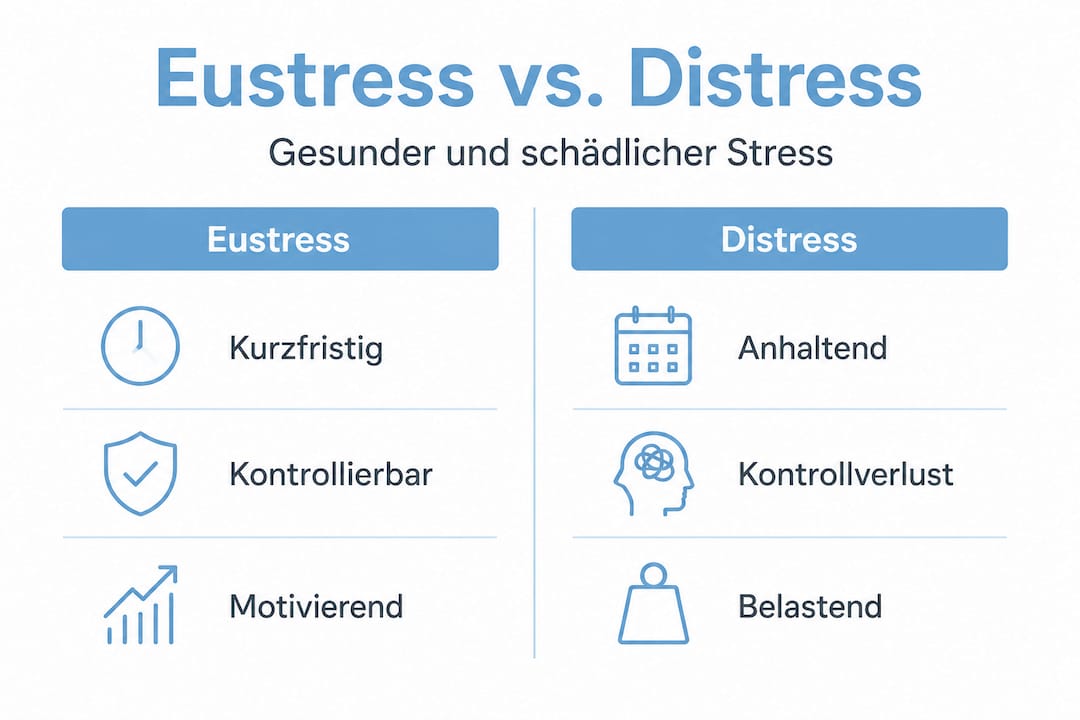
Acute, controllable stress as eustress is motivating, keeps you alert, and is limited in duration. Imagine an athlete before a competition: an elevated heart rate, tension, and focus. That is precisely eustress. It subsides as soon as the situation is over, and the body fully recovers.
Distress, on the other hand, arises when stress is perceived as uncontrollable, lasts too long, or is not followed by a genuine recovery phase. The helpful alarm system then becomes a permanent strain.
Characteristics of eustress:
- Limited in duration and situation-specific
- Feeling of control and agency
- Motivating, performance-enhancing
- Ends with recovery and a sense of achievement
Characteristics of distress:
- Persistent, with no apparent end
- Feeling of loss of control and helplessness
- Exhausting, demotivating
- Leads to physical and psychological symptoms
| Characteristic | Eustress | Distress |
|---|---|---|
| Duration | Short-term | Persistent |
| Control | Given | Lost |
| Effect | Motivating | Exhausting |
| Recovery | Complete | Incomplete or missing |
The gender-specific dimension of stress is also interesting. Women more often experience emotional and physical symptoms such as exhaustion, headaches, or anxiety. Men more often express stress reactions through performance-related or unusual behavioral patterns, such as irritability, withdrawal, or riskier behavior. These differences are not merely cultural but are also hormonally driven. As symptoms of elevated cortisol in women show, hormone levels make a measurable difference in symptom presentation.
Pro tip: Keep a brief stress diary for one week. In the evening, note which situations triggered stress and how you felt in response. After just a few days, patterns can emerge showing whether you are dealing with manageable everyday situations or chronic strain. This small investment provides valuable self-awareness that no app tracker can replace.
The ability to recognize individual types of anxiety and stress also helps you better understand your own reactions and respond in a targeted way. Knowing your personal stress type allows you to choose effective strategies instead of universal ones.
Long-term effects of chronic stress on the body and mind
What happens when distress persists for months or years? The medical answer is clear and alarming. Chronic stress is not merely a matter of how one feels; it is a serious health risk.
Chronic stress worsens pre-existing conditions, increases the risk of anxiety disorders and depression, promotes cardiovascular disease, and weakens the immune system through persistently elevated cortisol levels. The World Health Organization confirms that stress is one of the key risk factors for noncommunicable diseases worldwide.
“Stress does not kill immediately. But it paves the way for diseases that do.” This sober assessment by medical professionals makes it clear why taking preventive action is so important.
The five most important long-term effects of chronic stress:
- Cardiovascular risk: Chronic stress increases blood pressure and heart rate. Over the years, this leads to an increased risk of heart attack and stroke, even in otherwise healthy people.
- Mental health disorders: Depression and anxiety disorders are significantly more common among people with chronic stress. The connection between persistently elevated cortisol and mood regulation is well established biologically.
- Immune suppression: Cortisol has an immunosuppressive effect at high doses taken over long periods. Affected individuals become ill more often, recover more slowly, and are more susceptible to infectious diseases.
- Cognitive impairments: Memory problems, difficulty making decisions, and declining creativity are direct consequences of a stress system that remains overloaded over time.
- Digestive and metabolic problems: The gut-brain axis is highly sensitive to stress. Chronic stress alters the gut microbiome, promotes inflammatory processes, and contributes to weight gain.
An often-underestimated aspect: Micronutrient deficiencies often develop during chronic stress because the body uses more B vitamins, magnesium, and vitamin C under strain. These deficiencies intensify the symptoms and complete the vicious cycle.
Emotional overload syndrome aptly describes how those affected increasingly lose the ability to regulate their emotions. It feels as though everything is becoming too much at once, even small things. This is not a character flaw; it is a measurable biological process.
Individual paths out of stress: Recognizing warning signs and taking targeted action
Knowledge alone is not enough. What matters is what you actually do. And this is where the real challenge lies: there is no universal solution. What helps one person may be ineffective or even counterproductive for another.
Healthy stress remains manageable and energizing, whereas pathological stress results from a perceived loss of control and leads to exhaustion. Women more often experience physical and emotional symptoms, while men tend to show performance- and behavior-related symptoms. What this means for you: Know your patterns and act accordingly.
Practical approaches to managing stress:
- Prioritize sleep: No other tool is as effective as restful sleep. Seven to nine hours of sleep are not a weakness; they are a biological necessity.
- Use exercise as an outlet: Moderate exercise lowers cortisol—not through intense workouts, which create additional stress, but through walking, yoga, or cycling.
- Learn to set boundaries: It sounds simple, but it isn’t. Anyone who continually says yes trains their stress system to become overloaded.
- Nurture social connections: Conversations with people you trust have been shown to lower cortisol levels. Isolation, by contrast, significantly intensifies stress symptoms.
- Shape your diet mindfully: A healthy diet during periods of stress supports physical resilience. Sugar, caffeine, and alcohol, on the other hand, intensify stress symptoms.
Pro tip: Do not start with ten changes at once. Choose one specific measure and follow it consistently for three weeks. Consistency beats intensity. Someone who meditates for ten minutes every day benefits more than someone who books a wellness weekend once a month.
When should you seek professional support? If symptoms persist for more than four weeks, fail to improve despite attempts to recover, or noticeably interfere with everyday life. In that case, professional support from doctors, psychologists, or providers of evidence-based health analyses can be beneficial.
A balanced hormonal profile is an underestimated key factor. Those who know their hormone levels can take targeted action instead of groping in the dark. And anyone who also understands how to regulate hormones naturally has a lasting advantage when dealing with stress responses.
Perspective: Why many symptoms of stress are overlooked and what really helps
There is a reason why so many people only go to the doctor when their body breaks down. Our society glorifies resilience. Anyone who says they are stressed is quickly considered weak or oversensitive. Yet recognizing the symptoms of stress is not a sign of weakness; it is a sign of self-awareness.
From our experience in the field of evidence-based health analyses, we know that most people do not come in with the diagnosis “I have stress.” They come with headaches, sleep problems, weight gain, or persistent fatigue. Stress as a cause is often far outside their frame of reference. And that is exactly where the problem lies.
Universal advice such as “more yoga” or “working less” falls short. It ignores the fact that everyone reacts to stress differently due to their genetics. Some people naturally have a more robust cortisol metabolism, while others are biologically more sensitive. Those who know their genetic susceptibility to stress understand why the same situation affects two people in completely different ways.
The uncomfortable truth: Self-reflection alone is not enough. You need data. Not as an end in itself, but as the basis for targeted decisions. Those who know that their cortisol is elevated, their vitamin B levels are low, and their sleep is structurally disrupted can take concrete action. Those who are merely “somehow exhausted” are left in the dark.
Generalized advice creates a sense of activity without real progress. What has a lasting effect is a combination of honest self-awareness, measurable data, and individualized measures. This is not a luxury; it is modern preventive healthcare.
How You Can Individually Support Your Stress Management with mybody®x
Anyone who takes their own stress symptoms seriously and wants more than general advice needs precise information about their body. That is exactly what mybody®x offers. With ISO-certified laboratory analyses of blood, saliva, and stool, we make invisible stress mechanisms visible: from cortisol levels and micronutrient deficiencies to hormonal imbalances. All tests can be conveniently completed at home and provide individualized, scientifically validated reports with concrete recommendations. Discover what your body is really telling you about your stress and take action based on real data rather than assumptions. More than 11,300 satisfied customers already trust mybody®x on their journey toward greater well-being.
Frequently Asked Questions About Stress Symptoms
How can I tell the difference between healthy stress and stress that makes me ill?
Eustress, as controllable stress, motivates you and remains limited in duration, while distress caused by a loss of control and constant pressure leads to a vicious cycle of exhaustion and worsening symptoms. As long as you can fully recover after a period of strain, the stress is generally healthy.
What physical symptoms may indicate stress?
Typical physical symptoms of stress include muscle tension, headaches, persistent fatigue, digestive problems, and sleep disorders. If several of these symptoms occur at the same time without an organic cause, stress is a likely trigger.
Can chronic stress cause long-term illnesses?
Yes, chronic stress has been shown to increase the risk of cardiovascular disease, depression, and anxiety disorders, and it weakens the immune system through persistently elevated cortisol levels. This risk also affects people with no pre-existing conditions.
How can I recognize the first warning signs of stress in everyday life?
The first warning signs of stress are persistent fatigue, irritability without a clear reason, difficulty concentrating, and physical symptoms without an organic cause. Noticing and taking these patterns seriously at an early stage can make it much more effective to counteract them.
Recommendation
- Finally Understand and Relieve Intolerances – mybody®x
- Cortisol Too High: Recognizing & Treating Symptoms in Women – mybody®x
- What Is Cortisol and How Does It Control Your Body? – mybody®x
- Lower Cortisol Naturally – Your Guide to Inner Balance – mybody®x
- Stress Effects » How Harmful Is Stress? | FITTASTE
- Symptoms of Anxiety and Stress: A Complete Guide to Recognizing Them



Share now:
DNA structure explained simply: Your code for health
How to Read Body Metrics Correctly: A Guide to Health & Nutrition