
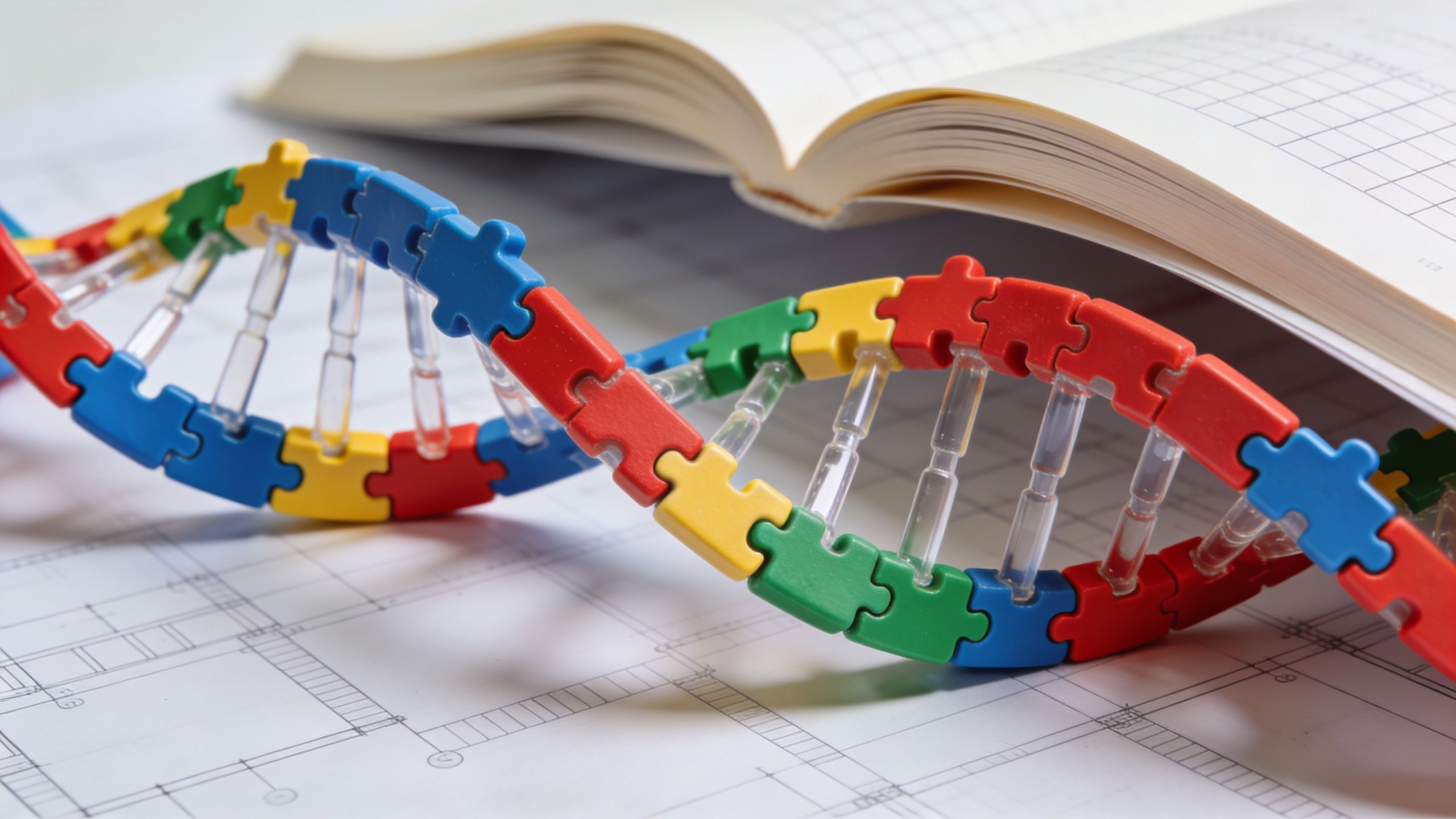
DNA Structure Explained Simply: Your Code for Health
You may know the situation: A particular diet works remarkably well for a friend but hardly at all for you. One person swears by lots of carbohydrates, another by more fat, and at some point you wonder why your body does not simply respond according to the same plan.
This is precisely where the topic of DNA structure explained simply suddenly becomes relevant to everyday life. DNA is not a textbook term that only comes up in biology class. It is your body’s inner blueprint. When you understand how this blueprint is structured, you also better understand why people respond differently to nutrition, exercise, and lifestyle.
Your Inner Blueprint: What Exactly Is DNA?
You eat muesli in the morning and feel energized until noon. Someone else quickly feels hungry again after the same breakfast. Such differences do not begin only on the plate. They are also connected to the blueprint your body follows.
DNA is short for deoxyribonucleic acid. It is found in almost all your cells and stores genetic information. This information functions like a blueprint for your body. It describes not only how traits develop, but also how cells function, renew themselves, and respond to their surroundings.
That is why DNA is not some distant biology topic.
It is connected to everyday life—to energy, metabolism, recovery, and the way your body processes nutrients. Some genetic differences, for example, affect how well certain enzymes work. This can help determine how you respond to carbohydrates, fats, caffeine, or individual micronutrients.
DNA does not lie loose inside the body. It is packaged into chromosomes and organized with extreme space efficiency so it can fit inside the cell nucleus. At the same time, it remains arranged so that the body can use the right information at the right time. You can think of it as a highly precise filing system. Everything has its fixed place, so the cell does not have to search when it needs an instruction.
A misunderstanding often arises here. DNA does not determine every step of your life. Rather, it describes the foundation your body works with. Nutrition, sleep, exercise, and stress affect it every day. Understanding your own blueprint better can help you make more targeted everyday decisions instead of simply trying general tips.
Your body does not follow chance, but a biological blueprint that looks slightly different in every person.
If you want to understand the interplay between heredity, bodily functions, and everyday life even better, Genetics explained simply offers a good overview.
That is precisely why this topic is also worthwhile for your well-being. When you understand the structure of DNA, you no longer see nutrition merely as a question of calories, but as something that works together with your body’s own blueprint. This knowledge helps you interpret your body’s signals more accurately.
The building blocks of life: nucleotides explained simply
You may know this from everyday life. You eat something and feel alert and light afterward. On another day, a similar meal makes you feel sluggish instead. Such differences do not begin only with organs or hormones, but right at the level of the smallest building blocks of your biological blueprint. In DNA, these are the nucleotides.

A nucleotide consists of three parts
Every nucleotide follows the same basic structure. You can think of it like an entry in a cookbook. The page and binding hold everything together. The actual content is found in the individual ingredient details. In DNA, it looks like this:
- Sugar, more precisely deoxyribose. It forms part of the basic framework.
- Phosphate group. It connects many nucleotides into a long chain.
- Base. This is where the information is contained.
Sugar and phosphate are therefore primarily responsible for stability. The base is the part that changes. This is precisely what allows DNA to store different information.
The four letters of the genetic alphabet
Your body uses only four bases for this information:
- Adenine
- Thymine
- Guanine
- Cytosine
They are abbreviated as A, T, G, and C.
Many people stumble at this point because four letters sound like very little. The trick lies in the sequence. A cookbook does not need an infinite number of characters either. What matters is the order in which they appear. This allows a vast number of recipes to be created from just a few basic characters. In DNA, A, T, G, and C form the instructions for the body’s growth, repair, and metabolic processes.
Why these building blocks matter so much to your body
In a DNA strand, sugar and phosphate repeat over and over. This creates a stable framework on which the bases sit like information markers. As a result, DNA is both durable and precisely readable.
This also relates to your well-being. Your body uses genetic information to produce enzymes, transporters, and other proteins that are involved, among other things, in processing nutrients. When you understand the structure of DNA, nutrition becomes more tangible. It is no longer just about calories, but also about how your body stores and uses instructions. If you want to understand more deeply how this information is technically read, DNA gene sequencing is a suitable next step.
Key point: Sugar and phosphate form the framework. The bases carry the information.
A simple image to remember
A nucleotide functions like a precisely standardized building block in a blueprint. The shape of the building block remains the same; only the information component changes between A, T, G, and C. Your personal code emerges from this sequence.
Once this is clear to you, many things become easier. Terms like genes, heredity, metabolism, or DNA test no longer seem like technical language from the classroom, but rather like parts of a system directly connected to your everyday life.
The Double Helix: An Ingenious Structure
You eat a meal, your body processes nutrients, and the same blueprint is present in every cell. To ensure that this information is stored securely and can be used quickly when needed, DNA needs a form that can do both. Protection and order.

This shape is the double helix. It looks like a twisted ladder or a spiral staircase with two solid sides. That is precisely where its strength lies. DNA saves space, remains stable, and protects its information inside.
Why DNA is twisted
The two outer sides of the double helix consist of sugar and phosphate. They form the stable framework. Inside are the bases, the letters of the genetic code.
This is not a coincidence. Water surrounds almost every cell in your body. That is why it makes sense for the stable backbone to lie on the outside, while the more sensitive information remains shielded inside. You can think of the double helix as a well-bound cookbook. The cover holds everything together, while the actual recipes are protected on the pages.
Two strands that fit together perfectly
DNA consists of two strands that run opposite each other. Experts call this antiparallel. For a basic understanding, a simple image is enough: The two strands do not lie randomly next to each other, but in fixed opposite directions. This allows the cell to read and accurately replicate the code reliably.
In the middle, the bases always connect according to the same pattern:
- Adenine pairs with thymine
- Guanine pairs with cytosine
These pairs attach to each other through hydrogen bonds. A with T is somewhat looser, while G with C is somewhat stronger. For you, one thing is especially important: The cell does not have to guess. Each letter has a clear partner.
| Base 1 | Base 2 | Number of hydrogen bonds | Pairing type |
|---|---|---|---|
| Adenine (A) | Thymine (T) | 2 | complementary |
| Guanine (G) | Cytosine (C) | 3 | complementary |
Why this structure is relevant to everyday life
The double helix is not just a beautiful model from biology class. It is the packaging for instructions used by your body to produce enzymes, hormones, and transport proteins. Many of these substances help determine how you process nutrients, how well your energy metabolism functions, and how your body responds to physical strain.
That is precisely why the structure of DNA is more than just theory. Anyone who understands why the code is protected, organized, and unambiguous also better understands why small genetic differences can be noticeable in everyday life, for example in nutrition, recovery, or well-being.
Remember: The double helix protects the code, saves space, and ensures that each base has a fixed partner.
Stable, but not rigid
DNA is stable enough to store information over the long term. At the same time, it is flexible enough for cells to access individual sections when a particular protein is needed.
That is precisely what makes this structure so clever. It works like a well-organized reference book that remains safely closed and can be opened at the right place. If you want to better understand how experts technically read such information, DNA sequencing explained step by step offers a helpful supplement.
How DNA is copied and read
Your body works without pause. Skin renews itself, the intestines continuously produce new cells, and minor damage is repaired. For this to work, DNA must be copied and used at the right locations.

Copying like a zipper with a template
During copying, the DNA opens up section by section. This works somewhat like a zipper opening in the middle. This briefly exposes the two strands, and each serves as a template for a new complementary strand.
The cell adds bases one by one according to the known pairing rules. Adenine pairs with thymine, and guanine pairs with cytosine. Precisely because this pairing is so fixed, the information can be copied very reliably.
Experts call this semiconservative replication. This means that, in the end, each of the two new DNA double strands consists of one old strand and one newly built strand.
Why the cell is so careful
Even a small error can have consequences if it occurs at an important location. That is why the cell does not simply copy DNA quickly, but does so with precision checks. Special enzymes also check whether the correct building block has been inserted and correct errors as early as possible.
This is also relevant to everyday life. Only when cells accurately pass on their genetic information can tissues function reliably, recover after stress, and process nutrients using the right enzymes.
In short:
- The DNA is opened locally.
- Each single strand serves as a template.
- Matching nucleotides are added.
- Errors are detected and corrected as directly as possible.
How the cell reads individual instructions
DNA is not only replicated. It is also read. The cell uses only certain sections at any given time, depending on what is needed.
A useful everyday analogy is a house with many electrical circuits. The entire blueprint is available in the fuse box, but not every light in the house is switched on at the same time. Similarly, not all genes in a cell are active all the time. The cell specifically uses the sections from which a protein is to be produced.
These proteins are your body's workforce. They help with digestion, control metabolic pathways, transport nutrients, and support regeneration. That is why reading DNA is directly connected to well-being. When your body produces an enzyme for fat, sugar, or caffeine metabolism, it follows precisely these genetic instructions.
DNA does not merely store information. Every day, it provides the template for functions that you can feel in your energy levels, digestion, and recovery.
The article on epigenetics and gene regulation in everyday life explains particularly clearly why some genes are more active than others even though the DNA remains the same.
Repair is also part of the plan
Using DNA also involves maintaining it. Certain genes provide instructions for repair mechanisms that identify and fix damage to the genetic material. This is another reason why understanding DNA structure is more than just textbook knowledge when it comes to your health.
Once you understand that the body is constantly copying, reading, and repairing its genetic information, you also view nutrition and lifestyle differently. Sleep, exercise, and nutrient supply do not change your basic code, but they do help determine how well your body can work with that code.
Your code is unique Genetics and heredity
Two siblings often eat similar foods, sleep in the same house, and grow up in a similar environment. Even so, one person may tolerate coffee in the evening without any problems, while the other lies awake for hours afterward. Such differences often begin with small variations in the genetic code.
Your DNA is not a standard recipe. It works more like a personal cookbook with many shared basic recipes and a few individual variations. The structure is the same in all people, but the exact sequence of individual building blocks differs in many places. That is precisely where genetic diversity comes from.
Small variations, noticeable differences
These differences are called genetic variants. They often affect just a single “letter” in the DNA code. That may sound like a tiny change. Yet it can still make a difference to the body, for example in how quickly caffeine is broken down, how strongly hunger is perceived, or how the metabolism responds to certain foods.
One point is important here, and it reassures many people. Genes are not a fixed prediction of your life.
They tend to point in a certain direction, similar to a blueprint that allows for several possibilities. Diet, sleep, exercise, and stress also influence how well your body works with these specifications. Those who understand their own code better can make more targeted choices in everyday life instead of simply trying general rules.
Inheritance means more than eye color
Many people first associate genetics with visible traits such as hair color or height. But traits that you cannot see in the mirror are inherited as well. These include, for example, tendencies related to appetite, nutrient utilization, or reactions to certain diets.
That is what makes genetics so interesting for everyday life. If your body responds differently to the same meal than someone else’s, it does not necessarily mean a lack of discipline. It may also be because you are working with slightly different biological conditions.
Why this knowledge is useful in everyday life
The benefit does not lie in labeling genes as “good” or “bad.” The benefit lies in better understanding. When you know that your body processes certain stimuli, nutrients, or habits differently, you can tailor your diet and lifestyle more precisely to yourself.
A DNA test for nutrition and metabolism can help make these individual differences more visible. It does not replace healthy habits, but it can explain why your personal cookbook is written differently in some places than someone else’s.
Once you truly understand the basics of DNA explained simply, inheritance no longer seems like an abstract school subject. It becomes a practical tool that helps you understand your body more clearly and support your well-being more consciously.
Read your personal cookbook with a DNA test
When you know that your DNA works like a personal cookbook, the practical question almost arises on its own. How do you read this book so that it leads to decisions that work in everyday life?
A DNA test for nutrition starts right there. It examines selected genetic variants associated with metabolism, nutrient utilization, and nutrition. The goal is not to squeeze your entire life into a formula. The goal is to gain more clarity where there have previously only been assumptions.

From the genetic code to the kitchen
The practical benefit lies in the translation. Abstract genetic information becomes guidance for your everyday life. This is especially interesting if you have already tried many general nutrition tips and feel that your body reacts differently than expected.
Such an approach is comparable to an individual cookbook and recipe book. Instead of cooking from a standard recipe for everyone, you receive guidance on which ingredients, proportions, and priorities might suit your body better.
- When it comes to macronutrients, this can help you choose the balance of carbohydrates, fats, and proteins more consciously.
- When it comes to habits, it may make more sense to plan meals in a more structured way instead of constantly switching between trends.
- When it comes to expectations, things often feel calmer because you no longer have to push your body to conform to unfamiliar concepts.
A specific connection to the product
The DNA Test for Nutrition from MYBODY Lab GmbH is an example of this approach. It is described on the DNA Test for Nutrition page and combines the analysis of genetic traits with practical nutrition guidance for everyday life, as well as an individual cookbook and recipe book.
If you first want to get an overview, you can find more information and background on DNA testing in this section about how such analyses can generally be interpreted.
When a DNA test can be particularly useful
Not everyone needs a test right away. But it can be useful if you recognize yourself in one of these points:
- You have tried many diets and want to understand why your body reacts so differently.
- You want to take preventive action and stop managing your nutrition based solely on feelings or trends.
- You want to understand your body better instead of constantly comparing it with general rules.
In the end, it is not about memorizing biology. It is about learning to read your own system better. Understanding the structure of DNA helps you do exactly that.
If you want to better understand your personal genetic cookbook and tailor your nutrition more precisely to your body, MYBODY Lab GmbH offers scientifically based analyses and easy-to-understand health information to help you take your next step.



Share now:
Understanding electrolytes: Function, effects, and nutrition tips
Recognize stress symptoms and take effective action against them