

Read Your Body Data Correctly: A Guide to Health & Nutrition
TL;DR:
- BMI is a useful but limited metric for assessing body weight because it does not distinguish between fat mass and muscle mass. Better indicators of health include waist circumference and the waist-to-height ratio, which reflect fat distribution. Body composition and individual factors, such as visceral fat and hormonal changes, determine actual risk and should be taken into account during health checkups.
BMI is the most widely used metric worldwide for assessing body weight—and at the same time one of the most misleading. People with an allegedly normal BMI may have an increased risk of diabetes, heart disease, or metabolic problems, while someone with a formally elevated BMI of 27 may be perfectly healthy. Anyone who truly wants to understand their health needs to look deeper: at fat distribution, muscle mass, body water, and individual metabolic processes. This guide shows you which body measurements really matter, how to measure them correctly, and what they mean for your diet and everyday life.
Table of contents
- The basics and limitations of important body data
- Understanding body composition holistically
- How to track and evaluate body data effectively: Practical tips & sources of error
- Individual differences and special cases—the bigger picture
- Application: Adjusting nutrition and lifestyle to body metrics
- Why Numbers Are Only the Beginning: Our Practical Takeaway
- Next steps: Your personal health analysis with mybody®x
- Frequently asked questions about correctly interpreting body metrics
Key insights
| Point | Details |
|---|---|
| BMI alone is not enough | Combine different measurements to gain an accurate picture of your health. |
| Regular tracking is crucial | Consistent measurements taken under the same conditions significantly increase their value. |
| Take individual characteristics into account | Exercise, age, and hormones have a major influence on how your body data should be interpreted. |
| Adjust your diet strategically | Start with protein and calories to actively improve your measurements. |
| Stay calm | Long-term trends, not individual numbers, are the foundation of your health. |
The basics and limitations of important body data
The first step in interpreting your body data is to take an honest look at what common metrics actually measure—and what they conceal.
BMI: Useful but limited
According to the WHO classification, BMI is calculated by dividing weight in kilograms by height in meters squared. A normal weight is between 18.5 and 24.9. Overweight begins at 25, and obesity at a value of 30 or higher. That sounds precise. However, BMI does not distinguish between fat mass and muscle mass, between body regions, or between genetically determined differences in fat distribution.
A professional boxer weighing 90 kg and measuring 185 cm has the same BMI as an untrained office worker with the same measurements. Both come in at around 26.3, which falls within the “overweight” range. However, their risk profiles could hardly be more different.
Waist circumference and WHtR as better complements
Waist circumference and the so-called waist-to-height ratio (WHtR) are better than BMI alone. WHtR is calculated by dividing waist circumference by height. According to the risk values in the ADAC Health Guide, a value below 0.5 is considered normal. If WHtR rises above 0.5, cardiovascular risk increases. This value takes into account where fat accumulates and therefore provides a much more realistic assessment.
“Waist circumference is often more meaningful than body weight because it directly indicates abdominal fat – the fat depot with the highest risk potential.”
Which values should you know?
- BMI: Rough reference value, insufficient as a sole measure
- Waist circumference: >94 cm (men) and >80 cm (women) signals increased risk
- WHtR: Waist-to-height ratio, target value below 0.5
- Body fat percentage (BFP): Percentage of fat mass in the body
- Muscle mass: Proportion of skeletal muscle in total body weight
- Water content: Body water as an indicator of hydration and cell function
Pro tip: Always measure your waist circumference on an empty stomach immediately after getting up, at the level of the navel, while exhaling normally. Different measurement points can shift the result by several centimeters.
Those who want to measure their body fat percentage can now find simple methods for use at home. Scales with bioelectrical impedance analysis (BIA) provide initial useful estimates, provided that measurement conditions are kept consistent.
Understanding body composition holistically
Once you know which values exist, the real work begins: understanding how they are connected.
Visceral versus subcutaneous fat
Not all fat is equally dangerous. Subcutaneous fat lies directly beneath the skin and is physiologically normal and even necessary in certain amounts. Visceral fat, on the other hand, accumulates around the internal organs. It is metabolically active and releases pro-inflammatory substances. Elevated visceral fat is associated with a higher risk of diabetes and heart disease and is considered one of the most important preventable risk factors for metabolic diseases.
Visceral fat cannot be seen or felt directly. The abdominal area may feel firm even when high amounts of fat are present inside. Newer-generation BIA devices, and especially DEXA scans (Dual Energy X-ray Absorptiometry), can make this fat visible.

Normal ranges for muscle mass and water content
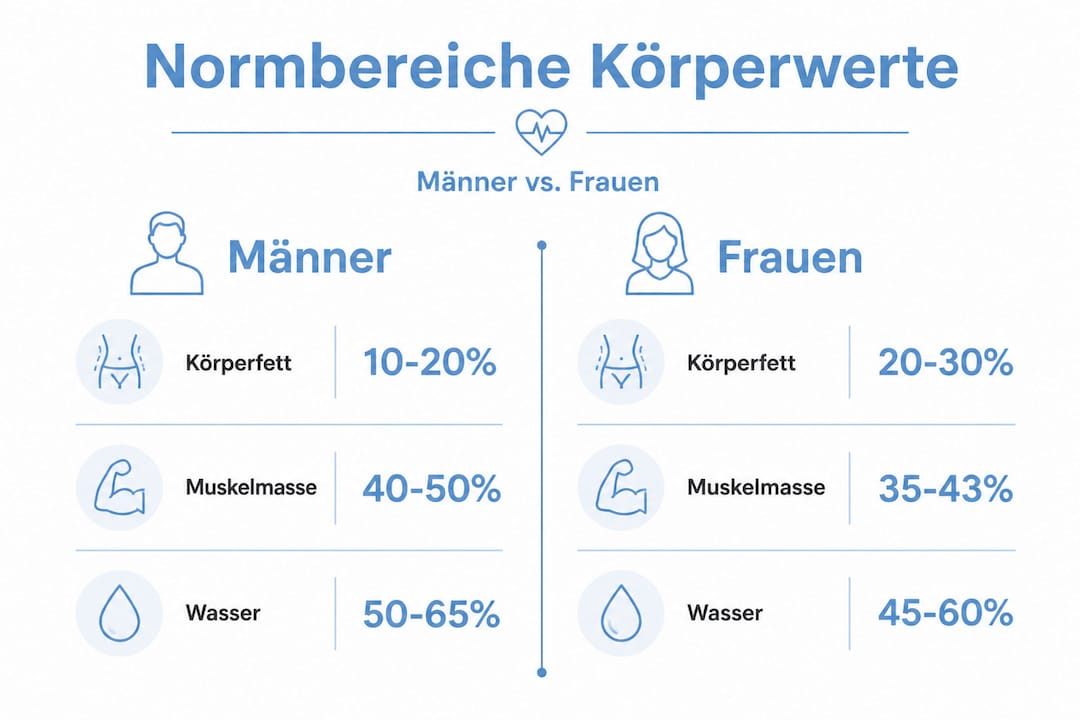
According to available health data, a healthy muscle mass percentage is 40 to 50 percent of body weight for men and 30 to 40 percent for women. Water content should be between 50 and 65 percent, with well-trained people often at the upper end of this range because muscles store more water than fat tissue.
| Metric | Men’s normal range | Women’s normal range |
|---|---|---|
| Body fat percentage | 10-20 % | 20-30 % |
| Muscle mass | 40-50 % | 30-40 % |
| Water content | 55-65 % | 50-60 % |
| Visceral fat (BIA scale) | Level 1–9 normal | Level 1–9 normal |
BIA versus DEXA: What the methods can do
BIA scales send a weak alternating current through the body and use resistance to estimate fat mass, muscle mass, and water content. They are affordable, easy to use, and well suited to regular tracking. However, they are sensitive to hydration status. Someone who measures well hydrated in the morning will get different values than after a strenuous workout.
DEXA measurements are significantly more precise. They use X-rays and can determine body fat, muscle mass, and bone density with millimeter-level accuracy, even for individual regions of the body. A DEXA scan usually costs between 80 and 150 euros and is increasingly available at specialized health centers. For an annual in-depth assessment, it is the most accurate option available outside clinical settings.
A well-founded metabolism analysis guide shows how this data can be combined with genetic information to provide a complete picture. And anyone who wants to know whether genetic factors play a role in their weight can find a data-based starting point in the DNA analysis for weight loss.
“Body composition data are not a one-time diagnosis—they only reveal their value over time and in the context of your lifestyle habits.”
How to track and evaluate body data effectively: Practical tips & sources of error
Knowing about the values is of little help if the measurements themselves are unreliable. Consistency beats precision when it comes to everyday tracking.
The most common measurement errors at a glance
| Source of error | Possible impact | Prevention strategy |
|---|---|---|
| Measuring after exercise | Reduced body water, distorted body fat percentage | Always measure in the morning, while fasting |
| Varying times of day | A weight difference of up to 2 kg is normal | Choose a fixed time, ideally in the morning |
| Fluctuating hydration status | Muscle mass and fat may appear altered | Do not drink anything for 2 hours before the measurement |
| Hormonal cycle phase | Water retention of up to 3 kg is possible | Document the cycle day; focus on trends rather than individual values |
| Changing devices | Different algorithms produce different values | Always use the same device |
Step by step: Building your own tracking system
- Choose a reliable measuring device: A BIA scale with a smartphone app is sufficient for most people. What matters is not absolute precision but consistency over several weeks.
- Set consistent measurement conditions: Measure in the morning after your first trip to the bathroom, before breakfast, without shoes, and in the same clothing. According to tracking recommendations, maintaining these conditions under consistent circumstances is essential for meaningful comparisons.
- Document more than just weight: Also record sleep quality, stress level, calorie intake, and training sessions. Without context, body data are difficult to interpret.
- Analyze trends over at least four weeks: Daily fluctuations of one kilogram are biologically normal. Only the trend over several weeks reveals genuine changes.
- Compare your data with personalized benchmarks: Reference values from the literature are starting points. Your personal baseline and the direction of change are more meaningful than comparisons with average values.
Pro tip: Anyone who undergoes a metabolic analysis for weight loss receives data-based benchmarks tailored much more precisely to their own physiology than general reference tables.
Do not store your measurement data in your head; record it in an app or a simple spreadsheet instead. This helps you identify patterns that remain invisible when looking at individual measurements.
Individual differences and special cases—the bigger picture
Standard values are useful guidelines. But for many people, they do not go far enough.
Athletes: When good numbers look bad
A strength athlete weighing 88 kg at 178 cm has a BMI of 27.7, which is clinically classified as “overweight.” His body fat percentage is 12 percent. The problem is the BMI, not the athlete. According to analyses of special cases in body measurements, athletes regularly have formally elevated BMI values despite extremely low body fat percentages. BMI was never developed for competitive athletes.
The TOFI phenomenon: Thin but risky
Even more insidious is the opposite case. TOFI stands for “Thin Outside, Fat Inside.” People with a normal BMI and a slim appearance can accumulate significant amounts of visceral fat without knowing it. Those particularly affected include people with predominantly sedentary lifestyles and poor diet quality but moderate body weight. Their organs are surrounded by fat that remains invisible on the scale or in the mirror.
“Being slim does not automatically protect you from metabolic risks. Anyone who disregards body composition and focuses only on weight may be overlooking the most dangerous factor.”
Hormones and life stages as confounding variables
Women going through menopause often experience a shift in their fat distribution pattern. Declining estrogen levels promote fat storage around the abdomen, regardless of calorie intake or physical activity. This hormone-related redistribution of fat makes conventional reference values more difficult to interpret. Those who would like to learn more about estrogen deficiency and weight gain will find important background information there.
The same applies to men with low testosterone, people with thyroid disorders, and those who have experienced prolonged periods of elevated cortisol due to stress. Anyone who considers only weight or BMI will not see these connections. A deeper article on the connections between belly fat and metabolism provides more information.
Hormones play a role that goes beyond fat distribution. Insulin, glucagon, and cortisol directly control where energy is stored and where it is drawn from. Understanding your hormonal blood sugar dynamics allows you to apply nutrition and training strategies much more precisely.
Application: Adjusting nutrition and lifestyle to body metrics
Data without an action plan remain numbers on a display. This is where information becomes guidance.
Step by step: From data to decisions
- Determine your starting point: Measure all relevant metrics under consistent conditions. Record your BMI, waist circumference, WHtR, and, if possible, body fat percentage and muscle mass.
- Define a realistic goal: Not “lose weight,” but something specific: “Reduce visceral fat level from 12 to below 9” or “Increase muscle mass by 3 kg in four months.” Measurable goals allow for clear progress tracking.
- Set protein targets based on your muscle mass: According to evidence-based body recomposition research, the optimal range for muscle gain is 1.6 to 2.2 grams of protein per kilogram of body weight per day. When also in a calorie deficit, the upper end of the range is more appropriate.
- Adjust your calorie intake to your goal: Body recomposition, meaning simultaneous muscle gain and fat loss, is particularly possible for beginners and people who are overweight. In such cases, a moderate deficit of 200 to 400 calories per day is more effective than extreme calorie restriction.
- Adjust your training stimulus to your current metrics: People with little muscle mass benefit more from strength training than from endurance sessions. Those who already have good muscle mass can specifically reduce visceral fat with interval training.
- Check every four weeks: Compare your measurements and adjust your strategies. No linear change is a signal, not a defeat.
Pro tip: Anyone familiar with losing weight with DNA analysis knows that genetic factors largely determine how well a body responds to low-carb, low-fat, or strength-training stimuli. Building a nutrition plan without this information is like navigating without a map.
Avoiding Common Mistakes When Making Adjustments
Many people begin by changing too much at once. They drastically reduce calories, start exercising every day, and eliminate entire food groups. The result: the body responds by releasing stress hormones, losing muscle, and becoming exhausted, while body data may even worsen in the short term. Precise, gradual adjustments are always more effective than radical cuts. And adequate protein intake has been shown to protect muscle mass during periods of caloric deficit better than any other single nutritional measure.
Why Numbers Are Only the Beginning: Our Practical Takeaway
We work every day with people who want to optimize their health based on numbers. And we have learned this: The most common mistake is not measuring the wrong values. The most common mistake is giving too much importance to a single value.
Anyone who discovers that their BMI is 27 and then panics has misunderstood BMI. Anyone who takes a BIA measurement and regards the value as absolute has misunderstood the method. BIA is practical but dependent on hydration, while DEXA is more precise but more expensive and less accessible. Both methods have their place; neither completely replaces the other.
What really matters is the trend. Anyone who observes over six months that their waist circumference is decreasing, their muscle mass is increasing, and their energy level is rising has done everything right, even if their BMI remains unchanged. Body data are instruments, not judgments. They show directions, not endpoints.
Another aspect we repeatedly observe in practice: People who achieve long-term success treat their body data with professional curiosity rather than emotional reactions. Poor measurements on Monday morning after a stressful weekend do not mean a catastrophe. They mean that sleep, hydration, and cortisol influenced the measurement.
The Health Analysis Guide offers further insights into how systematic analyses can permanently sharpen your understanding of your own body.
That is why we always recommend to our customers: Start with a solid data foundation. Supplement it with genetic and biochemical analyses where appropriate. Then stop questioning every number. Observe patterns. Act based on trends. Stay curious, but remain calm.
Next steps: Your personal health analysis with mybody®x
Interpreting body metrics is a skill that can be significantly improved with the right tools. mybody® offers you exactly that: scientifically validated analyses of DNA, metabolism, nutrient status, and hormones that you can conveniently carry out from home. Instead of projecting general standard tables onto your body, you receive answers tailored to your biological reality. All analyses are performed in ISO-certified laboratories with the highest data protection standards. Discover the right analyses for your goals at mybody®x and lay the foundation for data-driven, sustainable health optimization today.
Frequently asked questions about correctly interpreting body metrics
How often should I measure my body metrics?
Weekly measurements taken at set times of day are optimal because they show reliable trends without overemphasizing daily biological fluctuations. Consistent measurement conditions are more important than high measurement frequency.
Why isn't BMI enough?
BMI completely ignores fat distribution and muscle mass and should always be supplemented with waist circumference or body fat percentage. As a screening tool alone, it can provide initial indications, but little more.
How can I recognize dangerous belly fat?
A waist circumference above 94 cm for men or above 80 cm for women, as well as a WHtR above 0.5, are considered warning signs of increased metabolic risk from abdominal fat.
How can I improve my body metrics?
Sufficient protein according to benchmarks for muscle building—between 1.6 and 2.2 grams per kilogram of body weight daily—combined with regular strength and endurance training and a moderate calorie deficit sustainably improves body composition.
What is the difference between visceral and subcutaneous fat?
Visceral fat accumulates around the internal organs and significantly increases the risk of diabetes and heart disease more than subcutaneous fat, which lies harmlessly beneath the skin and has barely noticeable metabolic effects in everyday life.
Recommendation
- Test for nutrient deficiencies: Recognize symptoms & specifically address deficiencies – mybody®x
- Health optimization: 70% do not benefit from standard approaches – mybody®x
- Optimize your nutrition based on your test results: Step-by-step guide – mybody®x
- Which metabolic type am I? Discover your path to optimal nutrition – mybody®x
- Unlock body temperature trends for early illness detection – Smartlet



Share now:
Recognize stress symptoms and take effective action against them
Gut detox: Your 4-week plan for a healthy gut