

D3 K2 vitamin: dosage, effects, and combination
The combination of vitamin D3 and K2 is one of the most discussed micronutrient pairings in modern preventive healthcare. Many people take vitamin D3 alone and wonder whether K2 is really necessary. The answer is nuanced: the D3 K2 combination makes biological sense, but it is not an essential safety requirement. This article explains how the two vitamins work together, which dosages are currently recommended, what the scientific evidence actually supports, and how to take them in practice.
What does D3 K2 vitamin do in the body?
Vitamin D3 and vitamin K2 are both fat-soluble vitamins that work closely together in the body. Their functions overlap at a crucial point: the regulation of calcium.
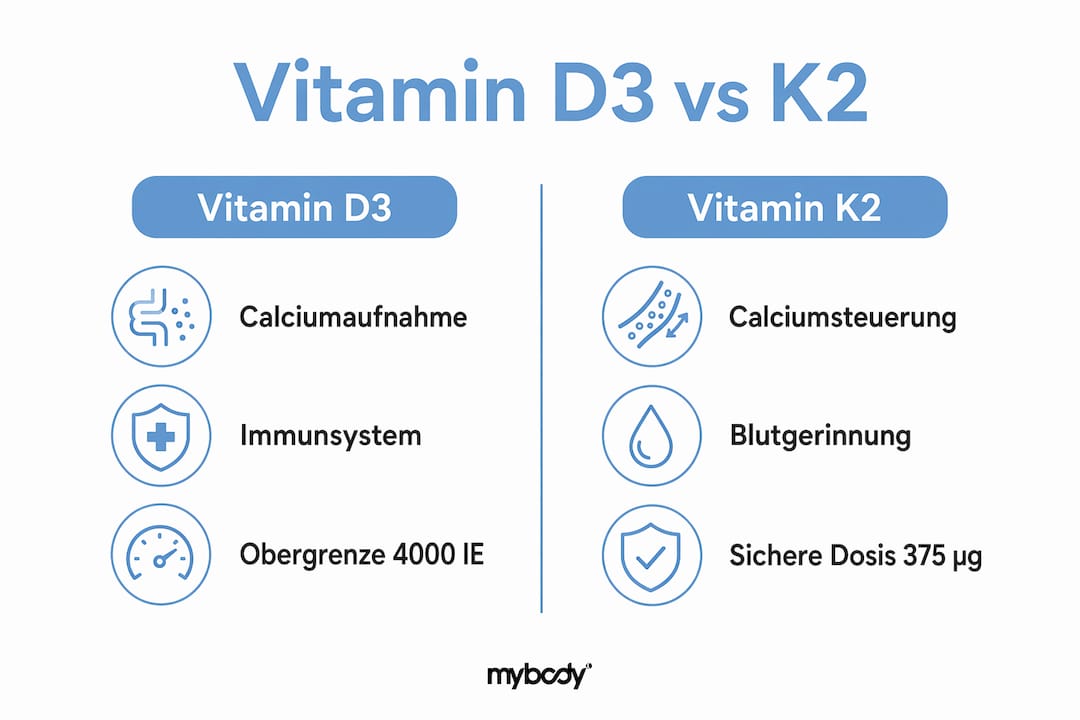
Vitamin D3 increases calcium absorption from the intestines and stimulates the production of calcium-binding proteins. This is beneficial for the bones, but it can become problematic if the calcium does not reach where it is needed. This is precisely where vitamin K2 comes into play.

Vitamin D increases calcium absorption and the production of vitamin K-dependent proteins. Vitamin K2 activates these proteins and controls whether calcium is incorporated into the bones or the blood vessel walls. Without sufficient K2, calcium may be deposited in the arteries instead of strengthening the bones.
The key functions at a glance:
- Vitamin D3: Increases calcium absorption in the intestines and supports the immune system and muscle function
- Osteocalcin: A protein activated by vitamin K2 that incorporates calcium into the bone matrix
- Matrix Gla Protein (MGP): Also dependent on K2, it prevents calcium deposits in blood vessel walls
- MK-7: The preferred form of vitamin K2 in supplements because it has a longer half-life and better effects in tissues than K1 or other forms of K2
The difference between vitamin K1 and K2 is relevant here. K1 is primarily involved in blood clotting and is abundant in green vegetables. MK-7, a form of K2, has a longer half-life and better effects in tissues than K1 or other forms of K2, which influences the choice of the right supplement. MK-7 is therefore the more relevant form for bone and cardiovascular health.
What does science say about the D3 K2 combination?
The scientific evidence for the vitamin D3 K2 combination is promising but not yet conclusive. The mechanistic rationale is convincing. Clinical studies provide initial positive signals, but no universal recommendations.
The study by Knapen et al. (2015) showed that in postmenopausal women, a combination of vitamin D3 and MK-7 improved bone stiffness and vascular elasticity. The 2022 AVADEC study examined effects on vascular health in at-risk patients and provided further indications of synergistic effects. These findings are significant but do not apply universally to all population groups.
“The combination of vitamin D3 and K2 is mechanistically plausible, but not essential for safety. Individual optimization is possible.” (Nutritailor)
Particularly important: Guidelines from the NHS, NICE, and the Endocrine Society 2024 do not routinely recommend K2 as a necessary cofactor for vitamin D supplementation. This does not mean that K2 is useless. It means that vitamin D3 can be taken safely on its own without K2 being strictly necessary.
The following points summarize the current body of evidence:
- Postmenopausal women have been shown to benefit from the combination for bone and vascular health.
- Positive signals have been observed in patients at cardiovascular risk, but there is no conclusive evidence.
- High doses of vitamin D3 without K2 are not automatically dangerous according to current guidelines.
- The Endocrine Society 2024 no longer recommends a universal 25(OH)D target level, but rather testing based on indications.
The practical conclusion: The D3 K2 combination makes sense for many people, especially if you already want to supplement both vitamins. However, it is not medically necessary for everyone.
Vitamin D3 K2 Dosage: Recommendations and Safety
The correct dosage is the decisive factor for both benefits and safety. Blanket recommendations fall short here.
According to EFSA, vitamin D3 has an upper limit of 4,000 IU per day for adults. This corresponds to 100 micrograms per day. This limit is considered safe for most healthy adults, but does not rule out the possibility that higher doses may be appropriate under medical supervision. Many common supplements provide 1,000 to 2,000 IU per day, which is sufficient for basic needs.
For vitamin K2 in the form of MK-7, the highest observed safe daily dose is 375 µg, according to an analysis by the Council for Responsible Nutrition (CRN). Typical supplements contain 75 to 200 µg of MK-7 per day, which is well below this limit.
| Nutrient | Typical daily dose | Safe upper limit | Special feature |
|---|---|---|---|
| Vitamin D3 | 1000 to 2000 IU | 4000 IU (EFSA) | Fat-soluble; take with a meal |
| Vitamin K2 (MK-7) | 75 to 200 µg | 375 µg (CRN) | Not with blood thinners without medical advice |
The most important principle for dosage: Actual requirements depend on the measured 25(OH)D level in the blood. Vitamin D status is determined using the 25(OH)D blood marker. A level below 30 nmol/L is considered deficient, while 30 to 50 nmol/L is considered insufficient. Those who guess instead of measuring rarely choose the optimal dose. A vitamin D home test gives you clarity about your actual baseline level.
Pro tip: Have your 25(OH)D level measured before starting supplementation. Someone who is already at 60 nmol/L needs a different dose than someone at 20 nmol/L. Blind supplementation wastes money and can cause long-term harm at very high doses.
A critical note applies to people taking vitamin K antagonists such as warfarin. Vitamin K2 can interact with blood thinners and should only be taken under medical supervision in this case. Anyone taking anticoagulants should generally discuss K2 supplements with their treating physician. You can find more information about drug interactions in our guide.
What is the best way to take D3 and K2?
The bioavailability of both vitamins depends heavily on the form and timing of intake. Both are fat-soluble, which has specific practical implications.
-
Take with a fat-containing meal: Vitamin D3 is preferably taken with a fat-containing meal to optimize fat solubility and absorption. The same applies to K2. Avocado, nuts, olive oil, or a regular lunch are sufficient.
-
Prefer MK-7 as a form of K2: MK-7 has a half-life of several days, while other forms of K2, such as MK-4, are broken down much more quickly. This makes MK-7 the more effective choice for supplements.
-
Combination supplements vs. individual supplements: Combination supplements containing D3 and K2 are practical and ensure that both vitamins are taken at the same time. Individual supplements offer more flexibility in dosing but require greater discipline. For most people, a combination supplement is the simpler solution.
-
Know and assess food sources: Vitamin D3 is found in fatty fish such as salmon and herring, as well as in egg yolks. Vitamin D3-fortified dairy products have been shown to increase 25(OH)D levels and are an effective strategy against deficiency. Vitamin K2 is found primarily in fermented foods such as natto, cheese, and quark. Dietary amounts alone are insufficient for many people, especially during the winter months.
-
Consult a doctor or nutritionist: If you are unsure, have pre-existing conditions, or take medication, professional advice is not a luxury but a sensible choice.
Pro tip: It is best to take your D3 K2 supplement with lunch or dinner, when you are eating something fatty anyway. Absorption is significantly poorer in the morning on an empty stomach.
Anyone who wants to correct a vitamin D deficiency should consider diet, sun exposure, and supplementation as a complete package, not as isolated measures.
Common misconceptions about the vitamin D3 K2 combination
Persistent misconceptions circulate about D3 K2 dietary supplements. Here are the most important misconceptions and what is actually true.
-
"Vitamin D3 is dangerous without K2": This is false. Current guidelines from the NHS, NICE, and the Endocrine Society confirm that vitamin D3 can be safely supplemented on its own. K2 is a useful addition, but not a safety requirement.
-
"The more vitamin D, the better": False. The EFSA upper limit of 4,000 IU per day exists for good reason. Chronically excessive doses can lead to hypercalcemia, meaning a dangerously high calcium level in the blood. In this case, more is not better.
-
“A blood test is unnecessary if you have symptoms”: Symptoms such as fatigue, muscle weakness, or frequent infections can have many causes. Only the 25(OH)D level in the blood reliably shows whether a deficiency is present. Anyone who notices signs of a vitamin D deficiency should get tested instead of guessing.
-
“K2 and blood thinners are not a problem”: This is a potentially dangerous misconception. Vitamin K2 affects blood clotting and can alter the effect of warfarin and similar medications. Anyone taking anticoagulants must discuss K2 with their doctor.
-
“The combination automatically protects the heart and bones”: The evidence is promising but not conclusive. There are particularly positive indications for postmenopausal women and people with cardiovascular risks. However, the combination is no guarantee.
-
“Vitamin D from sunlight is enough in summer”: In Central Europe, sunlight from October to April is too weak for sufficient vitamin D synthesis. Even in summer, it is insufficient for many people, especially those who predominantly work seated indoors.
Key findings
The vitamin D3 and K2 combination makes biological sense, can be individually dosed, and is safe for most healthy adults, but it is not a cure-all without first measuring the 25(OH)D level.
| Point | Details |
|---|---|
| Biological synergy | Vitamin D3 increases calcium absorption, while K2 directs where calcium ends up in the body. |
| Dosage based on measurement | Measure your 25(OH)D level before determining your dosage. Blind supplementation is inefficient. |
| Safe upper limits | Vitamin D3: maximum 4,000 IU daily (EFSA); MK-7: maximum 375 µg daily (CRN). |
| K2 is not an essential partner | Guidelines do not recommend K2 as a mandatory cofactor, but consider it a useful supplement. |
| Caution with blood thinners | Anyone taking warfarin or similar medications must discuss K2 with their doctor. |
What I really think about this topic after years of experience
If I have learned one thing, it is this: Most people who come to us have either supplemented too much or too little vitamin D without ever having their levels measured. That is the real problem—not whether K2 must be included.
The combination of D3 and K2 often makes practical sense because it is simple and both vitamins are frequently deficient at the same time anyway. But I also repeatedly see people who become unsettled by marketing claims and believe that taking D3 without K2 is inherently risky. That is simply not true. The science here is clearer than many supplement manufacturers would like to admit.
What I really recommend: Measure first, then supplement. The 25(OH)D level is the only reliable compass. Someone at 25 nmol/L needs a different strategy than someone at 55 nmol/L. And anyone adding MK-7 should choose a form with proven bioavailability, not the cheapest product on the shelf.
The combination is not a miracle cure. It is a useful tool when you know why you are using it.
— MYBODY X
Your next step: Measure your levels, then take targeted action

Anyone who really wants to know whether they need vitamin D3, K2, or both cannot avoid a blood test. mybody x offers an at-home vitamin D test that lets you conveniently measure your 25(OH)D level yourself. The result shows whether you are in the healthy range or should take targeted action. No guessing, no one-size-fits-all supplementation, but a decision based on real data. In addition, mybody x offers Vitamin D in Foods and other guides to help you optimize your overall nutrient status. Health begins with knowledge.
FAQ
Do I always need to take K2 when supplementing with D3?
No. Current guidelines from the NHS, NICE, and the Endocrine Society in 2024 do not recommend K2 as a mandatory cofactor for vitamin D3. The combination makes sense, but it is not a safety requirement.
What daily dose of vitamin D3 is safe?
EFSA sets the safe upper limit for adults at 4000 IU per day. For most people, 1000 to 2000 IU per day is sufficient for basic supplementation, depending on the measured 25(OH)D level.
Which form of vitamin K2 is most effective?
MK-7 is the preferred form because it has a longer half-life and better tissue activity than K1 or other forms of K2. According to the CRN analysis, the safe maximum dose for MK-7 is 375 µg per day.
Can I take D3 and K2 if I am taking blood thinners?
Not without consulting a doctor. Vitamin K2 affects blood clotting and can alter the effect of vitamin K antagonists such as warfarin. Be sure to discuss this with your doctor.
How can I tell whether I have a vitamin D deficiency?
Only a blood test measuring the 25(OH)D level provides reliable information. A level below 30 nmol/L is considered a deficiency. Symptoms alone are not sufficient for a diagnosis.



Share now:
How does DNA analysis work: How does DNA analysis work?
Vitamin D3 Drops: Dosage, Effects, and Use