

Vitamin D3 drops: dosage, effects, and use
Vitamin D3 drops are a liquid form of the fat-soluble vitamin D3 (cholecalciferol) and are considered one of the most flexible methods of targeted dietary supplementation. Despite their growing popularity, many people do not know how to dose the drops correctly or when it is best to take them. Vitamin D deficiency is widespread in Germany, especially during the winter months, but indiscriminate use without knowing one's own blood level carries risks. This guide explains what vitamin D3 drops can do, how to find the right dose, and which mistakes you should avoid.
What are vitamin D3 drops, and what benefits do they offer?
Vitamin D3 is the most biologically active form of vitamin D and is mainly produced in the body through exposure to sunlight on the skin. It regulates calcium absorption in the intestines, supports bone health, and is involved in numerous metabolic processes. Vitamin D deficiency primarily affects the bones, as insufficient vitamin D restricts calcium absorption. This means that anyone who consistently has too little vitamin D risks bone loss and muscle weakness.
The drop form offers specific advantages over tablets and capsules. Vitamin D3 drops enable flexible dosing and are considered highly bioavailable, making them particularly practical for people with increased needs. You can adjust the dose drop by drop, which is not possible with fixed-dose forms. They are also easy to add to drinks or place on a spoon, making daily intake easier.
The following properties make vitamin D3 drops popular as a dietary supplement:
- Flexible dosing: Each drop contains a defined amount, such as 500 or 1,000 International Units (IU).
- High bioavailability: Liquid forms are often absorbed by the body more quickly than pressed tablets.
- Easy to take: Particularly suitable for children, older people, or those with difficulty swallowing.
- Combinable: Many products also contain vitamin K2, which supports calcium utilization in the bones.
Vitamin D3 drops made from lanolin are often biologically more stable than plant-based alternatives, although quality varies considerably depending on the manufacturer. When buying vitamin D3 drops, anyone who values quality should look for clear ingredient declarations and verified manufacturing standards.
What should the vitamin D3 drops dosage be?
Dosage is the decisive factor when taking vitamin D3 drops. Adults should take 800 to 1000 IU of vitamin D daily to maintain a good level. This corresponds to the recommendation of the German Nutrition Society (DGE) and covers the basic requirement with normal sun exposure.

The following table provides an overview of recommended dosages by age group and situation:
| Group | Recommended daily dose | Maximum daily dose |
|---|---|---|
| Adults (18 to 65 years) | 800 to 1000 IU | 4000 IU |
| Older adults (65 and over) | 1000 to 2000 IU | 4000 IU |
| Pregnant and breastfeeding women | 1000 to 2000 IU | 4000 IU |
| Children (1 to 12 years) | 400 to 600 IU | 2000 IU |
| Infants (0 to 12 months) | 400 IU | 1000 IU |
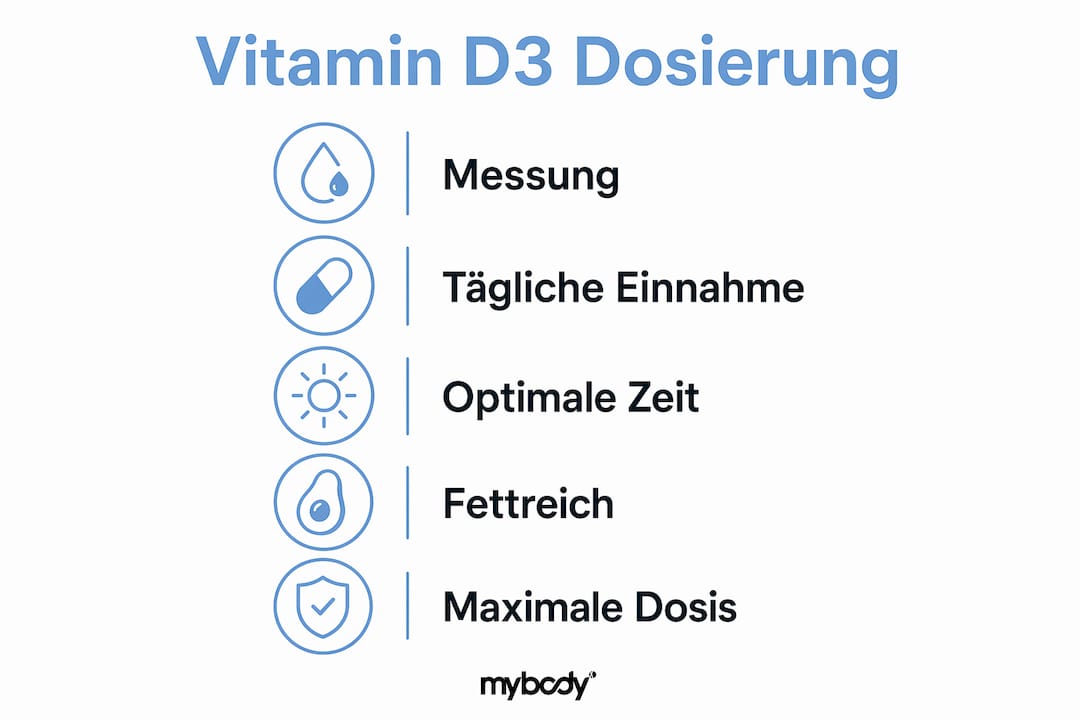
The maximum daily amount of 4000 IU is considered a safe upper limit for healthy adults. This does not mean that this amount is appropriate every day, but rather that it is the threshold above which risks may arise. In 2025, Stiftung Warentest tested vitamin D supplements with daily doses of 200 to 4000 IU and found that many products are at the upper end of this range without a medical need having been demonstrated.
People with dark skin, older adults, pregnant women, and people who are ill benefit particularly from targeted vitamin D3 supplementation. These groups either have reduced natural production or an increased need that exceeds the standard recommendation.
Pro tip: Have your vitamin D level measured before starting supplementation. If you already have a good level, you do not need high doses. If you have a deficiency, you may benefit from a targeted, higher starting dose under medical supervision.
How should you take vitamin D3 drops correctly?
Taking it correctly determines how well your body can actually absorb vitamin D3. Follow these steps for reliable use:
- Shake the bottle: Some products settle. Shaking briefly ensures an even concentration.
- Count the drops: Hold the bottle upright and count the drops directly onto a spoon or into a small glass. Avoid dripping directly into your mouth, as this makes the dosage inaccurate.
- Take with a meal containing fat: Vitamin D3 is fat-soluble. Taking it in the morning with food improves bioavailability because dietary fat supports absorption in the intestines.
- Maintain regularity: Taking it at the same time every day establishes a routine and prevents missed doses.
- Note the storage conditions: Vitamin D3 drops should be stored in a cool, dry place protected from light. Direct sunlight and heat degrade the active ingredient.
The optimal time to take it is in the morning with breakfast. Taking it in the evening can affect sleep in some people, as vitamin D is involved in the metabolism that also influences the sleep-wake cycle. This is not a hard-and-fast rule, but it is a point many users confirm.
Common mistakes when taking it include adding the drops to hot drinks (heat destroys the active ingredient), taking it on an empty stomach without fat, and taking it irregularly and then making up for it by consuming large amounts. The latter increases the risk of a short-term overdose.
Pro tip: Take it with a high-fat food such as a tablespoon of olive oil, nuts, or avocado. This is not essential, but it noticeably maximizes absorption.
How can you recognize a vitamin D deficiency and adjust the dosage?
Vitamin D deficiency rarely presents with a single clear symptom. The signs are often nonspecific and are easily attributed to other causes. Typical signs include:
- Persistent tiredness and exhaustion without an apparent reason
- Frequent infections, as vitamin D regulates the immune system
- Muscle pain or muscle weakness, especially in the legs
- Bone pain, especially in the back and hips
- Low mood or depressive moods, especially in winter
- Hair loss that exceeds normal shedding
These symptoms alone are not enough to confirm a deficiency. Measuring the 25(OH)D blood level is the most reliable method for assessing vitamin D status and adjusting dosages individually. A level below 30 nmol/l is considered deficient, while levels between 50 and 125 nmol/l are considered optimal.
The vitamin D requirement varies greatly from person to person and depends on factors such as skin type, body weight, age, and sun exposure. Someone who weighs 90 kilograms needs a higher dose than someone who weighs 60 kilograms, as vitamin D is stored in fatty tissue and is distributed across more tissue at a higher body weight.
Medical advice is advisable if you have symptoms of a deficiency, take medications that affect vitamin D metabolism (such as corticosteroids or certain antiepileptic drugs), or plan to take high doses over an extended period. A blood test at your primary care doctor's office or a certified vitamin deficiency self-test provides the basis for an informed decision.
What does the science say about vitamin D3 drops and overdose?
The evidence on vitamin D is more nuanced than many advertising messages suggest. There is no general recommendation for healthy adults to take vitamin D3 supplements long term, but moderate intake is not harmful. This means that anyone who is not deficient gains little from supplementation but also faces little risk at low doses.
“Vitamin D is not a cure-all. The evidence shows clear benefits for at-risk groups, but no confirmed effect on cancer, heart disease, or dementia in healthy adults.” (Tagesschau Faktenfinder, 2024)
However, the evidence is strong for certain groups. Older people, individuals with little sun exposure, and people with malabsorption disorders such as Crohn's disease or celiac disease demonstrably benefit from targeted vitamin D3 supplementation. Here, the benefits clearly outweigh the risks.
The risk of overdose is real and is often underestimated. Long-term vitamin D overdose can lead to elevated calcium levels, kidney stones, vascular calcification, and cardiac arrhythmias. This is not a theoretical risk but one documented in clinical practice. It is important to know that the body's own vitamin D production regulates itself, so an overdose from sunlight is not possible. Supplements, however, can indeed lead to toxic levels when taken at persistently high doses.
Many overdoses result from misinterpreted dosage recommendations on social media. Influencers sometimes recommend 10,000 IU daily without any medical basis. This is dangerous. Anyone who regularly takes vitamin D3 drops should have their blood levels checked at least once a year.
Key findings
Vitamin D3 drops are a useful dietary supplement for people with a confirmed deficiency or increased needs, but they are only truly effective when dosage, timing, and blood monitoring are coordinated.
| Point | Details |
|---|---|
| Recommended daily dose for adults | 800 to 1,000 IU per day covers the basic requirement; a maximum of 4,000 IU is considered a safe upper limit. |
| Optimize intake with fat | Vitamin D3 is fat-soluble. Taking it in the morning with a fat-containing meal improves absorption. |
| Measure blood levels before taking it | The 25(OH)D level in the blood shows the actual need and prevents unnecessary or dangerous overdosing. |
| Provide targeted support for risk groups | Older adults, pregnant women, and people with dark skin benefit most from vitamin D3 supplementation. |
| Take overdosing seriously | Persistently high doses can cause kidney stones and heart rhythm disturbances. Regular monitoring is essential. |
What I have really learned after years with vitamin D3 drops
At mybody x, we see test results every day from people who believe they are well supplied, yet still have a significant deficiency. And we see the opposite: people taking high doses without needing them because a podcast or Instagram account recommended it.
The uncomfortable truth is this: vitamin D3 drops are not a product you buy once and then take thoughtlessly every day. The body responds individually to supplementation. Two people taking the same dose can have completely different blood levels after three months, depending on body weight, gut health, genetics, and sun exposure habits.
What really works is the combination of measuring, dosing, and measuring again. Anyone who knows their baseline can start in a targeted way. Those who retest after three months can see whether the dose is right. This may sound time-consuming, but it is not. A simple blood test is enough, and it gives you more certainty than any blanket recommendation.
I also recommend not considering vitamin D in isolation. Magnesium is necessary for the activation of vitamin D. Vitamin K2 directs the calcium mobilized by vitamin D into the bones instead of the blood vessels. Anyone who only takes vitamin D3 drops and ignores the rest is optimizing just one part of the system.
Exaggerated claims about vitamin D, whether for cancer, depression, or autoimmune diseases, are not supported by scientific evidence. That does not make vitamin D3 any less valuable. It makes it more human and realistic. Use it for what the evidence is strong for: bone health, immune function, and addressing a confirmed deficiency.
— MYBODY X
Determine your vitamin D status specifically with mybody x
Anyone who wants to use vitamin D3 drops effectively needs a reliable baseline. With mybody x, you can conveniently test your vitamin D status and receive a scientifically validated result with specific recommendations for action.

The test is simple to perform at home using a small finger-prick blood sample. mybody x's ISO-certified laboratory analyzes your 25(OH)D level and shows you exactly whether you have a deficiency, are adequately supplied, or are even taking too many supplements. More than 11,300 customers have already benefited from personalized health analyses. Instead of dosing blindly, you will know exactly what your body needs. That is the difference between guessing and knowing.
FAQ
What is the right daily dose of vitamin D3 drops?
For healthy adults, professional societies recommend 800 to 1000 IU daily. The maximum safe daily dose is 4000 IU. Higher doses should only be taken after a blood test and medical advice.
When is the best time to take vitamin D3 drops?
Taking them in the morning with a fatty meal is optimal, as vitamin D3 is fat-soluble and dietary fat improves absorption in the intestine. Taking them in the evening may affect sleep in some people.
Can vitamin D3 drops be overdosed?
Yes. Long-term intake of more than 4000 IU daily can lead to elevated calcium levels, kidney stones, and cardiac arrhythmias. Unlike exposure to sunlight, the absorption of supplements is not self-regulating.
Are vitamin D3 drops suitable for children?
Vitamin D3 is suitable for children in lower doses. Infants generally receive 400 IU daily, while children up to 12 years old can receive up to 600 IU. The exact dose should be discussed with a pediatrician.
How can I tell whether I have a vitamin D deficiency?
Typical signs include fatigue, frequent infections, muscle pain, and low mood. A deficiency can only be reliably confirmed by measuring the 25(OH)D level in the blood, either by a doctor or with a certified home test.



Share now:
D3 K2 Vitamins: Dosage, Effects, and Combination
B-Complex Vitamin Supplements: Proper Dosage