
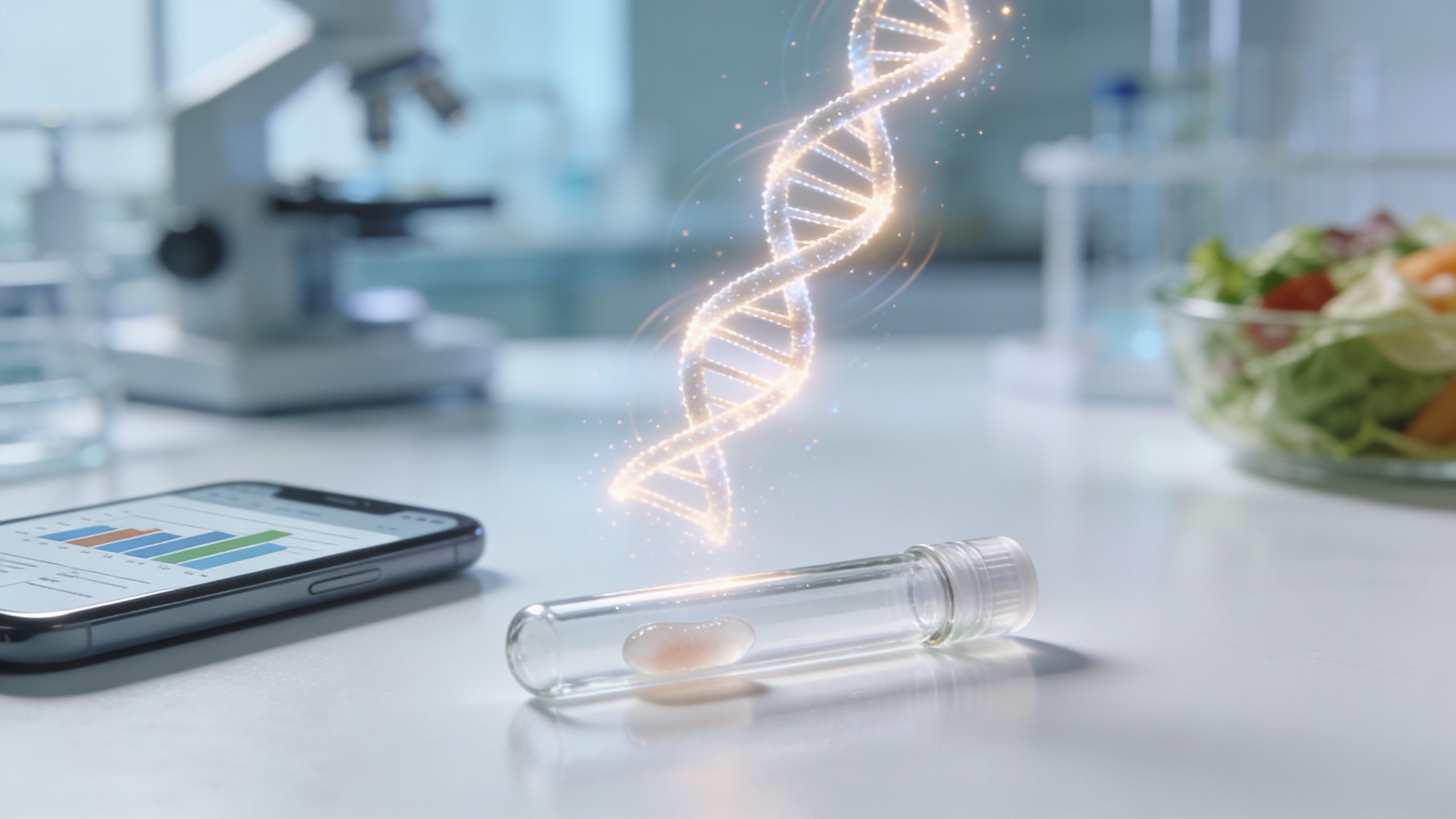
How does DNA analysis work: How does DNA analysis work?
You are making an effort. You read labels, try different diets, pay attention to exercise, and want to do something good for your body. Yet much of it still feels like guesswork. What works for others may do little for you, or it may simply not fit into your everyday life.
This is exactly where the question “how does DNA analysis work” becomes interesting. Not because genes determine everything, but because they can help you understand how your body is more likely to respond to food, caffeine, or certain macronutrients. This turns generalized nutrition advice into a more personalized approach. So you are not “difficult.” You simply have an individual metabolism that standard plans often do not accurately reflect.
Why diets fail and your genes know the answer
Many diets do not fail because of a lack of discipline. They fail because they are based on an average person who hardly exists in reality. One person feels stable and capable with more carbohydrates, while another does not tolerate them as well. One person can easily drink coffee in the evening, while another lies awake.
Health-conscious people often notice this very early. They realize that their body responds differently to the same plan than the bodies of friends, partners, or colleagues. Then the familiar pattern begins: first low-carb, then intermittent fasting, then “more protein,” and then back to something else. This costs energy, motivation, and often trust in your own body.
You are on the right track. DNA makes it more precise.
Genes are not a verdict. They are more like a basic setup that your body works with. When you understand what this setup looks like, you can align your nutrition and lifestyle more purposefully. That is precisely why more and more people are interested in genetically personalized approaches. Others are already optimizing on this basis. You do not have to chase every trend when you can use your own compass instead.
Anyone who wants to understand the basics better will find a good introduction in the article Genetics Explained Simply. For everyday life, one thing is particularly important: A DNA analysis does not completely eliminate trial and error, but it significantly shortens the process. You save yourself unnecessary detours and make decisions based on more substantial information.
What this means for you in concrete terms
- Less trial and error. You don’t have to test every diet for months just because it’s currently popular.
- More peace of mind. When you understand the connections, you assess setbacks more realistically.
- Better priorities. Instead of trying to optimize everything at once, you focus on the levers that suit you.
From Cheek Swab to Laboratory: The Journey of Your DNA Sample
You sit at the kitchen table in the morning, open the test kit, and may wonder: Is that all? In fact, a DNA analysis often starts exactly this way—with a cheek swab or saliva sample that you collect yourself at home in just a few minutes.
This offers you a clear advantage. As a rule, you do not need blood, a visit to a medical practice, or elaborate preparation. Getting started is easy. That is precisely why it is worth understanding the process, because the informative value begins not in the laboratory, but with collection.
How it works from your perspective
-
You collect the sample at home
You rub the swab along the inside of your cheek or provide saliva in the designated tube. This collects cells from which the DNA will later be extracted. The instructions are more than a formality here. They ensure that enough usable material arrives.
-
The sample is packaged and shipped
After collection, the sample goes back into the included container and is then shipped to the laboratory. The organizational process begins there: receipt, labeling, and assignment. This may sound unremarkable, but it prevents mix-ups and creates a sound basis for the subsequent analysis.
-
Your sample is processed securely
Reputable providers use pseudonymization. In practice, this means the sample is processed in the laboratory using a code rather than your name at every individual step. This protects your data and separates personal information from technical processing.
Practical rule: A properly collected sample improves the basis for reliable analysis.
Why your participation makes such a difference here
A common misconception is that laboratory technology alone determines quality. The first quality factor often lies in sample collection. If enough cells end up on the swab and the sample is not contaminated, the laboratory can work more precisely.
This is directly relevant to you. A good sample increases the chance of obtaining clear, interpretable results that you can later use to derive meaningful guidance for nutrition and metabolism. Anyone who wants to use their genetics to make better decisions in everyday life should not treat this first step as an afterthought.
So take a few quiet minutes. If the instructions require it, avoid eating and drinking immediately beforehand. Wash your hands, read through all the steps once, and follow the order. A little care at the start saves unnecessary uncertainty later.
What is actually examined from your sample
Another misconception is the idea that a sample automatically reveals the complete genetic blueprint for every conceivable purpose. In a DNA analysis for nutrition or metabolism, specific genetic variants that match the purpose of the test are examined.
You are not submitting a sample for unlimited scrutiny. You are submitting material for a clearly defined analysis process. That is important for its personal usefulness. The laboratory is not looking for everything, but for what can help you better understand the connections between genetics, nutrition, and your metabolism.
A look inside the laboratory: How your DNA is decoded
Your sample does not simply go into a machine at the laboratory that immediately produces a finished answer. It is more like a highly precise translation process. Step by step, a few cells become an analyzable pattern from which insights for nutrition and metabolism can later be derived.
The most important point for you to understand is this: The laboratory does not read your entire life. It examines clearly defined genetic characteristics that match the purpose of the test. That is precisely what makes the results useful to you in everyday life.
Step one: extraction
It starts with extraction. During this process, the DNA is released from the cells and separated from other components. Proteins, cell debris, and other substances could interfere with the measurement, so they are removed.
This purification is the foundation for everything that follows. A clean DNA sample produces clearer signals. Clearer signals ultimately mean more reliable conclusions about which genetic variants you have.
This simplified overview of the process can help you get oriented:

Step two: PCR as a genetic photocopier
After purification, the PCR, or polymerase chain reaction, often follows. PCR works like a photocopier for selected sections of your DNA. The laboratory amplifies exactly the regions needed for the subsequent analysis.
The reason is simple. A cheek swab contains only a small amount of starting material. For certain genetic variants to be identified reliably, the laboratory needs many copies of these target regions.
For you, this is more than a technical intermediate step. Only through this duplication can small genetic differences be made visible enough to produce a useful health report.
Step three Genotyping and SNPs
Now comes the part that is particularly relevant to personalized nutrition. Many health-related DNA analyses look for SNPs. These are tiny differences at individual positions in the genetic material. These small variations can influence how your body processes nutrients, responds to caffeine, or uses certain metabolic pathways.
The actual analysis is called genotyping. The laboratory specifically examines which variant of such a genetic marker you carry. You can think of it as reading individual letters in a very long text. Not every line is needed. What matters are the positions relevant to the question being investigated.
This is exactly where uncertainty often arises. It is important to distinguish between different types of DNA analysis because they have different objectives.
| Method or focus | Simply put |
|---|---|
| STR analysis | Is used primarily in forensics to compare individual profiles |
| SNP-based analysis | Is suitable for many lifestyle and nutrition-related questions |
| Mitochondrial DNA | Can be additionally helpful with difficult or highly degraded samples |
Forensic procedures and health-related analyses therefore do not automatically address the same question. Forensics is primarily concerned with identity. Nutrition and metabolism focus on how the body responds biologically to specific stimuli and nutrients. The result is not a verdict about your future, but an additional perspective for making better everyday decisions.
In practical terms, this means: A laboratory report is useful when it translates scientific measurements into concrete questions. Do you metabolize caffeine relatively slowly or quickly? Are there indications that your body processes certain nutrients differently? Where is it worth taking a closer look at your diet, timing, or habits? This is precisely where laboratory technology becomes personally useful.
Laboratory quality Why not every analysis is the same
A DNA analysis appears objective at first glance. Sample in, result out. In reality, quality depends heavily on how carefully the entire process is designed.
The greatest source of error often lies not in theory, but in practice. The quality of sample collection has the greatest influence on the success rate of a DNA analysis. Contaminated samples, insufficient DNA concentration, or incomplete extraction can lead to inaccurate results. That is why correct swabbing technique and strict laboratory controls are crucial, as Studyflix explains when discussing the stability of DNA analyses.

How to recognize good laboratory quality
Not every laboratory works with the same level of care. As a user, you should therefore pay less attention to marketing language than to process quality.
-
Proper sample handling
The sample must be clearly identified, stored correctly, and processed in a standardized manner. -
Quality control steps in the laboratory
Good laboratories check whether enough DNA is present and whether its quality is sufficient for analysis. -
Standardized processes
Repeatable processes reduce the risk of results being distorted by avoidable variations.
Why automation helps, but does not solve everything
Automation speeds up processing. However, it does not replace a good primary sample. If too little material is available at the outset or the sample is contaminated, even a state-of-the-art system cannot produce an ideal signal from it.
Good technology makes a good sample better. It cannot reliably rescue a poor sample.
Anyone using a home test should therefore pay attention not only to the test itself, but also to the provider and the laboratory behind it. According to the publisher's information, MYBODY Lab GmbH works with ISO-certified laboratory testing, including for saliva samples. This is not a minor detail; it is precisely the level at which a nice gadget becomes a credible health tool.
What your genes reveal about nutrition and metabolism
The most interesting part comes after the laboratory work. What do the data mean for your everyday life? Not in the abstract, but in relation to breakfast, shopping, training, and energy at work.
The important thing to understand first is this: Genes describe tendencies, not rigid categories. Nevertheless, patterns are helpful. They explain why two people can react very differently to the same diet.
Four metabolic profiles for orientation
These profiles are not medical diagnoses. They are only intended to help you roughly recognize yourself.
The carbohydrate type
You often feel more stable with balanced, complex carbohydrates than with extreme low-carb phases. If you reduce carbohydrates significantly, your energy, mood, or training performance may decline. In that case, your key factor may not be maximum restriction, but the quality and quantity of the carbohydrates.
Typical questions include: Do you generally respond well to oats, legumes, potatoes, or whole grains? Or do large amounts throw you off balance more quickly?
The fat-metabolism type
Some people do well with higher-fat meals. Others feel sluggish after eating them or feel that a very high-fat diet does not fit well into their everyday lives. For them, it can be decisive which fats they prefer and how much they limit highly processed, saturated fat sources.
This is a good example of why “more fat” or “less fat” is often too simplistic as general advice.
The protein-oriented type
You quickly feel hungry again even though you have eaten. Or you exercise regularly and notice that meals lower in protein do not keep you full for long. In that case, protein may be a more important lever in your diet, especially for satiety, recovery, and structure in your daily eating routine.
The caffeine-sensitive type
Coffee is a classic example. Some people sleep soundly despite having an espresso in the evening. Others become restless, shaky, or lie awake for a long time. Such differences are a good everyday example of how genetic variants can have practical relevance.
Save yourself years of trial & error. A test gives you a shortcut that remains valid for life.
What a mental self-test can and cannot do
Many people try to categorize themselves. That makes sense, but it has its limits. Perhaps you think you are “clearly a low-carb type” because you gained weight after eating bread. In reality, several factors often come together: portion sizes, sleep, stress, eating patterns, activity, and individual tolerance.
A brief self-assessment can still help:
-
You feel very different after different meals
Then it is worth taking a more systematic look. -
You react strongly to coffee or late-night eating
This may indicate individual differences in metabolism. -
You have tried many nutrition trends, but none of them works for you in the long term
Then perhaps what you lack is not motivation, but precision. -
You don’t just want to lose weight—you want to eat more intelligently in the long term
That is precisely why genetic insights are particularly interesting.
Anyone who wants to explore the topic further will find practical examples in the article on DNA-based nutrition of how genetic insights can be translated into concrete decisions.
The real benefit
A good DNA analysis can help you
| Everyday question | Potential benefits of an analysis |
|---|---|
| Which diet is more suitable for me? | You get guidance instead of just general trends |
| Why didn’t previous diets work well? | You identify possible individual differences |
| Where should I start? | You prioritize macronutrients, routines, and habits more deliberately |
That saves time—and often frustration too.
Your path to personalized health: Safe and self-determined
Many people have questions not only about the technology but also about data protection. That is sensible. Especially with genetic data, you want to know what it is used for and where the limits lie.
A common misconception is that every DNA analysis automatically reveals all kinds of information about a person. In Germany, the legal framework in criminal proceedings is narrowly defined. Under § 81e StPO, only DNA identification patterns, ancestry, and sex may be determined. Other genetic characteristics are expressly prohibited, as explained in the article on DNA analysis for solving crimes.

A lifestyle test is not forensic analysis
This distinction is important because many terms get mixed up. A forensic DNA comparison serves a completely different purpose than a lifestyle test for nutrition or metabolism. One is used for identification in a criminal context. The other is intended to help you understand your body better and make more informed decisions.
Medical diagnostics are something else again. A nutrition test is not intended to diagnose a disease. Rather, it provides a genetic map for everyday life, prevention, and self-observation.
What to look for in data security
When choosing a provider, check these points:
-
Pseudonymization
Your sample should be processed separately from your real name as early as possible. -
Clear purpose limitation
It should be clear which analysis is carried out and which is not. -
Handling of the sample after analysis
A transparent provider explains what happens to the sample after completion. -
Easy-to-understand results report
Good reports help you turn the data into action instead of leaving you alone with technical terms.
If you are interested in everyday applications, the article on personalized nutrition offers good examples of how genetic information can be turned into practical nutrition steps.
Self-determined instead of at the mercy of others
Genetic knowledge does not make you dependent. On the contrary, it can make you less dependent on trends. You no longer have to adopt every method uncritically just because it sounds good on social media. You can filter: What is likely to suit me, and what probably isn’t?
That is the real benefit. More self-determination, less noise.
Frequently asked questions about DNA analysis
How long does the entire process take
That depends on the provider, shipping, and laboratory logistics. It makes sense to allow some time, as several steps take place between shipping the sample, laboratory analysis, and receiving the report. The article how long does a DNA test take provides a good overview of typical processes.
Why is a DNA test only needed once
Your genetic makeup does not keep changing. That is precisely why a DNA analysis is more of a one-time foundational investment than a test you need to repeat constantly. What changes is your lifestyle, age, stress level, and daily routine. Your genetic foundation remains the same.
Can a DNA test reliably predict diseases
For lifestyle and nutrition analyses, the honest answer is: no. Such tests are not diagnostic and are not a substitute for medical evaluation. They mainly reveal predispositions and help you align your nutrition and habits more intelligently.
How secure is this kind of data in general
That depends heavily on the provider. Look for transparent data-protection processes and understandable information about data processing. Anyone generally interested in how Swiss companies communicate and contextualize data protection can find a useful complementary perspective in the information on Swiss data protection in neurobranding.
Is this better than general nutrition advice
Not automatically better for everyone. But often more precise. General advice is a sensible starting point. A DNA analysis can turn it into a more personalized plan, especially if you’ve already tried a lot and want to understand more precisely where your key levers lie.
Who can benefit from this in particular
Especially for people who
- already live consciously but aren’t making further progress,
- want to work specifically on nutrition or metabolism,
- are looking for clarity instead of trend-hopping,
- a long-term foundation for better decisions.
If you want to stop guessing and make more informed decisions, only a DNA test can provide the most reliable answer. At MYBODY Lab GmbH, you’ll find suitable options for a DNA nutrition test as well as other DNA metabolism tests. Test once, understand your body better, and use that knowledge over the long term.



Share now:
How many bananas a day are healthy? The honest answer
D3 K2 Vitamins: Dosage, Effects, and Combination