

Determine your metabolism: Find out what your body really needs
Do you know the feeling of constantly fighting against your own body? You try diets and force yourself to exercise, yet the results fail to appear or do not last. Perhaps the solution is not even more discipline, but finally understanding your body properly. To determine your metabolism, you first need to know how it works. It is about so much more than just burning calories—it is the foundation of your entire physical and mental energy.
Your metabolism: What it really is and how you can control it
Think of your metabolism, also called metabolic function, as your body’s operating system. It is the sum of all the biochemical processes that continuously take place in your cells to convert food into vital energy. Without this engine, you could neither breathe nor think nor move. The exciting thing is that each of us has our own unique operating system, determined by our DNA.
This system runs 24/7, even when you sleep. To truly understand and positively influence your metabolism, we need to take a closer look at the two main components of your energy expenditure.
Basal metabolic rate and active energy expenditure: The two engines of your energy
Your basal metabolic rate, often referred to as Basal Metabolic Rate (BMR), is the amount of energy your body uses in a state of absolute rest. This is the energy required for basic life-sustaining functions:
- Breathing and heartbeat
- Maintaining your body temperature
- Cell renewal and repair processes
- Brain function
Your basal metabolic rate accounts for the lion’s share of your daily energy expenditure, usually between 60 and 75 percent. It is influenced by factors such as age, sex, height, weight, and above all your muscle mass. The simple formula is: More muscle means a higher basal metabolic rate, because muscle tissue burns significantly more energy than fat tissue even at rest.
Then there is active energy expenditure. This includes every single calorie you burn through physical activity—from walking the dog and doing housework to a sweat-inducing workout. Even digesting food, also known as diet-induced thermogenesis, counts.
Why one-size-fits-all diets are bound to fail
Now it also becomes clear why a “one-size-fits-all” diet rarely leads to success. Your personal metabolism is a complex interplay of genetics, hormones, and your lifestyle. For example, your genes determine how efficiently your body processes carbohydrates, fats, or proteins. Some people are naturally better “carbohydrate burners,” while others use fat much more efficiently as an energy source.
Your metabolism is as individual as your fingerprint. Generalized advice ignores the most important variable in the equation: you. Knowing your metabolism precisely is therefore not a luxury, but the foundation for any successful and sustainable health strategy.
Hormones such as thyroid hormones, insulin, and the stress hormone cortisol are the directors of your metabolism. An imbalance, for example due to chronic stress, can throw the entire system out of sync and make losing weight a struggle. This is precisely where accurate analysis methods come in. Instead of guessing, they decode the unique way your body functions.
Would you like to delve even deeper into the basics? In our guide, we explain metabolism in simple terms and provide further insights.
The first and most important step, therefore, is not to blindly follow the next trendy diet. Instead, determine your individual metabolism. Only with this knowledge can you develop a nutrition and lifestyle strategy that truly suits you, gives you energy, and brings you closer to your goals—without frustrating trial and error.
The most common methods of metabolic analysis compared
If you want to understand your metabolism, you have an exciting range of options to choose from. The spectrum extends from quick online calculators to precise DNA analyses. Every method has its place, but finding the right one for your goals is worth taking a closer look at the advantages and disadvantages.
Let’s compare the most common methods. This will help you quickly determine what level of detail is truly useful for you and when it’s worth delving deeper into the analysis.
Estimation formulas and online calculators as a first point of reference
The easiest way to get a rough idea of your calorie expenditure is to use mathematical formulas. The best-known is probably the Harris-Benedict equation, which estimates your basal metabolic rate based on your sex, age, height, and weight. Almost all fitness apps and online calculators rely on algorithms like these.
These calculators are a great starting point for getting a first feel for your energy needs—quick, free, and immediately available. However, their major drawback is that they are impersonal. Individual factors such as your body composition (more muscle = higher energy expenditure), your hormone status, or your genetic predisposition are completely left out.
An online calculator is like a rough map. It shows you the approximate direction, but precise route planning requires much more detailed information. Two people with identical basic data can have completely different metabolisms.
Bioelectrical impedance analysis (BIA) for more details
One level more precise is bioelectrical impedance analysis, or BIA for short. You are probably familiar with it from body fat scales or the gym. A weak, imperceptible current is sent through your body. Because fat, water, and muscle conduct electricity to different degrees, the device can draw conclusions about your body composition.
A BIA measurement provides you with specific values for:
- Body fat percentage
- Muscle mass in kilograms
- Body water percentage
This data is worth its weight in gold because it goes far beyond mere body weight. It helps you understand whether you are actually losing fat or perhaps only water or even valuable muscle mass. But be careful: Accuracy depends heavily on the device and the circumstances. Your hydration status, your last meal, or a workout shortly beforehand can significantly distort the results.
Indirect calorimetry: the precise snapshot
If you want to know exactly, indirect calorimetry is the only way to go. It is considered the gold standard for determining resting energy expenditure. With this method, which is often offered at sports medicine centers or by specialized nutritionists, you breathe through a special mask for a few minutes.
The device precisely measures the oxygen you inhale and the carbon dioxide you exhale. The ratio of the two gases allows your resting energy expenditure to be calculated to the exact calorie. You learn how much energy your body burns when you are doing absolutely nothing.
As precise as the measurement is, it is still only a snapshot. Factors such as stress or your current health can influence the result. It is also more time-consuming and expensive than simpler methods. If you are wondering what other examples of metabolic tests and their benefits are available, you will find a detailed overview in our guide.
This infographic will help you decide which path is right for your goals—whether you want more energy or targeted weight loss.
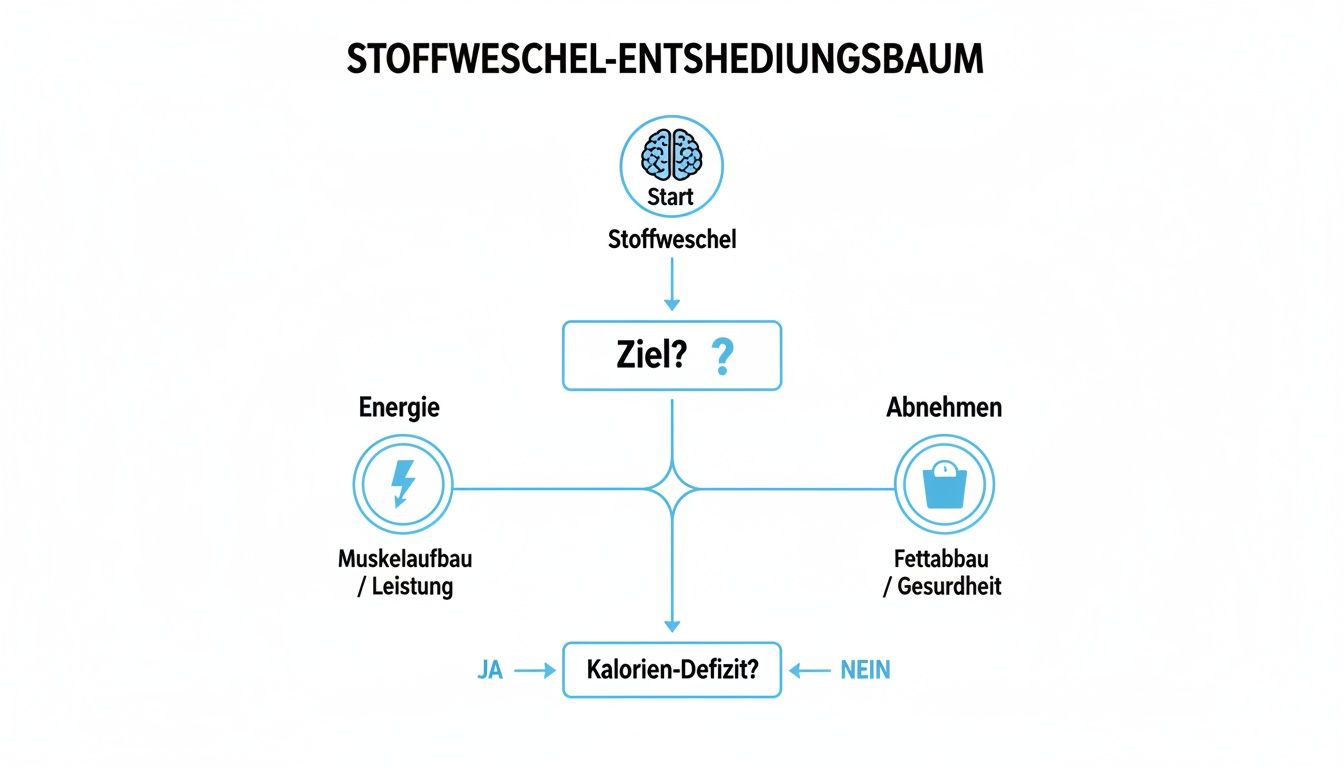
The diagram makes it clear: The choice of method depends directly on your personal goal. Is it about building muscle and increasing energy, or targeted fat loss through a calorie deficit?
Comparison of methods for determining metabolism
To make the decision easier for you, we have summarized the different approaches in a table. Here you can see at a glance which method is best suited to whom.
| Method | Accuracy | Cost | Application area |
|---|---|---|---|
| Online calculator | Low | Free | A rough initial estimate to get a sense of your calorie needs. |
| BIA measurement | Medium | Low to medium | Tracking body composition (fat vs. muscle) in a fitness context. |
| Indirect calorimetry | High | High | Precise determination of resting metabolic rate for performance diagnostics or medical purposes. |
| DNA analysis | Very high | Medium to high | Identifying the causes and creating a lifelong, personalized strategy. |
As you can see, every method has its place. Calculators are sufficient for a quick estimate, BIA is great for guiding your training, and maximum precision requires laboratory testing. However, for a truly sustainable and personalized strategy, looking at your genes is the crucial step.
DNA-based metabolic analyses: A look inside
The methods mentioned so far determine what and how much your body is burning at the moment. A DNA analysis goes one crucial step further: It explains why this is the case. It reveals your genetic predisposition—the fundamental programming that controls your metabolism.
The DNA-based metabolic analysis from mybody® is the most precise way to find your personal nutrition strategy. Your DNA reveals how efficiently your body processes the three macronutrients—carbohydrates, fats, and proteins. You receive a kind of personal user manual for your body that never changes throughout your life. Instead of guessing which diet might work, you get a scientifically sound roadmap tailored precisely to your genetic predisposition.
How your genetic metabolic type determines your diet
Have you ever wondered why your best friend can eat pasta and bread without any problem, while for you, just thinking about them seems to add weight to your hips? Or why someone in your circle of friends achieves great results with a high-fat ketogenic diet, while it just leaves you feeling weak and drained? The answer is not a matter of willpower—it is deeply rooted in your genetic blueprint.
Each of us has a unique genetic code that determines how our body responds to different nutrients. This predisposition is why there simply cannot be one perfect diet for everyone. While simple methods such as a BIA measurement or calorie calculators only scratch the surface, genetic analysis goes straight to the root of your metabolism.
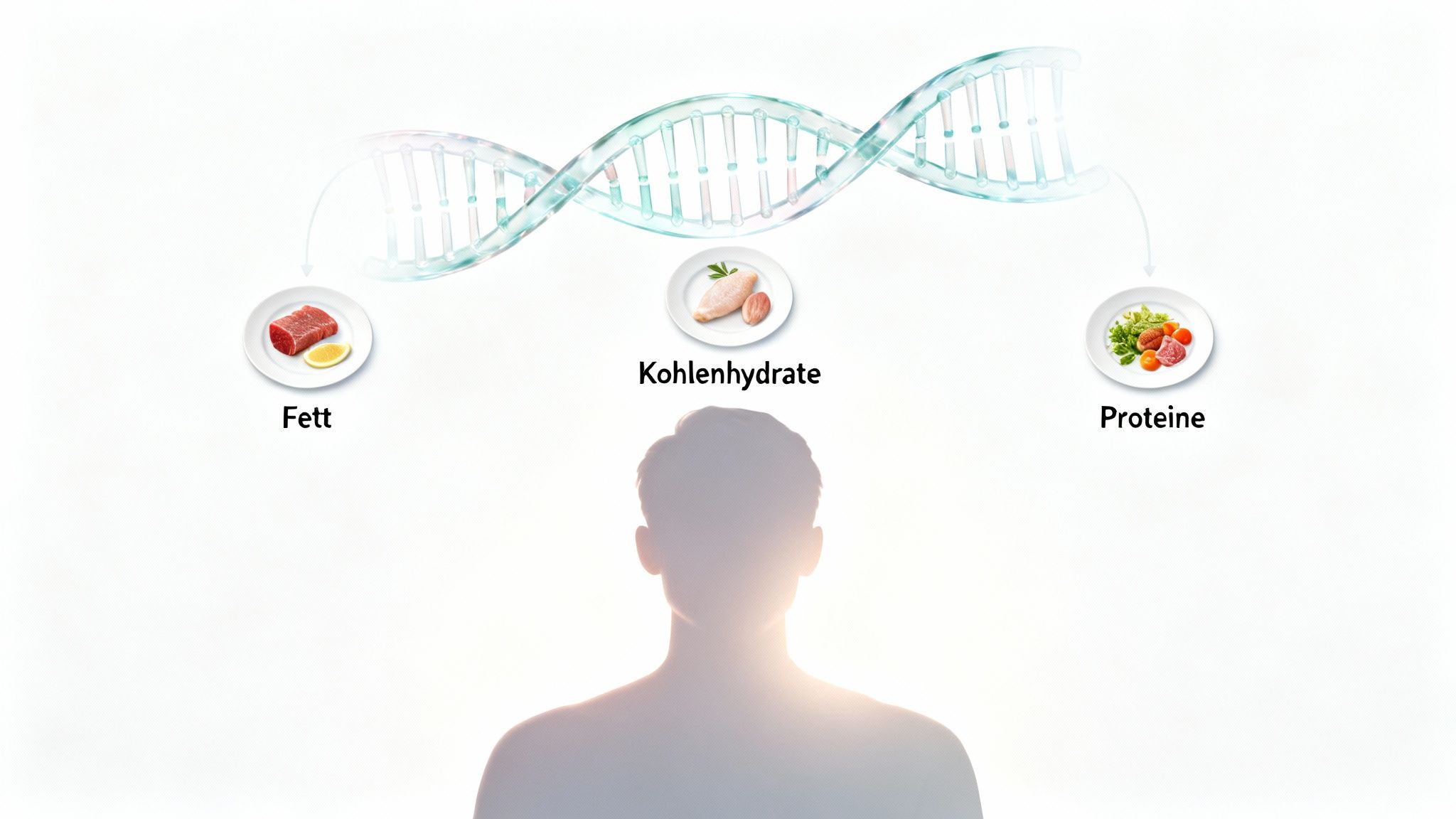
The three major macronutrient types
Basically, we distinguish between three fundamental metabolic types based on genetic markers. The classification depends on which macronutrient—carbohydrates, fats, or protein—your body can use most efficiently to produce energy. Of course, no one is 100 % one type or another, but the genetic tendency is usually very clear.
-
The carbohydrate type (C type) Your body is a master at converting carbohydrates into quick energy. After a meal with whole-grain bread, potatoes, or rice, you feel energized and full. A diet that is too high in fat, on the other hand, often makes you sluggish.
-
The protein type (P type) You need a diet rich in protein and fat to function optimally. A steak with vegetables gives you energy for hours, while a large portion of pasta makes you tired and triggers cravings. Your body preferentially derives its energy from protein and fats.
-
The mixed type (M type) Your metabolism is flexible and handles a balanced mix of all three macronutrients well. Extreme diets, whether low-carb or low-fat, are usually not the best choice for you, as your body needs variety.
This knowledge puts an end to the frustrating guesswork. It explains why you get cravings after certain meals or why you simply do not lose weight despite counting calories. It is about working in harmony with your genetics instead of constantly fighting against them.
Your genetic code as an instruction manual
A genetic metabolic analysis like the one offered by mybody® is far more than simply determining your macronutrient type. It is a personal instruction manual for your body. Your DNA reveals how you respond to certain foods, which type of exercise is most effective for you, and which hidden levers you can use to improve your health.
Imagine finding out not only whether you should avoid carbohydrates or fats, but also:
- Your feeling of satiety: Is there a genetic predisposition that makes it harder for you to feel full and more likely to reach for snacks?
- Your tendency to become overweight: How strongly does your genetics influence your tendency to gain weight (the so-called yo-yo effect)?
- Your optimal physical activity: Do you benefit more from endurance exercise such as jogging or from strength training to boost your metabolism and burn fat?
A genetic analysis does not provide short-term diet rules, but a lifelong strategy. The results do not change—they are a reliable foundation you can always return to, whether your goal is weight loss, muscle building, or simply having more energy in everyday life.
This field of science, which examines the connection between genes and nutrition, is called nutrigenetics. If you’d like to delve deeper into this fascinating topic, you can read more in our science portal about what nutrigenetics is and how it determines our lives.
A practical example
Let’s take Anna as an example. She is clearly a carbohydrate type. For years, she put herself through the misery of low-carb diets because everyone raved about them. Although she lost weight in the short term, she constantly felt tired and irritable and had intense cravings for sweets. After a genetic analysis by mybody®, she discovers that her body needs complex carbohydrates to function optimally.
She changes her diet: Instead of cutting out carbohydrates completely, she now consciously includes oatmeal for breakfast, quinoa for lunch, and sweet potatoes in the evening. The result? Her cravings disappear, she has much more energy during the day, and she loses weight sustainably. Simply because she has finally found a way of eating that suits her body and that she can maintain without feeling deprived.
Anna’s example clearly shows: Determining your metabolism means learning the unique language of your body. A DNA analysis is the most precise and personal interpreter you can find.
From analysis results to everyday routine: how to put your insights into practice
Having an analysis result in your hands is a great first step. But the true value of your new insights only unfolds when they move from paper into your everyday life. Now the most exciting part begins: putting them into practice. Here you’ll find a practical guide to turning the data from your metabolism analysis into sustainable, motivating habits.
Your result is not a rigid set of rules, but your very own personal map. It shows you the most efficient route to your goals—whether that means more energy, weight loss, or simply feeling better in your body. Instead of continuing to grope around in the dark, you now have a clear compass. It helps you make the right choices about nutrition, exercise, and lifestyle.

Your personal nutrition plan – step by step
Perhaps the most important insight from your analysis concerns the composition of your meals. It is not about rigidly counting calories, but about getting the right calories from the sources that are optimal for you.
1. Find the right macronutrient distribution A genetic analysis in particular can give you clear guidance on your ideal ratio of carbohydrates, fats, and proteins.
- Are you a carbohydrate type? Then focus on complex carbohydrates such as whole-grain products, oats, quinoa, and legumes. They provide long-lasting energy and keep you full.
- Are you a protein type? Prioritize high-quality protein sources such as lean meat, fish, eggs, and tofu. Combine them with healthy fats from avocados, nuts, and olive oil.
- Are you a mixed type? Your strength is balance. Make sure every meal contains a good mix of all three macronutrients.
2. Adjust portion sizes and meal frequency Forget rigid rules such as “three large meals a day.” Your metabolic type also determines how best to distribute your food throughout the day. Some people benefit from smaller, more frequent meals to keep their blood sugar levels stable, while others do better with three main meals.
Your results report is your personal blueprint. Start small: Put together a typical meal based on the new recommendations. Replace white bread with whole-grain bread, increase the proportion of vegetables, or add a healthy source of fat. Small, consistent changes are the key to success.
Exercise that really suits you
Not every sport affects every metabolism in the same way. Your genetic predisposition can reveal whether you benefit more from endurance training or short, intense strength sessions to optimally boost your metabolism.
- Endurance types: Long, moderate sessions such as jogging, cycling, or swimming are ideal for getting fat burning going.
- Strength types: Short, intense workouts such as HIIT (High-Intensity Interval Training) or traditional strength training build muscle mass. This sustainably increases your basal metabolic rate.
But honestly, the best plan is the one you can stick to. Find an activity you enjoy and that fits easily into your daily routine. Even 20–30 minutes of targeted exercise on most days of the week can make a huge difference.
The invisible helpers: sleep and stress management
You can eat and exercise as perfectly as possible—but if sleep and stress take a back seat, you’re sabotaging your own efforts. Chronic stress causes the release of cortisol, a hormone that promotes fat storage, especially around the abdomen, and slows down your metabolism.
At the same time, getting enough sleep is essential for hormonal regulation. Lack of sleep disrupts the hormones ghrelin and leptin, which regulate hunger and satiety, often leading to cravings. Try to sleep 7–8 hours per night and deliberately incorporate small moments of relaxation into your day.
The role of targeted nutrient supplementation
Sometimes your metabolism needs targeted support. Your analysis may also indicate an increased need for certain vitamins or minerals. A good example is vitamin D, whose deficiency negatively affects metabolism in more than half of adults in Germany. According to the National Nutrition Survey II, 82 percent of men and 91 percent of women do not reach the recommended daily intake. Since vitamin D regulates calcium and phosphorus metabolism and influences insulin secretion, a deficiency can promote metabolic disorders.
Putting your results into practice is a process. There will be days when it feels easier and others when it’s challenging. Be patient with yourself and celebrate the small successes. Every step brings you closer to a life full of energy and well-being. For detailed guidance, we’ve put together a guide showing you how to optimize your diet after receiving your test results.
Typical metabolic problems—and how to recognize them
Do you pay attention to your diet and exercise, but your weight stays the same or even increases? That’s not only frustrating, but often also a subtle warning sign from your body. Do you often feel tired, lack motivation, or struggle with cravings even though you’re actually eating enough?
If you are nodding along, you are not alone. Symptoms like these often point to deeper imbalances. In most cases, the problem is not a lack of discipline or willpower, but biochemical processes taking place in the background. Understanding these signals is the first step toward regaining control and getting your metabolism back on track.
Insulin resistance: The silent saboteur in the background
One of the most common and, at the same time, most insidious metabolic problems is insulin resistance. Imagine insulin as a key that opens the door to the cells so they can absorb sugar (glucose) from the blood for energy. With insulin resistance, however, the cells become somewhat “deaf” to this signal. The key no longer fits the lock properly.
Your body responds by having the pancreas produce more and more insulin to try to open the cells anyway. This persistently high insulin level has serious consequences for your body:
- Fat burning is blocked: As long as there is a lot of insulin in the blood, it signals to the body to “store, not burn.” Fat loss is then virtually impossible.
- Constant cravings for sweets: Even though there is enough sugar in the blood, it does not reach the cells. Your brain cries out for quick energy—and that usually means sugar and simple carbohydrates.
- Feeling tired immediately after eating: You eat, but the energy does not reach where it is needed. The result is the classic “food coma” or afternoon slump.
Insulin resistance develops gradually, often over many years, and is the direct precursor to type 2 diabetes. It is a clear sign that your glucose metabolism is overloaded—usually due to a diet with too many processed carbohydrates and too little exercise.
Being overweight: A vicious cycle for metabolism
For a long time, people thought that fat tissue was merely a passive energy store. Today we know that it is a highly active hormonal organ that constantly produces pro-inflammatory messenger substances. Being overweight is therefore far more than a cosmetic problem—it is an active disruptor of your metabolism.
This creates a dangerous cycle: More body fat leads to more low-grade inflammation and worsens insulin resistance. This, in turn, makes it even harder to break down fat and promotes further weight gain. The body enters a downward spiral that is difficult to escape.
A disrupted metabolism is rarely just one isolated problem. It is usually a domino effect in which one imbalance triggers the next. The good news: you can break this cycle by addressing the right place—your individual metabolism.
The figures tell a clear story: The obesity rate in Germany has nearly doubled since the turn of the millennium. While around 12.2 percent of adults suffered from obesity in 2003, that figure had already reached 19.7 percent by 2023. This is alarming, because excess weight slows the basal metabolic rate and promotes metabolic syndrome. Find out more in the current obesity statistics on marcusknispel.com.
Hormonal imbalances as a hidden cause
Sometimes the root of the problem isn’t directly related to diet or exercise at all, but to hormones. The thyroid is a major factor here. It’s essentially your metabolism’s accelerator pedal. An underactive thyroid (hypothyroidism) significantly lowers your basal metabolic rate. The consequences often include fatigue, constantly feeling cold, and unexplained weight gain.
Chronic stress is also a real metabolism killer. If you’re constantly under pressure, your body continuously releases the stress hormone cortisol. High cortisol levels specifically promote the storage of belly fat and disrupt your blood sugar levels. Analyzing your metabolism therefore also means understanding these deeper connections. That’s the only way to correctly interpret warning signs before they develop into serious problems.
Your questions about metabolic analysis
Okay, after all this information, you probably still have a few questions swirling around in your head. That’s completely understandable, because metabolism is a complex topic. We’ve collected the most frequently asked questions we encounter in practice to clear up any remaining uncertainties.
How quickly will I see results if I change my diet?
This is probably the question that’s on everyone’s mind. The honest answer: It’s completely individual. Some people feel a real boost in energy after just a few weeks and see their first results on the scale. That’s when your body realizes it’s finally getting the right “fuel.”
For truly sustainable changes, especially when losing weight or building muscle, you should give yourself two to three months. During this phase, new routines become established, and your metabolism permanently adjusts to the optimized nutrient supply. Patience and consistency are your best friends here.
Can a “broken” metabolism be repaired permanently?
The term “repair” may not be entirely appropriate. Your metabolism isn’t a machine that breaks down; it’s an extremely adaptable system that responds to everything you do. So you can’t simply repair it, but you can permanently optimize it and steer it in the right direction.
With the right diet, targeted exercise, and a healthy lifestyle, you can create the perfect conditions for your metabolism. A metabolism analysis is like your personal compass: It shows you where your greatest opportunities lie so you can keep your metabolism performing at its best over the long term.
Does a metabolism analysis make sense even if you are not overweight?
Absolutely! Knowing your metabolism is about so much more than just a weight-loss tool. Many of our customers use an analysis to achieve entirely different goals:
- More energy in everyday life: Find out which nutrients really give you energy and banish the classic afternoon slump once and for all.
- Better athletic performance: Optimize your nutrition for faster muscle growth and more effective recovery after training.
- Fewer digestive problems: Finally understand which foods your body can process well and which ones only place unnecessary strain on it.
- Prevent illness: Giving your body what it really needs strengthens your long-term health and can actively counteract metabolic disorders such as insulin resistance.
Ultimately, it is about working with your body, not against it.
A metabolism analysis is an investment in yourself. You stop guessing and start making decisions based on facts about your unique body. This knowledge gives you the power to make choices every day that help you become healthier, fitter, and more energetic.
What is the difference between a blood test and a DNA analysis?
Both provide incredibly valuable but completely different insights. Think of it this way:
A blood test is a snapshot. It shows you what your status looks like today. What are your thyroid hormone levels? Do you currently have enough iron? Is your blood sugar in balance? It is perfect for detecting acute deficiencies or hormonal imbalances.
A DNA metabolism analysis goes much deeper. It is your personal, unchanging “instruction manual.” It reveals how your body naturally processes fats, carbohydrates, and proteins. This genetic predisposition is the lifelong foundation of your nutrition strategy and ideally complements the snapshot provided by a blood test.
Are you ready to stop guessing and finally understand what your body really needs? A scientifically backed DNA analysis is the first step toward a healthier, more energetic life. At mybody®, discover the right analysis for your personal goals.



Share now:
What is the yo-yo effect? Recognize the causes and maintain your weight long term
Metabolic analysis cost: What you really get for your money