
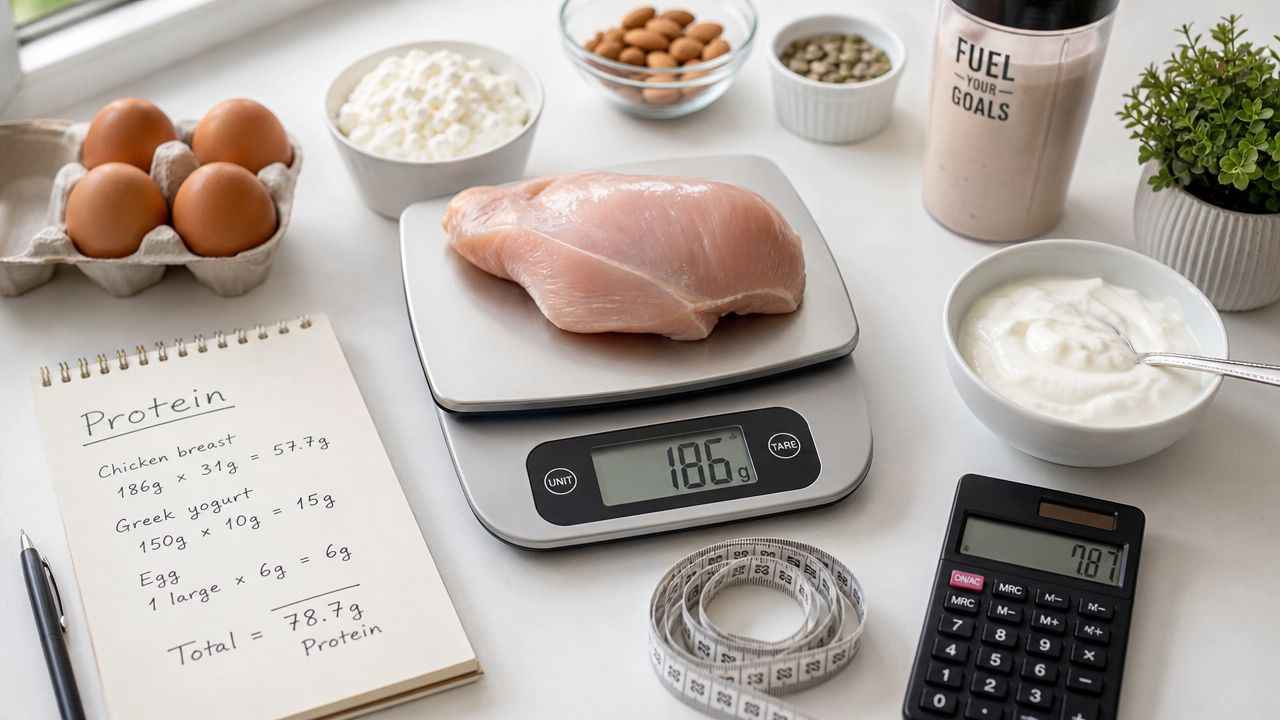
Calculate your protein needs: the exact guide 2026
You want to calculate your protein needs, do a quick Google search, and immediately find yourself in chaos. One source says a little is enough. The next recommends significantly more. At the gym, you get a third opinion. And in the end, you ask yourself one thing above all: What actually applies to me?
That's where the problem begins. Protein is not a random value, nor is it a fixed gram amount that suits everyone. Your needs depend on your age, how active you are, whether you want to build muscle or lose weight, and what your body composition is.
Many people start with a general number and then get stuck there. That's okay as a first step. But for real guidance, you need more than a rule of thumb. If you want to delve deeper into the topic, you'll find a good supplement in Understanding Daily Protein Needs. Here, we take a systematic approach, from simple basic calculations to the points where standard formulas become imprecise.
How much protein do you really need?
The confusion is understandable. Two people can weigh the same amount and still not have the same protein needs. One sits a lot, the other exercises regularly. One wants to maintain their weight, the other is on a diet. These differences alone change what is sensible.
Added to this is a very common misconception. Many people are looking for the one right number. In practice, however, protein requirements are more of a corridor than an exact value identical for everyone. The art lies in choosing the right starting point and then adapting it to your reality.
Protein is not a fad. It's a calculation question plus body awareness.
If you want to calculate your protein needs, three guiding questions will help you:
- How old are you? This plays an important role in the basic recommendation.
- How active are you? More training usually means more need.
- What is your goal? Maintenance, muscle building, or fat loss do not require the same strategy.
Many guides stop at the formula. It's more useful to view the formula as a starting point. Then it gets exciting. Because your body reacts not only to calories and training, but also to things like muscle mass, body fat, and individual utilization.
The basis of your protein needs according to DGE
You need a starting value that is simple enough to calculate and still technically sound. The DGE recommendation is perfect for this. For healthy adults aged 19 to under 65, it is 0.8 g protein per kilogram of body weight per day. From 65 years, the DGE recommends 1.0 g/kg/day. You can find the classification in the DGE announcement on protein requirements.

How to calculate your basic needs
The calculation is deliberately simple:
Body weight × 0.8
Like a rough map, this formula first shows you the direction, not every detail. For a body weight of 70 kg, this results in 56 g of protein per day. For many people, this is the first useful reference point, because a vague feeling finally becomes a concrete number.
Important is the why behind this formula. The DGE describes the basic supply for healthy adults. It answers the question: What is a reasonable basis for your body to be supplied in everyday life? It does not yet answer the question of what would be optimal for training, muscle building, or a diet. If you want to understand this difference better, our article on how much protein you really need for muscle building will also help you.
Why the formula is only the first step
This is where confusion often arises. Many equate the DGE number with their personal ideal value. A different perspective is more practical: The DGE formula is the starting line. From there, you check whether your body and your daily routine require more precision.
Because body weight alone is a rough measure. Two people with the same weight can have very different compositions. One has more muscle mass, the other more body fat. This is relevant for protein requirements, because protein is primarily needed where tissue is to be maintained, repaired, or built up. This is precisely why general formulas often remain imprecise, even though the mathematics may seem clear at first glance.
Note: The DGE gives you a basis. The calculation becomes more precise when you understand your body composition.
Why older people should calculate differently
With age, not only appetite or daily routine changes. The body's response to protein can also change. Therefore, the guideline for people aged 65 and over is higher. This clearly shows why general rules, while helpful, do not apply equally well to every stage of life.
So, if you are calculating for yourself or for relatives, do not treat age as a minor detail. It is part of the basic formula.
What this basis is good for
The DGE formula is suitable if you are looking for initial guidance and no longer want to estimate your needs. It is particularly useful for people who are healthy and want to plan their daily routine in a structured way.
It becomes less precise for very active individuals, targeted muscle building, calorie deficit, or significantly different body composition. Then the next step is worthwhile. Instead of just using total weight, fat-free mass is often more meaningful. And for those who want to work even more precisely, individual differences in utilization and metabolism are even considered. This is exactly where mybody-x comes in, because true optimization does not end with the formula, but begins with understanding one's own body.
A practical side thought for everyone who wants to integrate training and nutrition more consciously into their everyday life: Small motivational aids can help to stick to new routines, for example Animus Medicus gifts for athletes.
Adjust the formula to your personal goal
You eat exactly the same for two days. On one day you sit a lot and go for a walk. On the other, you train hard or maintain a calorie deficit. It sounds illogical that your protein needs should be identical in both situations.
That's exactly why the basic formula is only enough to start with. As soon as you pursue a goal, the calculation must fit your situation. Protein is not a fixed daily value like a shoe size. It's more like building material, which is needed in different quantities depending on repair, conversion, or maintenance.

The multipliers in comparison
The following overview serves as a practical guide. It shows not only a number, but also the biological background behind it.
| Goal | Protein (g per kg body weight) |
|---|---|
| Maintenance in healthy adults | 0.8 |
| Sportily active with more than five hours of sport per week | 1.4 to 2.0 |
| Muscle building, often more sensible range | 1.2 to 2.0 |
| Weight reduction and muscle maintenance in calorie deficit | 1.6 to 2.2 |
For adults, EFSA confirms 0.83 g/kg/day as a reference value. For physically active people, a significantly higher value is often used in practice. Swissmilk summarizes 1.4 to 2.0 g/kg/day as a sensible range for people with more than five hours of sport per week. For a 60-kg person, this would be about 84 to 120 g per day, as Swissmilk explains in the overview of the protein requirement calculator.
For diet phases, the need is often higher than for simple maintenance. The reason is simple. In a calorie deficit, your body has to pay more attention to preserving existing muscles. Protein helps with this and often also supports satiety, as already explained earlier in the article.
How to choose the right range
Many readers ask at this point: Which number should I use specifically?
The simplest answer is: Choose the value according to your goal, not according to habit.
Maintain weight
If you are healthy, move normally, and do not engage in targeted training, the basic level is a sensible starting point. More is not automatically better. Only your daily routine and your goal give the number meaning.
Train regularly
Here, the need usually increases because protein not only covers basic functions but also supports regeneration and adaptation to training. The more structured and intense you train, the more likely you are to be in the upper range.
Lose fat and maintain muscle
In this phase, calculations are often too low. The deficit saves calories but increases the pressure on muscle maintenance. A higher protein value is therefore often more sensible than for simple maintenance.
Those who only cut calories but do not adjust protein risk unnecessary muscle loss in addition to fat loss.
A simple model for practice
For the formula to work in real life, a fixed sequence helps.
-
Determine goal
Maintenance, muscle building, or fat loss. -
Choose a suitable range
Not everyone immediately needs the highest value. A middle range is often sufficient, which you can later adjust based on satiety, regeneration, and training success. -
Only then calculate
This creates a number that suits your everyday life and doesn't just look mathematically correct.
This is precisely where rough guidance separates from true precision. Many guides stop at multiplying body weight by a factor. For beginners, this is okay. But those who want to work more precisely quickly realize that the same formula can lead to very different results for two people of the same weight. The reason lies in body composition and, later, even in individual biological differences.
Endurance, strength, and diet have different requirements
A marathon runner, a person doing strength training, and someone in a weight loss phase do not use protein for the same reason in the same amount. In endurance training, regeneration is often in the foreground. In muscle building, adaptation and building processes are more important. In a diet, protein serves as a protective shield for existing muscles.
If you want to classify this specifically for training, you will find a suitable in-depth discussion in the article how much protein is useful for muscle building.
And if you're looking for something that content-wise suits active people and doesn't sound like typical fitness advertising, Animus Medicus gifts for athletes is also a surprisingly useful find. Especially for people with a serious training focus, more coherent ideas can be found there than the typical standard gadgets.
The most common mistake in calculation and the solution
Many people calculate accurately and still arrive at an unsuitable number. The reason is simple: they use total body weight, although this is not always the best reference.

Why total body weight can be deceiving
A common mistake in calculation is to blindly apply the protein value to the total body weight. In cases of overweight, calibrating to the target weight or fat-free mass is professionally more accurate to avoid overestimating the requirement. This is exactly what Smarticular describes in the article on protein requirement calculation.
This sounds technical but is easy to understand. Protein is primarily needed where metabolically active tissues are to be supplied, maintained, or built up. If a large proportion of body weight does not consist of muscle, the pure kilogram calculation can be too high.
A vivid example
Let's take a practical customer case. A person weighs 85 kg and has 28% body fat. A general calculation came to 170 g of protein. However, an analysis showed that only 62 kg of muscle mass were relevant. The actual requirement was 125 g of protein.
The difference is crucial. Not because more protein would be fundamentally bad, but because an imprecise target number unnecessarily complicates everyday life. Anyone who aims for too high an amount every day makes meal planning more difficult, reaches for shakes faster, and often feels like they are constantly falling behind.
Practical thought: The more precise the reference, the more realistic your protein goal will be.
How to know when you should calculate more precisely
A general formula is often no longer useful if you recognize yourself in one of these points:
-
Higher body fat percentage
Then your total weight poorly reflects your active mass. -
Targeted weight loss goal
Here, the target weight is often a more sensible reference than the current weight. -
Strong interest in precision
If you really want to coordinate training, regeneration, and nutrition, a rough rule of thumb is rarely sufficient.
The solution is not more complicated calculation for the sake of calculating. The solution is to choose the right reference variable. For some, the target weight is enough. For others, fat-free mass is a much better basis.
The genetic factor almost no one knows about
Even if you define your goal clearly and calculate with fat-free mass, one level remains open. Two people with similar body composition can react differently to the same protein intake. The reason often lies not in will or discipline, but in biological differences.

Why genetics influences protein more than many think
Nutrigenetics deals with how individual genes co-determine your reaction to nutrition. When it comes to protein, according to analyses from mybody-x, ACTN3, FTO, and PPARA are particularly relevant. These variants can influence how efficiently your body utilizes protein, how your metabolism works, and how well training stimuli are translated into adaptation.
This does not mean that genes determine everything. But they explain why standard recommendations work very well for some people and only moderately well for others.
The difference between guessing and knowing
General values are practical. They give you orientation. But they cannot show whether your body uses protein efficiently or whether you individually need more. According to the briefing, some people may genetically need 20% more. This information only becomes visible through genetic analysis.
Those who want to delve deeper into the connection between nutrition and genetics will find a good introduction in What is nutrigenetics and how does it determine our lives.
The most exciting question is often not how much protein is generally recommended. The most exciting question is how your body actually deals with it.
What this means for you in practice
If you get along well with general formulas, that's perfectly fine. But if you feel that your body reacts differently than expected despite good nutrition and training, it's worth taking a closer look.
Then it's no longer just about grams per kilogram. Then it's about true personalization. So, about the question of which recommendation suits your body, not just an average person.
Optimally covering your protein needs in everyday life
You now know your target amount. The real challenge often only begins at the kitchen table. Because 120 grams of protein per day sounds clear on paper, but quickly seems abstract in everyday life. That's precisely why it helps to translate the daily amount into normal meals.
In everyday life, protein works like a weekly budget that you distribute wisely. If almost everything comes only in the evening, implementation becomes unnecessarily difficult. Several protein-rich meals spread throughout the day are usually simpler, easier to plan, and more suitable for everyday life.
Practically, this means: every main meal should contain a recognizable protein source. Then you don't have to frantically "eat extra" at the end of the day, just because there was almost nothing in the morning and at noon.
What works well in everyday life
-
Start early
A low-protein breakfast often carries through the entire day. Those who incorporate something in the morning start the rest of the day with less pressure. -
Plan meals around protein
For each main meal, ask yourself first: What is my protein source today? Only then do you add side dishes, vegetables, or fruit. That's easier than hoping at the end that it will somehow be enough. -
Set simple standards
Recurring solutions save energy. For example, quark, Skyr, eggs, tofu, legumes, fish, or a protein-rich dinner. The less you have to decide anew each day, the more stable the implementation will be. -
Don't rely solely on powder
Shakes can help, especially when time is short. However, the base should still consist of normal foods. You can find good guidance in this overview of protein-rich foods and their sources.
The most common everyday mistake is therefore not a lack of knowledge, but an unsuitable translation into actual meals. This is precisely where the difference between a rough formula and true individualization becomes apparent. A number is the start. Your protein plan only truly fits when it matches your hunger, your daily routine, and your body's reaction. mybody-x addresses precisely this point. A general recommendation becomes a plan that suits you biologically and practically.
Frequent Questions about Protein Requirements
Is a lot of protein bad for the kidneys?
For healthy people, this topic is often discussed unnecessarily generally. The context is crucial. If a known kidney disease already exists or there is a corresponding suspicion, protein intake should be assessed individually with medical supervision. Without such pre-existing conditions, the more important question in everyday life is usually whether your amount fits your goal and your overall eating habits.
How do I meet my needs as a vegetarian or vegan?
It's possible, but usually requires more planning. Especially if you have high goals or a low appetite. It helps to consciously build each main meal around a protein-rich component. In addition, it's worth looking not just at individual foods, but at the entire day. Variety makes implementation significantly easier.
Do I have to hit the exact same amount every day?
No. The body doesn't work like a stopwatch that immediately causes problems with small fluctuations. A reliable average and a structure that you can maintain long-term is sensible. Perfection brings less than consistency.
When is a more precise analysis useful?
If you're not making progress despite training and conscious eating, receiving widely fluctuating recommendations, or want to consider your body composition more precisely. A thorough analysis can also help with plant-based diets, dieting phases, or the desire for more precision. Then it's not just about the protein value itself, but about the overall picture of body composition, supply, and utilization.
If you no longer want to estimate your protein requirements but truly understand them individually based on body data, nutrient status, and genetic factors, it's worth taking a look at the analyses from MYBODY Lab GmbH. There you will find scientifically sound tests for DNA, metabolism, and nutrient supply that can help you turn general formulas into a personal strategy.



Share:
Your anti-aging nutrition plan: Younger in 2026
How Much Sodium Per Day: Limits, Requirements & DNA Test 2026