
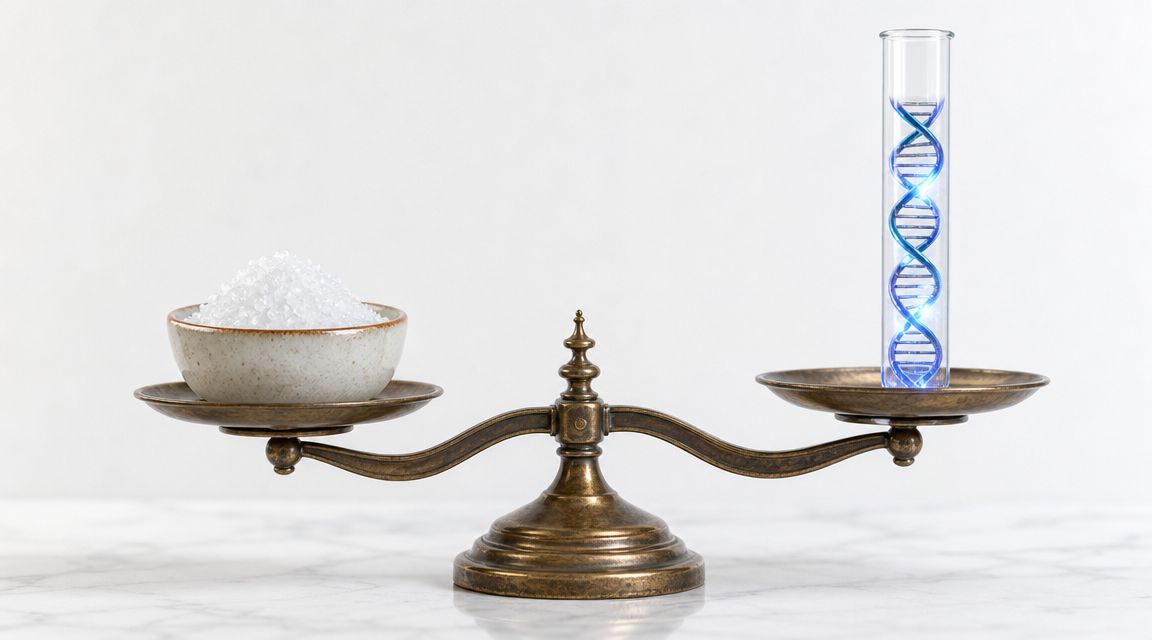
How much sodium per day: Limits, requirements & DNA test 2026
Many guides give you a simple answer to the question of how much sodium per day is advisable: eat less salt. That is not wrong, but it is often too broad. Sodium is not merely something you should “cut back on.” Your body needs it. At the same time, many people unknowingly consume more than is good for them.
That is exactly where the confusion arises. Official limits are important, but they do not automatically tell you what is personally right for you. Blood pressure, daily routine, medication, exercise, sweating, kidney function, and even your genetic salt sensitivity can affect how you interpret the recommendation in practice. So if you are wondering whether you consume too much, too little, or simply more sodium than you realize, you need more than a general number.
How much salt is too much? Why the answer is personal
“Just eat less salt” sounds sensible. In everyday life, however, this advice is often only of limited help. It overlooks two things: sodium is essential to life, and not everyone responds the same way to the same amount of salt.
Sodium is one of the minerals your body needs for normal functions. Among other things, it plays a role in fluid balance and blood pressure regulation. So the problem is not sodium itself. Rather, the issue is that intake can quickly increase unnoticed in everyday life, especially through processed foods.
Why general recommendations are often not enough
If you eat with your health in mind, you may first think of the salt shaker on the table. But many people underestimate the amount that is already in the product. In addition, two people can eat very similarly and still react differently. One may barely notice anything. The other may develop problems with blood pressure, water retention, or general discomfort more quickly after eating very salty foods.
This is where an individual perspective becomes important. An official guideline is a useful point of reference for the general population. On its own, however, it is often not enough for your specific circumstances.
Not every high sodium intake immediately feels problematic. That is precisely why it is worth taking a closer look at your habits rather than focusing only on symptoms.
How to better assess your own situation
Ask yourself three questions:
- How often do you eat processed products? Bread, cheese, sausage, ready-made meals, and snacks often contribute more to your intake than adding salt at the table.
- How does your body respond? Do you have high blood pressure, feel “bloated” after salty meals, or need to take a closer look for medical reasons?
- How individual is your risk? Some people are more salt-sensitive than others. In that case, the same diet can have a significantly stronger effect.
Anyone who really wants to understand how much sodium per day is appropriate should therefore not look for just one number. What matters is the combination of basic knowledge, an honest assessment of actual intake, and an interpretation tailored as closely as possible to the individual.
Sodium and salt The small but important difference
Anyone who wants to understand their sodium intake must first clear up a linguistic trap. In everyday life, we almost always say “salt.” On packaging, in technical texts, and in laboratory results, however, “sodium” often appears. The two do not mean the same thing.
The short version: Table salt consists of sodium and chloride. Sodium is therefore only one part of salt. That is why it is easy to misinterpret information on labels when you mix up the terms.

The conversion you should know
For everyday use, a simple rule of thumb is enough: 1 g of sodium corresponds to about 2.5 g of salt.
This is useful because manufacturers and recommendations use different measurements. If a product lists sodium, you can roughly convert it to salt. If you read a recommendation in grams of salt, you can better understand what it means for the nutrition label.
A simple analogy helps: sodium is the active amount, while salt is the package in which it usually reaches you.
The official guidelines in Germany
For adults, the DGE gives an estimated adequate sodium intake of 1,500 mg of sodium per day. As a practical recommendation, the DGE also advises limiting daily table salt intake to a maximum of 6 g of salt per day. This corresponds to about 2.4 g of sodium. You can find this information in the DGE reference values for sodium.
At first glance, these figures seem contradictory. However, they describe two different levels. The estimated value refers to the body's needs. The upper limit for salt is a practical everyday guideline because many people consume considerably more through processed foods than they realize.
This is exactly where blanket figures are often not enough. Two people can follow the same recommendation and still respond differently. One remains stable. In the other, blood pressure or water retention may increase even with an intake that is technically still within the recommended range.
Why this distinction is more than just semantics
Sodium regulates fluid balance and blood pressure. That is why it makes sense not to look only at the salt shaker, but to understand your total intake. For a basic understanding, it is also helpful to read Understanding Electrolytes: Functions, Effects, and Nutrition Tips, because sodium is always part of the overall electrolyte balance.
The next point is even more important: The same sodium level does not automatically mean the same risk. This is where the difference between public health recommendations and personalized medicine begins. People who are genetically more salt-sensitive, for example because of variants in signaling pathways such as ACE or AGT, often need a more precise assessment than simply “less salt.”
Key point: Sodium is the mineral your body regulates. Salt is the most common form in which you consume it.
The health consequences of an incorrect sodium balance
The real danger often lies not only in “too much salt,” but in a sodium balance that does not suit your body. That is precisely why blanket recommendations are only of limited use. People who are salt-sensitive may react to amounts that still go unnoticed by others. Those who lose a lot of fluid and electrolytes may even run into problems by being equally restrictive with salt.

When too much sodium accumulates over time
In the body, sodium acts like a control dial for fluid levels and blood volume, and therefore also for blood pressure. If this dial stays set too high for a long time, the strain on the blood vessels, heart, and kidneys increases in many people. This rarely happens overnight. It is more like a water system that is constantly under slightly too much pressure. Eventually, the pipes show signs of wear.
This is particularly relevant for people with high blood pressure, impaired kidney function, or a genetic predisposition to greater salt sensitivity. Variants in genes such as ACE or AGT may influence how strongly your body responds to sodium. That is why the same salt intake is not automatically equally harmless for two people.
In everyday life, a high sodium load often initially shows up in unremarkable ways. Rings fit more tightly. Weight fluctuates after salty meals. Some people report feeling puffy or being thirstier. These signals are not a diagnosis, but they are a reason to take a closer look.
Anyone who wants to better understand sodium’s role in the bigger picture will find a good starting point in this overview of minerals and their functions in the body.
When intake drops too low
The opposite direction is often underestimated. Sodium is not something you should simply keep reducing indefinitely. Your body needs it for nerve conduction, muscle function, and regulating the water balance. If there is too little of it, the system gets out of balance.
This can lead to symptoms such as nausea, weakness, dizziness, confusion, or muscle cramps. These are more likely to occur in certain situations, such as heavy sweating, gastrointestinal infections, very intense endurance exercise, or while taking medications that alter the water and electrolyte balance.
Health-conscious people in particular can sometimes fall into a subtle trap here. They reduce salt very consistently, drink plenty of fluids, and automatically assume this is better. That works for some people. For others, it tends to dilute the balance rather than improve it.
Who should take a particularly close look
A blanket sodium target is particularly unsuitable when your body is already sensitive to small changes. Particular attention is warranted in cases of:
- high blood pressure, because sodium can affect blood pressure regulation
- kidney disease, because excretion and balance are often affected
- heavy sweating or regular endurance training, because you lose more electrolytes
- vomiting or diarrhea, because sodium and fluids are lost at the same time
- medications such as diuretics, because they can alter the body's water and salt balance
- Pregnancy, because any major restriction or self-adjustment should be approached carefully during this time. The article on safe nutrition during pregnancy offers useful guidance
The practical conclusion is simple: Symptoms, blood pressure, daily life, and genetic predisposition need to be considered together. Only then can a general recommendation become a goal that is truly right for you.
Hidden sources of sodium The biggest sources in your diet
Many people say: “I hardly add any salt, so I surely don’t eat too much salt.” This assumption is often misleading. In the supermarket, sodium is frequently found where you would not immediately expect it.
The AOK points out that in Germany, the largest amounts of sodium are often found in industrially produced foods. These include, among other things, bread, cheese, and processed meats. Even mineral water can contain significant amounts of sodium. You can find an overview in the AOK information about sodium in everyday life.

A perfectly ordinary shopping trip with a surprising result
You go to the supermarket and shop for a “sensible” day: bread, cheese, some cold cuts, perhaps a tomato soup in a jar, along with mineral water and, in the evening, a quick ready meal. None of it seems extremely salty. The salt shaker remains almost unused.
Even so, a shopping trip like this can strongly shape your daily sodium intake. Not because you are eating incorrectly, but because many standard products are already made with a lot of salt. Few people think of sodium when it comes to bread. Cheese or sausages are more obvious. Almost no one thinks of mineral water.
Where you should look especially carefully
A quick look at typical product groups can help:
| Food | Typical sodium content (in mg) |
|---|---|
| Bread & baked goods | varies depending on the product |
| Cheese | varies depending on the type |
| Sausages & cold cuts | often high |
| Ready meals | often high |
| Canned foods & sauces | often relevant |
I am deliberately not providing exact figures for this table because they can vary greatly depending on the product. In everyday life, therefore, it is not just the product category that matters, but also checking the label.
How to read the label effectively
- Look for sodium or salt information: Some manufacturers list salt, while others use sodium.
- Compare products within the same category: Two breads may seem similar and still differ noticeably.
- Check beverages too: Mineral water in particular is often overlooked when it comes to sodium.
- Think about portion sizes: A product may seem “okay,” but the actual portion can contribute significantly more than expected.
Anyone who wants to delve deeper into the basics will find this overview of minerals a good starting point for considering sodium in context rather than in isolation.
Reading labels is even more important during certain stages of life. If, for example, you are wondering which foods are advisable or potentially problematic during pregnancy, the guide to safe nutrition during pregnancy is a practical supplement.
If you want to reduce sodium, you rarely save the most by cutting back on the salt shaker. The greatest leverage usually lies in your shopping cart.
Your individual sodium needs: Why your genes matter
At this point, it becomes clear why the question of how much sodium per day cannot be answered the same way for everyone. Two people can eat similar amounts according to the label and still react differently. One important reason for this is genetic salt sensitivity.
Certain genetic variants, for example in the AGT and ACE genes, may provide indications of how sensitive someone is to sodium. In practice, this is not assessed in isolation but considered together with blood pressure and kidney markers. This creates a much more accurate picture than generic dietary advice alone.

Why your neighbor reacts differently than you
You may know this from people around you. One person loves salty foods and seems to have no direct problems. Another reacts to even small changes with higher blood pressure or quickly feels burdened. This may not be due solely to discipline, age, or a “poor diet.” It may also be because the body processes sodium differently based on genetics.
This is a central point. Official recommendations protect the general population. However, they cannot capture how your individual body reacts to salt.
A concrete case study from practice
Reports from personalized analyses in practice describe a customer, 53 years old, who had a blood pressure of 148/92. The DNA analysis showed an ACE risk variant. After adjusting sodium intake to 1.5 g per day and increasing potassium intake, blood pressure fell within 6 weeks to 128/82, according to the briefing, without medication.
This example is not a free pass for self-treatment. However, it clearly shows why generic recommendations often fall short. The key question is not only whether salt is “bad.” The more important question is: How sensitive are you personally to it?
What a personalized approach does better
A meaningful individual approach combines several levels:
- Genetics: indications of salt sensitivity, for example through AGT and ACE
- Measurements: blood pressure and suitable laboratory markers
- Everyday life: eating habits, exercise, sweating, medication use
- Implementation: specific target values instead of vague prohibitions
If you are interested in how genetic nutrition tests work in principle, you can find a good introduction in the topic DNA Testing for Nutrition.
The more strongly your body reacts to sodium, the less helpful a blanket average value is for you.
Practical steps toward your personal sodium target
The good news is that you do not have to make the topic more complicated than it is. Once you understand where sodium is found and that your needs may be individual, you can take targeted action in everyday life.
Many people do not need a radical new beginning, but a few solid steps. What matters is that you observe rather than guess.
A sensible starting point for the next few days
- Track briefly and honestly: For about a week, note which salt-rich products you actually eat. Not perfectly, but realistically.
- Check prepared foods first: This is often where the greatest potential for reduction lies.
- Read labels side by side: Especially for bread, cheese, sausages, sauces, and convenience foods.
- Think of potassium-rich foods: In everyday life, bananas and spinach are often mentioned as simple examples for making your diet more balanced.
- Drink enough: This supports the body's management of fluid and electrolyte balance.
When general tips are no longer enough
If your blood pressure is elevated, you have kidney disease, sweat heavily, or react noticeably to salty foods, you should not simply conclude “eat less salt.” In that case, a more personalized assessment makes sense. This can be supplemented with blood tests, medical advice, and, if desired, genetic information.
For a laboratory-based assessment of minerals and trace elements, an overview of minerals and trace elements in blood tests may be helpful.
Your quick everyday checklist
| Question | If you often answer “Yes” |
|---|---|
| Do you often eat processed foods? | checking and comparing labels |
| Do you have blood pressure issues? | monitoring your intake more consciously |
| Do you sweat a lot or engage in intense exercise? | Balance instead of blanket reduction |
| Do you react noticeably to salty meals? | considering a personal assessment |
Ultimately, it is not about strict restriction. It is about understanding your personal pattern. Anyone who knows how much sodium per day is appropriate for their own body can eat much more relaxed than someone who relies only on general warnings.
If you want to stop guessing about your sodium target and understand it based on data, an individual health check may be worthwhile. MYBODY Lab GmbH offers analyses of DNA, nutrients, and other health markers that can help you assess your diet and lifestyle more personally. Especially when it comes to salt sensitivity, blood pressure, and mineral balance, this approach is often much more helpful than yet another blanket recommendation.



Share now:
Your plan for anti-aging nutrition: Younger in 2026
NMN supplement effects: what has been proven and what applies in the EU