
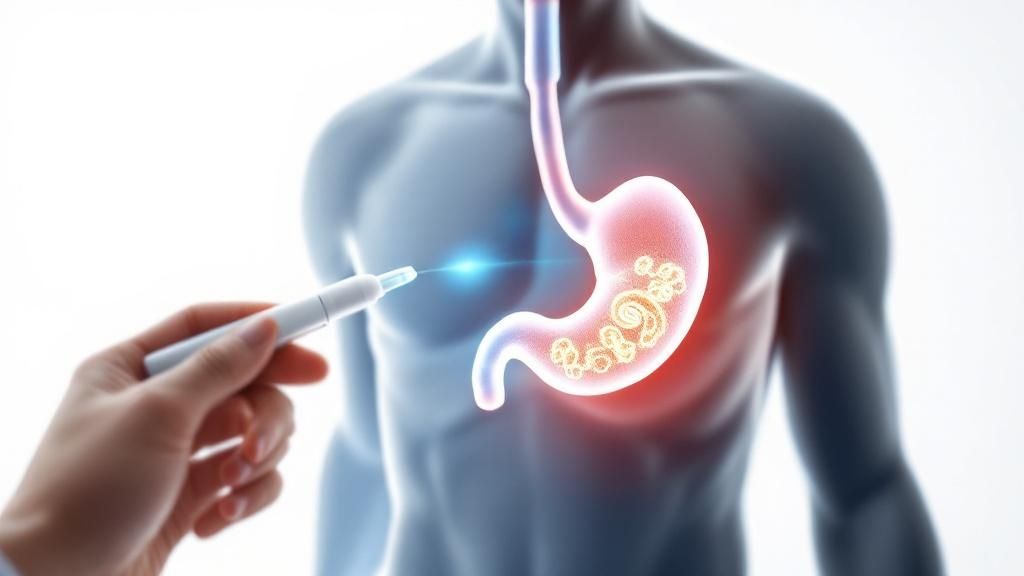
Rapid test for Helicobacter pylori: Your guide to diagnosis
Imagine your stomach as a well-fortified fortress whose walls consist of aggressive stomach acid. Normally, hardly any organism would have a chance of surviving there. But Helicobacter pylori is like a clever spy that finds a secret way in and makes itself comfortable there. This spiral-shaped bacterium has a clever survival strategy: It produces an enzyme called urease, which acts like a chemical shield. It neutralizes the stomach acid in its immediate surroundings, creating a safe niche for itself.
Why Helicobacter pylori is the hidden troublemaker in your stomach
Once it has taken up residence, this invisible tenant can remain unnoticed for years. Most people initially do not notice its presence at all. In the background, however, the bacterium irritates the sensitive stomach lining and triggers chronic inflammation, known as gastritis. You can think of it as a constant, smoldering fire that slowly but surely attacks the tissue. If this inflammation remains untreated, it can lead to more serious problems.
From a silent guest to a serious problem
Initially, the symptoms are often nonspecific—perhaps just mild discomfort or occasional heartburn. However, ongoing irritation of the stomach lining weakens its protective function. This makes it more vulnerable to aggressive stomach acid, which can lead to the formation of painful stomach ulcers (ulcers). This process often develops gradually over many years, making the infection so insidious.
The prevalence of Helicobacter pylori is not to be underestimated in Germany either. Studies show that almost half of adults are infected, which often leads to chronic gastritis. Around 20% of those infected develop stomach ulcers during their lifetime. In around 1% of cases, the infection can even lead to stomach cancer. You can find out more about diagnosing Helicobacter pylori at vorsorge-online.de. A rapid test for Helicobacter pylori serves as a crucial early warning system here, detecting the infection before it causes serious damage.
The role of the rapid test as an early warning system
A rapid test for Helicobacter pylori is more than just a diagnostic tool—it is your personal detective. It helps you uncover the “hidden troublemaker” and puts you back in control of your stomach health. We also offer products that can help with general digestive problems.
How the rapid test exposes the bacterium in its hiding place
A Helicobacter pylori rapid test basically works like a detective collecting evidence. It does not look directly for the bacterium itself, but for the distinctive clues it leaves in your body. These traces are so characteristic that they enable clear identification. There are various methods for tracking down this invisible intruder, each relying on different types of evidence.
The different detection methods in detail
Each testing method uses its own approach to detect the presence of Helicobacter pylori.
-
The stool test (antigen test): This is the most direct method and a common form of rapid home testing. Think of it as investigators searching a crime scene for fingerprints or traces of DNA. That is exactly what the stool test does: it looks for antigens. These are tiny protein fragments that come directly from the surface of the bacterium. If the test finds these antigens in a stool sample, it is direct evidence of an active infection.
-
The blood test (antibody test): This test is more like questioning a witness. It does not look for the bacterium itself, but for the reaction of your immune system. When Helicobacter pylori is active in your body, your immune system produces specific antibodies to fight off the intruder. These antibodies are your body’s defense forces. One drawback is that antibodies can remain in the blood for a long time after successful treatment, much like the memory of a past battle. That is why this test is less suitable for checking whether treatment was successful.
-
The breath test (urea breath test): This method uses a clever survival trick of the bacterium against itself. You drink a special test liquid containing labeled urea—a harmless substance. If Helicobacter pylori is present in the stomach, it breaks down this urea using its enzyme urease. This produces labeled carbon dioxide, which you exhale. A measuring device detects this gas and sounds an alarm. It is like setting a trap for the bacterium that it triggers through its own activity. This test is very accurate, but is usually performed at a doctor’s office.
To get an overview of the differences and similarities between the various testing methods at a glance, the following table is helpful. It provides an overview of the most important characteristics, such as accuracy, duration, and cost.
| Test method | Accuracy | Duration | Cost | Special features |
|---|---|---|---|---|
| Stool antigen test | High (approx. 95 %) | Quick (10–15 min.) | Low | Ideal for home use, detects active infection, suitable for monitoring treatment |
| Blood antibody test | Medium to high | Quick (10–15 min.) | Low | Does not distinguish between an active and a past infection |
| Urea breath test | Very high (>95 %) | Medium (approx. 30 min.) | Medium to high | Performed by a doctor, highly reliable, also suitable for monitoring treatment |
| Gastroscopy | Very high | Long (appointment required) | High | Invasive, but enables direct tissue sampling and an accurate diagnosis |
The table makes it clear that the stool antigen test offers an excellent balance of high accuracy, quick performance, and low cost, making it a practical option for home use. Other methods are also accurate, but usually require a visit to the doctor.
The following graphic compares a typical at-home rapid test with a comprehensive laboratory test performed by a doctor.
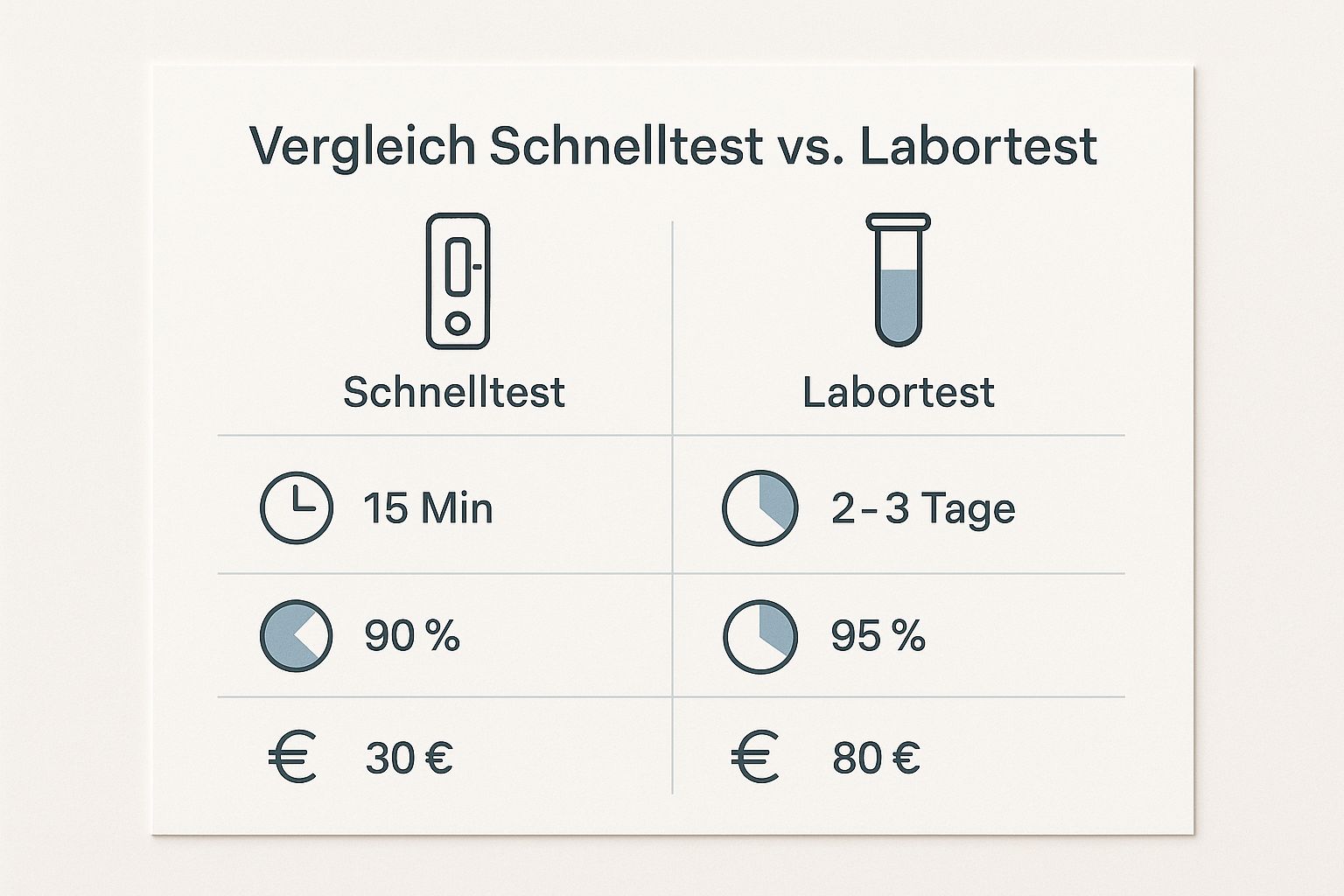
The graphic shows that the at-home rapid test stands out mainly for its quick availability and lower cost, while the laboratory test has slightly higher sensitivity but requires significantly more time and money.
When you should pay closer attention: your personal test check

Not every stomach pang immediately calls for a test. However, there are certain warning signs that are worth paying closer attention to. Think of your body like a car: some noises or warning lights simply cannot be ignored because they could indicate an underlying problem. A Helicobacter pylori rapid test can provide clarity in such situations and is often the first step toward finding the cause of persistent symptoms.
Whether a test is worthwhile for you depends entirely on your personal situation and symptoms. It is not a blanket recommendation, but an individual decision. But when is the point reached at which a test is really worth considering?
Your personal risk checklist
Certain factors and symptoms make a Helicobacter pylori infection more likely. If you notice several of the following points in yourself, taking a test may be advisable. Use this list as a brief guide:
- Recurring stomach pain: Do you often have pain, especially on an empty stomach or at night? Does it improve shortly after eating?
- Persistent feeling of fullness and nausea: Do you often feel full quickly, suffer from constant belching, or experience unexplained nausea?
- Family history: Have there already been cases of stomach ulcers or even stomach cancer in your immediate family (parents or siblings)?
- Iron-deficiency anemia without a clear cause: Can’t your doctor find a cause for your persistent iron deficiency? An H. pylori infection can hinder the absorption of iron from food.
- Unintentional weight loss: Have you lost weight without changing your diet or exercising more?
These symptoms are not proof, but they are important clues. They are the “warning lights” that flash, suggesting that a closer examination is warranted.
Who is particularly affected? Risk groups in focus
The prevalence of Helicobacter pylori is not the same across all population groups. The statistics show clear differences. While around 24% of adults and only about 5% of children in Germany are affected overall, the figures are significantly higher in other groups. For example, a prevalence of 52–86% was found among immigrants and 36–44% among their children. These data show that background and living conditions can play a role. More information about the background to Helicobacter pylori diagnostics is available at imd-berlin.de.
Doctors pay particular attention when so-called warning symptoms are added to the complaints mentioned. These include vomiting blood, black stools (also known as tarry stools), or severe difficulty swallowing. In these cases, an immediate medical examination is essential and usually goes beyond a simple rapid test. However, a rapid test for Helicobacter pylori is an excellent tool for the initial assessment of less dramatic but nevertheless distressing chronic symptoms.
From preparation to result: Your journey through the test
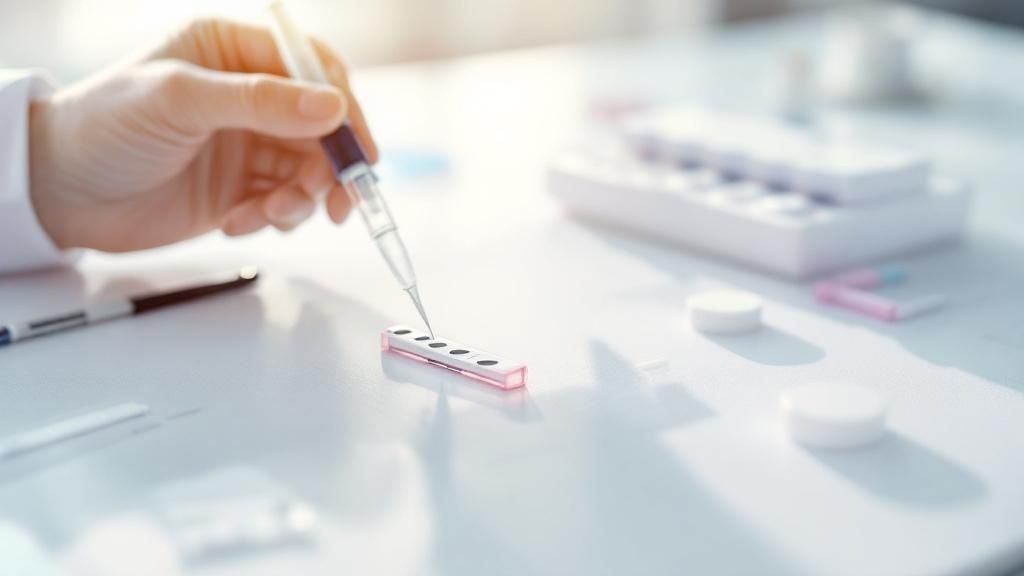
A rapid test for Helicobacter pylori is only as reliable as its administration. You can think of it like cooking: even the best ingredients do not guarantee a successful dish if you do not follow the recipe. The same applies to the test. To make the result as accurate as possible, a few simple but very important preparatory steps are required. They ensure that no external influences distort the result or mask traces of the bacterium. The entire process—from preparation to reading the result—is straightforward as long as you know what matters.
The golden rule: Take a break from medication before the test
Perhaps the most important step before a stool or breath test is a deliberate break from medication. Some medications can inhibit the activity of Helicobacter pylori so strongly that the bacterium becomes practically invisible to the test.
- Proton pump inhibitors (PPIs): Active ingredients such as omeprazole or pantoprazole, which reduce stomach acid production, should no longer be taken at least two weeks before the test.
- Antibiotics and bismuth preparations: These medications directly combat the bacterium or interfere with its detection. Here, a break of at least four weeks before the test is necessary.
Important: Always discuss stopping any medication with your doctor first. This pause is crucial to prevent a so-called false-negative result—in other words, a situation in which the test shows negative even though you are infected.
Test-day procedure: Step by step to the result
Once the preparation is complete, the test itself is very simple. With a home test, such as a stool test, the procedure is clearly defined. You use the enclosed swab to collect a small stool sample. Then you place a few drops of the sample liquid onto the test cassette. The result is usually visible after just 10 to 15 minutes. It is essential to read and follow the instructions for use carefully to avoid errors during application.
When you take a breath test at a doctor's office, you generally need to arrive fasting. The procedure is straightforward here as well: You provide an initial breath sample, drink a special test solution, and provide a second breath sample after a short waiting period. With the right preparation, you can be confident of obtaining a reliable result with either method.
Decoding your test result: What positive and negative findings mean
You are holding the result of your Helicobacter pylori rapid test in your hands, and it may feel a little puzzling. A positive result can quickly cause concern, while a negative result often brings relief. However, interpretation is not always black and white.
A positive test result does not automatically mean that you are seriously ill. Many people carry the bacterium without ever developing symptoms. Conversely, a negative result is a very good indication that there is no active infection, as the test was unable to detect any antigens of the bacterium in your sample. A positive result, on the other hand, confirms the presence of Helicobacter pylori in your stomach. It can be the crucial clue to finding the cause of symptoms such as persistent stomach pressure and a feeling of fullness. Read in our related article whether Helicobacter could be behind your symptoms. With this knowledge, you can discuss the next steps with your doctor.
When the smoke detector goes off by mistake
Think of the test as a highly sensitive smoke detector. In most cases, its alarm is a reliable indication of a fire. Sometimes, however, the alarm is triggered merely by burnt food. Medical tests work similarly: There are so-called false-positive and false-negative results, even though these are very rare with modern rapid tests.
- False negative: The test shows “negative” even though an infection is present. This can happen if acid-reducing medications (proton pump inhibitors) or antibiotics were taken shortly before the test. These medications can reduce the bacteria so significantly that the test can no longer detect them.
- False positive: The test shows “positive” even though there is no active infection. This scenario is extremely unlikely with stool antigen tests, such as those used at home. With blood tests, however, it can occur because they detect antibodies that may remain in the blood even after an infection has long since cleared.
Fortunately, such inaccuracies are the exception. The accuracy of a high-quality rapid Helicobacter pylori test is usually above 95%, making it a highly reliable tool.
The following table will help you better understand the various results and their significance.
| Test result | Meaning | Next steps | Frequency |
|---|---|---|---|
| Positive | Helicobacter pylori antigens were detected in the sample. An active infection is very likely. | Medical advice to confirm the result and initiate treatment (e.g., eradication therapy). | Common in people with stomach complaints. |
| Negative | No antigens were detected. An active infection is very unlikely. | If symptoms persist, further medical evaluation of other causes is recommended. | Common in people without an infection. |
| False positive | The test is positive, but there is no active infection. | Confirmation with another test (e.g., a breath test or gastroscopy). | Extremely rare with stool tests; possible with blood tests. |
| False negative | The test is negative even though an infection is present. | If symptoms strongly suggest an infection, repeat the test after stopping certain medications. | Rare; may be caused by taking medication. |
As the table shows, a negative result is usually reassuring, while a positive result should always prompt a visit to the doctor.
A positive result should therefore always be taken seriously and evaluated by a doctor so that the appropriate treatment can be started. It is the first and most important step on the way back to good digestive health.
Test methods compared: Which one is right for you?
Finding the right test for a Helicobacter pylori infection is a bit like choosing the right mode of transport for a journey. Not every method is suitable for every purpose. A rapid Helicobacter pylori test for home use offers very different advantages from a test performed by a doctor. To help you make the best decision for your personal situation, let’s take a close look at the options—with no marketing hype, just clear facts.
The gold standard and its challenges: the breath test
Among medical professionals, the urea breath test is considered the most reliable method for detecting an active infection. Its accuracy is over 95%, making it extremely reliable. You could compare it to a flight: precise and quick to reach its destination, but requiring somewhat more planning. You have to visit a doctor's office or laboratory and usually arrive fasting. In addition, it is often more expensive, and health insurance does not always cover the costs.
The quick snapshot: The blood test
A blood test is easy to perform and provides a quick result. It works by looking for antibodies that your immune system has produced in response to the bacterium. However, this is also its biggest drawback: The test cannot distinguish whether the infection is currently active or occurred years ago and has long since cleared up. It is like a smoke detector sounding an alarm even though the fire was extinguished long ago. It is therefore not suitable for follow-up testing after treatment.
Convenience at home: The stool test
The stool antigen test offers the greatest convenience, as you can perform it discreetly in your own home. It directly detects components of the bacterium, known as antigens, in your stool sample and therefore clearly indicates an active infection. Its accuracy is comparable to that of the breath test, making it an excellent and reliable alternative.
It is essentially the flexible car for your health journey: you choose the time and place yourself. What matters for an accurate result is that you collect the sample carefully according to the instructions and perform the test exactly as described. The stool test is ideal for initial diagnosis and also for checking treatment success after therapy.
As with Helicobacter pylori, other digestive problems can also be investigated with at-home tests. Learn more about food intolerance tests, which can also provide you with clarity.
Myths and facts: What you really need to know about the infection
Many stories and half-truths surround Helicobacter pylori. After a positive diagnosis, the same questions often arise: Am I now inevitably going to develop stomach cancer? Did I catch it by kissing? And can I simply fight the bacterium with broccoli sprouts? It is time to dispel the most common myths and put scientific facts first.
Why not everyone who is infected becomes ill
One of the most intriguing questions is why some people remain completely symptom-free despite an infection, while others suffer from severe symptoms. Think of it like a pollen allergy: The same pollen that causes only a slight tingling in one person's nose triggers severe allergic reactions in another. Helicobacter pylori behaves similarly. Whether and how severely the infection manifests itself varies from person to person.
Several factors play an important role:
- Stress: Prolonged stress can weaken the immune system and make the sensitive stomach lining more vulnerable to the bacteria.
- Diet: A diet high in heavily processed foods can promote inflammation in the body and worsen symptoms.
- Genetic predisposition: Some people seem to naturally have a more resilient stomach barrier or a more effective immune response, making them less susceptible to stomach problems.
The idea of being helplessly at the mercy of the infection is therefore a myth. Although the bacterium is the trigger, your lifestyle and genes have a decisive influence on how your body reacts. If you would like to learn more about how closely your genetics can be linked to digestive problems, you can find interesting information in our article about digestive problems and genetic analyses.
Common fears and what is really behind them
A positive rapid test for Helicobacter pylori is no reason to panic. Although the fear of stomach cancer is understandable, the statistical risk is low. Only a very small proportion of those infected actually develop this serious disease. The routes of transmission are also less direct than is often assumed. While transmission within the family is considered likely, transmission through kissing is extremely unlikely.
Rather, a positive test result is an important impetus to take action. It is an opportunity to develop the best strategy for your personal stomach health together with a doctor or therapist.
Would you like to take proactive control of your health? Discover the scientifically backed tests from MYBODY Lab GmbH and gain profound insights into your body.



Share now:
Understanding microbiome tests: Your guide to gut health
Understand and specifically resolve constant burping and stomach pressure