

Iron deficiency self-test: Interpret symptoms & measure your levels correctly
Constant fatigue, hair loss, exhaustion—does this sound familiar? An iron deficiency self-test can be the first crucial step toward getting to the bottom of the cause of these symptoms. With modern at-home nutrient tests, you can easily check your ferritin level—the amount stored in your iron reserves—yourself, without having to wait weeks for a doctor’s appointment.
Constantly tired and exhausted? Your path to greater clarity
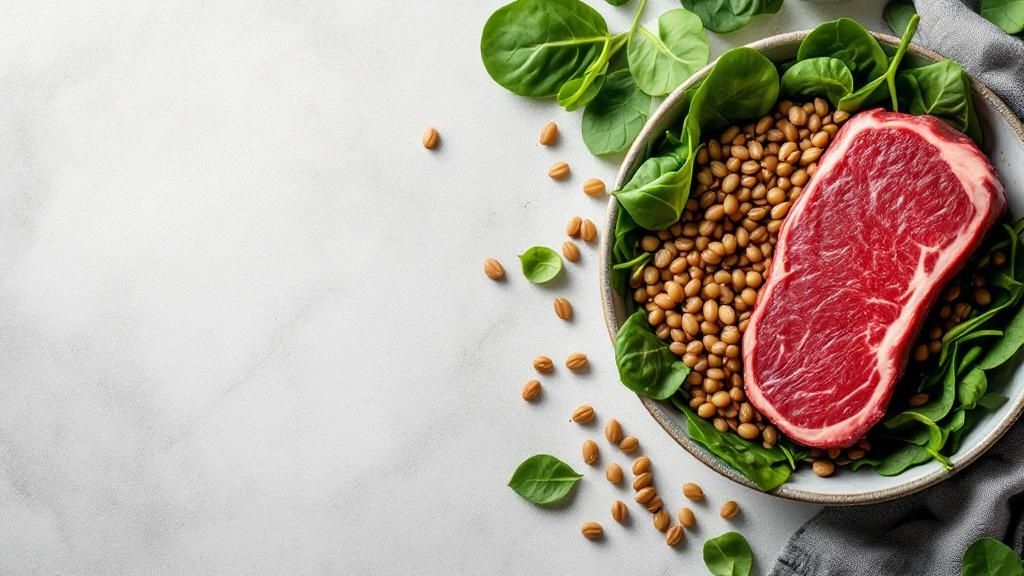
Do you know that feeling of going through the day with the handbrake on? Your concentration quickly fades, your energy is gone by the afternoon, and even after a long night, you feel anything but refreshed.
I experienced firsthand how much a low ferritin level affected my energy and performance. For years, I blamed my constant sluggishness on stress and a busy schedule. Until I realized that the answer often lies deeper—directly in our blood values.
The good news is that you don’t simply have to accept this condition. Symptoms such as fatigue, hair loss, or pale skin are often caused by a simple but far-reaching nutrient deficiency.
The central role of iron and ferritin
Iron is so much more than just a trace element. It is the engine that transports oxygen in your blood. Imagine your red blood cells as small delivery vans supplying every cell in your body with vital oxygen. Iron is the fuel that keeps this fleet running.
Without this fuel, your entire body runs on low power. The result is exactly the symptoms you may be noticing:
- Persistent exhaustion: Your body simply lacks the energy for its daily tasks.
- Problems concentrating: Your brain also suffers from the lack of oxygen, which often manifests as “brain fog.”
- Hair loss and brittle nails: The cells responsible for strong hair and nail growth are no longer receiving adequate nourishment.
The ferritin level is the key indicator here. It does not measure the iron currently circulating in your blood, but rather the amount your body has stored for a rainy day. A low ferritin level is like a nearly empty tank—a clear warning sign that your reserves are running low and an acute deficiency is looming.
By the way, you’re not alone. Around 2 billion people worldwide suffer from iron deficiency. In Germany, women are about five times more likely to be affected than men. Ferritin testing is now considered the gold standard for reliably detecting depleted iron stores at an early stage.
Your path to greater clarity begins with a test
The first step toward regaining your energy is to gain clarity. Instead of continuing to guess, you can have your level accurately determined with a modern iron ferritin self-test. These tests are designed to be conveniently carried out at home. All it takes is a small finger prick to send a sample to a certified laboratory.
This approach gives you a scientifically sound basis for taking your health into your own hands. A specific measured value is essential for understanding the extent of a deficiency and taking the right steps.
If you would like to learn more about how to specifically support your body, you can find valuable information in our guide on how to test for a nutrient deficiency.
Symptom check vs. blood test: What is the difference?
Do you often feel tired and unfocused, and wonder what might be causing it? If you then search online for an “iron deficiency self-test,” you will quickly encounter two completely different options: simple symptom questionnaires or medical tests that directly measure your ferritin level.
Both approaches have their merits. But to make a truly good decision for your health, you should know exactly where their strengths and weaknesses lie.

The symptom questionnaire: An initial indication
Symptom checklists are often the first, straightforward step. They ask about typical complaints such as fatigue, pale skin, or concentration problems and give you an initial, rough indication. Such questionnaires take only a few clicks to complete and create awareness that something might not be right in the first place.
I have experienced firsthand how easy it is to simply attribute symptoms like exhaustion to everyday stress. A questionnaire like this can provide the crucial impetus to take a closer look and stop ignoring your symptoms.
But the major weakness of this method is obvious: The symptoms are nonspecific. Constant fatigue or hair loss could just as easily indicate a vitamin B12 deficiency, hormonal problems, or simply too little sleep. A symptom assessment alone can therefore only ever give you a suspicion, never a definitive diagnosis.
The clear language of numbers: An iron ferritin self-test
This is exactly where modern nutrient tests come into play. They allow you to determine your ferritin level—meaning the amount stored in your iron reserves—directly from your blood. An iron ferritin self-test provides a specific, measurable value in ng/ml. These are facts you can work with.
Think of it this way: The symptom checklist is like looking at a dark blanket of clouds—it suggests rain. The ferritin test is like looking at the rain gauge—it tells you exactly how much rain has already fallen.
A common approach to symptom-oriented testing is, for example, a short questionnaire in which points are assigned for symptoms such as fatigue or difficulty concentrating. This method is popular in Germany for strengthening an initial suspicion. If this approach interests you, you can discover further insights on prohmed.de.
Why a specific measurement is simply superior
An objective measurement has decisive advantages over mere speculation:
- Clarity: A number doesn’t lie. You can see in black and white whether your iron stores are empty, well stocked, or in the optimal range. No more guessing.
- Early detection: Your ferritin level often drops long before the most severe symptoms even appear. This gives you the opportunity to take proactive action before manifest iron deficiency develops with all its consequences.
- Basis for action: Only with a specific value can you take targeted measures—whether through dietary changes or supplements—and genuinely monitor their success later on.
So, a questionnaire tells you: “You might have a problem.” A medical iron deficiency self-test, on the other hand, gives you the certainty and data you need to address this problem in a targeted and effective way.
Your at-home iron deficiency self-test: It’s this easy
Great, so you’ve decided to get to the bottom of things and check your ferritin level. A very good decision! An iron deficiency self-test for home use may sound complicated at first, but I can assure you: it’s really easier than you think. I’ll show you how simple the whole process is.
For many people, the biggest hurdle is drawing blood. The idea of pricking your own finger isn’t pleasant for everyone. But don’t worry: modern test kits are designed so that you barely feel the prick. It’s really just a tiny sting that’s over in a flash.
What to look for when choosing your test
Before you get started, an important decision awaits: choosing the right provider. Not every iron ferritin self-test on the market delivers reliable results. To make sure you can actually do something with the result in the end, pay attention to these points:
- Certified laboratory: This is absolutely essential. Your sample must be analyzed in an accredited specialist laboratory, such as one operating according to ISO standards. This is the only way to guarantee medical standards and precise results.
- Understandable instructions: Good instructions are illustrated, clearly worded, and free of technical jargon. They should guide you safely through every single step.
- Data protection: The handling of your sensitive health data must be transparent. Pseudonymized processing, in which the laboratory does not know whom the sample belongs to, is the gold standard here.
- Clear results: What good is a laboratory value if you cannot interpret it? A reputable provider gives you a detailed yet easy-to-understand results report that also outlines specific next steps.
As soon as you have your test kit in your hands, you can get started. It is best to set aside about 15 minutes during which you can relax and will not be disturbed.
How your at-home test works
The test itself is a clearly structured and genuinely simple process. Most kits, including our nutrient tests, are designed in a very similar way and essentially guide you through the process.
First, you activate your test kit online using an individual code. This is important so that the laboratory can later assign your sample anonymously. Then comes the crucial moment: collecting the blood sample. Usually, only a few drops of blood from the fingertip are needed. Simply have everything included in the kit ready: disinfectant wipe, lancet, small sample tube, and a plaster.
This graphic clearly illustrates how the core process works for many rapid tests that provide you with a direct result.
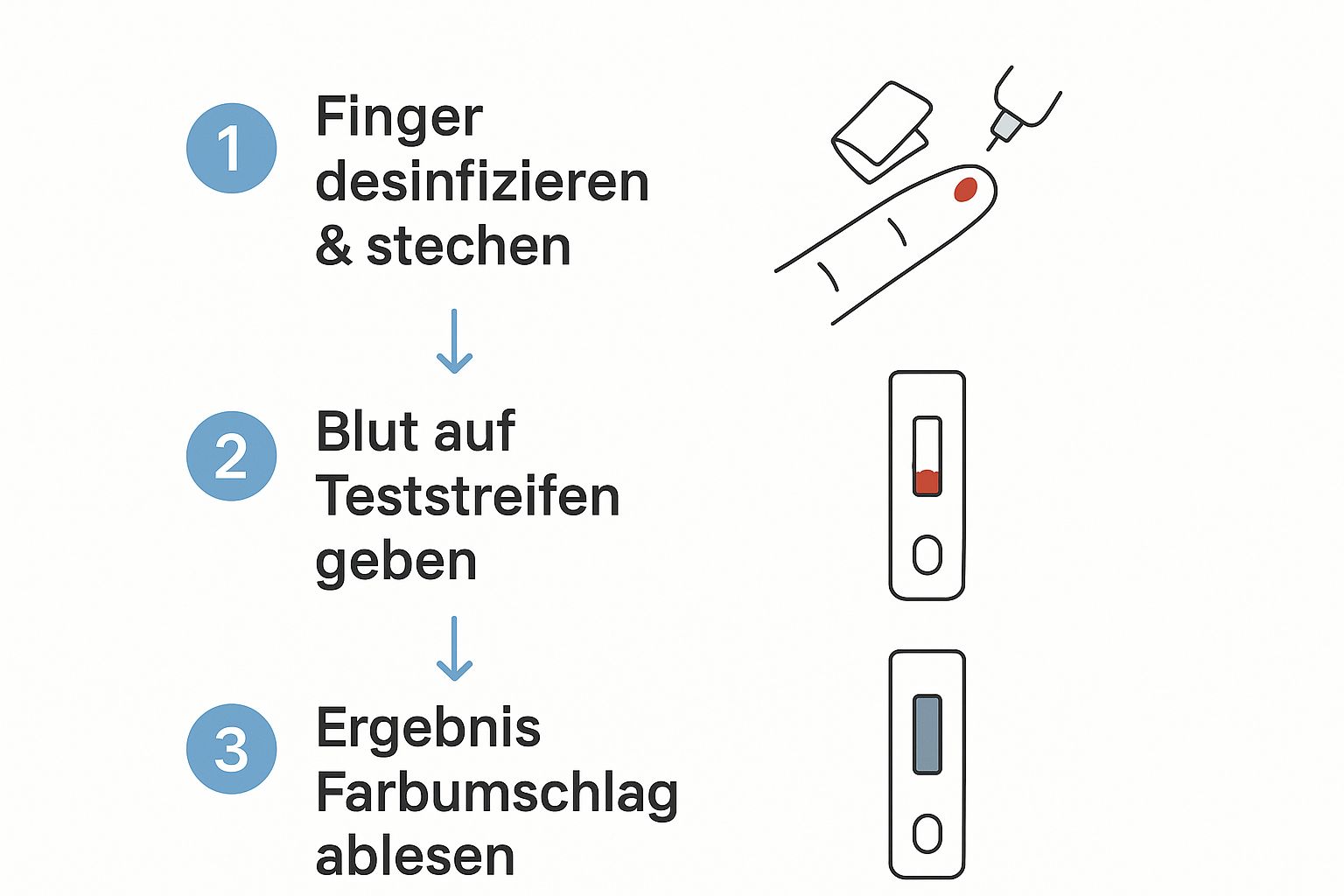
Basically, it involves just three simple steps, as the illustration shows.
With laboratory tests, such as those from MYBODY, you collect the drops of blood in a small tube instead of dripping them onto a test strip. The advantage? This method enables a much more accurate and differentiated analysis of your ferritin level in the laboratory.
My personal tip from experience: Wash your hands with warm water beforehand and rotate your arm a few times. This stimulates circulation, making the drops of blood flow much more easily. This saves you the unpleasant need to press on your finger.
Once you have collected the required amount of blood in the tube, simply seal it securely, place it in the enclosed return envelope, and take it to the post office. That’s it! The specialist laboratory takes care of the rest.
After a few days, you will usually receive an email informing you that your personal results report is available online. Modern diagnostics can be this simple and accessible today.
Interpret and understand your ferritin level correctly

The exciting moment has arrived: Your result from the iron deficiency self-test is available. You log in and see a number, for example, “Ferritin: 25 ng/ml.” But what does this mean specifically for your energy, concentration, and overall well-being?
Don’t worry, we’ll figure this out together now. Your ferritin level is much more than just a number – it is an important indicator that you should always consider in the context of your personal situation and symptoms.
I know from personal experience how much a low ferritin level can drain your energy and how liberating it is to finally have clarity.
What is a normal ferritin level?
When you open your test report, you usually see your personal value alongside a so-called laboratory reference range. This range may vary slightly from one laboratory to another, but it provides a general range for “normal” values. Typically, this range is about 15 to 150 ng/ml for women and 30 to 300 ng/ml for men.
But here is the crucial point: “Normal” does not necessarily mean “optimal.”
Many people, especially women, feel anything but fit with levels in the lower normal range – for example, below 50 ng/ml. Symptoms such as constant fatigue or hair loss can already be clearly noticeable, even though the level is officially still considered “within the normal range.”
Based on my own experience and that of many experts, a level below 30 ng/ml is a clear warning sign of depleted iron stores (latent iron deficiency). Your reserves are practically exhausted at this point, even if your blood count (that is, your hemoglobin level) may still appear normal. Your body is essentially running on reserve.
That is why it is so important not to focus rigidly on the reference range, but to compare the value with how you personally feel. An iron ferritin self-test gives you exactly the number you need for this assessment.
Understanding ferritin levels – a simple guide
This table helps you classify your ferritin level and understand what the different ranges mean for your health. It serves as an initial guide to help you plan the right next steps.
| Ferritin level (ng/ml) | Meaning | Recommended next steps |
|---|---|---|
| < 15-20 ng/ml | Manifest iron deficiency: Your iron stores are completely depleted. | Seek urgent medical advice. Medical-supervised treatment is usually necessary here. |
| 20 - 50 ng/ml | Empty to low stores: You are in the “gray” area. | Adjust your diet and improve iron absorption. Medical evaluation to investigate the causes is highly advisable. |
| 50 - 100 ng/ml | Functional range: Your stores are generally replenished. | A good range for most people. Make sure to eat an iron-rich diet to maintain this level, especially when under strain. |
| > 100 ng/ml | Optimal stores: Ideal for athletes or when requirements are high. | Perfect! Now it is about maintaining this status through a conscious lifestyle. |
Your result is therefore always a starting point. It is the foundation you can build on and gives you the power to make informed decisions instead of continuing to feel in the dark.
If you would like to explore the topic in greater depth, you can find more details about optimal ferritin levels and their significance in our in-depth article.
Always remember: Your iron deficiency self-test is the first, decisive step toward improvement. With the result in hand, you can now take targeted action—either through a more conscious diet alone or, if your levels are very low, together with your doctor.
What to do about iron deficiency: Your next steps
Great, the iron deficiency self-test has shown you where you stand. But a measured deficiency is not the end of the world; it is your starting signal to take action. Now it is about replenishing your iron stores intelligently and, above all, sustainably. Forget radical diets or randomly taking tablets—we are focusing on practical solutions for everyday life that really make a difference.
The key lies in a smart, conscious diet. It is well known that the body can utilize iron from animal sources (so-called heme iron) much more effectively than iron from plant-based foods (non-heme iron). But don't worry—even as a vegetarian or vegan, you can effectively replenish your stores. It all comes down to using the right techniques.
The best sources of iron for your everyday life
Intentionally include foods rich in this important trace element in your diet. Here are a few options that are easy to incorporate:
- Animal-based sources: Lean red meat, especially beef, as well as liver and egg yolks, are true iron powerhouses. Even small portions can make a significant contribution.
- Plant-based sources: Lentils, chickpeas, beans, tofu, pumpkin seeds, flaxseeds, quinoa, and oats are excellent vegan sources. And of course, the classic: leafy green vegetables such as spinach and kale.
But putting only iron-rich foods on your plate is only half the battle. The real game changer is the right combination.
The vitamin C boost: Vitamin C is iron's best friend. It can increase the absorption of plant-based iron by up to sixfold! A glass of orange juice with your muesli, bell peppers in a lentil salad, or a few berries with yogurt can make a huge difference.
At the same time, there are also so-called “iron blockers” that inhibit absorption. These include tannins in coffee and black tea, phytates in whole-grain products and legumes, and calcium from dairy products.
That doesn't mean you have to give up your morning coffee. It's just about smart timing. It's best to enjoy your coffee or tea at least one hour apart from your iron-rich meal.
When are dietary supplements beneficial?
If your ferritin level is really at rock bottom after the iron ferritin self-test (typically below 30 ng/ml), changing your diet alone is often not enough to quickly replenish your depleted stores. This is where dietary supplements are not only beneficial, but often necessary.
But the key point is this: Never take iron tablets based solely on suspicion. Too much iron can be harmful. Your decision should always be based on a specific test result and, ideally, medical advice. Talk to your doctor about which product and dosage are right for you.
If you want to delve deeper into the subject, our guide explains in detail what to do in case of iron deficiency and how to take the right steps.
With this roadmap of mindful eating and targeted supplementation when needed, you're well equipped to regain your energy and bring your levels back into the optimal range.
Frequently asked questions about the iron deficiency self-test
Naturally, questions arise when it comes to taking a self-test at home. And that's a good thing, because your health is at stake and you want to be sure that everything goes smoothly. I've collected the most frequently asked questions here to resolve any lingering doubts.
My goal is to give you the knowledge you need to confidently keep track of your levels yourself. The test is the first step, but understanding what lies behind it gives you the confidence to make the right decisions for your well-being.
How reliable is a self-test like this, really?
This is the question I’m asked most often—and it’s absolutely justified. The answer depends heavily on the type of test. A simple test strip that shows you a result directly at home provides more of a rough indication. Tests in which you collect a small blood sample and send it to a certified medical laboratory are much more accurate and informative.
These laboratories use exactly the same analytical equipment and quality standards as they do for a sample collected by your doctor. The accuracy is therefore extremely high. Especially in Germany, where an estimated 20% of women of childbearing age are affected by iron deficiency, a reliable result is worth its weight in gold. Modern home tests with a sensitivity of over 97% and a specificity of over 96% give you a truly reliable assessment—often without an appointment at a medical practice. Learn more about the accuracy of such tests on prio-one.de.
Is a ferritin-only test enough, or do I need more values?
The ferritin level is the crucial early indicator for detecting depleted iron stores. In other words, it shows you how full your reserves are—often months before the hemoglobin level (Hb level) drops in a complete blood count and signals manifest anemia.
An iron ferritin self-test is therefore the ideal and most important starting point. If the level is very low or your symptoms remain unclear, a doctor can determine additional values such as hemoglobin, transferrin, or the inflammation marker CRP to complete the overall picture. For an initial, well-founded assessment, however, the ferritin level is entirely sufficient and the most informative.
What if I’m afraid of the small prick?
I hear this concern often and can absolutely understand it. But I can reassure you: The modern lancets included in the test kits are designed so that the prick is truly minimal. It’s more of a brief, barely noticeable pinch than real pain.
My tip from experience: Warm your hands well under warm water beforehand. This stimulates circulation and helps the blood flow much more easily, so you can quickly and easily collect the few drops needed.
If you’re still unsure or have questions about the exact process, you’ll find many helpful answers in our comprehensive FAQ section on mybody-x.com.
Are you ready to regain your energy and finally gain clarity about your iron levels? At MYBODY Lab GmbH, you’ll find scientifically backed nutrient tests that you can perform easily and conveniently from home. Take control of your health.



Share now:
What to do about iron deficiency? Your practical guide to more energy
What’s in your genes – Your personal DNA guide