

What your genes contain—Your personal DNA guide
Have you ever wondered why you can sleep soundly after three cups of coffee while your best friend is bouncing off the walls after just one? Or why one diet works wonders for your colleague but has absolutely no effect on you? The answer to these questions is as unique as you are and is hidden deep within your body: in your genes.
Imagine your DNA as a vast library. It contains the complete blueprints for your entire life. In this enormous collection, each individual gene is like a specific book—a highly precise guide to everything that makes you who you are.
What your genes really are and what they do for you

Perhaps you still remember this from biology class: A gene is a section of your DNA. That is correct, but there is much more to it than dry theory. Each gene contains a code that instructs your body to produce a very specific protein. These proteins are the diligent workers in your cells, carrying out countless tasks.
You can think of them as tiny specialists responsible for practically everything that happens in your body. One gene provides the instructions for a protein that determines your eye color. Another supplies the blueprint for an enzyme that breaks down lactose (milk sugar). You have approximately 20,000 to 25,000 of them in each of your individual cells.
The blueprint of your life
The entirety of all your genes—your genome—is like the complete blueprint for a unique house. It determines where the walls stand, how many windows there are, and what material the roof is made of. In the same way, your genome determines fundamental characteristics of your body and your personal predispositions.
Your genes are not your destiny, but your personal map. They show you possible paths and potential, but you are in the driver’s seat and decide which route to take.
This genetic predisposition explains why some people are natural-born sprinters, while others excel at endurance sports. It is also why a particular diet works wonders for your friend but has hardly any effect on you.
The key lies in the details
The idea that there is such a thing as a fundamental unit of heredity is not entirely new. In fact, it was the Danish biologist Wilhelm Johannsen who coined the term “gene” as early as 1909 to describe this constant. Although the discovery of DNA’s structure did not come until decades later, this early insight laid the foundation for modern genetics.
Today, thanks to modern genetic tests, you can take a look at your personal blueprint. Instead of simply guessing, you can find out specifically which diet, exercise, and lifestyle best suit your unique genetic makeup. In our comprehensive guide, learn how you can understand your genes and use DNA analysis for your health.
How a genetic test deciphers your personal map
You’re probably wondering how such a detailed report about your innermost predispositions can come from a simple saliva sample. The whole process is much simpler and more fascinating than you might think. Come along on the journey of your DNA—from the cheek swab at home to analysis in a high-tech laboratory.
Imagine Anna. She had always been frustrated because after exercising, she felt like it took her twice as long to recover as her friends. When she opened her genetic test report, she discovered not only surprising information about her ancestry, but also the reason for her slow recovery: a specific genetic variant. It affects how efficiently her body breaks down muscle inflammation after exercise. Suddenly, everything made sense.
From cheek swab to data set
The entire process is designed to give you maximum insight with minimal effort. Here's how it works:
- Step 1: Collecting the sample at home. It all begins with a simple kit delivered to your home. Using a cotton swab, you collect a saliva sample from the inside of your cheek—it only takes a few seconds and is completely painless.
- Step 2: The journey to the lab. You then send your sample in the prepaid envelope to a certified laboratory. There, your DNA is carefully isolated from the cells. This is the moment when your very personal blueprint is made accessible.
- Step 3: Analyzing your genes. Specialized machines, known as sequencers, now read specific sections of your DNA. They look for tiny variations in your genes (also called SNPs) that make you unique and provide insight into your predispositions.
The following illustration shows the fascinating molecular process by which genetic information is read from DNA. A fundamental step that also takes place in a similar way during laboratory analysis.
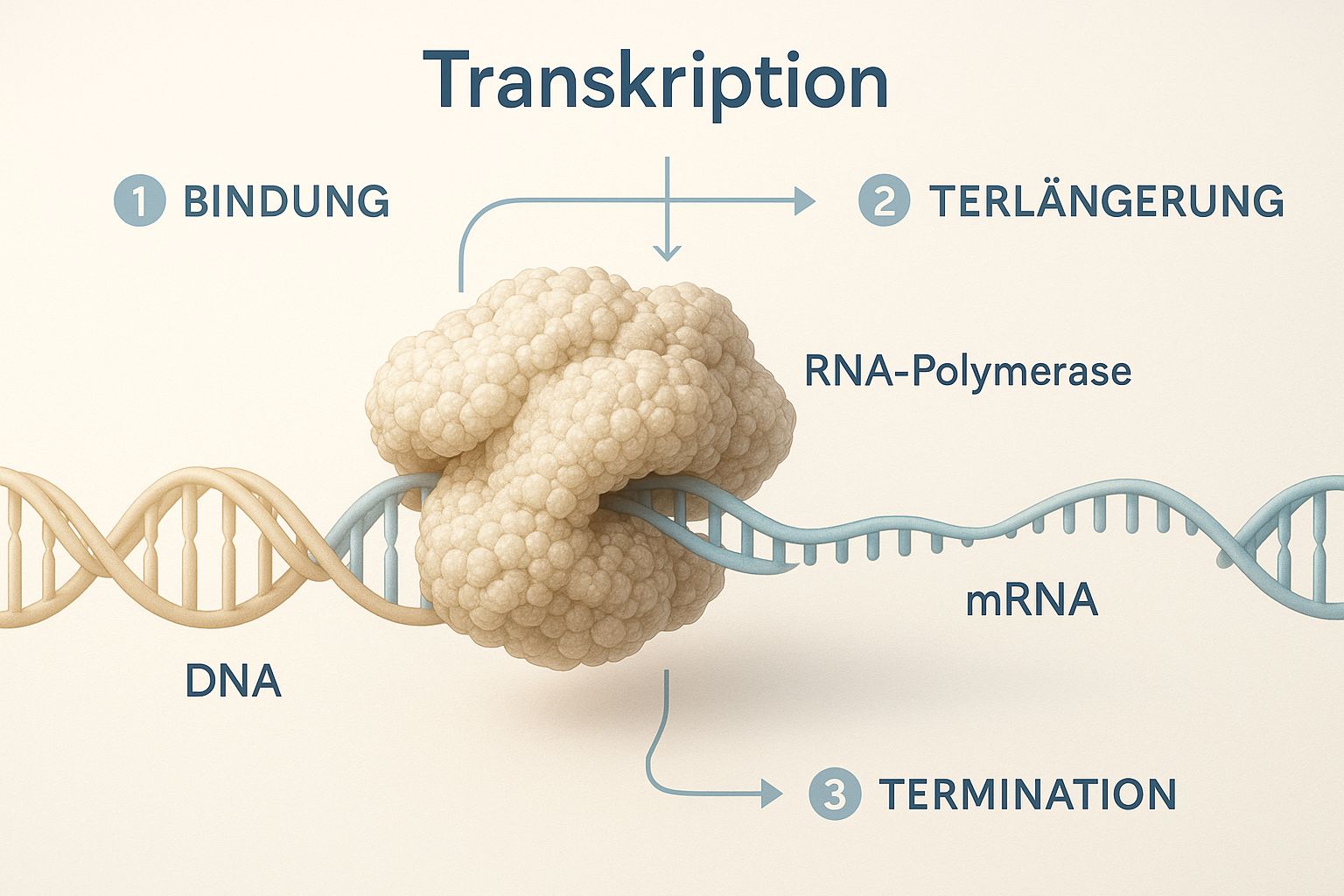
This illustration makes it clear how precise the instructions in your gene are and how they are translated into active commands for your body.
Your personal translator
Raw genetic data would be difficult for most of us to understand. This is where the real magic comes in: An easy-to-understand report translates this complex information into clear, understandable, and above all actionable recommendations.
A genetic test doesn’t give you orders—it gives you options. It shows you where your strengths lie and where even small adjustments can have a major impact.
You’ll learn not only which nutrients are particularly important for you or which type of exercise best suits your muscles. You’ll also learn how your genes could influence your ability to age healthily. Curious? Find out how your genes influence healthy aging and what role they play in your longevity.
This is how pure science becomes a personal strategy for your well-being.
How you can proactively shape your health
Your genes are not an unchangeable fate set in stone. It’s much better to think of them as your personal health compass. They may point you in a direction, but you hold the wheel and decide which path to take. This knowledge empowers you to actively shape your health instead of merely reacting passively to problems.
Many people hear the words “genetic risk” and immediately think of an unavoidable disease. But this is precisely where there is a crucial distinction you should understand: A predisposition is not the same as a diagnosis.
A predisposition merely means that your genetic makeup could make you more susceptible to certain conditions. Your lifestyle—meaning your diet, the amount you exercise, and how you handle stress—is the decisive factor that can tip the scales.
Predisposition versus destiny
Simply imagine two people who have exactly the same genetic predisposition to high cholesterol. One of them follows a balanced diet, exercises regularly, and doesn’t smoke. The other, however, has a stressful job, often eats fast food, and spends most of their time sitting.
Which of the two is more likely to develop cholesterol problems? Exactly—the second person. The gene alone did not cause the disease. But in combination with an unfavorable lifestyle, the risk was able to fully manifest itself. So you can see: Your choices carry enormous weight.
You cannot change your genes, but you can change the way your body responds to them. Your lifestyle is the tool you can use to positively influence your genes’ instructions.
This principle applies to countless areas of your health:
- Cardiovascular health: A predisposition to high blood pressure does not mean you will develop it. A low-salt diet and regular endurance exercise can significantly reduce your risk.
- Metabolism: Do you have a genetic tendency toward insulin resistance? A low-sugar diet and targeted strength training help your body respond more sensitively to insulin.
- Digestion: Some people naturally have a more sensitive intestinal barrier. A high-fiber diet can make a huge difference here. Learn more in our article about the role genetics plays in digestion and how digestive problems and genes are connected.
Knowledge is the first step toward prevention
A genetic test provides you with exactly this knowledge. It gives you the opportunity to learn about your personal health risks long before they become a problem. Instead of groping in the dark, you receive a clear overview of your predispositions. With this information, you can make targeted, well-informed decisions about your future and take your health into your own hands.
The importance of genetic factors for public health must not be underestimated. In Germany, an estimated 5 to 7% of the population is affected by rare genetic disorders. In addition, around 5 to 10% of all cancer cases have a genetic background, such as mutations in the well-known BRCA genes. This is precisely where the strength of preventive genetics becomes apparent, enabling us to take countermeasures at an early stage.
Find the diet that matches your DNA

Have you ever wondered why your friend achieves great results with a low-carb diet while the number on your scale simply refuses to budge? Or why your colleague feels full of energy after a plate of pasta, while afterward all you want to do is lie down? The answer often isn’t a lack of discipline, but is hidden deep within you—in your genes.
This is exactly where we enter the fascinating world of nutrigenetics. This field of science explores how your unique genetic makeup influences the processing of nutrients. Every gene involved in your metabolism provides your body with a kind of blueprint for how it should process fats, carbohydrates, and proteins.
Your personal nutritional blueprint
At this point, a genetic test works like a precise translator for your body’s language. It can reveal what type of metabolism you have and which nutrients your body processes particularly well—or less efficiently.
Imagine discovering that, due to your genetics, you are a “carbohydrate type” and that your body prefers complex carbohydrates as its primary energy source. Suddenly, it makes sense why you felt so sluggish and low on energy on a strict low-carb diet.
A genetic test puts an end to the endless guesswork and trying out countless diet trends. It finally gives you permission to listen to your own body—and provides you with the right instruction manual as well.
But these insights go much further. Looking at your genes can show whether you have a predisposition to certain intolerances, often long before noticeable symptoms appear.
- Lactose intolerance: A specific gene (the LCT gene) controls how much of the enzyme lactase is produced. A particular variant of this gene may be the reason dairy products cause digestive problems for you.
- Gluten sensitivity: Certain genetic markers (known as HLA genes) are associated with a higher likelihood of celiac disease or gluten sensitivity.
- Vitamin status: Your genes can also influence how efficiently you absorb important vitamins such as vitamin D or B12 from food and convert them into their active forms. As a result, a deficiency can develop even despite a healthy diet.
Armed with this knowledge, you can stop chasing generic advice or popular diet myths. Instead, you can begin tailoring your diet precisely to your body’s needs. This not only helps you reach your goals more effectively—whether weight management or increased energy—but also enhances your overall well-being. If you’d like to explore the topic further, learn how a DNA test can improve nutrition and help you find a truly personalized strategy.
Train smarter, not harder—with your genetic advantage
Imagine having a personal coach who knows exactly how your body works. One who can tell you whether you’re built for explosive sprints or long-distance endurance runs. That coach is already inside you—it’s your genes. And this knowledge can take your training to an entirely new level.
This isn't about putting you in a box. It's about intelligently adapting your training plan to your own unique biology. What works for one person may not be right for you. Your genetic profile gives you the crucial advantage of fully realizing your potential instead of pushing yourself unnecessarily or overtraining.
Are you a powerhouse or an endurance natural?
You may have noticed that certain sports come easily to you, while others leave you struggling. The cause often lies in your genes. Certain genetic variants influence how your muscle fibers are structured and how your body provides energy for physical exertion.
I was genuinely surprised when I took my first genetic test. For years, I had forced myself through long runs because everyone said they were the best way to get fit. But my results showed a clear predisposition for explosive power. Since switching my training to shorter, more intense sessions like sprints and strength training, I’ve not only seen better results—I’m finally having fun with it again.
A look at your genes can give you insight into crucial areas:
- Muscle fiber type: Are you more inclined toward Type I fibers for endurance or Type II fibers for explosive power? This knowledge can help you find the sport in which you can naturally excel.
- Oxygen uptake (VO2max): Your genetic predisposition affects how efficiently your body can absorb oxygen—a key factor for any endurance athlete.
- Motivation to exercise: Yes, you read that right. Even your basic desire to move can be influenced by certain genes.
Your genes don't dictate your limits. They simply show you where your natural strengths lie. Use this knowledge to optimize your training instead of fighting against your own biology.
Target injury risk and recovery
It gets really interesting when we look at injury prevention and recovery. Certain genes influence how stable your connective tissue is and, consequently, how high your risk of tendon or ligament injuries is. A genetic test can show you whether you have a weakness in this area—and whether you should safeguard your training with targeted strengthening and stability exercises.
How quickly you recover after exercise is also genetically determined. Some people reduce inflammation after training more quickly than others. If you know that your body may need a little more time to recover, you can plan your breaks more mindfully and finally avoid overtraining effectively. This way, you work with your body, not against it.
Frequently asked questions about genetic tests
The world of genes is incredibly fascinating, but it naturally raises many questions. You may be curious, but perhaps also a little uncertain? That is completely normal! Here, we answer the questions we are asked most frequently and clear up a few myths. Our goal is to give you clear, straightforward answers so that you feel confident and well informed.
Is my genetic data safe with you?
Yes, absolutely. Protecting your data is our top priority. Precisely because genetic data is so personal, it is important to know all about your data protection rights and how they protect you. We have established strict security measures to protect your sensitive information at all times.
Here is exactly how we proceed:
- Pseudonymization: Your sample is not linked to your name in the laboratory; instead, it is assigned a unique code. This prevents anyone from directly linking it to you.
- Secure transmission: All data is transmitted in encrypted form and stored on secure servers that comply with strict European data protection standards (GDPR).
- No sharing with third parties: Your data will never be shared with third parties—such as insurers or employers—without your explicit consent. You retain full control.
Can a genetic test diagnose a disease?
This is a very important point: No, a lifestyle genetic test does not provide a medical diagnosis. Nor is it a substitute for a medical examination or consultation. Instead, it reveals your genetic predispositions and potential risk factors.
The result is not an immutable verdict, but valuable information. Think of it as a tool you can use to take preventive and proactive care of your health.
If you have health problems or are worried about a particular disease, please always consult a doctor. A genetic test can, however, be a valuable supplement to help you prepare more effectively for your conversation with your doctor.
What do I do with the results?
A genetic test report is not a dry data sheet that disappears into a drawer. Think of it as a practical guide for your everyday life. You receive not raw data, but specific, easy-to-understand, and above all actionable recommendations for your diet, training, and lifestyle.
We show you step by step how you can put these insights into practice. For example, you might discover that your body processes vitamin D less efficiently. Our recommendation would then be to specifically focus on vitamin-D-rich foods and perhaps consider supplementation after consulting a doctor.
There is considerable interest in these kinds of insights. One study shows that around 15% of Germans have already taken a genetic test or plan to do so. Around 40% of users hope to better assess potential health risks. At the same time, there are understandably concerns about data privacy. Learn more about the use of genetic tests in Germany in the study results on genetic tests.
Do my genes change over the course of my life?
Your basic DNA sequence—in other words, the blueprint encoded in your genes—remains the same throughout your life. It is the foundation you inherited from your parents.
What can indeed change, however, is so-called epigenetics. Think of epigenetics as a series of switches and dimmers attached to your DNA. Depending on your needs, these switches can turn your genes up or down—in other words, switch them “on” or “off.” Your lifestyle, diet, stress, and environmental influences are precisely the factors that operate these switches.
So every day, you have the opportunity to positively influence your genes’ activity and make the most of your genetic potential.
Are you ready to unlock the secrets hidden in your genes and take your health to a new, personal level? Discover your genetic predispositions and receive a clear plan to take control of your well-being.



Share now:
Iron deficiency self-test: Understand symptoms & measure levels correctly
Your nutrition genetic test for optimal results