

DNA Test for Dieting: Can Your Genetics Reveal Your Weight-Loss Secret?
A DNA test for dieting provides you with a customized nutrition plan precisely tailored to your genetic predisposition. Instead of general tips, you get a clear strategy based on your personal metabolism. You learn how your body best processes fats, carbohydrates, and proteins.
Why your past diet frustration is not your fault

Does this sound familiar? You start your next diet full of motivation, painstakingly count calories, avoid certain foods, and exercise regularly. But after a few initial successes, disappointment sets in: the yo-yo effect kicks in or the scale simply stops moving. Countless people share this feeling, and the reason is almost never a lack of discipline.
The real problem lies in the approach itself. Standard diets treat everyone as if they were the same. They ignore the crucial fact that each of us carries a unique biological blueprint within us—our DNA.
Imagine your body as a high-security lock. A standard diet is like a universal key tried on millions of locks. It is pure chance if it fits anyone. Most of the time, it fails because it was not made for that individual lock.
A DNA test for dieting, on the other hand, is the custom-made key precisely tailored to your personal lock. It deciphers what your body really needs to achieve lasting results.
The myth of the one perfect diet
Low-carb, low-fat, keto, paleo—the list of diet trends is endless and often contradictory. What worked for your friend or colleague may not lead to success for you at all. The reason lies deep in your genes and primarily concerns your very own metabolism.
Your body has a genetically determined tendency in how it handles the three main nutrients—the so-called macronutrients:
- Carbohydrates: Some people can use carbohydrates extremely efficiently to produce energy. In others, excess carbohydrates are stored as fat much more quickly.
- Fats: Fats work in much the same way. Your genetic profile determines whether your body metabolizes fats efficiently or whether you fare much better on a lower-fat diet.
- Proteins: The optimal protein requirement is also highly individual. Adequate intake is crucial for maintaining muscle mass and promoting satiety, especially during a diet.
These genetic differences explain why a blanket recommendation such as “Eat fewer carbohydrates” can be life-changing for one person while being completely ineffective for another.
Before we continue, let’s briefly compare the two approaches. The following table shows at a glance where the key differences lie.
Standard Diet versus DNA-Based Nutrition at a Glance
This table compares the fundamental differences between a general diet approach and a personalized nutrition strategy based on your DNA.
| Feature | Standard diet | DNA-based diet |
|---|---|---|
| Approach | “One-size-fits-all”—one plan for everyone | Personalized to your unique genetics |
| Foundation | General dietary guidelines | Individual genetic markers |
| Focus | Calorie reduction and restriction | Optimal nutrient utilization |
| Success rate | Often short-term, with a high risk of the yo-yo effect | Higher chance of sustainable, long-term success |
| Motivation | Based on sheer willpower | Based on understanding your own body |
| Flexibility | Rigid and inflexible | Adaptable to your lifestyle and preferences |
As you can see, DNA-based nutrition isn’t about being even stricter, but about eating smarter—in a way that suits what your body naturally does best.
Failed diets are a widespread problem. According to Germany’s 15th DGE Nutrition Report, around 67 percent of men and 53 percent of women are overweight, making it one of the greatest health challenges. For deeper insights, read the DGE’s full study on the nutritional situation in Germany.
Instead of continuing to guess and go through frustrating diet cycles, a scientific approach offers the chance to finally gain clarity. Learn more about how personalized nutrition based on your DNA can help you achieve sustainable results.
What your genetic blueprint reveals about your metabolism
Imagine if your body came with a built-in user manual. That’s exactly what a DNA test for your nutrition provides: not vague guesses, but hard facts about yourself. But how do a few letters in your DNA become a concrete roadmap to success? Let’s take a look under the hood.
Essentially, it is about identifying very specific genetic markers. These are tiny variations in your DNA—known as SNPs (single-nucleotide polymorphisms)—that help determine how your body responds to food and exercise. Important: These are not genetic defects, but simply individual characteristics that make you who you are.
You can think of it like software running on every computer. Most people have the default settings, but a few of your dials may be adjusted differently. As a result, processes such as fat burning or carbohydrate metabolism simply work a little differently. A DNA test reads these individual settings precisely.
The key genes for your metabolism
The science of nutrigenetics has made huge strides in recent years. Researchers have identified a whole range of genes that are directly linked to our weight and metabolism. For a DNA diet test, the genes involved in the major control mechanisms are, of course, particularly interesting. If you want to learn more, read our article about what nutrigenetics is and how it shapes our lives.
Here are some of the most important genes examined:
- FTO (Fat Mass and Obesity-Associated Gene): This gene is also known as the “obesity gene.” Certain variants can trick your feeling of fullness, causing you to feel hungry again sooner and making you more likely to overeat. If you know your FTO variant, you can take targeted steps to counteract it—for example, by eating more protein, which keeps you full for longer.
- PPARG (Peroxisome Proliferator-Activated Receptor Gamma): This gene is essentially the manager of your fat storage. Depending on which variant you have, your body may react more sensitively to dietary fats, especially saturated fatty acids.
- ADRB2 (Beta-2 Adrenergic Receptor): This gene plays a role in how efficiently fat is released from cells (the technical term is lipolysis). A less active variant may mean that your body holds on to its fat reserves more stubbornly. The good news: You can then specifically focus on sports that are particularly effective at stimulating fat loss.
- TCF7L2 (Transcription Factor 7 Like 2): This gene has a lot to do with your blood sugar levels and insulin response. Certain variants suggest that your body reacts more sensitively to carbohydrates—especially simple sugars.
These are, of course, just a few examples. A good analysis examines an entire orchestra of genes to create a coherent overall picture.
From genes to your individual metabolic type
The combination of these and other genetic variants produces your very own metabolic profile. Forget rigid categories such as “apple” or “pear” types, which only describe where you gain fat. Genetic analysis goes much, much deeper.
The results of a DNA test do not put you in a box. Instead, they show you your individual metabolic strengths and weaknesses. They give you a clear percentage-based recommendation for how best to distribute fats, carbohydrates, and proteins.
A good analysis report translates complicated genetic data into language you can understand. For example, you learn whether your body naturally:
- Uses carbohydrates efficiently to produce energy—or not.
- Is sensitive to a high intake of saturated fats.
- Has a higher protein requirement to stay full and protect your muscles.
- Burns fat best through endurance sports or perhaps through strength training.
These insights are precisely what set it apart from any run-of-the-mill diet. Instead of blindly following a trend, you get a scientifically grounded plan perfectly tailored to the way your body works. You finally learn to work with your body rather than fight against it.
How your personalized nutrition plan is created
Are you wondering how a simple saliva sample becomes a complete nutrition plan tailored to you? The process is surprisingly straightforward and begins conveniently at home. We guide you through this journey step by step—from the sample to the finished plan.
It is a clearly structured process that combines scientific precision with understandable, actionable insights. In the end, you hold more than just data in your hands—you have a genuine guide for your everyday life.
The infographic shows you the core process at a glance:
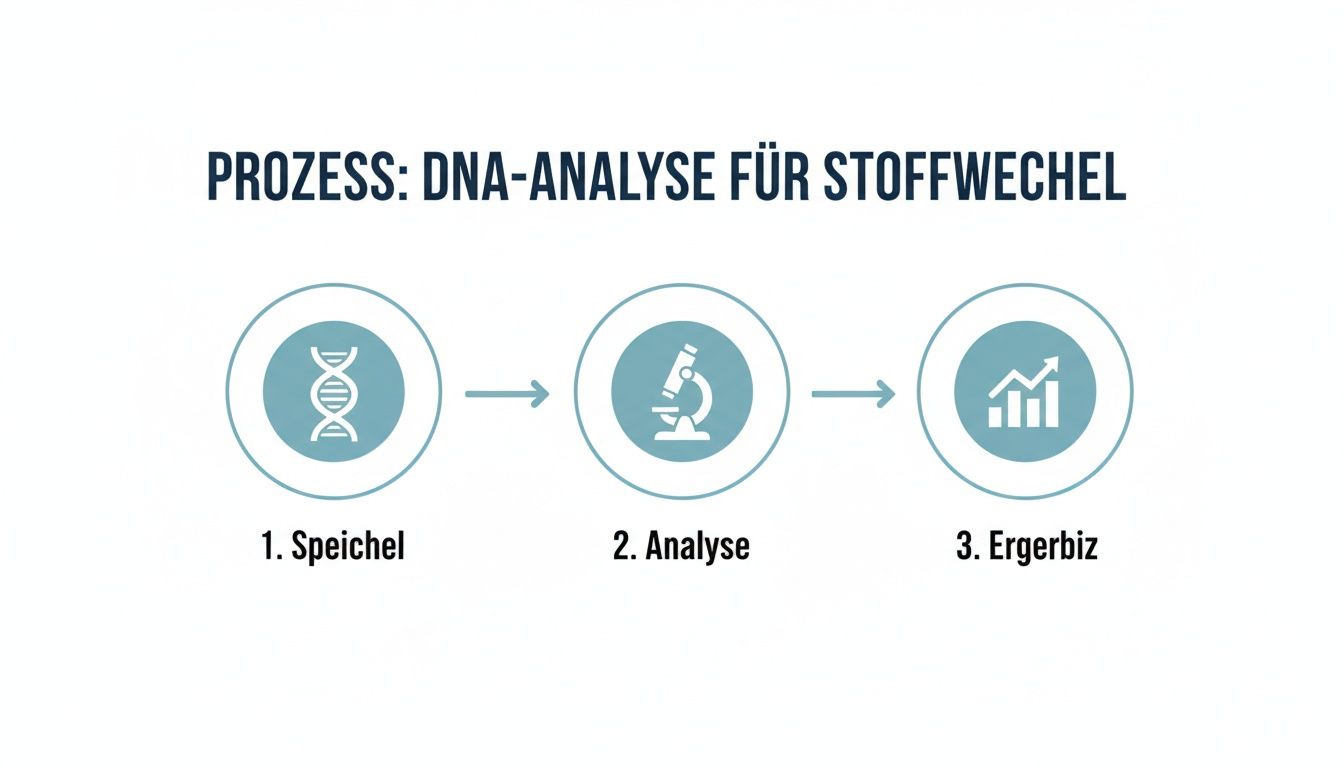
As you can see, your saliva sample becomes a valuable data set in the laboratory, forming the basis for your highly personalized recommendations.
Step 1: Collecting the sample at home
It all starts with a simple test kit delivered straight to your home. No doctor’s appointment, no complicated procedures. The kit contains everything you need: a sample tube and crystal-clear instructions.
Collecting the sample itself is incredibly easy and takes just a few minutes. You use a cotton swab to take a simple saliva sample from the lining of your mouth. It is completely painless and hygienic.
As soon as the sample is in the tube, you place it in the enclosed return envelope. From that moment on, the laboratory takes over.
Step 2: Analysis in the certified laboratory
As soon as your sample arrives at the laboratory, the scientific part begins. Your DNA is isolated from the cells in the saliva sample. This all takes place in an ISO-certified laboratory, guaranteeing the highest quality and safety standards.
Your sample is strictly pseudonymized throughout the entire process. This means that no one in the laboratory can link your personal data to your sample. Your name and sample are handled separately to ensure maximum data protection.
Specialized procedures now examine the gene variants relevant to your metabolism, such as which variant of your FTO or PPARG gene you have.
The market for personalized nutrition is growing rapidly. Providers such as mybody-x.com, a Swiss pioneer focused on the German market, have already helped more than 11,300 satisfied customers. Their GDPR-compliant analyses and money-back guarantee create trust—especially among people between 25 and 65 who are tired of endless frustration with losing weight.
Step 3: Analysis and results report
Now comes the most exciting part: The complex genetic data is translated into an understandable and actionable report. This is where pure science becomes a practical guide for your life. So you do not receive a dry laboratory report, but a detailed results report that genuinely helps you.
A good results report is more than a collection of data. It is your personal translator, explaining in clear language and with informative graphics what your genes mean for your nutrition, exercise, and well-being.
In your personal report, you will find specific instructions that you can put into practice immediately. These include, for example:
- Your optimal macronutrient distribution: You will see, in percentages, how your ideal plate should be composed of carbohydrates, fats, and proteins.
- Food recommendations: You will receive lists of foods that are particularly suitable—or less suitable—for your metabolic type.
- Sports and exercise tips: You will find out whether your body benefits more from endurance or strength training to burn fat effectively.
This report is the foundation for finally taking targeted action according to a clear plan. If you want to take a deeper look at how to structure these insights, also read our guide on how to create your individual nutrition plan.
How to apply your genetic insights in everyday life

A detailed results report is a fantastic first step. But true success only happens when you bring this knowledge into your everyday life. The good news? It’s much easier than you might think. It’s not about turning your life completely upside down, but about making targeted, smart adjustments that build on your genetic strengths.
The biggest advantage of a DNA diet test is the clarity it provides. You no longer have to guess which foods are good for you or struggle through conflicting advice. Instead, you have a clear, scientifically grounded roadmap to guide you while shopping, cooking, and planning your meals.
The key to success lies in viewing the recommendations not as rigid rules, but as personalized guidelines. They give you the freedom to get creative within your optimal framework and enjoy a diet that truly suits you and tastes good.
This shift from reactive guesswork to proactive planning makes all the difference for sustainable results.
From knowledge to action: Here’s how
Putting this into practice begins with small but effective steps. Instead of changing everything at once, focus on one or two key recommendations from your report. This could mean adjusting your macronutrients or replacing certain foods.
Let’s assume your analysis shows that you are a genetic “carbohydrate type.” This doesn’t mean you can never eat pasta again. It means learning to choose the right carbohydrates at the right time.
- Swap simple for complex: Instead of white bread, choose whole-grain bread. Instead of white rice, opt for quinoa or brown rice. These provide energy for longer and keep your blood sugar levels stable.
- Combine wisely: Always eat carbohydrates together with protein and healthy fats. An apple on its own can quickly bring your hunger back; an apple with a handful of nuts will keep you full for hours.
Or perhaps you’re a “protein type” with a predisposition to cravings, as is often associated with the FTO gene. Your strategy would then be to ensure that every meal contains a solid source of protein.
- Start the day with protein: Scrambled eggs or Greek yogurt with nuts instead of a jam roll can change your entire day. You start out feeling full and satisfied, which helps prevent cravings later in the day.
- Plan smart snacks: Keep protein-rich snacks such as a protein shake, boiled eggs, or a small cup of cottage cheese on hand to beat the afternoon slump.
These small changes add up and lead to great results without making you feel like you have to give anything up.
Your New Shopping List
Implementation starts at the supermarket. Think of your results report as your personal shopping advisor. Create a list of foods that are particularly beneficial for your metabolic type.
It is best to organize your shopping list by food groups:
- Protein sources: Chicken, fish, eggs, tofu, lentils, chickpeas, Greek yogurt.
- Healthy fats: Avocados, nuts, seeds (flax, chia, hemp seeds), olive oil.
- Complex carbohydrates: Oatmeal, quinoa, sweet potatoes, whole-grain products, legumes.
- Vegetables & fruit: Focus on a colorful variety to cover all the important micronutrients.
When your shopping basket is filled with these foods, it automatically becomes easier to make the right choices at home.
Exercise That Really Suits You
Just as with nutrition, there is no one-size-fits-all solution when it comes to exercise. Your genetics can indicate whether you respond better to endurance exercise or strength training when it comes to burning fat.
- “Endurance” type: If your genes show that you burn fat best through moderate, longer periods of exertion, activities such as jogging, cycling, or swimming are ideal for you. Plan two to three longer sessions per week.
- “Strength” type: If your analysis shows that you respond better to intense, shorter exertion, your body can benefit enormously from strength training. This does not mean that you have to become a bodybuilder. Two to three sessions per week with weights or your own body weight can sustainably boost your metabolism.
The following table gives you an overview of what implementation might look like for different metabolic types, making the theory a little more tangible.
Practical Examples for Different Metabolic Types
This table uses specific examples to show how dietary recommendations can differ for different genetic metabolic types.
| Genetic Type | Optimal Macronutrient Distribution | Example meal | Recommended type of exercise |
|---|---|---|---|
| Protein type | 40 % Protein, 30 % Fat, 30 % Carbohydrates | Grilled salmon fillet with quinoa and broccoli | Strength training, HIIT |
| Carbohydrate type | 25 % Protein, 25 % Fat, 50 % Carbohydrates | Chicken breast with sweet potatoes and a large salad | Running, cycling, swimming |
| Balanced type | 30 % Protein, 40 % Fat, 30 % Carbohydrates | Ground beef skillet with plenty of vegetables and avocado | Combination of strength and endurance training |
By translating your findings from the DNA diet test into such concrete, everyday habits, you turn scientific data into real, tangible, and above all lasting results.
What you should consider when choosing your provider
The market for the DNA diet test is growing rapidly, and it can be quite difficult to keep track of everything. However, the quality of providers varies enormously. Making a smart choice is especially important here, because your sensitive health data is at stake, as well as how effective your new dietary strategy will ultimately be.
To find a partner you can trust with your health, you should look for a few essential quality features. These criteria help you separate the wheat from the chaff and ensure that your analysis is not only scientifically sound, but that you can also genuinely use it to your advantage.
Checklist for a reputable DNA test provider
Before deciding on a test, it is best to go through this short list. A truly good provider should meet all of these criteria.
-
Certified laboratory: Your sample must be analyzed in a laboratory certified according to ISO standards. This certification is not merely a formality—it guarantees the highest scientific standards, precision, and therefore completely reliable results. It is the be-all and end-all of laboratory analysis.
-
Strict data protection: Your genetic data is extremely sensitive. Make absolutely sure that the provider not only mentions the strict requirements of the General Data Protection Regulation (GDPR), but actually complies with them. This means your data must be stored and processed securely.
-
Guaranteed data security: A reputable provider such as mybody-x.com uses pseudonymization. This sounds complicated, but it means something very simple: Your sample is assigned an anonymous code number in the laboratory. This means no one can link your personal data to your sample. Equally important is the guarantee that your biological sample will be properly destroyed after analysis.
What matters in the results report
A good results report is so much more than just a dry collection of raw data. It must translate scientific findings in a way that you understand and can immediately apply in everyday life.
A high-quality report should not only tell you what your genes say, but also why that matters to you and how you can use this information in a practical way. It is your personal roadmap, not just a laboratory report.
Make sure the report provides understandable explanations, informative graphics, and, above all, clear, actionable recommendations. Afterwards, you should know exactly which foods are optimal for you, what your ideal nutrient distribution looks like, and which type of exercise best supports you on your journey. If you would like to know how quality affects the cost, read our guide how much a DNA test costs and how to recognize a fair offer.
Transparency about the scientific basis, comprehensible recommendations, and an uncompromising focus on data privacy—these are the pillars of a trustworthy DNA test for dieting. This is the only way to be sure that you are making a valuable investment in your health.
The Limits of a Genetic Diet and What Really Matters
A DNA test for dieting is an incredibly powerful tool. It finally gives you clarity about what your body really needs. Yet, despite all the excitement about science, honesty and realistic expectations are the keys to your long-term success. So let’s talk openly about what a genetic diet can achieve—and where its limits lie.
Your genetics are the foundation on which everything is built. You could think of them as the blueprint for your body, determining how you respond to certain nutrients or exercise. But your genes are not the entire house. Numerous other factors have a massive impact on your weight, energy, and overall well-being.
A DNA test is your personal compass, pointing you in the right direction. But it is not the ship that takes you to your destination. You are the one holding the helm—through your daily decisions.
The insights from your genetic analysis are therefore the starting point, not the finish line. They do not replace healthy habits; instead, they help you find the right habits for you.
Genetics Is Not Your Destiny
A widespread misconception is the belief that our genes irrevocably determine our destiny. That is simply wrong. Your genes indicate tendencies, not immutable judgments.
Just because you carry, for example, a variant of the FTO gene associated with increased hunger, you aren’t doomed to experience constant cravings. Rather, it means you may benefit especially from following a protein-rich diet to consciously manage your feeling of fullness. Your genes provide the information; your lifestyle gives you the power to change.
The interplay with other factors
Your DNA never acts in isolation. Your body is a complex system in which everything is interconnected. To achieve truly lasting results, you need to keep the bigger picture in mind.
Here are the key players that, alongside your genetics, play a decisive role:
- Lifestyle and behavior: How much you exercise and whether you smoke or drink alcohol—these choices can amplify or reduce the influence of your genes.
- Sleep quality: Chronic sleep deprivation throws your hormonal balance completely out of sync. The hormones ghrelin (which increases appetite) and leptin (which signals fullness) are particularly affected. Even the best genetic plan can struggle to counteract the effects of too little sleep.
- Stress levels: High stress causes the release of cortisol. This hormone not only increases cravings for unhealthy foods but also promotes fat storage, especially around the abdomen.
- Gut health: Your microbiome—the community of trillions of bacteria in your gut—influences how you absorb nutrients, how your immune system functions, and even your mood. A healthy gut flora is a key building block for successful weight loss.
A DNA test for your diet isn’t a magic switch that solves all your problems overnight. Instead, think of it as the missing puzzle piece that helped you understand the bigger picture. It gives you an invaluable, personalized foundation.
True success only comes when you use these genetic insights to build a holistic lifestyle—one that truly suits you, gives you energy, and that you can maintain with enjoyment over the long term. The combination of genetic knowledge and conscious everyday choices is the key that permanently unlocks the door to better health.
Frequently asked questions about the DNA test for your diet
Are you thinking about a DNA test for your diet? Great—then you probably have a few questions. That’s a good thing, because it shows that you’re taking a thoughtful approach to your health. We’ve collected answers to the most frequently asked questions here to give you clarity.
How secure is my genetic data?
Quite simply: With reputable providers like mybody-x.com, the security of your data is the highest priority. The entire process is designed to protect your privacy from start to finish.
Your sample will be pseudonymized. This means that no one in the laboratory knows that the sample belongs to you—your name and sample are kept separate. The analysis itself is conducted exclusively in ISO-certified laboratories, and data processing follows the strict requirements of the European General Data Protection Regulation (GDPR).
Important to know: After the analysis, your biological sample will be properly and completely destroyed. You retain full control over your data at all times and decide what happens to it.
Is a DNA test a guarantee that I’ll lose weight successfully?
A DNA test is an incredibly valuable tool—so to speak, a personalized shortcut to a diet that truly works for you. But it isn’t a magic switch you can simply flip.
Ultimately, your success depends on how consistently you apply the scientifically grounded recommendations in your everyday life. Your genes provide the blueprint, but your lifestyle—exercise, sleep, and stress management—is how it is implemented. You’ll achieve the best results when you use these insights as the foundation for sustainable habits and start working with your body instead of against it.
Who can benefit most from a DNA test like this?
The test is ideal for anyone who has already given up on several diets in frustration and finally wants to understand why standard plans simply don’t work for them. It’s also perfect for health-conscious people who don’t want to leave their nutrition and fitness to chance, but instead want to optimize them based on solid data.
In short: For anyone who is tired of guessing and would rather take a preventive, proactive approach to managing their health.
How long does it take to receive my results?
The process is quite straightforward and designed to provide you with valuable insights quickly. After collecting the simple saliva sample at home and sending it to the laboratory, the analysis usually takes between two and four weeks.
As soon as your detailed results report is ready, you’ll receive a notification. You can then access your detailed, personalized evaluations online and get started right away.
Are you ready to stop guessing and discover your personal path to greater well-being? At mybody-x.com, you’ll find scientifically grounded analyses that help you truly understand your body.
Discover the DNA Metabolism Analysis now



Share now:
What is a self-test? Scientifically reliable at home
Lose Weight with a Genetic Test: Your Genetic Blueprint as the Key to Success