

Determine your metabolic type: Your at-home DNA guide
Why some people seem to be able to eat anything
Do you know them too? Those friends who seem to devour kilos of pizza, pasta, and chocolate and still remain slim. While you think twice about every bite and still struggle with your weight. The secret? It often lies not in magical willpower, but in your individual metabolic type. Some people simply process carbohydrates better, while others process fat or protein better. That is why the same miracle diet works for your friend but not for you at all. The following infographic shows the distribution of the different metabolic types: ectomorph, mesomorph, and endomorph.
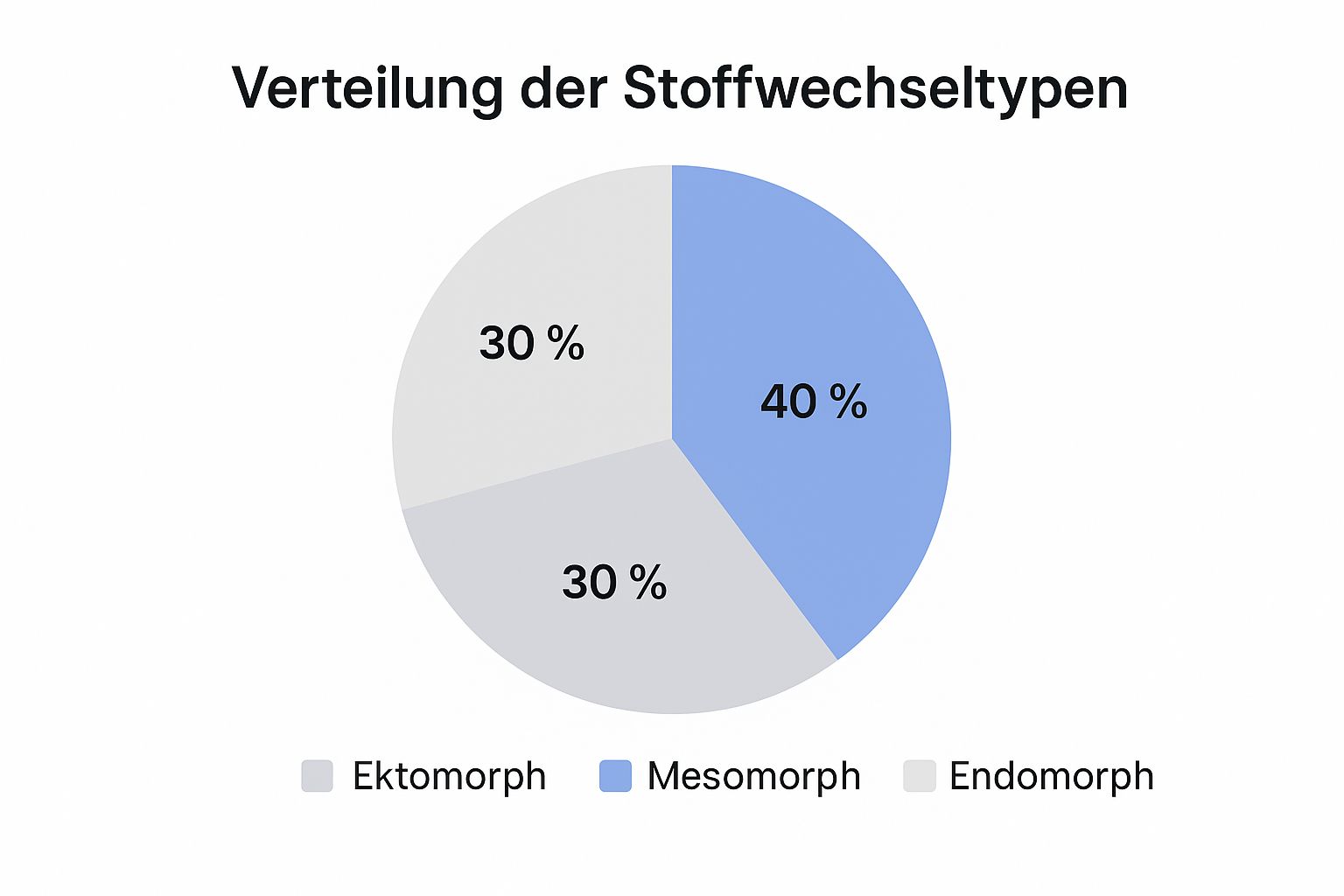
As you can see, the mesomorph type is the most common at 40%, while ectomorphs and endomorphs each account for 30%. These different metabolic types also explain why many people struggle with their weight and why personalized nutrition is becoming increasingly important. Losing weight is a major topic in Germany: Almost one in two people would like to lose a few kilos for health or personal reasons. In 2022, 49 percent of Germans went on a diet. More on weight-loss trends in Germany.
When you know your metabolic type, you understand how your body really works. Instead of working against it, you can optimally adapt your diet and training. Imagine that your friend tolerates carbohydrates extremely well, while you feel sluggish and tired after a plate of pasta. Perhaps you are a protein type and need more protein. Or your body may process fats particularly well.
Understanding your metabolism
By understanding your metabolic type, you can find the eating pattern that is perfect for you and helps you achieve your goals. This could mean finally losing weight without constant hunger, feeling more energetic in everyday life, or achieving better performance in sports.
Here is a table comparing the different metabolic types and their characteristics:
Comparison of metabolic types
Overview of the different metabolic types and their characteristic features
| Metabolic type | Macronutrient preference | Typical characteristics | Best nutrition strategy |
|---|---|---|---|
| Ectomorph | Carbohydrates | Slim build, fast metabolism, struggles to gain weight | A balanced diet with sufficient carbohydrates for energy |
| Mesomorph | Balanced | Muscular build, moderately fast metabolism, gains or loses weight relatively easily | A balanced diet with moderate amounts of all macronutrients |
| Endomorph | Fat | Sturdy build, slow metabolism, gains weight easily | A diet with reduced carbohydrates and a focus on healthy fats and proteins |
This table provides an initial overview. Of course, every person is individual, and there are mixed types. It is therefore worth exploring the subject in greater depth and learning more about the various ways of determining metabolic type, for example through questionnaires, laboratory tests (DNA, microbiome, nutrient checks), and their evaluation.
At-home DNA tests: A saliva sample with a major impact
Determining your metabolic type doesn’t have to be complicated. Forget doctor’s appointments and long waiting times—with modern DNA tests, you can do it conveniently from home. A simple saliva sample is all it takes to analyze more than 30 relevant genes that influence metabolism. Reputable providers examine variants such as the FTO gene, which is responsible for feelings of satiety, or APOA2, which regulates the body’s response to saturated fatty acids.

Such a report provides detailed insights into individual genetic predispositions and helps with interpreting the test results. The analysis usually takes 2–3 weeks. You then receive a comprehensive report detailing your personal genetic characteristics. Good tests generally cost between 80–150 euros. I would personally be somewhat more cautious with cheaper offers. Anyone who wants to learn more about DNA metabolic analysis can find further information here: Understanding DNA Metabolic Analysis.
The results show not only the metabolic type but also provide indications of which vitamins the body may absorb less effectively or how it responds to exercise. From my own experience, I can say: This information is worth its weight in gold for tailoring nutrition and training individually.
It is also important to remember that a DNA test shows your genetic predisposition, not an inevitable fate. It provides valuable information that can help determine your metabolic type and optimize your diet. Factors such as exercise, sleep, and stress also play an important role in overall well-being.
Blood Tests and Biomarkers: Your Current Metabolic Status

DNA tests such as the one from MYBODY Lab GmbH provide information about our genetic predisposition, but blood tests show the current state of affairs—a snapshot of your metabolism. They show how your body is working right now. Fasting blood glucose and HbA1c are particularly informative. They reveal how well your body processes carbohydrates.
The HOMA index can also provide indications of possible insulin resistance. This is particularly important if you want to lose weight. The thyroid levels (TSH, T3, T4) also play an important role, as they have a major influence on our basal metabolic rate. Inflammatory markers such as CRP can also reveal hidden inflammation that slows down the metabolism.
In Germany, nutrition and metabolism are becoming increasingly important topics. Research into metabolic diseases such as obesity is a key focus. The Robert Koch Institute reports that 53 percent of women and 67 percent of men in Germany are overweight. More information about metabolic research.
Microbiome analysis using a stool sample is also becoming increasingly interesting. This is because the composition of our gut bacteria has a major influence on how well our bodies process nutrients. Many of these tests can be carried out directly by a family doctor or in a laboratory. Depending on the scope, the cost ranges from 50 to 200 euros.
Microbiome Analysis: The Secrets of the Gut
Microbiome analysis gives us insights into the fascinating world of our gut. Trillions of bacteria live there, influencing our digestion and metabolism. Dysbiosis, or an imbalance in the gut flora, can lead to various problems, such as difficulty losing weight. The analysis helps us identify targeted measures for better gut health and an optimized metabolism.
How to interpret blood test results correctly
Blood test results should always be discussed with a doctor or nutritionist. This helps put the results into the context of your personal medical history and circumstances. A single value often doesn’t say much. What matters is the overall picture and how the different values relate to one another.
Self-tests: Learn to understand your body without a laboratory

Sometimes our body knows best what is good for it. We just need to learn to pay attention to the signals. Before undergoing expensive lab tests to determine your metabolic type, you can first try a simple macronutrient self-test. Over 3–4 weeks, this can provide valuable insights into how your body responds to different nutrients.
The test takes place in three phases, during which you focus on one macronutrient for a week at a time: carbohydrates, proteins, and fats. In the first week, the focus is on carbohydrates; in the second week, proteins; and in the third week, fats. Don’t worry—you don’t have to follow an extreme diet! The goal is simply to focus on the respective macronutrient.
How to conduct the self-test
The most important thing during the test: Pay close attention to how you feel! Observe your energy level, mood, and hunger after meals. Do you feel tired after pasta for lunch? Does a protein-rich breakfast keep you full for a long time? Such observations are worth their weight in gold! You can find more information about nutrigenetics and how our genes influence our diet here: What Is Nutrigenetics and How Does It Determine Our Lives?
A food diary can help you identify patterns. Don’t just write down what you eat, but above all, how you feel afterward. This isn’t about counting calories, but about understanding your body’s signals.
Pay close attention to how your body reacts to certain foods. Do you experience an energy crash after eating pasta? Do you feel focused and capable after a high-fat dinner? This self-observation costs nothing and often provides surprisingly clear results.
To document the results of your self-test, you can use the following table:
Self-Test Protocol for Metabolic Types
Structured Plan for Conducting Self-Tests to Determine Metabolic Type
| Test Week | Macronutrient Focus | To Observe | Documentation |
|---|---|---|---|
| 1 | Carbohydrates | Energy level, mood, feeling of hunger, digestion | Detailed Notes in the Food Diary |
| 2 | Proteins | Energy level, mood, feeling of hunger, feeling of fullness | Detailed Notes in the Food Diary |
| 3 | Fats | Energy level, mood, concentration, feeling of hunger | Detailed Notes in the Food Diary |
This table helps you structure your observations during the self-test and evaluate them later. At the end of the test, you can more easily identify which macronutrient gives you the most energy and how your body responds to different nutrients. This is the first step toward tailoring your diet optimally to your needs.
Turning Test Results into Your Personal Nutrition Plan
You have determined your metabolic type and are now wondering how to put it into practice? The results of your test—whether DNA, blood, or self-test—form the basis of your personal nutrition plan. But don't panic; this isn't about completely turning your life upside down.
Imagine Julia. Her DNA test from MYBODY Lab GmbH showed that she does not process carbohydrates optimally. Instead of eliminating all carbohydrates, she adjusted her diet step by step. She now eats them mainly after exercising, when her body can use them best. She has also added more healthy fats and protein. The result: More energy and 8 kilos less without starving herself.
Or think of Marcus. His blood results indicated early insulin resistance. He responded by eating more fiber and distributing his meals differently throughout the day. His levels normalized after just a short time. Would you like to know how DNA tests can improve nutrition? Read more here.
The trick is to make small but regular adjustments. Instead of changing everything at once, start with one small thing per week. This way, you can see what works well for your body. Apps like MyFitnessPal or Cronometer can help you keep track of your macronutrients.
Conflicting results? No problem!
Sometimes different tests produce different results. That is completely normal! Every body is unique, and what works for one person will not necessarily work the same way for another. Pay attention to your body and choose the approach that makes you feel most comfortable. Your well-being is the best measure of a successful change in diet.
Common pitfalls when determining your metabolic type
Determining your metabolic type is currently very popular. But beware: There are also some pitfalls. Overpriced tests and dubious providers often promise the impossible. Tests costing less than 50 euros, for example, are a warning sign. Reputable genetic testing comes at a price. The absence of a legal notice or an attempt to immediately sell you expensive dietary supplements is also suspicious.
Speaking of dietary supplements: The use of such products and weight-loss aids is quite widespread in Germany, probably also because of the desire to optimize metabolism. In 2021, 0.33 million Germans used weight-loss aids daily or almost daily. More than half of those over 16 take dietary supplements. More information about weight-loss aids.
The interpretation of the results is not always easy either. Many people expect a clear metabolic type—carbohydrate, protein, or fat type. But reality looks different: Most of us are mixed types. Metabolism is dynamic and changes with age, stress, and hormones. Blindly relying on a test while ignoring influencing factors such as sleep, stress, and medication is a common mistake.
Professional help: When is it necessary?
If you notice no change after 4–6 weeks of consistently changing your diet, seeking professional help may be worthwhile. A nutritionist or doctor can support you. Sometimes persistent metabolic problems are caused by thyroid disorders or other health issues. Also read: Can a DNA test help with weight loss? An expert can help you identify the cause and develop the right strategy.
Your sustainable path to a healthy metabolism
So, you’ve determined your metabolic type. Great! Now it’s about integrating it into your everyday life and benefiting from it in the long term. The key? Sustainable habits that truly fit your life. Forget crash diets—we want a holistic approach that puts you and your well-being at the center.
What has always helped me personally is to start with a clear, positive goal. Instead of “losing weight,” you could aim to “feel energized after eating” or “get through the day without cravings,” for example. That’s much more tangible and motivates you to stick with it. Believe me, positive wording makes a huge difference!
Meal planning: Your secret recipe for stress-free weeks
I plan my meals for the entire week over the weekend. It may seem time-consuming at first, but it saves a tremendous amount of time and stress in everyday life. And as an added benefit, it helps you avoid unhealthy impulse purchases. Keep your metabolic type in mind and choose foods that are good for you. For example, if you know that you don’t tolerate carbohydrates very well, simply plan low-carb dishes with more healthy fats and protein.
Your food journal: Focus on well-being
Keep your food journal, but instead of counting calories, focus on how you feel. Do you feel energized or tired after eating? Do you experience cravings? This will quickly help you find out which foods are good for you and which aren’t.
Redefining success: More than just the number on the scale
Sure, the scale can be a useful indicator. But what matters much more is how you feel! Pay attention to your energy levels, sleep quality, and mood. If you feel fit, balanced, and in a good mood, you’re on the right track!
Metabolism check: Make adjustments from time to time
Your metabolism isn’t static; it’s constantly changing. That’s why you should review and adjust your strategy every 4–6 weeks. Listen to your body—it knows what it needs.
Healthy together: Motivation for the whole family
Involve your family! When everyone benefits from a healthy diet, it’s much easier to stay on track and motivate one another.
And remember: It’s not about perfection, but about sustainable progress. Small steps will lead you to your goal. It’s best to start today and discover the benefits of personalized nutrition with MYBODY Lab GmbH.



Share now:
Essential Nutrients Under Review: The Most Common Nutrient Deficiencies in Germany and What You Can Do
Personalized nutrition through epigenetics: How to eat right for your genes