

What are trans fats, and how do they really harm you?
You have probably heard of “trans fats,” usually in hushed tones and in connection with fast food, chips, or baked goods. But what exactly are they, and why are they such an important issue for your health?
Put simply: Trans fats are unsaturated fatty acids whose chemical structure has been altered. This change makes them a real problem for our bodies. Most of them are formed when liquid vegetable oils are industrially hydrogenated to make them spreadable and extremely shelf-stable.
What trans fats really are, simply explained
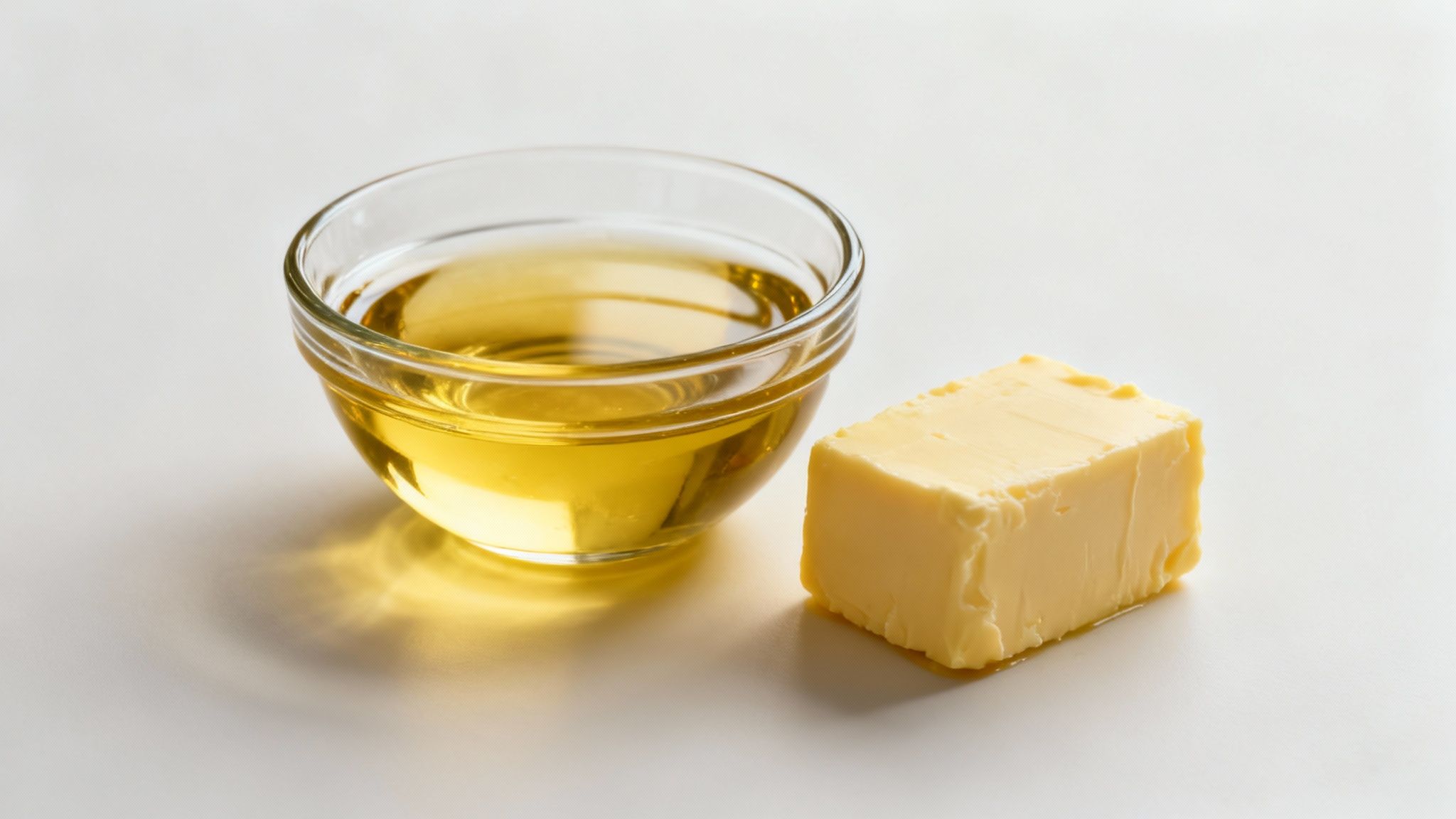
Imagine the fats in your body as precision-made building blocks. For everything to run smoothly, they need to fit together perfectly. Healthy, unsaturated fats naturally have a slightly bent shape. This makes them flexible—ideal for mobile cell membranes and a healthy metabolism.
Industrial trans fats are different. They have an unnatural, rigid, straight structure. You could compare them to a bent key that no longer fits the lock. Instead of carrying out their functions in the body, they block important processes and can lead to serious health problems over time.
Trans fats at a glance
Here is a quick overview summarizing the key properties of trans fats:
| Characteristic | Description |
|---|---|
| Formation | Mainly produced through the industrial hydrogenation of vegetable oils |
| Structure | Rigid, unnatural shape compared with healthy fats |
| Industrial benefits | Makes products shelf-stable, heat-resistant, and optimized for texture |
| Occurrence | In fried foods, baked goods, ready meals, margarine |
| Health | No benefit; increases the risk of cardiovascular disease |
In short: They are practical for industry but problematic for your health.
Why the food industry (used to) love them
For a long time, trans fats were an absolute win for food manufacturers. Through so-called partial hydrogenation, cheap vegetable oils were transformed into solid fats with unbeatable advantages:
- Extreme shelf life: Cookies, crackers, and ready meals stayed fresh and crisp for weeks.
- Perfect consistency: They provided the delicate texture in croissants or the creamy quality in spreads.
- High heat resistance: Ideal for frying, as they can withstand high temperatures without becoming rancid.
These properties made them a standard ingredient in countless processed foods. However, the health cost is high, because your body simply does not know what to do with these artificial fats.
The recommended upper limit is tiny
Health organizations around the world agree: trans fats provide no health benefits whatsoever. On the contrary, they can significantly disrupt your fat metabolism.
The World Health Organization (WHO) recommends limiting trans fat consumption to less than 1% of daily energy intake.
With an average diet of 2,000 calories per day, this amounts to a tiny 2.2 grams. This amount is reached astonishingly quickly—often with just one Berliner or a serving of deep-fried French fries.
This knowledge is precisely the first step toward understanding why taking a close look at the ingredients list is so important. It is the only way to make informed decisions for your health.
The difference between natural and industrial trans fats
 When we talk about “trans fats,” many people lump everything together. But that is a mistake. To truly understand what is in your food, you need to know one crucial distinction: there are natural and artificially produced trans fats.
Your body reacts to the two types in completely different ways. This knowledge is the key to making the right choices for your health at the supermarket.
In fact, nature itself produces trans fats, although only in small amounts. They form in the rumen of ruminants—such as cows, sheep, and goats—through normal bacterial processes. That is why you find natural trans fats in foods such as butter, cheese, beef, and lamb.
Based on current knowledge, these natural variants do not appear to have nearly the same harmful effects as their industrial counterparts when consumed in the usual small amounts.
The artificial danger from the factory
The real danger that health experts have been warning about for years lurks in industrially produced trans fats. These are the result of a chemical trick known as “partial hydrogenation.” In this process, liquid vegetable oils are combined with hydrogen under high pressure and intense heat to make them solid and spreadable.
This process twists the chemical structure of fatty acids in an unnatural way. The result is the problematic trans fatty acids your body can barely use.
The purpose of industrial hydrogenation was simple: to turn cheap vegetable oils into shelf-stable, texture-enhancing fats for baked goods, frying fats, and ready meals. But your health pays the price.
These fats used to be found almost everywhere. Until 2013, the average daily intake of trans fats in Germany was around 1.6 grams per day—a figure attributable almost exclusively to industrially processed foods. You can find more information about the situation at the time in the technical information from the German Nutrition Society.
Why the difference matters so much
The crucial factors are therefore the source and, above all, the amount. While natural trans fats are considered harmless in moderation, industrial variants are the real villains when it comes to your cardiovascular system.
Here are the key differences at a glance:
- Formation: Naturally in the rumen of ruminants vs. artificially through the industrial hydrogenation of vegetable oils.
- Amount: Low concentrations in meat and dairy products vs. often high concentrations in highly processed foods.
- Health effects: No clear negative effects have yet been demonstrated for natural trans fats vs. proven harmful effects on the heart and circulatory system from industrial trans fats.
But it’s not just about trans fats. A general imbalance between different types of fatty acids can also put strain on your body. That’s why it’s smart not to focus on just one type of fat, but to keep the bigger picture in mind. If you’d like to learn more about how important the right fats are for you, read our article about omega-3 fatty acids.
How trans fats endanger your heart health
Now things get serious. We know that industrial trans fats are problematic—but why exactly? Just imagine your blood vessels as an elaborate network of tubes that supplies every single cell in your body with everything it needs. Industrial trans fats act like small saboteurs here, causing trouble in two crucial areas at once.
Their main target: your cholesterol levels. They disrupt the delicate balance between “bad” LDL cholesterol and “good” HDL cholesterol. And it is precisely this double negative effect that makes them a real threat to your cardiovascular system.
The double blow to your cholesterol
First of all, trans fats increase LDL cholesterol (low-density lipoprotein). You may know it as “bad” cholesterol, and for good reason. It tends to build up on the inner walls of your arteries. Over time, these deposits, also called plaques, can harden, narrow the blood vessels, and obstruct blood flow. This increases the risk of heart attacks and strokes.
At the same time, they do something else: They lower HDL cholesterol (high-density lipoprotein). This is the “good” cholesterol, which plays an important protective role. Think of it as a kind of garbage collection service for your arteries. It collects excess cholesterol and transports it to the liver, where it is broken down. When your HDL level drops, this important cleaning process no longer works properly.
This two-pronged attack—more harmful LDL and less protective HDL—is at the heart of the problem. If you’d like to learn more about how you can positively influence your cholesterol levels, take a look at our guide to lowering LDL cholesterol.
The following graphic makes it immediately clear how strongly even small amounts of trans fats affect your blood lipid levels and disease risk.
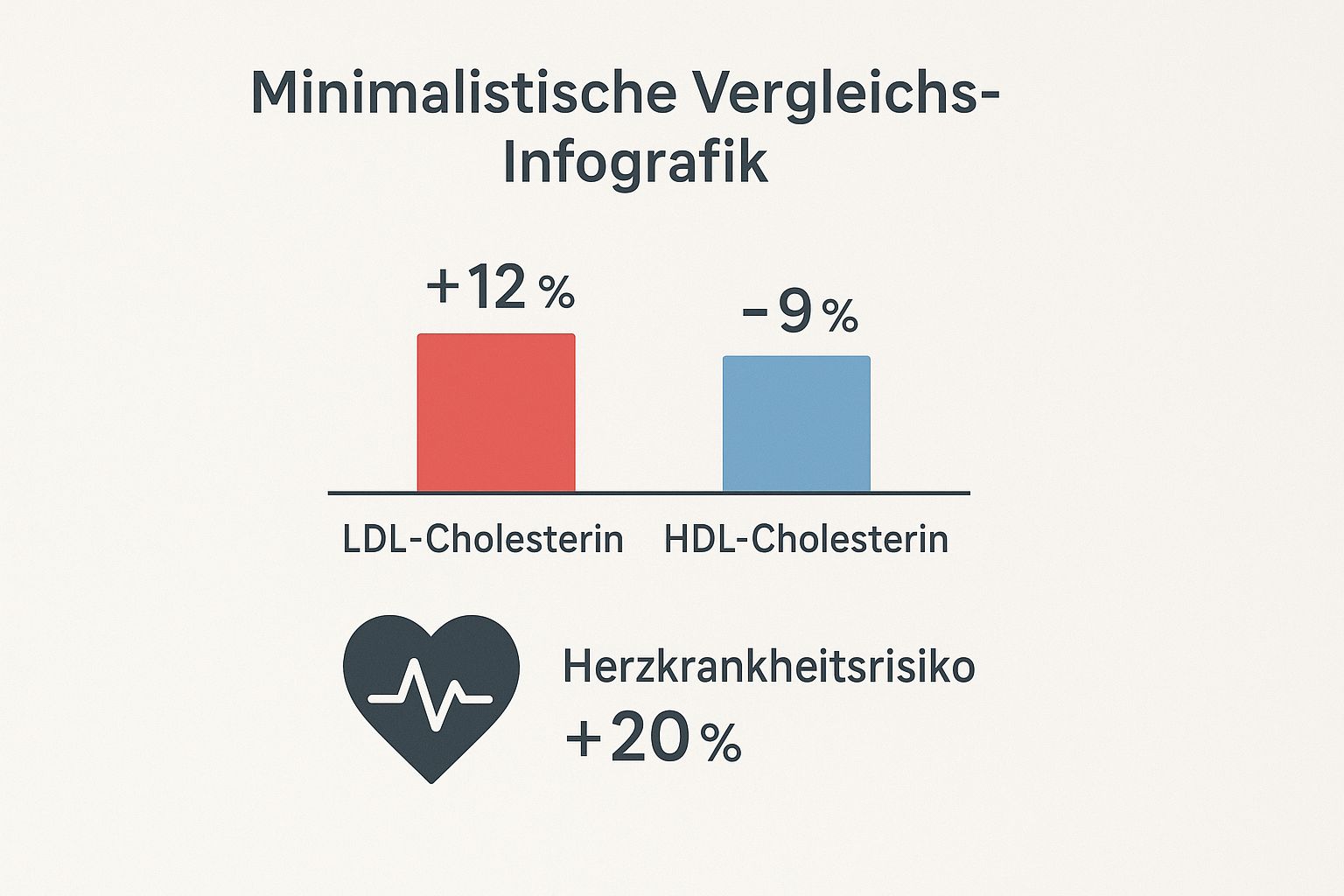
The data speaks clearly: Even low consumption of trans fats significantly worsens blood lipid levels and substantially increases the risk of heart disease.
More Than Just a Heart Problem
However, the harmful effects of trans fats do not stop at the heart. They can trigger negative chain reactions throughout the body.
- Promoting inflammation: Industrial trans fats can fuel chronic, low-grade inflammation in the body. These “silent inflammations” are considered a risk factor for many lifestyle-related diseases.
- Insulin resistance and diabetes: There is evidence that high trans fat consumption makes cells less sensitive to insulin. This can lead to insulin resistance, a direct precursor to type 2 diabetes.
- Damage to cell membranes: The rigid, unnatural structure of these fats can impair the flexibility and function of your cell walls. This, in turn, disrupts important metabolic processes.
The message is clear: Your body has absolutely no use for industrial trans fats. Every gram you avoid is a gain for your long-term health.
This knowledge is crucial. It’s not about forbidding yourself everything, but about making conscious choices about foods that nourish your body instead of burdening it. In the next section, we’ll show you exactly where the culprits are hiding in the supermarket.
Where trans fats hide in the supermarket

So, now you know how dangerous industrial trans fats can be for your heart. But where exactly are they hiding? The next step takes us straight to the supermarket—for that is precisely where these unhealthy fats are masters of disguise.
They often hide in products where you would least expect them. Consider this section your personal shopping compass. It will teach you to spot the traps and confidently steer around them.
The usual suspects on the shelves
Some supermarket aisles are veritable minefields for trans fats. This is simply because hydrogenated fats give many products exactly the qualities that make them so popular: a long shelf life, a crispy texture, or a wonderfully creamy consistency.
Be especially vigilant with these product groups:
-
Baked goods & sweets: Industrially produced donuts, croissants, cookies, and puff pastries are the classics. Many cake icings and creamy fillings also often contain hydrogenated fats to remain stable.
-
Ready meals & frozen foods: From frozen pizza and breaded fish sticks to quick instant soups, trans fats can be hidden anywhere long shelf life and easy preparation are desired.
-
Fried foods & snacks: Frozen French fries, many potato chips, and even microwave popcorn are often fried or prepared in partially hydrogenated fats. The reason: These fats are extremely heat-stable and inexpensive.
-
Margarines & spreads: Although a lot has changed in this area, some inexpensive margarines or specialty baking fats still contain hydrogenated vegetable fats as a base.
Although initiatives to reduce trans fats have existed since 2012, Germany still has no national law of its own with clear limits. At least since April 2021, an EU-wide regulation has limited the amount to a maximum of 2 grams of industrial trans fats per 100 grams of fat in the product. If you are interested, you can find more information about the legal status of trans fatty acids here.
Your most important tool: The ingredients list
Since manufacturers in the EU are not required to explicitly list trans fats in the nutrition table, the ingredients list on the back of the packaging becomes your best friend. This is where you can uncover hidden fats.
Look out for terms such as “hydrogenated vegetable fat” or “partially hydrogenated vegetable fat”. These phrases are the surest indication that industrial trans fats are involved.
A simple rule of thumb helps: The higher up one of these ingredients appears on the list, the greater its proportion in the product. And generally speaking, the shorter and easier-to-understand the ingredients list, the better.
Finding and enjoying smart alternatives
The best protection is, of course, to choose fresh, unprocessed foods as often as possible and cook for yourself. But we all know that sometimes, everyday life calls for something quick. For those moments, the following overview helps you make better choices at a glance.
Typical foods with a high potential for trans fats
A comparison of risky products and healthier alternatives.
| Product category | High-risk examples | Better alternatives |
|---|---|---|
| Baked goods | Industrial croissants, doughnuts, puff pastry | Whole-grain bread, homemade cake made with rapeseed oil, oat cookies |
| Snacks | Potato chips, crackers, microwave popcorn | Nuts, vegetable sticks with hummus, rice cakes |
| Spreads | Cheap margarine, shortening | Butter in moderation, avocado, nut butter, high-quality plant-based spreads |
| Ready meals | Frozen pizza, breaded products, ready-made soups | Home-cooked meals, fresh salads, plain yogurt |
When you replace these risky products with smart alternatives, you're not only doing your heart a huge favor. Overall, you'll feel fitter, more energized, and simply better.
Practical tips for a low-trans-fat diet
Theory is all well and good, but real change happens in your kitchen. Avoiding trans fats may sound like a science in itself, but with a few clever steps, it really isn't. It's not about giving up everything, but simply making more mindful and better choices for your body.
The most effective way to regain control is actually very simple: cook for yourself. When you work with fresh, unprocessed ingredients, you know exactly what ends up on your plate. This lets you avoid hidden trans fats from the outset and gives your body what it really needs—valuable nutrients instead of problematic industrial substances.
Choosing the right fats for your kitchen
Choosing the right oil is really crucial. Not every fat is suitable for every temperature, and when heated, unstable oils can oxidize and form unhealthy compounds.
Here are a few simple recommendations for everyday life:
- For cooking over medium heat: Extra-virgin olive oil or rapeseed oil are excellent choices. Both are relatively heat-stable while also providing valuable unsaturated fatty acids.
- For salads and cold dishes: Cold-pressed oils such as flaxseed oil, walnut oil, or hemp oil are the stars here. They are packed with delicate omega-3 fatty acids and should therefore never be heated.
- For searing or deep-frying: When the pan needs to get really hot, it’s best to use special high-heat cooking oils (e.g., rapeseed oil) or clarified butter, also known as ghee.
When you use the right fats for the right purpose, you not only minimize the risk of accidentally producing trans fats but also actively do something good for your health. After all, a balanced diet is one of the most important building blocks for a long, healthy life. You can find out more in our article on longevity nutrition.
Smart snacks instead of convenience foods
We all know it: that little hunger between meals is often the biggest trap. Instead of reaching for cookies, crackers, or other convenience snacks that are often packed with hydrogenated fats, you can whip up delicious and nutritious alternatives with very little effort.
A smart snack doesn’t just satisfy hunger—it also provides your body with energy and nutrients. It’s a conscious choice for your well-being, not a last resort.
Why not try these ideas at home or on the go:
- A handful of unsalted nuts such as almonds or pistachios.
- Vegetable sticks (carrots, cucumbers, bell peppers) with a delicious hummus dip.
- An apple with some nut butter.
- Plain yogurt with fresh berries and a few oats.
These small habits make a huge difference in the long run. This way, you not only avoid trans fats but also reduce sugar and unnecessary additives along the way. You’re taking active responsibility for your health—one bite at a time.
Still have questions about trans fats? Here are the answers.
We’ve now learned quite a bit about trans fats—what they are, where they lurk, and how to avoid them. But experience shows that a few very specific questions often remain at the end. Let’s clear those up now so you can feel truly confident when it comes to handling fats.
Are the natural trans fats in dairy products also a problem?
The good news is that there’s no cause for alarm here. Based on current knowledge, the natural trans fats found in small amounts in milk, cheese, or beef seem to have not the same harmful effects as the industrial varieties.
This is partly due to the much lower concentration, but also to their slightly different chemical structure. Official health recommendations therefore clearly target artificially produced trans fats. A yogurt or a piece of cheese is absolutely no cause for concern.
How can I identify trans fats if they are not listed separately?
This is actually the trickiest part, because in the EU, trans fats do not have to be listed separately in the nutrition table. Your most important tool therefore remains the ingredients list on the back.
Be sure to look out for these two telltale phrases:
- “hydrogenated vegetable fat”
- “partially hydrogenated vegetable fat”
If you come across either of these terms, it is a clear warning sign. As a rule of thumb, the longer and more complicated the ingredient list of a highly processed product is, the more likely it is to contain unhealthy fats.
The easiest way to avoid trans fats? Choose fresh, unprocessed foods. This gives you full control over what ends up on your plate.
Can trans fats also form when frying at home?
Theoretically, yes, but the context is crucial here. If you heat certain vegetable oils to very high temperatures, especially repeatedly—as happens when deep-frying in a fryer—tiny amounts of trans fats can indeed form.
For ordinary pan-frying, however, these amounts are so minimal that they are not comparable to industrial processes. To be completely safe, use heat-stable fats such as rapeseed oil or a special frying oil, and avoid heating the oil so much that it starts to smoke.
Is there an amount of trans fat that is still considered safe?
The answer from health organizations such as the WHO is unambiguous: No. Industrial trans fats have no health benefits whatsoever, which is why there is no safe limit.
The recommendation is to bring your intake as close to zero as possible. Your body simply does not need these artificial fats. So instead of worrying about limits, it is much wiser and healthier to consistently remove processed foods containing hydrogenated fats from your diet.
Your body is unique, and your metabolism has very individual needs. If you want to understand which fats and nutrients are best for you personally, the analyses from mybody-x.com can provide valuable insights. Discover with a DNA metabolism test how you can tailor your diet to your genetic predisposition to achieve your health goals effectively.



Share now:
Low-Carb Diet: Your Simple Guide to Getting Started
Understand and positively shape the aging process