

Why Am I Not Losing Weight Despite Exercising? Your Body, Your Rules
Do you exercise regularly and feel fitter, but the number on the scale simply does not change? Many people know this frustrating feeling. The quick answer is often sobering: Exercise alone is not enough, because your body is a clever adapter, and the scale does not tell the whole truth about your progress.
Understanding the Paradox on the Scale
Welcome to your journey toward solving the mystery of the stagnant scale. If you are asking yourself, “Why am I not losing weight despite exercising?”, you have come to the right place. It is a widespread misconception that more training automatically leads to less weight. Usually, it is a combination of overestimated calorie expenditure, unconscious eating habits, and your body’s smart adaptive mechanisms.

The Most Common Stumbling Blocks at a Glance
Many of us fall into the same traps when it comes to losing weight. The reward snack after a workout or misjudging how many calories you have actually burned are absolute classics. Exercise can also stimulate your appetite, which can quickly lead you to unknowingly consume the calories you burned—and sometimes even more—again.
Your body always strives for balance, known as homeostasis. When you burn more energy through exercise, it tries to compensate by increasing your feeling of hunger or reducing your everyday activity.
This compensatory mechanism is a common but often overlooked reason why weight-loss results fail to materialize. Scientific findings also confirm this. A 2022 study by the Technical University of Munich (TUM) involving 81 overweight women showed exactly that: Training three times a week for 30 minutes without changing their diet led to no weight loss. In fact, 55 percent gained weight, presumably because they unconsciously ate more after exercising. You can read more about these fascinating study results in detail here.
To make the most common reasons more tangible for you, I have summarized them in a table.
Typical Reasons for Weight Stagnation Despite Exercise at a Glance
This table summarizes the most common reasons why the scale remains stagnant despite training and gives you an initial indication of the solution.
| Problem | Brief explanation | Possible solution |
|---|---|---|
| Overestimated calorie expenditure | Fitness trackers and gut feelings are often inaccurate. You eat more than you burn. | Make a realistic assessment through tracking and focus on nutrition. |
| Unconscious compensation | Your body conserves energy in everyday life or increases your appetite after exercise. | Consciously increase your everyday movement and eat mindfully. |
| Poor nutrition | Too many processed foods, hidden sugar, or the wrong nutrients. | Focus on whole, nutrient-rich foods. |
| Muscle growth | Muscle is denser than fat. You lose fat but build muscle—the scale remains stagnant. | Use a measuring tape and pay attention to how you feel instead of focusing only on the scale. |
| Water retention | After intense training, your body may retain water, temporarily increasing your weight. | Be patient, drink enough water, and schedule recovery periods. |
| Hormonal factors | Stress (cortisol), thyroid problems, or other hormonal imbalances can block fat burning. | Stress management, good sleep, and, if necessary, medical evaluation through hormone testing. |
| Sleep deprivation | Too little sleep disrupts appetite-regulating hormones and increases cravings. | Make getting 7–8 hours of quality sleep a priority. |
This overview shows that weight is just a number and is influenced by many factors.
What really matters for losing weight
To break through the plateau, you need a holistic view of your lifestyle. It’s not just about how much you move, but above all also about what and how you eat, how well you sleep, and how you manage stress.
This article is your personal guide. We uncover the real reasons behind your lack of progress and provide scientifically backed, immediately actionable solutions. We’ll take a close look at:
- The truth about calorie balance: Why nutrition accounts for around 80% of your success.
- The muscle-fat myth: Why muscle can manipulate the scale and why that is actually a great sign.
- Invisible opponents: How hormones, stress, and sleep can sabotage your progress.
- Your personal genetics: How your body naturally works and how you can use this knowledge to your advantage.
Together, we’ll find out how you can finally see the results you deserve.
The truth about calorie balance
Think of your body as a simple energy account. Everything you eat deposits calories. Everything you do—breathe, think, move—withdraws calories. Weight loss happens precisely when you withdraw more than you deposit. Sounds simple, right? This principle is called a calorie deficit.
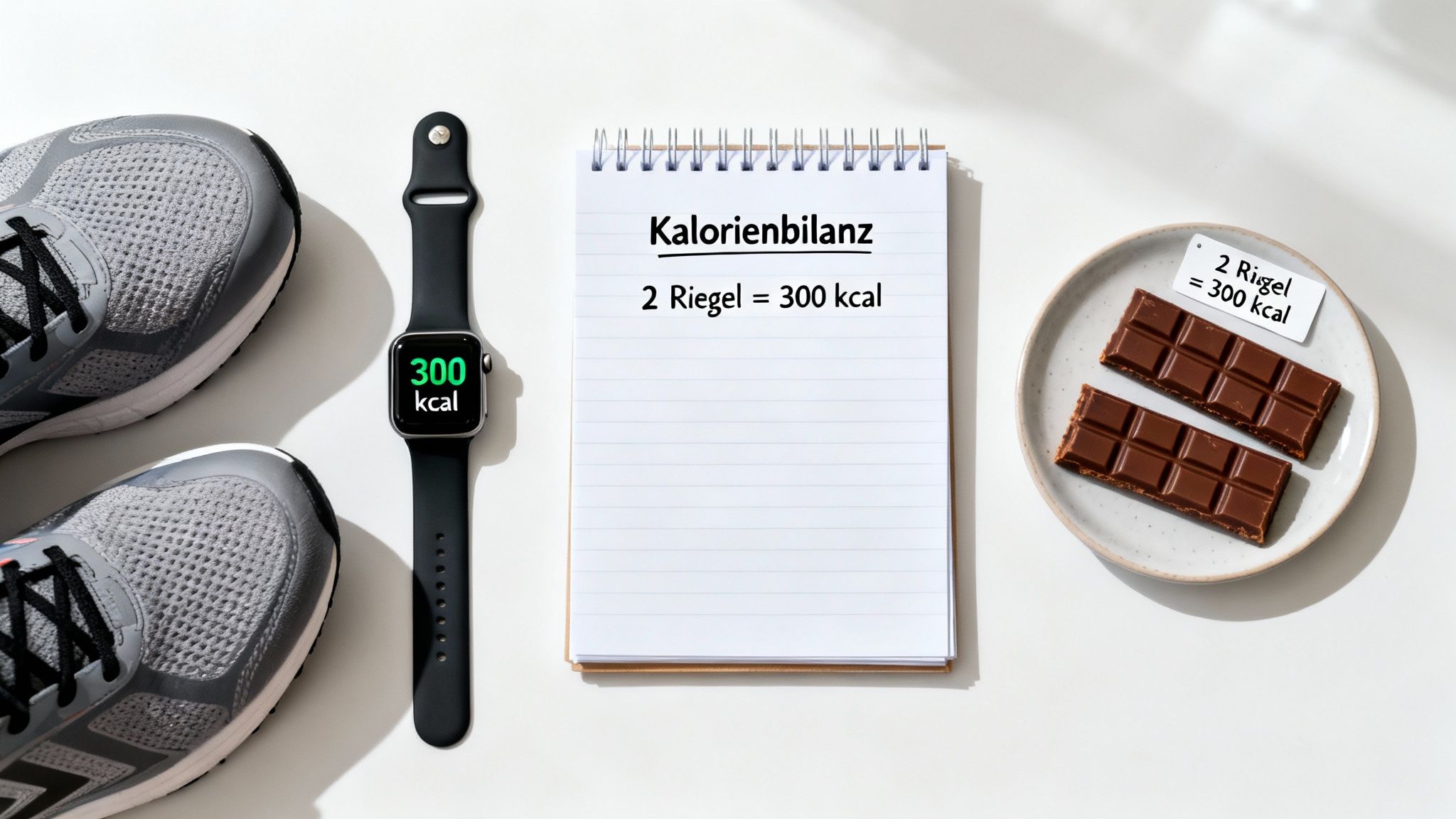
As important as exercise is for your health, well-being, and muscle development, your diet ultimately accounts for around 80% of your weight-loss success. Why? Because it’s infinitely easier to eat calories than to painstakingly work them off again.
The illusion of calorie burn
Let’s be honest: We all tend to massively overestimate how many calories we burn during exercise while completely underestimating the calories in small snacks. A 30-minute run burns perhaps 300 calories, depending on your pace and body weight. It feels like a huge accomplishment.
Unfortunately, reality is sobering. All that effort can be undone in just a few minutes by two small chocolate bars or a slice of cake. This exact discrepancy is one of the most common reasons the scale simply refuses to budge despite diligent training.
The hard truth is this: You can’t out-train a poor diet. Without an honest awareness of your calorie balance, you’re literally running in place.
To get a sense of how your body processes energy, it’s worth taking a look at the basics. A really good and simple explanation of metabolism will help you understand the bigger picture.
Why radical diets backfire
If you’re thinking now, “Okay, got it, then I’ll just eat much less!”—be warned. Radical diets with a huge calorie deficit (often under 1,200 kcal a day) are a guaranteed one-way street to the yo-yo effect. Your body is a clever survivor. If it suddenly gets far too little energy, it immediately switches into emergency mode.
The result? Your metabolism slows down to conserve energy. Instead of tapping into fat reserves, it breaks down valuable muscle mass. As soon as you start eating “normally” again, your body immediately stores every excess calorie as fat, purely out of panic about the next “famine.” The result: You gain the weight back, often even more than before.
The Overestimated Afterburn Effect
You keep hearing about the so-called afterburn effect (EPOC) as a secret weapon. This refers to the increased calorie expenditure after exercise while the body recovers. Yes, this effect exists—but its impact is often dramatically overstated.
- Moderate cardio: The afterburn effect is minimal here. It’s a nice extra, nothing more.
- HIIT or strength training: The effect is much stronger here, but it still doesn’t burn hundreds of additional calories. Think of it as a bonus, not the main strategy.
The key to success lies in a moderate and sustainable calorie deficit of around 300 to 500 calories per day. The best way to achieve this is through a smart combination of regular exercise and a mindful, nutrient-rich diet. To better estimate your personal needs, our article on calculating your calorie needs is a great starting point. This helps ensure that your body burns fat while your muscles and metabolism remain active and healthy.
Why Muscle Affects the Scale
Do your jeans feel looser and do you feel noticeably stronger when climbing stairs, but is the number on the scale going up? Take a deep breath and smile, because this is probably one of the best signs that you’re absolutely on the right track!
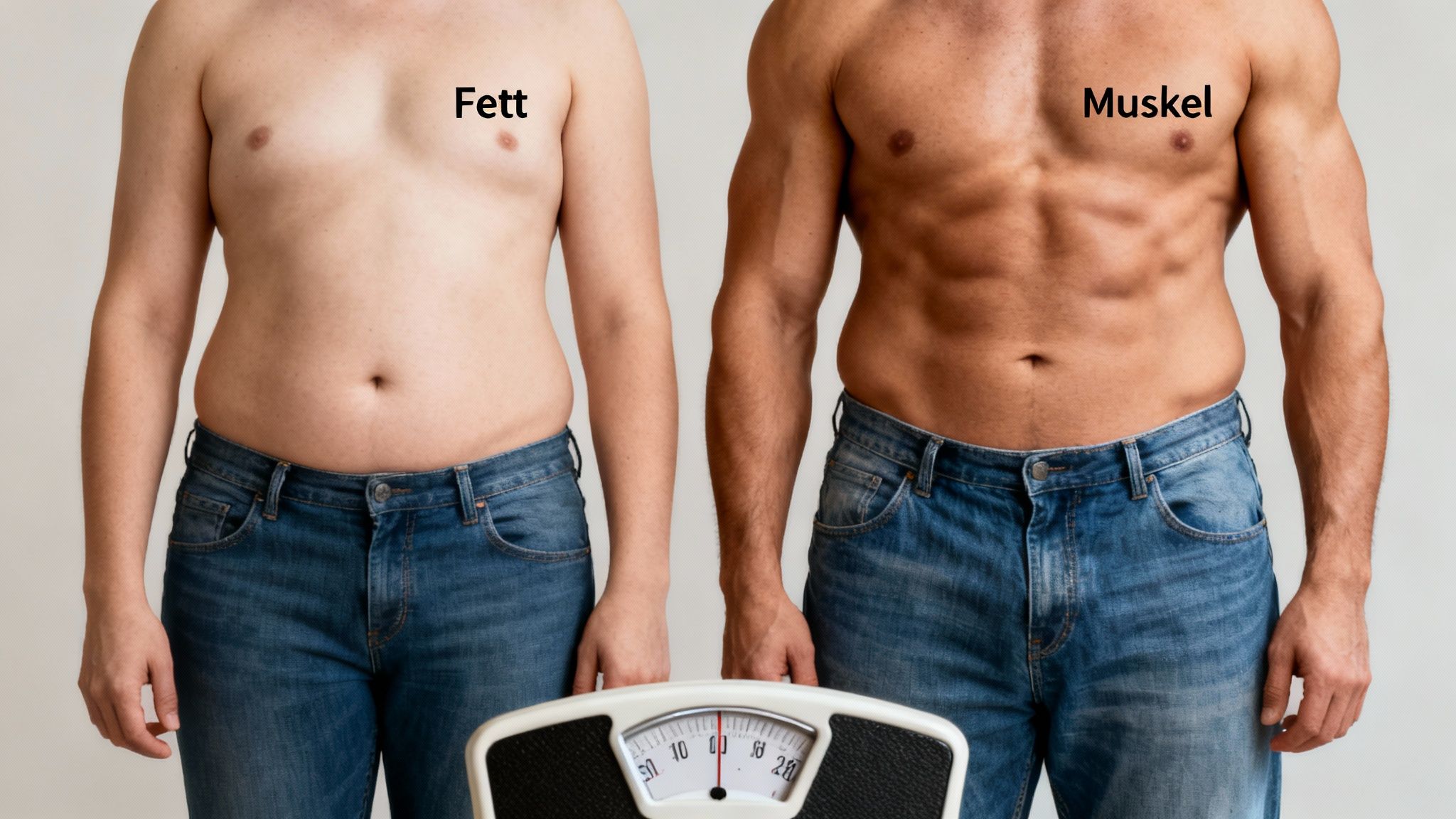
This phenomenon is a classic and the reason so many frustrated people ask, “Why am I not losing weight despite exercising?” The answer lies in the different densities of muscle and fat tissue. So it’s time to reveal the secret of why building muscle affects your scale weight—and why you should absolutely celebrate it.
The Difference in Density Between Muscle and Fat
Imagine one kilogram of feathers next to one kilogram of steel. Both weigh exactly the same, but the block of steel is tiny and compact, while the feathers form a huge pile.
This exact principle also applies to your body: One kilogram of muscle mass is considerably denser and more compact than one kilogram of fat. This means muscle takes up significantly less space at the same weight.
So if you lose fat and build muscle at the same time through your training, your body measurements may decrease while your weight stays the same or even increases slightly.
So you lose volume and gain shape, even if the scale says otherwise. Your body becomes firmer, more defined, and stronger. This isn’t stagnation—it’s a huge success!
This ingenious process, in which your body composition changes positively, is called body recomposition. You are essentially replacing “loose” fat tissue with “firm,” metabolically active muscle tissue.
Studies repeatedly confirm that strength training in particular leads to an increase in muscle mass. Specifically, at the same volume, muscle tissue weighs about 1.1 times more than fat tissue. This can initially increase your overall weight, even though your body fat percentage has already been declining.
Smart ways to measure your progress
So if the scale isn’t a reliable partner, how can you recognize your progress? It’s simple: It’s time to use smarter measurement methods that tell the true story of your progress.
- The measuring tape is your best friend: Regularly measure your circumference at key areas such as your waist, hips, thighs, and arms. This shows you clearly how your body is becoming slimmer and more toned.
- Before-and-after photos don’t lie: Take photos of yourself every four weeks in the same clothing and pose. The visual changes are often far more impressive than any number on the scale.
- Your reflection and how you feel: How do your clothes fit? Do you feel more energetic and stronger in everyday life? These subjective impressions are extremely valuable indicators of success.
- Professional body fat analysis: For precise data, a professional measurement (e.g., a BIA analysis at a gym) can provide insight into changes in your muscle and body fat percentages.
Why more muscle is your best ally when losing weight
Every single gram of muscle mass you build is a direct investment in your metabolism. Muscles are extremely active tissue, which means they burn calories even at rest.
More muscle increases your basal metabolic rate. This means your body burns more energy throughout the day—even when you’re sitting on the couch. In the long term, this makes it much easier to maintain a healthy weight and burn excess fat.
For this process to work optimally, the right nutrient intake is, of course, crucial. If you would like to learn more about the optimal nutrition for athletes, you’ll find valuable tips on the subject here.
So, free yourself from focusing exclusively on the scale. Celebrate the real achievements instead: a firmer body, greater strength, and a more active metabolism.
The invisible forces working against your progress
Sometimes the answer to the frustrating question “Why am I not losing weight despite exercising?” lies neither in the gym nor on your plate. It hides much deeper—in your lifestyle, your routines, and yes, even in the invisible biochemical processes that control your body.
Let’s bring the silent saboteurs of your weight-loss success into the spotlight: hormones, stress, and sleep. These three areas are as closely interconnected as the gears in a clockwork mechanism. If one gets out of sync, the entire system suffers. You can train and eat as diligently as you like—but when these opposing forces are active, your body works relentlessly against you.
The stress factor: When cortisol takes command
Stress is more than just feeling overwhelmed. Chronic stress, whether from work, your personal life, or even overly intense training, puts your body in a permanent state of alarm. The result? Your body releases huge amounts of the stress hormone cortisol.
Cortisol was originally a survival aid that quickly gave us energy in dangerous situations. In modern everyday life, however, this mechanism becomes a real figure-destroyer. Persistently high cortisol levels essentially shout at your body: “Crisis! Stockpile energy for hard times!”—preferably as stubborn belly fat.
The effects of too much cortisol are nasty and sabotage you on multiple levels:
- It promotes fat storage: Cortisol loves to accumulate visceral fat—the particularly unhealthy fat that collects around your abdominal organs.
- It makes you hungry: The hormone ramps up your appetite (hello, ghrelin!) while simultaneously dulling your sense of satiety (goodbye, leptin). The result is usually cravings for sweet and fatty foods.
- It slows muscle growth: High cortisol levels can even promote the breakdown of muscle protein, sending your basal metabolic rate plummeting.
A stressed body is in survival mode. In this state, burning fat is not a priority—storing energy takes precedence. Stress management is therefore not a wellness luxury but an absolute necessity for successful weight loss.
When sleep is lacking, your hormones go haywire
Sleep is perhaps the most underestimated component of a healthy metabolism and successful weight loss. While you sleep, your body not only regenerates—it also recalibrates your entire hormonal system. Sleep deprivation completely disrupts this delicate balance.
Even a single night of too little sleep can completely throw off the balance of your two most important appetite hormones:
- Ghrelin (the hunger hormone): Its level shoots up. You wake up hungrier and simply have a greater appetite throughout the day.
- Leptin (the satiety hormone): Its level drops. Your brain no longer receives a clear signal that you are full. This almost inevitably leads to larger portions.
Studies show that people with chronic sleep deprivation eat an average of 300 to 500 calories more per day. At the same time, sleep deprivation slows your metabolism, and your body responds less effectively to insulin. This means that the energy from food is much more likely to be stored as fat instead of being burned.
Hormonal fluctuations as an invisible obstacle to weight loss
In addition to stress and sleep, other hormonal factors naturally also play a decisive role. Women in particular experience natural fluctuations throughout their lives that can make losing weight a real test of patience.
During the monthly cycle, changes in estrogen and progesterone levels can lead to water retention, cravings, and mood swings. This affects not only the number on the scale but also motivation. During menopause, the declining estrogen level often leads to a slower metabolism and a redistribution of body fat—typically toward the abdominal area.
A thyroid that is not operating at full capacity can also paralyze the entire metabolism and make losing weight almost impossible. These hormonal obstacles are often invisible, but their impact is enormous. If you suspect that this could be a cause, it is worth taking a closer look. Sometimes a simple blood test can provide answers. You can find out more about how to test for nutrient deficiencies and identify connections in our guide.
A holistic approach that includes stress reduction, good sleep hygiene, and taking your hormonal status into account is therefore the key to removing these invisible brakes and finally allowing your body to let go of excess fat.
How your genes affect your weight-loss journey
You follow exactly the same diet and workout plan as a friend, yet while the pounds seem to melt off her, the number on your scale barely changes? This frustrating experience shows that there is no one-size-fits-all solution to weight loss. The answer to the question “Why am I not losing weight despite exercising?” could be buried deeper than you think—namely, in your unique DNA.
Think of your genes as your body’s operating system. They establish the basic rules governing how your metabolism functions, how your appetite is regulated, and how you respond to certain foods or types of exercise. What is a real game-changer for one person may be completely ineffective for you.
The Genetic Fingerprint of Your Metabolism
Each of us has a completely individual genetic makeup that determines how efficiently the body obtains and stores energy from food. Some people, for example, can metabolize carbohydrates extremely well, while others are genetically predisposed to use fat much more effectively as an energy source.
It’s like trying to fill a diesel car with gasoline. It will sputter, fail to run properly, and in the worst case may even suffer damage. Your body reacts similarly: if you constantly fuel it with the wrong “fuel”—nutrients that it is genetically poorly equipped to process—you slow down your metabolism. Your body then tends to store excess energy directly as fat.
Your DNA is not an excuse, but it is an explanation. Understanding it gives you the power to work with your body rather than against it.
This knowledge is crucial. So instead of blindly chasing the next trend, you could find out what your metabolic type really is. This one insight could completely turn your strategy on its head and finally lead you to the results you want. You can learn more about what nutrigenetics is and how it shapes our lives in our in-depth article.
FTO – The “Obesity Gene” and What It Really Means
A well-known example of this genetic influence is the FTO gene. Certain variants of this gene are indeed associated with a higher tendency toward obesity. People with this gene variant often experience less satiety and are more likely to struggle with cravings and binge-eating episodes.
But be careful: This is not an unchangeable fate! Modern science clearly shows us that our genes do not dictate everything. Your lifestyle—meaning your diet and training—has a huge influence on whether such genes are even “switched on.” Anyone who knows their genetic predisposition can take targeted countermeasures. For example, with a particularly protein- and fiber-rich diet, which has been proven to promote satiety and curb cravings.
From guesswork to certainty with personalized analyses
Instead of continuing to stumble around in the dark and trying one diet after another, you can finally take a data-driven approach. Personalized health analyses, such as the DNA metabolism test from mybody-x.com, provide you with a precise map of your body.
Imagine knowing exactly:
- Which macronutrient type you are: Does your body process fats, carbohydrates, or proteins most efficiently for energy?
- Your optimal type of training: Are you naturally more of an endurance or strength type? Which sport produces the best results for you?
- Your genetic predisposition: Are you predisposed to cravings or the dreaded yo-yo effect?
With this knowledge, you can stop guessing. You can finally tailor your diet and training precisely to your needs—for sustainable results without the constant frustration. That's the difference between a standard key and one that fits your very own lock perfectly.
Your personal roadmap to success
So, we've now explored all the complex reasons why the scale remains stuck despite exercise. You now know that calories, muscle, hormones, stress, and even your genes all play a major role. But honestly, theory alone has never gotten anyone to their goal. It's the implementation that counts. And that's exactly where we're starting now.
The frustrating truth is this: A standard plan only works for standard people. And since they don't exist, failure is often programmed in from the start. Instead of continuing to grope around in the dark, you can rely on scientifically grounded data—data provided by your own body.
From guesswork to precision
Modern health analyses are like looking under your body's hood. They translate your unique biology into clear language and give you concrete guidance you can act on. Instead of asking yourself why something isn't working, you can finally find out what works specifically for you.
The key is to stop fighting your body and start working with it. Personalized data is the compass that shows you the most direct path to your goal—without frustrating detours.
The following graphic sums it up: Should you follow a generic plan that applies to everyone, or one based on your very own DNA?
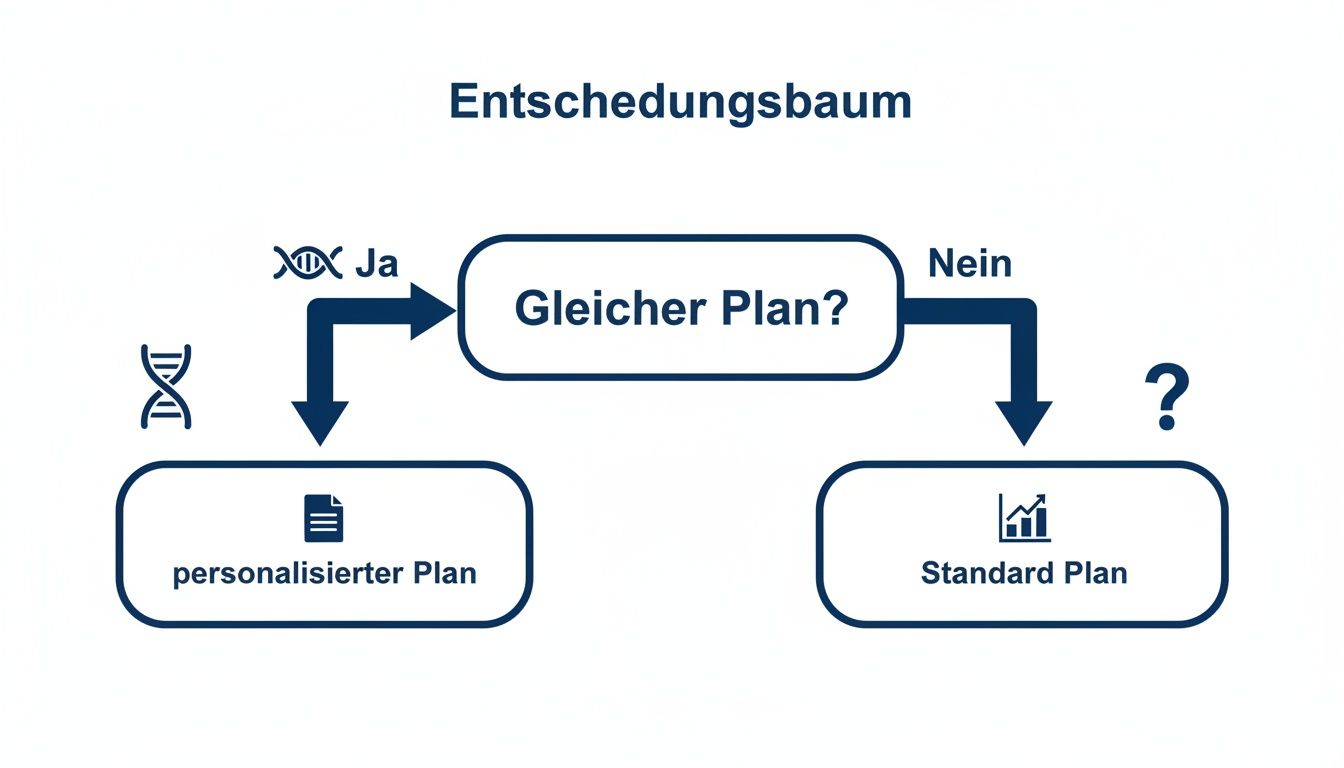
It’s clear: The path to a plan that truly works for you and delivers sustainable results lies in analyzing your individual prerequisites. Your DNA is a decisive factor in this.
Find the right test for your problem
Every piece of the puzzle that makes up your body tells part of the story. With the right tests from mybody-x.com, you can put these pieces together and finally understand the bigger picture. Each test provides highly specific answers to your questions, giving you back control.
To make it easier for you to get started, we have created an overview. It will help you find the right test for your personal situation.
Which mybody-x test is right for your problem?
Find out which analysis can help you identify and address the specific causes of your weight plateau.
| Problem / Question | Recommended test | What you will find out |
|---|---|---|
| “I feel like nothing works no matter what I eat. What type of metabolism do I have?” | DNA metabolism test | Your genetic metabolic type (fat, carbohydrate, or mixed type), your optimal nutrient distribution, and which type of exercise suits you best. |
| “I’m constantly tired and stressed, and most of my fat is around my stomach. Could my hormones be to blame?” | Hormone test for women / Hormone test for men | Whether there is an imbalance in important hormones such as cortisol (stress), DHEA, or sex hormones that is blocking your fat loss. |
| “My digestion is sluggish and I often feel bloated. Does this affect my weight?” | Microbiome analysis | The state of your gut flora, whether inflammation is present, and how well your gut processes nutrients—a key factor in an efficient metabolism. |
These analyses are not rocket science, but modern science that is available to you today. They give you the tools to find a path that truly suits you, your body, and your life.
It’s time to take control and create your personal roadmap to success.
The most frequently asked questions on the topic
Here I answer the questions I am repeatedly asked in this context. Short, concise, and to the point, so you can quickly gain clarity for your next steps.
How long does it take to see results despite exercising?
There is no one-size-fits-all answer, because every body works differently. But a good rule of thumb is that noticeable changes, such as firmer skin or your favorite jeans fitting more loosely, often appear after just 4 to 6 weeks—even if the scale remains unchanged.
Visible fat loss that is also reflected in the numbers on the scale usually requires 8 to 12 weeks of consistent training and a sensible calorie deficit.
Patience is your best friend here. Trust the measuring tape and your reflection in the mirror rather than the scale. They are less likely to lie and show you what is really happening.
Should I do more cardio or more strength training?
The best answer is: both! But with the right focus. A smart combination is the key to sustainable success.
Cardio is great for burning plenty of calories during the session and keeping your cardiovascular system fit. But strength training is the real game-changer for your figure. It builds valuable muscle mass, and those muscles are your metabolic engine. They increase your basal metabolic rate, which means you burn more energy even while lounging on the couch.
For most people, this split has proven effective:
- 2–3 strength-training sessions per week to build muscle and boost your metabolism.
- 2 cardio sessions per week to further support fat burning and strengthen the heart.
I already eat healthily, but I still can’t lose weight. Why?
This is a classic and incredibly frustrating. The most common reason: “Healthy” does not automatically mean “low-calorie.”
Many highly nutrient-dense foods, such as nuts, avocados, olive oil, and whole-grain products, are high in calories. So it is entirely possible to eat a very healthy diet while still unknowingly consuming more calories than you burn.
Sometimes, however, the cause lies deeper. Hidden metabolic obstacles such as nutrient deficiencies, an imbalanced gut flora, or a hormonal imbalance can sabotage any weight-loss efforts. Keeping an honest food diary for a few days can quickly show you whether calorie intake is the issue.
Are you ready to stop guessing and truly understand your body? The modern health analyses from mybody-x.com give you the precise answers you need—from your genetic metabolic type to your hormone status. Find out what is really behind your plateau and create a plan that is perfectly suited to you. Discover the right tests now at https://mybody-x.com.



Share now:
Where to get a metabolic analysis: four methods, four locations
Why am I gaining weight despite a calorie deficit, and what you can do about it