

Why am I gaining weight despite being in a calorie deficit, and what can I do about it?
Are you sticking firmly to your calorie deficit, but the scale is still going up? If this frustrating feeling sounds familiar, it is a clear sign: Your body is far more complex than a simple calculation.
Here is the quick answer: In most cases, it is not due to a mistake on your part at all. Rather, it is often a combination of inaccurate calorie tracking, water retention, muscle building, and hormonal adaptations.
Understanding the mystery on the scale

Picture the scene: You meticulously count your calories, eat more mindfully than ever, and yet the number on the scale is moving in completely the wrong direction. If this sounds familiar, you are definitely not alone. Countless people experience this exact moment of confusion and ask themselves: “Why am I gaining weight despite being in a calorie deficit?”
Your body is not a calculator; it is a clever biological system that constantly adapts to new conditions. Weight gain can have many logical explanations that often have absolutely nothing to do with an increase in body fat.
Before we delve deeper into the subject, this table provides a quick overview of the most common causes that we will examine in more detail in the article.
Quick overview of the most common causes
| Possible cause | Brief explanation | Initial steps toward a solution |
|---|---|---|
| Measurement errors and inaccuracies | Hidden calories, incorrect portion sizes, or inaccurate tracking lead to a higher calorie intake than expected. | Weigh portion sizes, check nutritional information carefully, and track even “small things” such as oils or drinks. |
| Water retention | A salty diet, stress (cortisol), hormonal cycles, or intense training cause the body to retain water. | Reduce salt intake, drink enough fluids, use stress management techniques, and be patient. |
| Muscle building | Especially for people new to training, building muscle mass (which is denser than fat) can lead to weight gain. | Focus on body measurements (circumferences) and photos rather than just the scale. Keep training! |
| Hormonal and metabolic adaptations | The metabolism slows down in response to the diet, or hormones such as thyroid hormones or cortisol are out of balance. | Consider professional diagnostics (e.g., through a self-test) and ensure sufficient sleep and recovery. |
These four points are often the main suspects when the scale refuses to budge. Let us now take a closer look at what lies behind them.
What Really Lies Behind the Number
The phenomenon is more widespread than you might think. According to the Robert Koch Institute, the prevalence of obesity in Germany increased from 12.2% to 19.7% between 2003 and 2023. A comprehensive study by Duke University showed that calorie intake plays an approximately ten times more important role in the obesity crisis than energy expenditure through physical activity. You can find more information in the current obesity statistics on marcusknispel.com.
Yet often it is not the obvious calorie bombs but invisible factors that sabotage the result on the scale. So before you throw in the towel in frustration, let us uncover the most common reasons together.
Your body is not a machine that operates rigidly according to the formula “calories in vs. calories out.” It is a dynamic ecosystem that responds to training, stress, hormones, and even the composition of your food.
This article will help you understand the real causes. We will show you which effective solutions are available to finally solve the mystery behind the number on your scale and achieve your health goals.
Uncovering the Most Common Calorie-Tracking Mistakes

The simple formula “calories in vs. calories out” sounds incredibly easy on paper. In practice, however, the devil is often in the details—and this is exactly where many people fail without even realizing it. The most common answer to the frustrating question “Why am I gaining weight despite being in a calorie deficit?” is brutally honest: Because the supposed deficit does not actually exist in reality.
Everyday life is simply full of small traps that undermine your careful planning. These inconspicuous mistakes quickly add up and ultimately make the difference between success and stagnation.
Hidden Calories: The Real Saboteurs
Do you only think about your main meals when counting? Then you are probably overlooking the biggest calorie bombs. The real culprits keeping the number on your scale from moving are often the inconspicuous extras.
- Oils and fats: Honestly, who weighs the splash of olive oil used for frying or in a salad dressing? One tablespoon easily contains over 100 calories. Healthy fats are important, no question, but their energy density is massively underestimated.
- Sauces and dips: Ketchup, mayo, or ready-made yogurt dressing—all of them often contain hidden sugar and fat. A dollop here, a spoonful there, and suddenly your deficit is gone.
- Liquid calories: The splash of milk in your coffee, the “healthy” orange juice in the morning, or the glass of wine to unwind in the evening. It all counts, but is quickly forgotten in the hustle and bustle of everyday life.
These small items can single-handedly wipe out your deficit. Without tracking them precisely, you’re essentially fighting an invisible wall.
How often you eat also plays a role. As the German Nutrition Society (DGE) explains, many small meals and snacks simply create more opportunities to exceed your daily calorie budget—especially with energy-dense foods. Studies have in fact shown a connection between the number of meals and obesity when inaccurate self-reporting is taken into account. You can find more information in the DGE’s technical information on meal frequency.
The power of portion size
Another critical issue is estimating. Unfortunately, our visual judgment is notoriously unreliable, especially with foods that are high in calories, such as nuts, cheese, or nut butter.
A heaped tablespoon of peanut butter can easily contain twice as many calories as a level one. That can quickly add up to 100 extra calories that don’t appear in any app.
The only way to achieve real accuracy is with a simple kitchen scale. Weigh everything you eat—at least for a while. This greatly improves your ability to estimate and gives you a realistic sense of quantities. This is the only way to ensure that your calorie deficit doesn’t remain merely a theoretical figure on paper.
Calculating your exact needs is naturally the first step. In our guide, you’ll learn how to determine your baseline with our calorie needs calculator. From there, you can set a realistic deficit and then achieve success through precise tracking.
Your body under reconstruction: When the scale doesn’t tell the whole truth

When you change your diet and perhaps even start strength training, something amazing happens in your body. You begin an impressive transformation process—but this positive change can initially cause confusion on the scale. You build valuable muscle mass while losing body fat at the same time. A huge success for your health and appearance!
The problem? Your scale cannot reflect this progress. It only displays a single, often misleading number.
Why muscles weigh more than fat
A classic reason why you may suddenly weigh more despite being in a calorie deficit is building muscle. Just imagine one kilogram of muscle next to one kilogram of fat. The weight is identical, of course, but the volume is completely different.
- Muscle mass is compact, firm, and highly dense. It takes up significantly less space in your body.
- Fat tissue, on the other hand, is much looser and softer and requires more space.
So if you lose fat and build muscle, you will become more toned, your clothes will suddenly fit more loosely, and your body shape will visibly change for the better. The scale, however, may stay the same or even rise slightly because you are building denser mass. That is a reason to celebrate, not to worry!
In fact, this phenomenon is widespread: Many people who eat more mindfully and exercise more are surprised by a slight weight gain. The Stiftung Gesundheitswissen confirms: More muscle mass boosts your basal metabolic rate and continuously burns more energy—even when you are relaxing on the sofa.
The impact of water retention
Another factor that can throw your weight off in the short term is water. Your body weight can fluctuate by one to two kilograms from one day to the next solely due to water retention. Without you gaining even a single gram of fat.
Water retention causes temporary fluctuations, not actual fat gain. It simply shows that your body is responding to various stimuli.
Several factors can cause your body to temporarily store more water:
- Intense training: After a strenuous workout, your body retains water to repair the muscles you have worked and supply them with nutrients. This is a completely normal part of the recovery process.
- Stress: High cortisol levels can cause the body to retain water.
- Hormonal fluctuations: Women in particular know this all too well. Over the course of the menstrual cycle, your weight can noticeably change due to water retention.
These fluctuations are completely normal and no reason to panic. So instead of weighing yourself every day and driving yourself crazy, reach for a measuring tape. Track your progress, take before-and-after photos, or pay attention to how your favorite jeans fit. These methods tell the true story of your success.
When Your Metabolism Hits the Brakes
Your metabolism is not a rigid engine, but an incredibly intelligent and adaptable system. It responds to what you give it—or do not give it. If you maintain a significant calorie deficit for a longer period, your body switches into a kind of “conservation mode” to protect its valuable energy reserves.
This phenomenon is also known in science as adaptive thermogenesis. Think of it like the heating system in a smart home. When resources become scarce outside (less energy from food), the system turns down the heating (your metabolism). Clever, right?
The Body in Survival Mode
This protective mechanism is a relic of times when food was often scarce. Your body does not know that you are dieting voluntarily. To it, a calorie deficit signals an impending famine—and it responds accordingly by becoming more efficient and trying to get by on fewer calories.
This has very tangible consequences for you:
- Your basal metabolic rate decreases: The amount of energy your body burns at complete rest goes down. Suddenly, the calorie deficit originally calculated is no longer large enough to keep you losing weight. The scale stops moving.
- The yo-yo effect is practically guaranteed: When you start eating normally again after such a crash diet, your usual calorie intake meets a slowed metabolism. The result? Rapid weight gain that often exceeds your starting weight.
Muscle loss is particularly insidious. With an overly aggressive calorie deficit, especially without sufficient protein and strength training, your body does not only use fat for energy—it also breaks down valuable muscle mass. And since muscles burn a considerable number of calories even at rest, this further lowers your basal metabolic rate.
How to activate your metabolism again
The good news is: You are not helplessly at the mercy of this process. You can deliberately signal to your body that there is no danger and that it can leave conservation mode again. If you want to know more about how to recognize a sluggish metabolism, take a look at our article on the symptoms of a slow metabolism and what you can do about them.
Your goal should be not to outsmart your metabolism, but to work with it. Give it the right signals so it can run at full speed again.
Here are a few proven strategies to get your metabolism moving again:
- Targeted strength training: Build muscle. It is your most important calorie-burning engine and sustainably increases your basal metabolic rate.
- Protein-rich diet: Protein is not only extremely filling, but also protects your muscles from breaking down during a diet.
- Strategic diet breaks (refeeds): Intentionally set aside days or even an entire week during which you increase your calorie intake again. This signals to your body that the “famine” is over and can help normalize your metabolism.
Hormones as hidden opponents in weight loss
Sometimes the answer to the question “Why am I gaining weight despite a calorie deficit?” is not on your plate or in the gym, but deeper within your body. Your hormonal balance is, so to speak, the hidden director of your metabolism. It has a huge influence on whether you lose or gain weight.
When certain hormones get out of balance, they can simply slow down your best efforts. Think of it like a finely tuned orchestra: As long as all the instruments play in harmony, the melody sounds harmonious. But if even one instrument falls out of rhythm, everything sounds off-key.
This infographic illustrates how a prolonged dieting phase can affect your metabolism.
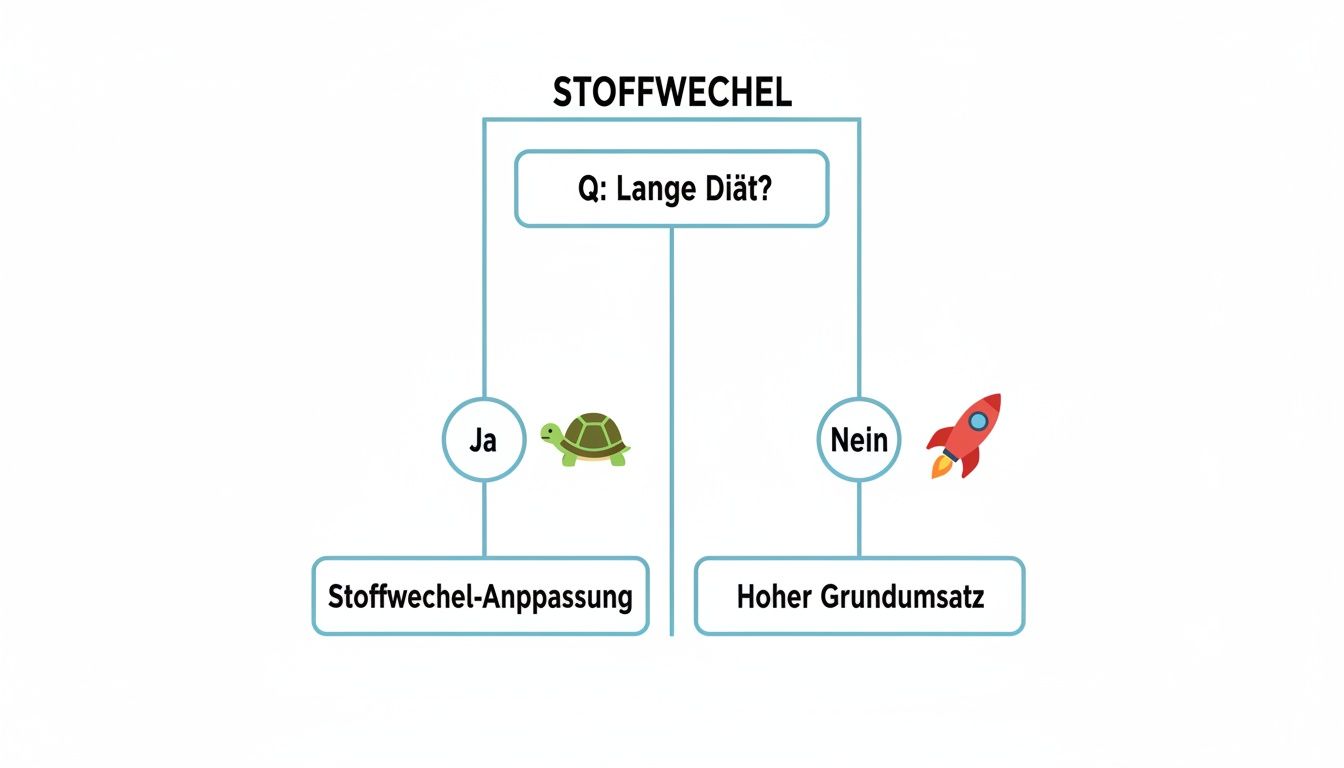
As you can see, a long diet often forces the metabolism into an energy-saving mode (turtle), while an unburdened metabolism can run at full speed (rocket). This is a completely natural protective response by your body.
The most important hormonal factors that disrupt weight loss
Three hormones play a particularly critical role in weight loss. If even one of them is out of balance, your progress can be completely blocked.
- Thyroid hormones (T3/T4): They are the accelerator pedal of your metabolism. Undiagnosed hypothyroidism can drastically slow down your basal metabolic rate. Typical signs: You constantly feel tired, get cold easily, and gain weight even though you barely eat anything.
- Cortisol: This stress hormone is essentially a survival mechanism. However, with chronic stress, cortisol levels remain elevated. This promotes fat storage – especially around the abdomen – and triggers cravings for sugar and fat.
- Insulin: This hormone regulates your blood sugar level. However, with insulin resistance, your cells no longer respond to it properly. Your body releases more and more insulin, which blocks fat burning and promotes fat storage.
When your body is hormonally in stress mode, storing fat takes priority over breaking it down. Your body tries to prepare for hard times – even if you are maintaining a calorie deficit.
If you suspect that your hormones are out of balance, it is time to take a closer look. In our guide, you will find 7 effective tips for hormonal balance that provide you with valuable initial guidance.
Which test is right for my symptoms?
This overview helps you identify the true causes of your weight problems and understand which test might be right for you.
| Typical signs and symptoms | Possible cause | Suitable mybody-x test |
|---|---|---|
| Constant fatigue, feeling cold, hair loss, weight gain | Underactive thyroid | Thyroid Test |
| Abdominal fat, cravings, sleep problems, inner restlessness | Chronically elevated cortisol levels | Stress & Sleep Test |
| Constant hunger, energy crashes after eating, weight gain despite a healthy diet | Insulin resistance | Blood Sugar Test |
| Digestive problems, bloating, skin problems, mood swings | Imbalance in the gut microbiome | Gut Health Test |
| Feeling that certain foods are not tolerated, unexplained weight gain | Predisposition for how the body processes fats and carbohydrates | DNA Metabolism Test |
With the right test, you can finally gain clarity instead of frustration.
When you should take a closer look
If you simply cannot lose weight despite all your efforts, constantly feel exhausted, or experience other unexplained symptoms, a targeted analysis is the next logical step. Standard diets fall short here because they completely ignore the underlying biological cause.
Modern analyses, such as those offered by mybody-x, can finally provide clarity here. A simple at-home test can show you precisely where the real problem lies:
- Hormone tests specifically check the levels of thyroid hormones or cortisol.
- Microbiome analyses provide insight into your gut health, which is closely linked to your hormone balance and metabolism.
- DNA metabolism tests show your genetic predisposition and how your body generally processes fats and carbohydrates.
With this knowledge, you finally regain control. Instead of feeling your way in the dark, you can make targeted adjustments in the right areas and support your body in finding its way back into balance.
Your personal plan for lasting success
After examining all the possible causes, one thing becomes clear: Standard diets often fail because they completely ignore your unique biology. The real key to lasting success is finally understanding your body instead of blindly counting calories and asking yourself, “Why am I gaining weight despite being in a calorie deficit?”
It’s time for a concrete, personalized plan. Instead of continuing to feel your way in the dark, you can take targeted action and find out what your body really needs to regain balance.
Understanding instead of guessing
The first and most important step is to collect precise data about your body. This is the only way to identify the true causes and finally fine-tune your diet and lifestyle to fit your needs. Evidence-based analyses give you back control and allow you to make informed decisions.
Instead of fighting your body, learn to work with it. Give it exactly what it needs, and it will stop resisting your goals.
Modern tests can help you uncover the hidden reasons behind your weight problems:
- DNA metabolism test: A test like this from mybody-x can, for example, tell you whether your body is genetically predisposed to metabolize carbohydrates or fats more efficiently. This helps you find out which macronutrient mix is personally optimal for you.
- Microbiome analysis: Your gut health has a huge impact on your weight and hormones. An analysis reveals how you can specifically support your microbiome with the right diet.
This knowledge is the foundation for finally achieving lasting results. It allows you to listen to your body’s signals and stop stressing it with one-size-fits-all diet rules.
With a tailored approach based on your individual biology, you lay the foundation for long-term change. In our guide, we show you how to achieve healthy, long-term weight loss by choosing the right strategies for your body. This way, you can reach your goals without constantly having to fight against your own metabolism.
Still have questions? Here are the answers.
After all the information about metabolism, hormones, and measurement errors, there are often still very specific questions left unanswered. No problem—I have summarized the most common ones here so that you know exactly what to do next.
How long is “normal” before I should be concerned?
Weight fluctuations of one or two kilos within a week are completely normal and are usually just water. But if the scale simply refuses to go down or even rises over three to four weeks, despite honestly reviewing your tracking, then it is time to take a closer look. This is the point at which you should consider deeper causes such as hormones or metabolic adaptations.
Can stress really make me gain weight?
Yes, absolutely—and very directly. Chronic stress floods your body with the hormone cortisol. This not only causes unpleasant water retention but also increases your cravings for sweet and fatty foods and specifically promotes fat storage around your abdomen. Your body switches into a kind of survival mode in which fat loss is no longer a priority.
Patience is your most important ally. Actual fat loss is a slow process that can be masked by short-term fluctuations on the scale. Focus on the long-term trend rather than the daily number.
Should I simply eat even less?
This is almost always the wrong approach and often only makes the problem worse. An overly severe calorie deficit makes your body cry out, “Famine!” Its response? It slows your metabolism down even further (adaptive thermogenesis) and starts sacrificing valuable muscle mass. A moderate deficit combined with enough protein and strength training is the much smarter and more sustainable approach.
If you want to stop guessing and finally understand what your body really needs, precise data is the key.
The modern health analyses from mybody-x.com give you insights into your individual genetics, hormone status, or gut health. Find out what is behind your weight gain and receive a personalized plan for sustainable success.



Share now:
Why am I not losing weight despite exercising: Your body, your rules
Why am I not losing weight despite dieting? 10 often-overlooked reasons