
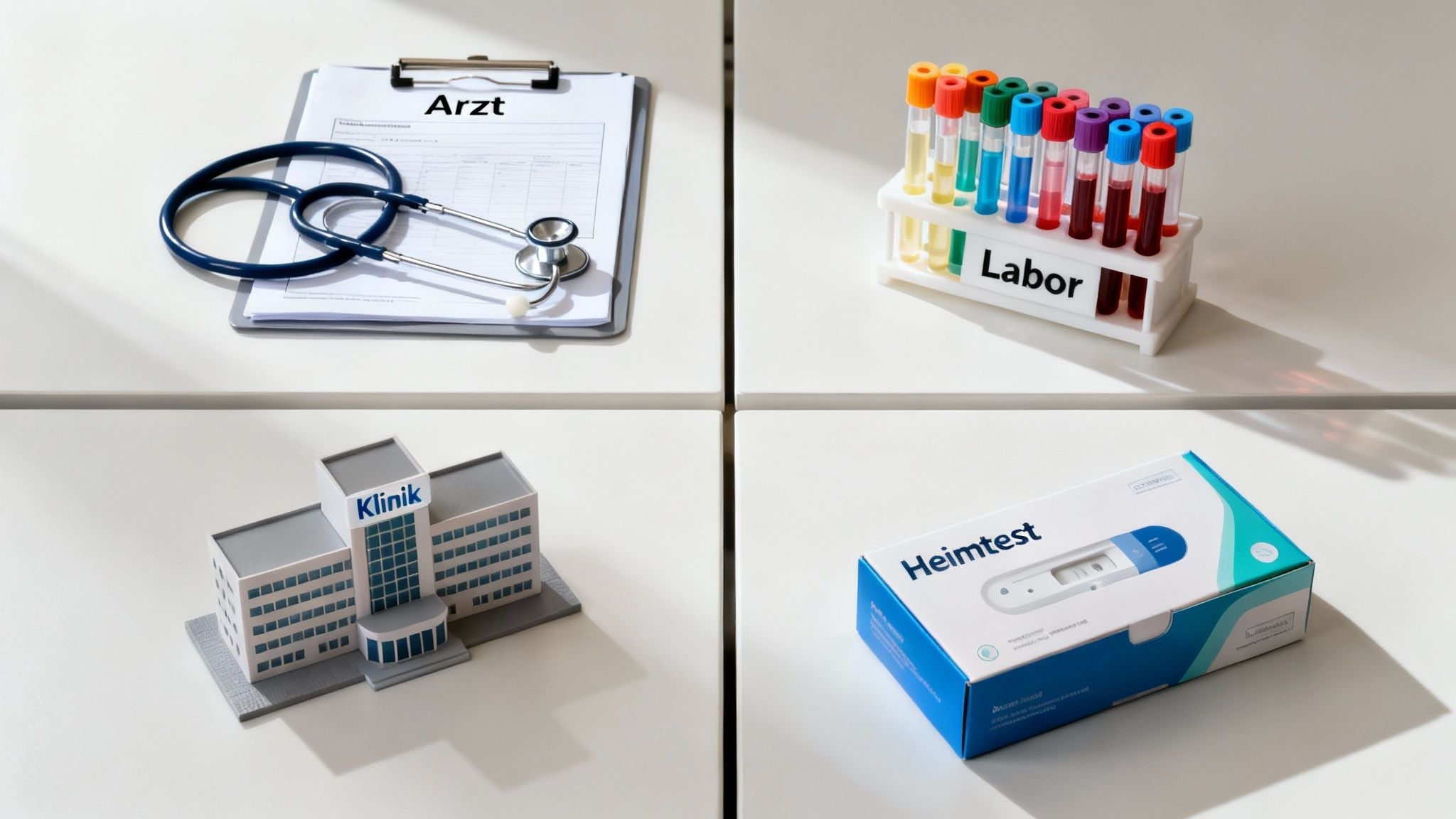
Where to get a metabolic analysis: four procedures, four places
The essentials at a glance
It depends on which procedure you mean. You can have your resting metabolic rate measured through your breath at nutritional medicine and sports medicine practices, university outpatient clinics, and rehabilitation facilities. You can perform a genetic analysis at home using a saliva sample. A medical practice can take blood samples; some individual tests are also available for use at home. You can find bioimpedance measurements at practices, pharmacies, and fitness studios.
Four procedures share the same name in everyday use, and they are offered at four different types of locations. This article assigns each procedure to its location, describes the type of facility, and lists the features that indicate a carefully conducted service. No provider names appear here, because a recommendation without personal verification would be worthless.
First, you will read which procedure belongs in which location. This is followed by the qualifications behind a reputable measurement, the four methods in detail, and a chapter explaining why there are no prices here for procedures performed elsewhere. The latter part addresses when an in-person appointment is worthwhile at all, how to check an address beforehand, and where the limitations of all four methods lie.
What to expect in this article
1. Four procedures, four places
2. Where indirect calorimetry is measured
3. How to recognize a reputable facility
4. Who performs measurements besides doctors
5. Spiroergometry: the same technology, a different question
6. Genetic analysis: the location is your kitchen table
7. Blood values: medical practice or at-home test
8. Bioimpedance: practice, pharmacy, fitness studio
9. Why there are no prices here for procedures performed elsewhere
10. When it is worth going to a practice
11. How to check an address before your appointment
12. Which of the four routes you can get here
13. The four routes and their locations side by side
14. Limitations: what no place on this list can answer
15. The shortest route to the right address
Frequently asked questions
Sources
Four procedures, four places
People searching for a metabolic analysis are usually looking for an address. A place where someone performs a measurement and then explains why their body responds the way it does. The search often ends with a list of very different services that all use the same term.
The word is the reason for the confusion. “Metabolic analysis” refers to four procedures that measure different things and take place in different settings. Which four they are and what each one measures is explained in detail in the overview of the four procedures. This article answers the follow-up question: Where can you get each one?
Key point
The question “Where can I have a metabolic analysis performed?” has four answers because four different procedures go by the same name. Anyone looking for a location must first choose the procedure.
The following overview assigns each of the four procedures to the type of facility where it is typically offered. It provides the framework for all subsequent chapters.
Indirect calorimetry
Measures energy expenditure through the air you exhale. Location: nutritional and sports medicine practices, university outpatient clinics, rehabilitation facilities. Not for home use.
Genetic analysis
Reads predetermined positions in the genetic material. Location: your kitchen table, using a saliva sample, with analysis in a laboratory. No appointment necessary.
Blood values
Shows the current status of individual values. Location: a medical practice with access to laboratory testing; for some values, an at-home test is also possible.
Bioimpedance
Estimates body composition based on electrical resistance. Location: medical practices, pharmacies, fitness studios. The location is easy to find; the number is difficult to interpret.
Two of these four options take place outside the home, and two do not. And only the first measures energy expenditure in the literal sense. This is the uncomfortable part of the article, and it appears here at the top rather than hidden at the end.
Where indirect calorimetry is measured
Indirect calorimetry is the procedure most people think of when they say “measure metabolism.” You lie still, breathe into a hood or through a mouthpiece, and a device determines how much energy your body uses at rest based on oxygen consumption and carbon dioxide output.
The procedure requires calibrated equipment, a quiet room, and standardized preparation. That is why it is not performed in the living room, but in facilities equipped for it. In Germany, these are essentially four types of providers.
Nutritional medicine practices
This refers to medical practices where at least one physician has completed the additional qualification in nutritional medicine. In the version dated June 8, 2021, the German Medical Association describes this field in the (Model) Curriculum for Nutritional Medicine as an addition to a specialist qualification focused on nutrition-related diseases and diseases caused by metabolic disorders. Anyone looking for energy-expenditure measurement in a medical context is looking for exactly this combination.
Sports medicine practices and outpatient clinics
Sports medicine practices often already have the equipment because they need it for exercise tests. The Continuing Education Regulations of the Baden-Württemberg State Medical Association dated October 12, 2022, explicitly list “performing and evaluating relevant general and sport-specific measurement methods, e.g., spiroergometry, graded field testing, lactate sampling/lactate measurement” among the content of the additional qualification in sports medicine. Where there is a spiroergometry system, there is usually also a device for measuring resting energy expenditure.
University outpatient clinics and university facilities
At university hospitals and sports science institutes, indirect calorimetry is part of the research equipment. Some of these facilities also offer measurements outside studies, often through an outpatient clinic or a performance diagnostics service. The waiting time is generally longer there, but standardization is usually stricter.
Rehabilitation and obesity treatment facilities
Several professional groups work together when treating severe obesity. In the S3 guideline “Prevention and Therapy of Obesity,” version 5.0 from October 2024, the German Obesity Society names, among others, general medicine, nutritional medicine, sports medicine, diabetology, psychology, and nutrition professionals as target groups. Those who enter through such a structure rarely receive the measurement on its own, but rather as part of a longer program.
What is missing from this list is intentional. Studios, institutes, and individual providers are not named here, either positively or negatively. A recommendation that no one in-house has personally checked would be a claim about someone else’s work.
How to recognize a reputable facility
The location alone says little. A device can quickly be placed in a room, and anyone may use the designation “metabolic analysis.” That is why the more useful question is not where the measurement is taken, but who takes it and how carefully the measurement is prepared.
The most reliable answer is found in the medical postgraduate training regulations. They describe what additional qualification a doctor must have acquired to be allowed to present themselves as working in this field, and how much time lies behind it.
The scope behind two additional medical qualifications
100
hours of course-based postgraduate training for the additional qualification in nutritional medicine (German Medical Association, 2021)
120
hours of case seminars in addition, alternatively six months of practical training (German Medical Association, 2021)
240
hours of course-based postgraduate training for the additional qualification in sports medicine, alternatively six months of clinical work (Baden-Württemberg Medical Association, 2022)
Source: German Medical Association, (Model) Course Book for Nutritional Medicine, version dated June 8, 2021; Baden-Württemberg Medical Association, postgraduate training regulations, as of October 12, 2022
These figures are not a seal of quality, but a lower limit. They tell you that behind the designation is verified training, not a weekend course. Anyone advertising with it has something verifiable to show.
Five characteristics that are visible before the appointment
A careful provider states before the appointment which device they use and exactly what is being measured. They distinguish between resting metabolic rate and total daily energy expenditure and do not claim that one is the other.
They send you preparation instructions. A resting metabolic rate measurement requires several hours without food, no exercise the day before, no caffeine in the morning, and a resting period before the measurement. Anyone who tells you that you can simply drop by is measuring something other than your resting metabolic rate.
They tell you in advance how long the appointment will take. A resting metabolic rate measurement is not a five-minute procedure, because the device only produces usable readings once your breathing has remained steady for an extended period.
They explain the result to you personally and provide it in writing. A printout without a conversation is a number without context, and a number without context changes nothing in everyday life.
And during the same appointment, they do not sell you a nutrition plan that would have looked exactly the same without the measurement. This is the hardest feature to verify and the most revealing one: Does the result change the recommendation, or was the recommendation already prepared beforehand?
Who measures besides doctors
Not every measurement takes place in a doctor’s office, and that is not a shortcoming. In Germany, nutritional counseling and nutritional therapy are provided largely by nonmedical professionals. What matters is which designation is protected and which is not.
On its page about quality assurance in nutritional therapy, updated in August 2025, the German Nutrition Society states that dietitians belong to the healthcare professions regulated by federal law and use a protected professional designation. This protection does not apply to graduates of ecotrophology or nutrition science.
This leads to a practical rule. “Nutritionist” or “dietitian” alone does not tell you anything about a person’s training, because the designation is not protected. A certificate recognized by health insurance funds for reimbursement is informative. The German Nutrition Society names the certificates issued by the Association of Dietitians, the Association for Nutrition and Dietetics, and its own certificate.
The 2024 S3 guideline of the German Obesity Society draws the same distinction. Under the term nutrition professional, it groups dietitians and, where they have equivalent qualifications, ecotrophologists and nutrition scientists, while explicitly referring to the formal provisions governing the performance of delegated medical services.
What this means for you: Ask about the training, not the job title. The question is uncomfortable to ask and can be answered in two sentences if the answer exists.
Spiroergometry: the same technique, a different question
Spiroergometry uses the same basic idea as resting energy expenditure measurement, but under exertion. You pedal a bicycle ergometer or run on a treadmill while respiratory gases, heart rate, and blood pressure are recorded. In their patient information dated April 28, 2026, the German Respiratory Society and the German Respiratory League describe the procedure as a lung function test under physical exertion.
That is a different question from the one about resting energy expenditure. Spiroergometry answers how well your cardiovascular system and breathing are functioning and where symptoms during exertion come from. It does not tell you how many kilocalories you burn on a day of rest.
The locations nevertheless overlap because the same facilities offer both: sports medicine practices, cardiology and pulmonology practices, university outpatient clinics, and rehabilitation clinics. Anyone who needs an exercise test will generally get there through a medical referral, not by booking online.
A point from the same patient information is also relevant: The significance of the results depends greatly on the person being examined cooperating well. An exercise test is not a measurement that happens independently of you. It is an exertion that ends with a number reflecting your effort.
Genetic analysis: the location is your kitchen table
With genetic analysis, the question of location is different from that for all the other methods. There is no appointment and no waiting-room wait. You receive a kit at home, collect a saliva sample, send it back, and the laboratory reads which variant is present at specified positions in your genetic material.
Key point
A genetic analysis from saliva is the only one of the four methods for which you do not have to leave home. However, it does not measure your energy expenditure; it describes predispositions.
The difference from calorimetry is fundamental. Calorimetry measures a state that changes with weight, muscle mass, age, and illness. Genetic analysis reads a sequence that does not change over the course of your life. Your DNA does not change. That is why one test is enough for your entire life.
A meaningful statement about the evidentiary value is one that rarely appears in shop copy. In 2022, the “Personalized Nutrition” working group of the German Nutrition Society stated in the journal Molecular Nutrition and Food Research that evidence for the success of gene-based dietary recommendations is still largely lacking (Holzapfel and co-authors, 2022). A genetic analysis therefore describes predispositions. It does not promise a result.
Two things matter more than the price when choosing. First, whether the provider discloses what happens to the sample and data and when both will be destroyed. Second, whether someone will discuss the results with you after the analysis. A report that no one explains is a document, not an answer.
Blood values: doctor’s office or at-home test
Blood values are the method most people already know, without calling it a metabolic analysis. They show the current status of individual measures: blood lipids, fasting blood glucose, thyroid values, and iron stores. These values change over weeks and months, so they are a snapshot rather than a characteristic.
The first place for this is a general practitioner’s office. In the Health Examination Guideline, the Federal Joint Committee regulates who provides this examination and at what intervals people with statutory health insurance are entitled to it.
Documented source
“Insured persons are entitled to a general health examination every three years from the age of 35.”
Federal Joint Committee
Health Examination Guideline, Section B I § 2(2), version dated December 19, 2019, last amended November 20, 2020
The same guideline specifies which doctors should perform the examination: those who are authorized to do so within their specialty boundaries and qualified under their continuing medical education regulations, namely general practitioners, internists, and doctors without a designated specialty. This is the specific point of contact behind the term “check-up.”
According to Annex 1 of the guideline, the laboratory component of this examination includes the lipid profile with total cholesterol, LDL cholesterol, HDL cholesterol, and triglycerides, as well as fasting plasma glucose. Resting metabolic rate is not included. If that is what you are looking for, having blood drawn is the wrong approach.
The second place is your home. For some of the values, there are tests in which you collect a few drops of capillary blood from your fingertip yourself and send them in. This does not replace a medical examination, but it shortens the process if you want an interim update between two appointments or if you first want to find out what you should talk to your doctor about.
The rule behind this is simple. Anything intended to become a diagnosis belongs in the hands of a doctor. Anything that is an assessment of your current status can be initiated by you.
Bioimpedance: doctor’s office, pharmacy, gym
Bioimpedance analysis is the method with the most locations. You stand on a platform or hold electrodes in your hands, a weak alternating current flows through your body, and a computational model uses the resistance to estimate how your body is distributed between fat, muscle, and water. Devices like these are found in doctors’ offices, pharmacies, gyms, and nutritional counseling practices.
This is exactly where a second look is worthwhile, because ease of access and the significance of the number do not always align. A systematic review by Oliver and colleagues in the Journal of Functional Morphology and Kinesiology (2026) compared bioimpedance devices with a four-compartment model as the reference. The mean difference in body fat percentage ranged from minus 3.5 to plus 4.4 percentage points, while the limits of agreement typically spanned 15 to 20 percentage points. The authors therefore do not consider the two methods interchangeable at the individual-person level.
The location is easy to find; the number is difficult to interpret.
This does not mean that the measurement is worthless. It is useful for monitoring changes over time if the same device, the same time of day, and a comparable hydration status are always used. Anyone who uses three devices at three locations and places the numbers side by side is comparing calculation models, not their body.
In its 2024 S3 guideline, the German Obesity Society states that body mass index describes body fat percentage only imprecisely and that body composition is therefore of great importance. Taken together, these points lead to a sober assessment: The general direction is right, but the individual decimal place is not.
And one point that is often overlooked: A bioimpedance measurement does not measure energy expenditure. Some devices nevertheless provide a basal metabolic rate. In that case, it comes from a formula that calculates a value from the estimated muscle mass, not from measuring your exhaled air.
Why there are no prices here for procedures performed elsewhere
At this point, you would expect to find a price list. It is not here, and the reason belongs in the text, not in a footnote.
There is no institution that provides a universally applicable figure for a resting metabolic rate measurement, spiroergometry, or bioimpedance measurement at an outside facility. What a practice charges privately depends on the effort involved and the facility's equipment. Any range given here would be an estimate with our name attached to it.
We therefore only state our own prices. You can find out everything else most reliably by asking two questions over the phone: How much does the measurement cost, including the consultation to discuss the results, and do you bill privately or through health insurance? Both can be clarified in one call, and both may be different in six months.
If the question of cost is generally of interest to you, it is covered in detail elsewhere. The article on the cost of metabolic analysis explains how prices are determined rather than opening up the subject a second time here.
When it is worth traveling to a practice
An in-person appointment takes time, usually costs money, and often involves travel. It is not always worthwhile. The following comparison presents both sides so you can avoid disappointment when the answer to your question lies elsewhere.
Useful for you if …
You want to know how much energy your body actually expends at rest. This number can only be obtained from your exhaled air, and this measurement is only available on-site.
Your weight has changed for no apparent reason or there may be an underlying illness. In that case, the examination belongs in medical hands anyway.
You experience symptoms during exertion. For shortness of breath, palpitations, or unusually early fatigue, an exercise stress test is the appropriate procedure.
You are looking for support over several months rather than a single number. An appointment is the start of a conversation, not the result.
Probably not if …
You want to know which predispositions are written in your genes. No one needs to travel somewhere for that; an at-home saliva sample is sufficient.
You are looking for a single body-fat percentage. The variation between devices is too great for a one-time value to support a decision.
You are promised a nutrition plan that is already set before the measurement. Then you pay for the measurement and receive the plan.
You hope the results will explain everything. No method on this list answers more than its own particular part of the question.
The right-hand column is the more honest one. A large proportion of people looking for a metabolic analysis do not want to know their resting metabolic rate; they want to understand why their own body reacts differently from other people’s. For that question, a practice is not automatically the right place to go.
How to check an address before your appointment
Once you have decided to book an appointment, a single phone call determines its value. Four questions are enough, and you can learn more from the way the answer is given than from its content.
First: Which method do you use? A clear answer is “indirect calorimetry with a canopy” or “bioelectrical impedance analysis.” An unclear answer is “our metabolic analysis.” In the latter case, it is reasonable to ask whether your exhaled air or your electrical resistance is being measured.
Second: How do I need to prepare? If no instructions are provided, resting metabolic rate will not be measured. A facility that tells you how many hours you need to fast has thought through the process.
Third: Who will explain the results to me, and how long will that conversation take? That is what distinguishes a measurement from a consultation. The value of an appointment is created in the second half.
Fourth: What does the appointment cost in total, and how is payment handled? Anyone who cannot answer this question over the phone will not answer it any better later.
An additional checkpoint concerns the language on the website. Phrases such as “we determine your metabolic type” are a warning sign because none of the four methods necessarily produces a type classification. The status of this theory of metabolic types is explained in the article addressing the question what is my metabolic type.
Chapter at a glance
Four questions on the phone will clarify the value of an appointment before you travel there: which method is used, how you should prepare, who explains the result, and what the appointment costs in total. If there is no preparation instruction in response to the second question, resting metabolic rate is not being measured. A facility that already knows your metabolic type before the measurement is not measuring but sorting.
Which of the four methods you get here
Of the four methods on this list, mybody®x (MYBODY Lab GmbH) fully covers exactly one: genetic analysis from saliva. For blood values, there are capillary blood tests that cover part of the field. There is no indirect calorimetry or spiroergometry here, nor can they be replicated by mail.
That is the honest answer to the question of location. Anyone who wants their resting metabolic rate measured will find the address in chapter two of this article, not in this shop.
For the second question—why your own body reacts differently—genetic analysis is the method requiring the least effort. It does not answer the same question as calorimetry, which is precisely why it is included here with a note about what it does not provide.

DNA test from saliva
DNA Metabolism Analysis including a 28-day plan
Reads predetermined positions in the genome and uses them to describe predispositions related to nutrition and weight. You collect the sample at home; no appointment is necessary. What the test does not provide: it measures neither your resting metabolic rate nor your basal metabolic rate, fat oxidation rate, or respiratory quotient—none of this information appears on the product page (accessed on 27 August 2026). It also does not provide a diagnosis.
Laboratory analysis 15–25 business days after receipt of the sample
Product page accessed on 27 August 2026
The missing laboratory information is deliberately included in the table rather than in a side note. If this article requires other facilities to name their equipment, it must allow the same question to be asked of its own offering.
The four methods and their locations side by side
The overview summarizes what was covered individually in the preceding chapters. It is structured around the same four criteria so that you can genuinely compare the options instead of merely reading about them side by side.
| Criterion | Indirect calorimetry | Genetic analysis | Blood values | Bioimpedance |
|---|---|---|---|---|
| Typical location | Nutritional and sports medicine practices, university outpatient clinics, rehabilitation facilities | At home, evaluated in a laboratory | Doctor's office; some values can also be tested at home | Medical practices, pharmacies, gyms, nutritional counseling centers |
| Sample or signal | Exhaled air | Saliva | Venous or capillary blood | Electrical resistance |
| Appointment required | Yes, with preparation | No | Yes in practice, no for the home test | Usually yes, often at short notice |
| What you will know afterward | Your resting energy expenditure at the time of measurement | Which variants are present at the tested positions in your genetic makeup | The current status of individual values, such as blood lipids and fasting glucose | An estimate of your body composition |
| Available from mybody®x | No | Yes | Partly, as a capillary blood test | No |
Two rows of this table are the actual answer to the initial question. The row with the typical location tells you where to go. The last row tells you what this shop is not the place for.
Limitations: what no place on this list answers
None of the four methods answers the question of why you are gaining weight or not losing weight. They provide building blocks, and each building block has a point beyond which it no longer applies.
Indirect calorimetry measures resting metabolic rate on one morning. It says nothing about how much you move throughout the day, and the contribution of movement to total energy expenditure varies more from person to person than resting metabolic rate itself.
Genetic analysis describes predispositions, not fixed outcomes. It is not a diagnostic procedure, it does not predict disease, and according to the assessment of the DGE working group in 2022, evidence for the effectiveness of gene-based dietary recommendations is still largely lacking. Knowing this, you read the report as context, not as instructions.
Blood values are a snapshot. A single value on a single day is a number with a range of variation, and reference ranges differ between laboratories and methods. The information on your own test result is always authoritative.
Bioimpedance estimates; it does not measure. This is not a criticism, but a description of the method: A body composition is derived from electrical resistance using a mathematical model, and models are designed for groups, not individuals.
And one point that applies across all four methods: No measurement replaces medical evaluation when symptoms are present. In the event of unintentional weight change, persistent exhaustion, or symptoms during exertion, the right place to go is a doctor's office, not a measurement appointment.
The shortest route to the right place
The question at the beginning was about where to go. The shortest shortcut there is to ask what you actually want to know.
If you want a calorie figure for your resting state, call a nutritional medicine or sports medicine practice and ask the four questions from chapter eleven. If you want to know which predispositions your genetic makeup describes, you do not need an address but a saliva sample. If you want to know your current blood lipid and blood glucose levels, claiming your health check-up from age 35 is the simplest entry point available.
There is one more thought to add, which was not previously included in the text. Most people are not really looking for a measurement, but for an explanation. A measurement provides a number; an explanation emerges only when someone connects that number with your everyday life. That is why the question about the follow-up consultation is ultimately more important than the question about the device. A good device without a consultation gets you less far than a simple method with proper interpretation.
If you are unsure which of the four methods is right for your question: The consultation is free, and it is not trying to sell you anything.
Frequently asked questions
Where can I have a metabolic analysis done?
That depends on the method. You can have your resting metabolic rate measured via respiratory gases at nutritional medicine and sports medicine practices, university outpatient clinics, and rehabilitation facilities. You can do a genetic analysis at home using a saliva sample. A medical practice can take blood samples, and some of these tests are also available for home use. You can find bioimpedance measurements at medical practices, pharmacies, and gyms. This article deliberately does not name providers.
Does health insurance cover a metabolic analysis?
There is an entitlement to a general health check-up: the Federal Joint Committee stipulates in its health check-up directive that people with statutory health insurance are entitled to one every three years from the age of 35; the laboratory tests include a lipid profile and fasting plasma glucose. A resting metabolic rate measurement, a bioimpedance measurement, and a genetic lifestyle analysis are not included. Ask the individual provider directly how much they charge privately for it.
Can I have my metabolism measured at home?
Not energy expenditure. Indirect calorimetry requires a calibrated device and a standardized resting period, neither of which is available at home. At home, two other options are possible: a genetic analysis from a saliva sample and tests using a few drops of capillary blood for some laboratory values. Both answer different questions than an energy-expenditure measurement, and neither replaces a medical examination.
How can I recognize an unreliable metabolic analysis?
There are three signals. It does not say which method is used, referring only to “our metabolic analysis.” There are no preparation instructions, even though resting energy expenditure is supposed to be measured. And at the same appointment, a nutrition plan is ready that is clearly independent of your measurement result. A fourth warning sign is the announcement that they will determine your metabolic type: no such classification necessarily follows from any of the four methods.
How accurate is body fat measurement at the gym?
It is useful for tracking changes over time but unreliable as a single measurement. A systematic review by Oliver and colleagues in the Journal of Functional Morphology and Kinesiology (2026), comparing bioimpedance devices with a four-compartment model, found a mean difference between minus 3.5 and plus 4.4 percentage points of body fat and limits of agreement typically ranging from 15 to 20 percentage points. The two methods are therefore not interchangeable for an individual. Anyone who wants to track changes should use the same device at the same time of day and in a comparable hydration state.
Next step
The method first, then the address
If your question concerns genetic predispositions, you do not need an appointment, just a saliva sample. If you want to review what each of the four methods measures first, start with the overview.
View DNA metabolic analysis The four methods at a glanceRead more
You might also be interested in this
An overview of the four methods behind a single word. This article answers the follow-up question about where.
What the body does when switching its energy source – the question behind the respiratory quotient reported by calorimetry.
Sources
- Federal Joint Committee: Directive on health examinations for the early detection of diseases (Health Examination Directive), version dated December 19, 2019, last amended on November 20, 2020, effective February 12, 2021 – g-ba.de
- German Medical Association: (Model) Course Book on Nutritional Medicine, 1st edition dated April 28, 2020, in the version dated June 8, 2021 – bundesaerztekammer.de
- State Medical Association of Baden-Württemberg: Continuing Education Regulations, excerpt on additional continuing education in sports medicine, as of October 12, 2022 – aerztekammer-bw.de
- German Obesity Society: S3 Guideline on the Prevention and Treatment of Obesity, AWMF Registration Number 050-001, Version 5.0, October 2024 – register.awmf.org
The verbatim quotation regarding entitlement to the general health examination from the age of 35, the information on the eligible medical professional groups, and the laboratory components lipid profile and fasting plasma glucose are taken from source [1]. The description of the additional qualification in nutritional medicine, as well as the information on 100 hours of course-based training and 120 hours of case seminars, are taken from [2]. The definition of the additional qualification in sports medicine, the verbatim quotation on sport-specific measurement methods, and the information on 240 hours of course-based training are taken from [3]. The list of professional groups involved, the definition of a nutrition professional, and the classification of body mass index in relation to body composition are taken from [4]. Also attributed in the main text and therefore not listed in a separate source line are: the systematic review by Oliver and colleagues in the Journal of Functional Morphology and Kinesiology (2026) on the accuracy of bioelectrical impedance analysis; the position paper by Holzapfel and co-authors from the “Personalized Nutrition” working group of the German Nutrition Society in Molecular Nutrition and Food Research (2022) on the evidence for gene-based dietary recommendations; the German Nutrition Society’s information on quality assurance in nutritional therapy as of August 2025; and the patient information on spiroergometry from the German Respiratory Society and the German Respiratory League dated 28 April 2026. Information on price, variants, sample type, and scope is taken from the mybody®x product page, accessed on 27 August 2026; processing times follow the central specification for DNA tests. This article intentionally does not provide a figure for the costs of external measurement methods because no institution has published a generally applicable figure for them. All sources were accessed and reviewed on 28 August 2026.

mybody®x Editorial & Expert Team
Nutritional Science Nutrigenetics Laboratory Diagnostics Interpretation of Blood Analyses
This article was created by the mybody®x editorial and expert team. The team brings together nutritional science, nutrigenetics, and laboratory diagnostics. The contributors are listed on the authors’ page.
Published on 23 December 2025 · Last updated on 27 August 2026
The content is for general information and does not replace medical advice, diagnosis, or treatment. DNA analysis is intended for nutritional and lifestyle counseling, is not a diagnostic procedure, and does not predict disease. Reference ranges for laboratory values depend on the laboratory, method, and age—always follow the information on your test report.




Share now:
Epigenetic Test – How Your Genes Influence Your Life
Why am I not losing weight despite exercising: Your body, your rules