

DNA test for nutrition: Your personal guide to optimal nutrition
A DNA test for nutrition is far more than just a trend. It's a genetic analysis that shows you how your body reacts to specific nutrients based on your unique DNA. Think of it this way: you're not forced into a rigid diet, but rather given personalized insights into which foods and nutrient ratios work best for you personally. The goal is to tailor your diet to your individual genetic predispositions.
What a DNA test for nutrition can really do for you

Are you wondering what's really behind the hype surrounding personalized nutrition? It's quite simple: A DNA test for nutrition is like looking into your personal "biological handbook." It analyzes specific gene variants that significantly influence your metabolism and how you process nutrients.
This isn't about promising you a miracle diet. Rather, you'll receive scientifically sound guidance. This will help you better understand your body and finally make informed decisions for your health. It's the key to adapting your diet to what your body, genetically speaking, can best utilize.
Understanding the limits of genetics
It's crucial to put the results of such a test into perspective. Your genes are only one piece of the puzzle. Your lifestyle, stress levels, sleep, and especially your current state of health play an equally important role.
A DNA test essentially provides you with your genetic blueprint. But only your current blood test reveals exactly what your body needs right now . The combination of both is the key to a truly holistic health strategy.
Science in this field is developing rapidly. Current studies show that while genes do have a direct influence on nutritional recommendations, they are not the only factor. According to researchers, gene variants often account for only a small part of individual needs – which is why other values, such as blood test results, are so crucial. If you want to delve deeper into current research on personalized nutrition, you can find fascinating insights at zdfheute.de .
What you can learn specifically
A good DNA test for nutrition provides insights into several key areas of your health. These findings are an extremely valuable basis for planning your diet effectively.
The following table summarizes the typical areas covered by a DNA test for nutrition and provides examples of the insights derived from it.
Overview of analysis areas of a DNA nutrition test
| Analysis area | Feature under investigation | Example of a possible insight |
|---|---|---|
| Macronutrient metabolism | Processing of carbohydrates, fats & proteins | Your body metabolizes fats particularly efficiently, which is why a moderately high-fat diet could be beneficial for you. |
| Micronutrient requirements | Predisposition for the need for vitamins and minerals | You have a genetic variant that increases the need for vitamin B12 , and you should ensure an adequate intake. |
| Food sensitivities | Genetic predisposition for intolerances | You have a genetic predisposition for lactose intolerance , which could explain your digestive problems. |
| Caffeine & alcohol metabolism | Degradation rate of stimulants | Your body metabolizes caffeine slowly due to genetics, which is why you should avoid coffee in the afternoon to avoid disrupting your sleep. |
| Tendency towards inflammation | Genetic predisposition for inflammatory reactions | Your genes indicate an increased tendency towards inflammation, which is why a diet rich in omega-3 fatty acids is beneficial for you. |
These insights allow you to go beyond general nutritional advice and make targeted adjustments tailored directly to your biological needs. Here are a few examples of what you can gain from such an analysis:
- Your metabolic type: You will find out whether your body tends to burn carbohydrates, fats or proteins more efficiently.
- Your nutritional needs: The analysis can provide indications of a genetically determined increased need for certain vitamins (e.g. B vitamins) or minerals.
- Possible intolerances: You will receive clear information about genetic predispositions for intolerances, such as lactose or gluten intolerance.
The science behind personalized nutrition
To understand how a DNA test for nutrition actually works, let's take a brief look at the world of nutrigenetics . It sounds complicated, but it's essentially the science that answers a simple question: How does my body react to what I eat, based on my genes? It's the direct link between your DNA and what ends up on your plate.
The core of this entire analysis lies in tiny variations in our genetic blueprint, the so-called single nucleotide polymorphisms , or SNPs for short (you simply pronounce them "snips"). Imagine your DNA as a giant cookbook. The SNPs are like individual swapped letters in the recipes – small differences that can, however, alter the taste of the dish, and thus your body's reaction.
These small variations are perfectly normal and make us who we are. But they can also determine how well you absorb certain nutrients, how your metabolism works, or why you react differently to some foods than your friends.
What SNPs reveal about your metabolism
Some of the most exciting findings from a DNA test revolve around the utilization of macronutrients. Your genes essentially tell your body whether it should prefer to tap into carbohydrates, fats, or proteins as an energy source.
- Your fat metabolism: Certain SNPs, for example in genes like APOA2 , influence how your body processes a high-fat diet. Some people tolerate saturated fats very well, while in others, cholesterol levels rise more quickly.
- Your carbohydrate metabolism: Variations in the AMY1 gene determine how efficiently your body produces the enzyme amylase. This enzyme is key to breaking down starch. If you have fewer copies of this gene, you may have more difficulty efficiently digesting starchy foods like potatoes or bread.
- Your protein metabolism: Genes like the well-known FTO gene play a role in our feeling of satiety and how we process protein. A specific gene variant can make you feel fuller and more satisfied after a protein-rich meal.
These genetic predispositions are precisely the reason why your friend's miracle diet might simply not work for you. If you'd like to delve deeper into this topic, our article "What is Nutrigenetics and How It Influences Our Lives" takes an even closer look at these connections.
An important point to remember: Your genes are not your destiny.
As valuable as the insights from nutrigenetics are, it's important to put them into perspective. Your genes don't carve your destiny in stone; rather, they draw a kind of map of your personal predispositions.
Your DNA reveals your predispositions – but it's not the sole determinant of your health. Your lifestyle, environmental factors, stress, and especially your gut microbiome play just as important a role. View the DNA test as an extremely powerful tool, but only as one piece of the puzzle.
A DNA test for nutrition doesn't give you rigid instructions, but rather provides personalized guidelines. It's your compass to finally make informed decisions and adapt your diet to what your body truly needs. Instead of blindly trying diets, you learn to work with your body – and not against it.
Here's how the DNA test works, step by step.
Are you considering taking a DNA test for your diet but aren't sure how it all works? Don't worry. The entire process is incredibly easy and designed so you can do everything from the comfort of your own home. I'll guide you through each step here.
It all starts with ordering your test kit. As soon as the package arrives, you can get started. Everything you need is included in the box.
Taking samples at home: It couldn't be easier.
The core component of the test kit is a simple cotton swab with which you take a cheek swab. This may sound complicated, but it is completely painless and takes less than a minute.
- Preparation: It's important that you don't eat, drink, smoke, or chew gum for about 30 minutes before the test. This ensures that your sample is clean and uncontaminated.
- The swab: You rub the cotton swab against the inside of your cheek for 30 to 60 seconds with light pressure. This easily collects enough cells for a meaningful analysis in the laboratory.
- Pack securely: Then, place the stick back into the supplied tube and pack everything securely in the return envelope. Done!
A crucial point is the protection of your data through pseudonymization . Reputable providers like mybody-x assign a unique code to your sample. The lab therefore never learns your name or other personal information, guaranteeing you the highest level of data protection.
What happens to your sample in the lab
Once your sample arrives at the certified laboratory, the actual scientific work begins. First, your DNA is carefully isolated from the cells of the cheek swab.
State-of-the-art analytical equipment then specifically examines the gene variants ( SNPs ) that are relevant to your diet. This process requires the utmost precision and therefore usually takes several weeks. Afterwards, the raw data is evaluated by experts and translated into understandable, actionable recommendations for you.
The following infographic shows you the entire process at a glance – from the simple sample collection to your personalized result.
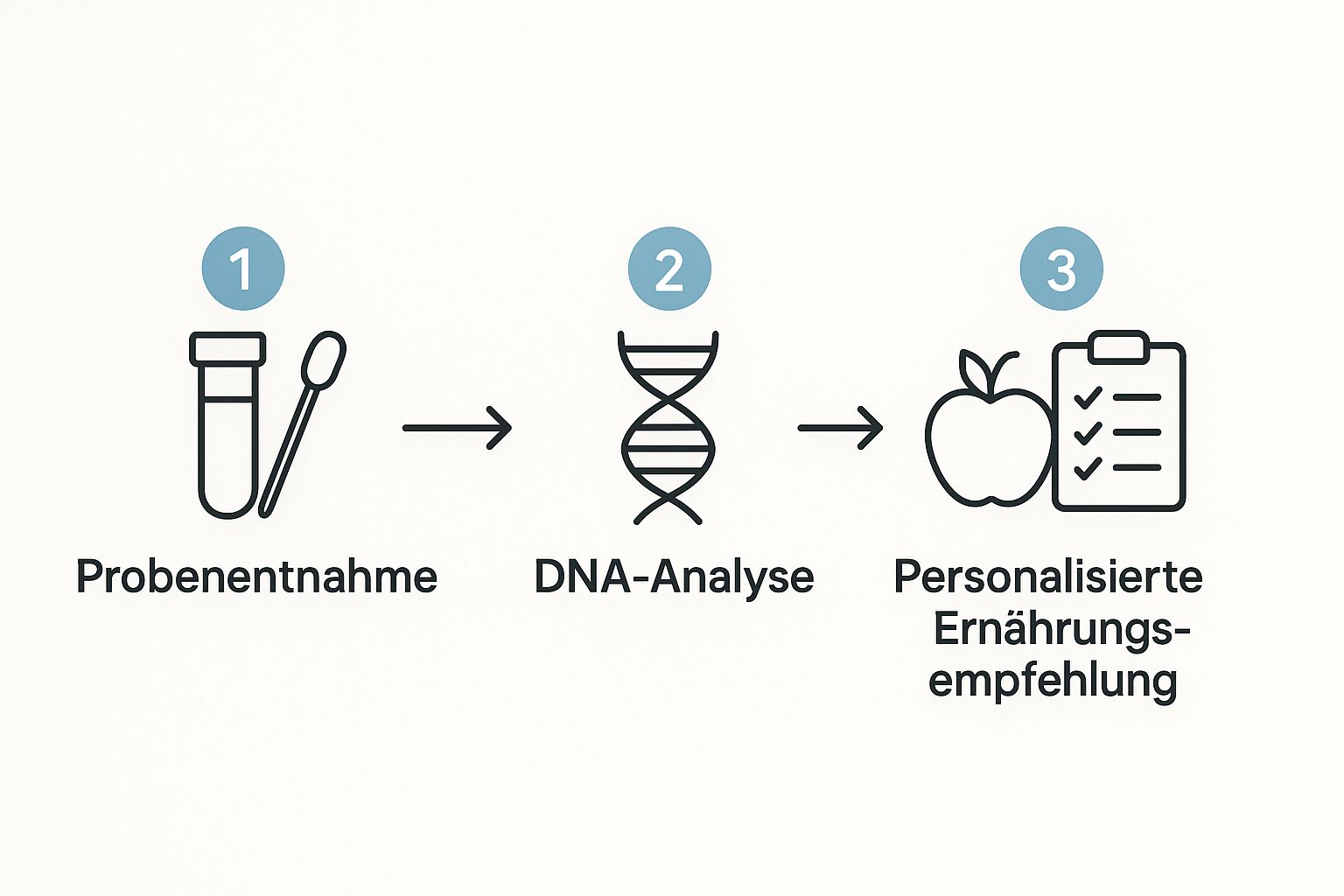
Here you can see very clearly how the individual steps seamlessly interlock to create a detailed roadmap for your personal health from a simple saliva sample.
Costs and providers of DNA nutrition tests – what you need to know

If you're interested in a DNA test for nutritional purposes , you'll quickly notice that the market is saturated and prices vary widely, ranging from under one hundred to several hundred euros. These price differences aren't random; they usually reflect the scope of the analysis and the quality of the data processing.
Simpler, cheaper tests often only look at a handful of known gene variants. In contrast, more expensive packages cover a much broader range of genetic markers and ultimately provide you with significantly more detailed, personalized reports. Therefore, your decision shouldn't depend solely on the price, but primarily on what you hope to gain from the test.
What you should pay attention to when choosing the right provider
Unfortunately, a high price is no guarantee of a better result. To find a reputable provider you can trust, you should keep a few key points in mind. This will allow you to better assess the value for money.
Here are the most important criteria you should check:
- Laboratory quality and certification: Ensure that the provider collaborates with ISO-certified laboratories in Europe. This guarantees scientific standards and ensures reliable results.
- Data protection in accordance with GDPR: Your genetic data is extremely sensitive. A reputable provider must meet the highest data protection standards and guarantee that your sample is pseudonymized in the laboratory, meaning it cannot be directly traced back to you.
- Clarity of results: You shouldn't receive a jumble of data, but rather a clearly understandable report with actionable tips. It's best to look at sample reports beforehand, if the provider offers them.
- Scientific basis: Check whether the provider transparently explains the scientific foundations on which the analysis is based. A good provider will also honestly communicate the limitations of what such a test can reveal.
Costs considered in a scientific context
The market for DNA nutrition tests in Germany is quite competitive, but not all offers deliver on their promises. Some large providers charge high prices – for example, 189 euros for the "DNA SLIM TEST" or even up to 350 euros for the "MetaCheck Gene Diet" – but often only analyze a very limited number of genes.
This is precisely what the Consumer Center of North Rhine-Westphalia and the Society for Human Genetics criticize. They warn against exaggerated promises and often limited scientific benefit. For example, a widely cited study from Stanford University with over 600 participants found hardly any measurable advantages to genetically modified diets. If you would like to delve deeper into the critical evaluation of such tests, you can find further information in this article on spiegel.de .
Ultimately, a DNA test for nutritional purposes is an investment in self-knowledge. It's about choosing a trustworthy partner like mybody-x who provides scientifically sound insights without making unrealistic promises of cures.
Making a good decision is crucial here. Perhaps you're now wondering, can a DNA test actually improve your diet? The answer lies in the combination of a high-quality analysis and your willingness to use the results as a valuable guide.
Realistically assess the opportunities and limitations of the gene-based diet
A DNA test for nutrition can be a real eye-opener, giving you a completely new perspective on your body. You finally feel like you're proactively doing something for your health – based on facts that are already within you. This personal motivation is one of the greatest strengths of a genetically tailored diet.
When you suddenly see in black and white why your body reacts to fats or carbohydrates the way it does, it often becomes much easier to establish new, healthier habits. It's no longer about general advice, but about you personally. This creates a much stronger connection to your body and gives you back responsibility for your well-being.
What a DNA test can really do
The greatest benefit often lies not in a completely new diet, but in the confirmation and deeper understanding of yourself.
- Motivation through personalization: Knowing that a recommendation applies specifically to your genes can be the decisive impetus to actually change your diet in the long term.
- Knowledge about your own body: You learn about your genetic strengths and weaknesses. This helps you in a very practical way to make more conscious decisions in the supermarket and to cook differently.
- Targeted nutrient optimization: Instead of randomly taking any vitamin pills, you can focus precisely on the areas where your genes indicate a potentially higher need.
A DNA test isn't a miracle cure, but it's a damn good guide. It doesn't replace the basics of a healthy diet, but it helps you perfectly tailor these basics to your individual needs.
Where genetics reaches its limits
It's equally important to be realistic. Your genes are only one piece of the puzzle. Your lifestyle, your stress level, how well you sleep, how much you exercise, and especially your gut microbiome – all of these have a huge impact on your health. A DNA test, of course, cannot capture these dynamic factors.
Experts therefore urge caution against blindly following the results. The science of nutrigenetics is still in its infancy, and many connections are only now being uncovered. A survey by the German Agricultural Society (DLG) shows that 47 percent of respondents firmly believe in the benefits of personalized nutrition, but experts emphasize that the main advantage currently lies more in increased motivation. To see the topic from different perspectives, read how experts assess personalized nutrition in Germany .
At the end of the day, it's simple: A balanced diet with plenty of vegetables, high-quality proteins, and healthy fats is and always will be the foundation for everyone. The insights from your DNA test are the icing on the cake—the fine-tuning that can help you better understand your body's needs. You can learn more about these fascinating connections in our article on nutrigenetics as the key to healthy eating .
Use DNA tests and blood values for a holistic picture
A DNA nutrition test provides you with, in a sense, the genetic map of your body. Imagine it like the blueprint of your house: it shows the foundation, the rooms laid out, and potential weaknesses. What this plan doesn't tell you, however, is what's going on in your house today – whether a window is open or water is dripping in the basement.
This is precisely where a blood test comes in. It provides you with a current snapshot, a snapshot of your body's status quo. While your DNA remains stable throughout your life, your blood test results show you in real time which nutrients you might be lacking, where silent inflammation lurks, or how your metabolism is actually functioning. The combination of both is the key to truly personalized health.
DNA as a guidepost, the blood test as a compass
Imagine your DNA test shows you have a genetic predisposition for an increased need for vitamin B12 . That's incredibly valuable information because it alerts you to a potential weakness. But does that automatically mean you already have a deficiency?
Not necessarily. Perhaps you already live a very conscious lifestyle and perfectly meet your needs. A blood analysis from mybody-x will give you the clear answer. It measures your current vitamin B12 level and shows you in black and white whether you really need to take action. This way, you make decisions based on facts, not just probabilities.
Your DNA reveals your potential and risks. Blood tests show you reality. Only when you combine both do you get a complete picture of your health and can target specific areas where it's most needed.
From knowledge to action: Leveraging synergy
Linking genetics with current blood values allows you a strategic and, above all, measurable approach to your health. You can not only take preventative action, but also directly monitor the success of your measures.
Here are two concrete examples of how the two complement each other perfectly:
-
Example of a predisposition to inflammation: Your DNA test indicates an increased genetic predisposition to inflammation. Your blood test measures the hs-CRP level (high-sensitivity C-reactive protein) and confirms that there is indeed a low-grade inflammation present in your body. Your action: You specifically incorporate anti-inflammatory foods such as omega-3-rich fish and turmeric into your diet. After a few weeks, you can check with a blood test whether the level is decreasing.
-
Example of fat metabolism: Your genes indicate that you metabolize fats less efficiently. A look at your blood lipid levels (cholesterol, triglycerides) will show you how your current diet is affecting this. Your action: You reduce saturated fats and increase your fiber intake to actively improve your levels.
This combined approach takes the guesswork out of your diet. You understand not only the "why" (your genetics) but also the "what now?" (your blood test results). This allows you to proactively manage your health and ensure that your efforts truly pay off.
If you would like to learn more about how genetic analysis can help you achieve your health goals, read our guide on genetic nutrition testing and losing weight based on DNA .
The most important questions about the DNA nutrition test
Are you wondering if such a test is right for you? Understandable! Here we address the most frequently asked questions and uncertainties – briefly, honestly, and to the point. This way you can make an informed decision about your health.
How secure is my genetic data?
This is probably the most important question of all, and there are no compromises here: Protecting your data is our absolute priority. Reputable providers like mybody-x strictly adhere to the stringent requirements of the GDPR .
Your test kit is immediately pseudonymized in the lab. This means your sample receives a unique code and from that moment on can no longer be directly linked to your name or personal data. After the analysis, your biological sample is professionally destroyed.
Does a DNA test really help with weight loss?
A DNA test isn't a magic bullet that will make the pounds melt away. But it's an incredibly powerful tool on your journey. It won't do the work for you, but it will show you the smartest and most efficient path for your body.
Imagine finally finding out whether your metabolism is genetically predisposed to carbohydrates, fats, or proteins. With this knowledge, you stop working against your body and start supporting it optimally. This can not only make the weight loss process easier but, above all, more sustainable.
Does the test replace a doctor's visit or nutritional advice?
Absolutely not. A DNA test is a preventative tool to optimize your lifestyle. It does not provide a medical diagnosis and can never replace the advice of a doctor or therapist.
Think of the test as a valuable supplement. The results provide a fantastic data foundation that you can also discuss with your doctor or a qualified nutritionist. Together, you can then develop the best strategies for you.
A DNA test gives you personalized insights into your genetic predispositions. It's a guide that helps you tailor general health recommendations to your unique biology, enabling you to make more informed decisions for your well-being.
How long will it take to receive my results?
From the moment you send back your sample until you receive your personal report, it usually takes several weeks. The exact duration naturally also depends on the laboratory's workload.
This time is well invested. It ensures that your DNA is analyzed carefully and with scientific precision. Quality and accuracy are paramount here – only then will you receive reliable and meaningful results that you can actually use.
What is the difference to a normal blood test?
A DNA test and a blood test are two completely different things, but they complement each other perfectly. They give you different, but equally important, perspectives on your health.
- The DNA test is your genetic blueprint. It reveals your lifelong stable predispositions, your potential, and possible risks that are anchored in your genes.
- The blood test is a snapshot in time. It shows your current status – for example, whether you currently have a nutrient deficiency or whether inflammation levels are elevated.
The combination of both is ideal: DNA explains the why , while blood values show the what now .
Are you ready to harness the personalized insights of your genes and take your nutrition to the next level? Discover at mybody-x.com how you can finally achieve your health goals with scientifically sound analyses.


Share:
Longevity nutrition: How to eat for healthy aging and a long life
DNA test nutrition experiences: 6 real insights that will help you