

Gut flora analysis: Your guide to greater well-being
The term gut flora analysis refers to a fascinating snapshot of your inner ecosystem—the gut microbiome. Think of it as a census of the trillions of microorganisms that inhabit your digestive tract. This analysis shows you in black and white which bacterial species live in your gut and whether they exist in a healthy balance.
What a gut flora analysis really reveals
Have you ever wondered what is really going on in your gut? Your gut is far more than just a digestive tube; it is a flourishing, living garden. And in this garden—your microbiome—countless tiny helpers are tirelessly working for your health.
A gut flora analysis is essentially an inventory of this inner garden. It gives you a clear overview of who and what lives there. This is not scientific busywork, but an incredibly valuable tool for getting to the root causes of many everyday complaints.
Your gut as a command center
What many people don’t know is that your microbiome is involved in a surprising number of bodily functions. The composition of your gut bacteria not only determines how well you process your food, but also directly influences:
- Your immune system: A huge part of your immune defenses is located in the gut. A balanced microbiome trains these defenses and helps keep them strong and ready to respond.
- Your mood: Yes, you read that correctly. Through the so-called gut-brain axis, your gut is in constant communication with your brain. Some bacteria even produce neurotransmitters such as serotonin, which can lift your mood.
- Your skin health: Skin problems such as acne or eczema often have their roots in an imbalance in the gut. A healthy gut flora promotes a clear complexion from within.
A healthy microbiome is primarily recognized by its diversity. The more varied the mix of beneficial bacteria, the more resilient your body is to disruptions and the better it can perform all its functions.
How a self-test can provide clarity
The good news is that you no longer have to feel in the dark. Modern gut microbiome analyses, such as the mybody-x Gut Microbiome Test, can now be carried out easily and discreetly at home.
You receive a test kit with everything you need for straightforward sample collection. The sample is then thoroughly analyzed in a specialized laboratory. The result isn’t technical jargon, but an understandable insight into the world of your very own microbiome.
For example, you’ll find out whether the ratio of important bacterial groups such as Firmicutes and Bacteroidetes is balanced or whether beneficial helpers such as lactobacilli and bifidobacteria are lacking. Would you like to delve deeper into this fascinating world? Then read our article about the importance of the microbiome for your health.
These insights are your personal starting point. Instead of following generic health advice, you can take targeted action. Based on your results, you can adjust your diet and lifestyle to care for your inner garden in a targeted way and take your health into your own hands.
To make everything even clearer, here’s a brief summary of what a gut microbiome analysis can do and why each point is so important.
Overview of the gut microbiome analysis
A summary of the key aspects of a gut microbiome analysis and what you can expect from it.
| Aspect | What it means | Why it matters |
|---|---|---|
| Bacterial diversity | The analysis measures how many different bacterial species live in your gut. | High diversity makes your microbiome more resilient to stress, infections, and a poor diet. |
| Balance of bacterial strains | The ratio of beneficial to potentially harmful bacteria is determined. | An imbalance (dysbiosis) is associated with digestive problems, inflammation, and a weakened immune system. |
| Analysis of important bacterial groups | The amount of specific “good” bacteria (e.g., lactobacilli and bifidobacteria) is quantified. | These bacteria are essential for producing vitamins and short-chain fatty acids and for strengthening the gut barrier. |
| Personalized recommendations for action | Based on your results, you’ll receive specific tips for nutrition and lifestyle. | General advice often falls short. Personalized recommendations help you support your microbiome in a targeted way. |
In short, a gut microbiome analysis is your personal guide to greater well-being, focusing directly on the center of your health—your gut.
What testing methods are available, and what do they really reveal?
When you start exploring gut health, terms like “16S sequencing” or “shotgun metagenomics” quickly start flying around. At first, that sounds more like a genetic laboratory than well-being, right? But don’t worry: They’re simply two different ways of taking a look inside your fascinating gut. I’ll explain what sets them apart and which method is right for you.
Think of your microbiome simply as a huge, vibrant city. To find out who lives there and what the residents are up to, there are various detective methods.
16S sequencing: A kind of census in your gut
16S sequencing is the established standard and by far the most widely used method for gut microbiome analysis. The best way to think of it is as a kind of census. It provides the answer to the crucial question: “Who is there?”
This method zooms in on one specific gene—the so-called 16S rRNA gene. This gene is like a universal barcode carried by almost all bacteria. Based on tiny differences in this barcode, we can identify and count the different bacterial genera and species. This tells us which bacterial families inhabit your gut and how they relate to one another in proportion.
- The goal: To find out which bacteria live in your gut.
- The result: You get a clear overview of the composition of your microbiome—meaning the status of important groups such as Firmicutes, Bacteroidetes, and the well-known Lactobacilli and Bifidobacteria.
- The advantage: This method is cost-effective, scientifically robust, and provides exactly the information you need to make targeted improvements to your health.
For the vast majority of us who want to take targeted control of our gut health, this approach is exactly right. It provides clear, actionable insights.
The following graphic wonderfully illustrates the entire process: from a snapshot of your microbiome through laboratory analysis to the goal of restoring a healthy balance.
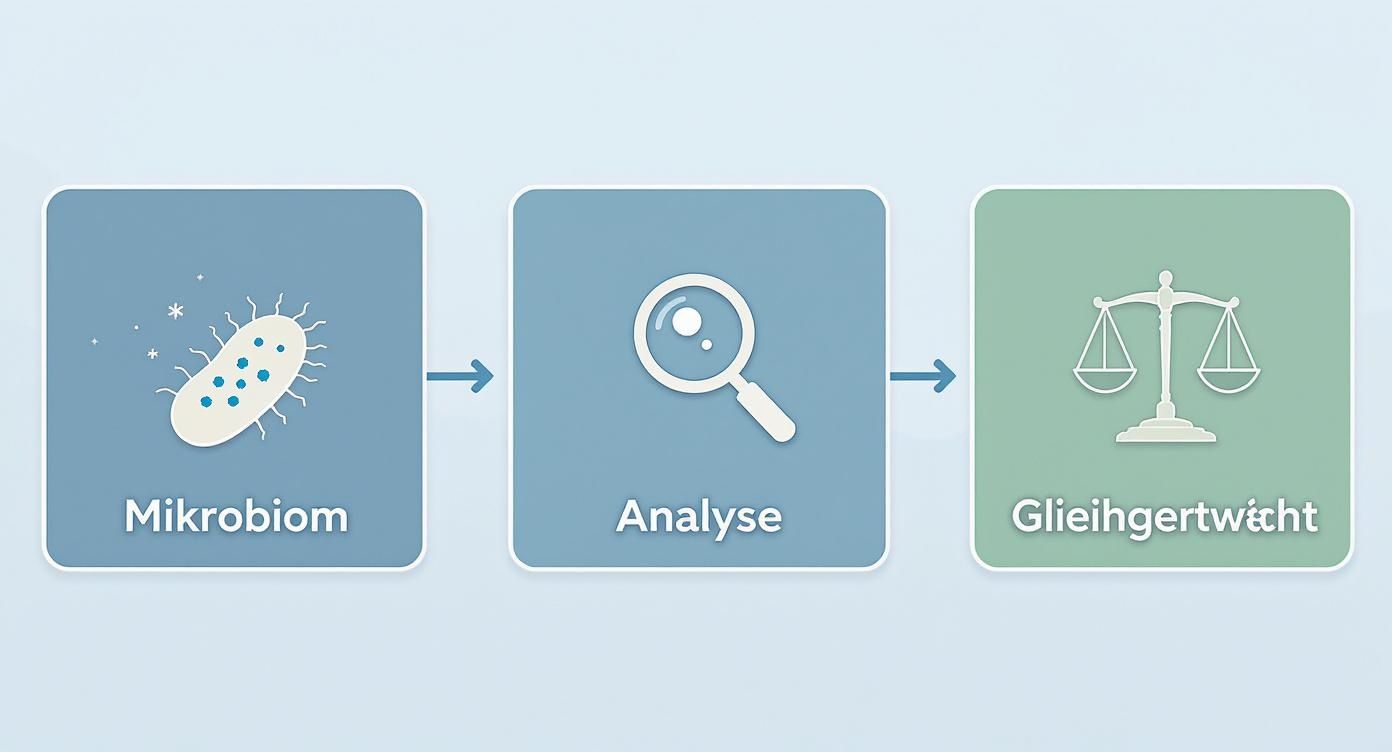
That is exactly what every analysis of the gut microbiome is about: identifying imbalances so that the right measures can then be taken to address them in a targeted way.
Shotgun Metagenomics: An in-depth look at occupations and skills
The Shotgun Metagenomics method is, so to speak, the next level. If 16S analysis is a census, then Shotgun Metagenomics is an in-depth investigation of the occupations, skills, and full potential of all the residents of your gut city. It answers the question: “What are they actually doing?”
Here, not just a single gene is analyzed, but the complete genetic material of all microorganisms in your sample—bacteria, viruses, fungi, everything. This tells us not only who is there, but also what the microbes could potentially do. We can therefore see which genes for producing vitamins, short-chain fatty acids, or other important substances are present.
- The goal: To identify not only the inhabitants, but also their genetic capabilities.
- The result: An extremely detailed picture of the functional potential of your microbiome.
- The disadvantage: This method is significantly more expensive, and the vast amount of data is difficult for laypeople to interpret. It is therefore used primarily in research.
For the vast majority of people who simply want to improve their health, the level of detail provided by the shotgun method is simply unnecessary. It generates a mass of data that can hardly be translated into practical recommendations without intensive scientific guidance.
The mybody-x approach: focusing on what really matters
At mybody-x, we’re convinced that it’s not about collecting the most data, but the right data. That’s why we use an approach that presents the crucial information clearly and understandably, without overwhelming you with technical jargon.
Our test provides you with a precise picture of the most important bacterial groups, their balance, and the overall diversity in your gut. This is the foundation of knowledge you need to make targeted adjustments to your diet and lifestyle and achieve real, noticeable results.
If you’re now curious and would like to learn more about how to test your microbiome and what the results mean, we’ve put together all the important information in a detailed article.
To conclude, the following table clearly summarizes the key differences between the two methods once again.
Comparison of testing methods for microbiome analysis
This table compares the two most important analysis methods and helps you understand their strengths and areas of application.
| Feature | 16S sequencing (the “Who is there?” test) | Shotgun metagenomics (the “What do they do?” test) |
|---|---|---|
| Primary question | Which bacteria are present? | Which bacteria are present and what are their genetic capabilities? |
| Focus | Taxonomic composition (identity of the bacteria) | Functional composition (genes and metabolic pathways) |
| Complexity | Moderate; results are easy to understand | Very high; requires expert knowledge to interpret |
| Cost | More affordable and ideal for home use | Significantly more expensive and mostly used in research |
| Ideal for | Health-conscious people who want a clear picture of their gut microbiome and actionable recommendations. | Scientific studies and highly specific clinical questions. |
As you can see, each method has its place. For home use and to derive concrete steps for your health, however, 16S analysis is usually the more practical and useful choice in most cases.
When is a gut test useful for you?
Gut microbiome analysis has long ceased to be a niche topic reserved for people with severe, diagnosed conditions. On the contrary, it is an incredibly valuable tool for anyone who wants to take charge of their health and better understand their body's signals. Perhaps you recognize yourself in one of the following situations? They can all indicate that your gut microbiome has fallen out of balance.
Your body often sends subtle but persistent signals when something is wrong. We quickly attribute many of them to stress, too little sleep, or the hectic pace of everyday life. But the true cause could lie much deeper—right at the center of your health: your gut.
When your digestion is calling for help
The most obvious warning sign is, of course, unhappy digestion. If the following symptoms have become your constant companions, your gut is practically crying out for attention:
- Constant bloating and a distended abdomen: Do you often feel like a balloon after eating? This may indicate excessive gas production by undesirable bacteria.
- Irregular bowel movements: Whether constipation, diarrhea, or a constant switch between the two—a stable microbiome is the foundation for regular, comfortable digestion.
- IBS-like symptoms: Abdominal cramps, discomfort, and general sensitivity are often associated with what is known as dysbiosis, an imbalance in gut bacteria.
A mybody-x gut test can act like a detective here and help you find out whether a lack of beneficial bacteria or an excess of disruptive ones is behind your symptoms.
More than just stomach aches
However, the effects of a disrupted microbiome are felt far beyond your stomach. Your gut is connected to your entire body through the gut-brain axis and the immune system. That is why the symptoms can be incredibly diverse.
Your gut microbiome is a key player in your overall well-being. An imbalance can manifest as fatigue, skin problems, or even mood swings because your body is not being optimally supported at the root.
So listen carefully when your body sends you these signals:
- Constant fatigue and lack of energy: Do you often feel drained even though you actually get enough sleep? Your gut plays a key role in absorbing nutrients and therefore in producing energy.
- Skin problems such as acne or eczema: A weakened gut barrier can allow unwanted substances to enter the bloodstream and fuel inflammation in the body, which then manifests on the skin.
- Frequent infections and a weakened immune system: Incredible but true: Around 70% of your immune cells are located in the gut. A diverse microbiome is therefore your most important training partner for strong defenses.
- Food intolerances: Do you feel that you suddenly can no longer tolerate more and more foods? Dysbiosis can reduce your body’s tolerance.
The influence of lifestyle and diet
Your lifestyle also provides important clues. An analysis of your gut flora is particularly worth considering if you have recently undergone major changes.
A study by Charité Berlin impressively demonstrated just how strongly external factors influence the microbiome. A severely calorie-restricted diet led not only to a reduction in the total number of microorganisms, but also to an increase in potentially problematic bacteria such as Clostridioides difficile. This clearly shows how sensitive your gut ecosystem is to changes. You can find more about these fascinating research findings on gut flora at charite.de.
So ask yourself honestly:
- Have you recently had to take antibiotics? Unfortunately, these medications cannot distinguish between good and bad bacteria and often wipe them out on a large scale.
- Have you been on a strict diet or radically changed your eating habits?
- Are you exposed to high levels of stress over the long term? Stress hormones can directly have a negative effect on the composition of your gut flora.
If you recognize yourself in one or more of these points, it’s time to take a closer look. A test gives you the clarity you need to stop merely treating the symptoms and instead address the root cause, giving your body exactly what it needs for a healthy balance.
How easy an at-home test like this is to use
Let’s be honest: For most of us, the idea of providing a stool sample takes some getting used to at first. But don’t worry—the days of complicated and unpleasant procedures are over. Modern at-home test kits, such as those from mybody-x, are cleverly designed to make the entire process discreet, hygienic, and surprisingly easy. The best part? You can do everything comfortably in your own home, without having to make an appointment at a doctor’s office.

Your mybody-x test kit contains everything you need to examine your gut flora. The entire process has been designed to help you feel confident and to make the final result as accurate as possible.
Good preparation is half the battle
To ensure that your analysis provides a truly authentic picture of your gut inhabitants, you should keep a few things in mind beforehand. A special diet is normally not necessary, as the aim is precisely to capture your everyday state.
However, there are a few factors that could temporarily distort the results:
- Antibiotics: If you have taken antibiotics recently, you should wait at least four weeks after taking the last tablet. These medications can significantly disrupt the composition of your gut flora.
- Probiotics: To get an accurate picture of your “baseline flora,” it is advisable to stop taking probiotics about one week before the test.
Your mybody-x test kit contains easy-to-understand instructions that guide you step by step. Take a moment to read them carefully before you begin.
Imagine taking a snapshot of your microbiome. The goal is to get a clear picture of your everyday state. With a few simple preparations, you can ensure that this snapshot is sharp and that you ultimately receive genuinely useful, personalized recommendations.
The process—explained step by step
Collecting the sample itself is clean and quick. The kit includes practical tools, such as a stool collection aid, to make the process as easy as possible.
Collecting your sample is this easy:
- Preparation: Lay out all the components from the test kit. Most importantly: Activate your test online using the enclosed code. This is the only way your sample can later be assigned anonymously to your personal account.
- Collecting the sample: Using the small spoon integrated into the lid of the sample tube, collect a tiny amount of stool from different areas. The instructions show you exactly how much (or rather: how little) is needed.
- Packaging: Seal the tube securely and place it in the prepaid return envelope. It is specially designed to transport your sample to the laboratory safely and hygienically.
The whole process takes just a few minutes. If you’re still unsure, our website has a detailed guide to the gut flora microbiome test with images that explains everything in detail. As soon as your sample arrives at our laboratory, the analysis begins. A short time later, you’ll find your results and recommendations directly in your secure online customer account.
Understanding and correctly interpreting your results
It’s finally here: the results of your gut flora analysis. This is a crucial moment, because now you have the opportunity to take your health into your own hands. But when you first leaf through the results, it may feel more like a complex biology lecture: lactobacilli, bifidobacteria, the ratio of Firmicutes to Bacteroidetes … What does it all mean for you and how you feel day to day?
Don’t worry, you don’t have to be a microbiologist to make use of this valuable information. We’ll help you translate it all.
Think of your mybody-x results not as a dry mass of data, but as your very own map of your inner ecosystem. It clearly shows you where your strengths lie, but also where there may be weaknesses that could be causing your recurring symptoms. This finally allows you to make targeted adjustments in the right areas.
The main players in your gut
At its core, interpreting your results comes down to two key aspects: the diversity of the bacteria and the balance between the most important bacterial groups. High diversity is like a well-stocked toolbox—the more different helpers you have, the better your gut can respond to challenges such as stress, an unhealthy meal, or an infection.
Some of the most important players involved in your results include:
- Lactobacilli & bifidobacteria: These are, so to speak, the classics among the “good” bacteria. They produce lactic acid, strengthen your intestinal barrier, and keep unwanted pathogens in check. A lack of them is often associated with digestive problems.
- Akkermansia muciniphila: This little helper is a true superstar when it comes to a healthy intestinal lining. It essentially “nibbles” on the mucus layer, stimulating it to constantly renew itself—a crucial protective barrier for your body.
- Faecalibacterium prausnitzii: This bacterium is one of the main producers of butyrate, a short-chain fatty acid. Butyrate is the most important fuel for your intestinal cells and has a powerful anti-inflammatory effect throughout the body.
Understanding the Firmicutes/Bacteroidetes ratio
Another important value in your gut flora analysis is the ratio between the two largest bacterial phyla: Firmicutes and Bacteroidetes. Think of Firmicutes as the “efficient calorie harvesters” and Bacteroidetes as the “modest eaters.”
A balanced ratio between these two is crucial for a healthy body weight and a stable metabolism. A significant excess of Firmicutes may indicate that your body tends to extract a particularly large amount of energy from food and store it as fat.
If you would like to delve even deeper into this fascinating world, our in-depth article explains the connections between analysis and what it means for your health in greater detail.
Your results are not a verdict but a starting point. They give you the power to make informed decisions. An imbalance is not a dead end but a clear call to action that you can address with targeted measures.
From analysis to practical application
The most exciting question is: What now? What are you going to do with all these insights? Your results are your personal guide. They show you exactly which of your beneficial bacterial groups may need a little support.
A lack of bifidobacteria can, for example, be a clear sign that you should add more fermented foods such as plain yogurt or kefir to your diet. If you are lacking important butyrate producers, fiber-rich foods such as oats, legumes, and plenty of vegetables are your best friends.
A clinical intervention study by the University Hospital Freiburg confirmed this impressively. It showed how consuming yogurt and fiber-rich oats every day measurably changes the composition of the gut flora for the better. This clearly demonstrates how directly the results of a gut test can be translated into effective, simple dietary tips. Learn more about these exciting study results on gut health at uniklinik-freiburg.de.
The mybody-x report provides you with precisely these personalized recommendations. It is your bridge from mere information to a concrete, noticeable improvement in your well-being.
Concrete steps for a healthy gut flora
Holding the results of your gut flora analysis in your hands is a fantastic first step. But the real value lies in using this knowledge now. So let’s look at how you can turn the insights from your test into concrete, practical steps for everyday life to specifically strengthen your gut health.

Your microbiome is not a static structure. Instead, imagine it as a garden that responds to care. With every decision, you have the opportunity to nurture your beneficial gut inhabitants and create a flourishing balance.
Feed your good bacteria intentionally
By far the most effective lever for a healthy microbiome is your diet. And your gut bacteria have two absolute favorites: prebiotics and probiotics.
Prebiotics are essentially nothing more than food for your good bacteria. They are indigestible fibers that help them multiply and produce important substances such as short-chain fatty acids.
You should regularly put these prebiotic powerhouses on your plate:
- Legumes: Lentils, chickpeas, and beans are true fiber powerhouses.
- Whole-grain products: Oatmeal, genuine whole-grain bread, and quinoa provide lasting energy not only for you but also for your gut.
- Vegetables: Onions, garlic, leeks, asparagus, and artichokes are especially rich in these valuable fibers.
- Fruit & resistant starch: Cooled potatoes or pasta from the day before are also excellent, because cooling creates resistant starch—a feast for your gut flora.
Imagine that you are the gardener of your inner ecosystem. With every prebiotic food, you spread high-quality fertilizer over the beds of your beneficial bacteria and ensure that they flourish.
Probiotics, on the other hand, are the “good bacteria” themselves. They are living microorganisms that, when you consume them in sufficient quantities, actively support and enrich your existing gut flora.
Fermented foods are the best natural sources:
- Plain yogurt and kefir
- Sauerkraut (important: unpasteurized, from the refrigerated section)
- Kimchi
- Miso
- Kombucha
These foods add greater diversity to your microbiome. If you want to delve deeper into the topic, take a look at our guide on how you can specifically build up your gut microbiome through your diet.
Your lifestyle as the key to success
A gut-friendly diet is essential, but your overall lifestyle plays just as important a role. Exercise, sleep, and how you manage stress are not minor details, but crucial factors for a balanced microbiome.
Movement gets your gut moving
Regular physical activity not only stimulates digestion and prevents constipation, it has also been shown to increase the diversity of your gut bacteria. You don't have to run a marathon—moderate exercise such as brisk walking, cycling, or a yoga session can already have great effects.
A clinical study from Germany examined exactly this: the impact of endurance training combined with probiotics. The result was clear: Both physical activity and targeted probiotic supplementation measurably improved the composition of the gut microbiome. This perfectly underscores the importance of a holistic approach. Find out more about the results of this gut microbiome study on drks.de.
Stress management for a relaxed gut
Chronic stress can completely disrupt your microbiome. Stress hormones can weaken the protective gut barrier and promote the growth of unwanted bacteria. So find ways that work for you to relax in everyday life:
- Breathing exercises: Just a few minutes of deep inhales and exhales can immediately calm your nervous system.
- Mindfulness & meditation: Practicing this regularly can help you respond to stress more calmly.
- Get enough sleep: Your entire body regenerates while you sleep—including your gut. Lack of sleep, on the other hand, can noticeably reduce bacterial diversity.
A gut microbiome analysis is your personal starting point. With these practical steps, you can turn the insights from your mybody-x test into a sustainable strategy for greater health and quality of life.
Frequently asked questions about gut microbiome analysis
Finally, we will answer some of the most frequently asked questions we receive about gut flora analysis. This will help you make a safe, well-informed decision about whether a test is the right step for you.
How often should I have my gut flora analyzed?
The first analysis is a kind of baseline assessment—your personal starting point. If you make targeted changes to your diet or lifestyle based on the results, a follow-up test after approximately three to six months is a very good idea.
This way, you can see in black and white whether your measures have really produced results and how your microbiome has changed. For general preventive healthcare, an annual analysis can be a valuable tool for maintaining balance over the long term and taking corrective action at an early stage.
Can a gut test detect food intolerances?
A gut flora test on its own is not designed to diagnose specific intolerances such as lactose intolerance or gluten sensitivity. However, it can provide important clues. In many cases, an imbalance in the gut—known as dysbiosis—lowers the tolerance threshold for certain foods and contributes to the development of sensitivities.
If you want to find out specifically whether your immune system reacts to certain foods, a specialized food intolerance test (IgG4) like the one from mybody-x is the perfect complement. Together, the two tests provide a truly comprehensive picture of your digestive health.
What is the difference between this and a hormone test?
Think of it this way: A gut flora analysis examines the diversity of the bacteria in your gut and how they interact. A hormone test, on the other hand, measures the concentration of certain messengers in the body, such as the stress hormone cortisol. That sounds like two completely different worlds, doesn’t it? In reality, however, they are closely interconnected.
Your gut microbiome has a direct influence on your hormone balance. A healthy, diverse microbiome helps, for example, to regulate stress hormones more effectively and promote overall hormonal balance. A gut test and a hormone test therefore shed light on two different yet closely interconnected aspects of your health.
Are you ready to take the first step and unlock the secrets of your gut? The mybody x gut microbiome test offers you a simple, scientifically sound way to gain clarity and take targeted control of your health. Discover now at mybody-x.com how you can support your well-being from the inside out.



Share now:
What to do for a healthy gut microbiome: Step-by-step guide
Is my gut healthy? Here’s how to find out with a test