

Rebuilding the gut flora after antibiotics: what is supported by evidence and what is not
The key points at a glance
What changes in the gut after antibiotic treatment has been described. What to do about it has barely been established. In the study by Palleja and colleagues, the composition of the gut flora was close to the baseline findings again after around six weeks, without anyone intervening. Nine species were still missing in most participants after 180 days.
This article separates three things that are merged into a promise online: what has been observed, what institutions recommend, and what is simply claimed. Every figure is accompanied by the author or institution and year. Where there is no evidence, that is stated as well.
First, you’ll read what the search term actually describes, followed by the signs that mean an appointment should come before any dietary questions. Then come the observed timeline, the question of the treatment itself, three common statements fact-checked, the evidence on probiotics, the chapter on fiber and fermented foods, a comparison of the approaches, and the limitations.
Here’s what to expect in this article
1. What “rebuilding the gut flora” describes and what the term promises
2. When symptoms after antibiotics warrant a visit to a doctor’s office
3. What has been observed in the gut after antibiotic treatment
4. Over what period the composition changes
5. Why the prescribed medication regimen should not be changed
6. Three common statements and what is actually supported by evidence
7. Probiotics: two questions that are constantly confused
8. Fiber and fermented foods: a fact check
9. What is practically possible in the weeks after antibiotics
10. Three approaches that are all called “rebuilding the gut flora”
11. What a description of the gut flora shows in this situation
12. Who benefits from a finding now—and who does not
13. Limitations: what no one can deliver on this topic
14. What matters in the weeks after antibiotics
Frequently asked questions
Sources
What “rebuilding the gut flora” describes and what the term promises
“Rebuilding the gut flora after antibiotics” is a search term, not a described process. It assumes two things at once: that something has been damaged and that there is a blueprint for putting it back together. There is no solid basis for either part.
What can be described is the composition: which bacterial groups occur in a stool sample, how frequently they occur, and how diverse the overall picture is. This composition changes during antibiotic treatment, and it changes again afterward. Both have been measured repeatedly.
What cannot be described is a target state. There is no recognized standard value for the gut flora like there is for a blood value. No reference range exists against which a finding could be assessed, and therefore there is no point at which rebuilding would be complete.
Key message
The composition of the gut flora can be described. However, no target state against which it could be assessed has been defined.
Why the symptoms are still real after taking antibiotics
Anyone who experiences bloating, loose stools, or abdominal pressure after antibiotic treatment is not imagining things. Diarrhea and nausea are known adverse effects of antibiotic therapy; the Institute for Quality and Efficiency in Health Care explicitly lists them in its patient information on antibiotic use (IQWiG, as of 2025).
These symptoms are a reason to take a closer look. They are not proof that a particular measure will resolve them. Several steps lie between “my stomach feels unsettled” and “this capsule calms it down,” and advice articles regularly skip them.
The role this article plays in the gut content cluster
This article examines the evidence regarding the period after antibiotic treatment. If you are instead interested in which test answers which question when you have abdominal symptoms, At-home gut test explains this. Microbiome test and health insurance addresses the question of costs, Diet for irritable bowel syndrome covers the dietary question, and Test for leaky gut syndrome covers measurement methods relating to the intestinal barrier.
When symptoms after antibiotics warrant a visit to a doctor’s office
This chapter deliberately comes first. Some cases of diarrhea after antibiotic treatment are caused by an infection with Clostridioides difficile, and this infection cannot be addressed through diet.
The Robert Koch Institute describes the symptoms of such an infection in its guidance. It lists watery diarrhea with a characteristic foul odor as well as pain in the lower quadrants of the abdomen, often accompanied by fever (Robert Koch Institute, as of January 22, 2025). According to the same guidance, blood in the stool is usually detected only in very severe cases.
The timing is close. The Robert Koch Institute states that the interval between a preceding antibiotic treatment and the onset of symptoms is usually only a few days (Robert Koch Institute, as of January 22, 2025). The guidance mentions treatments with clindamycin, ampicillin, or cephalosporins, among other triggers.
The four signs that should not be waited out
Persistent diarrhea after antibiotic treatment belongs in a medical practice. Bloody diarrhea belongs in a medical practice. Fever belongs in a medical practice. Severe abdominal pain belongs in a medical practice.
These four signs are not a reason to change your diet, take a supplement, or place an order. They are a reason to make an appointment. Anyone who notices them should not take a test but make an appointment.
No sentence in this article downplays that. Nor do the chapters that follow, nor the fact that most abdominal complaints after antibiotic treatment remain harmless.
What was observed in the gut after antibiotic treatment
The most precise description of this process comes from a study of twelve healthy men. A team led by Albert Palleja gave them a combination of three reserve antibiotics for four days and then tracked the composition of their gut microbiota for six months (Palleja et al., Nature Microbiology, 2018).
Two opposing shifts were described. Initially, Enterobacteriaceae and several other groups increased, while bifidobacteria and bacteria that produce butyric acid became less common. The picture then moved closer to the baseline findings again, without the participants taking anything.
Documented source
“The gut microbiota of the subjects recovered to near-baseline composition within 1.5 months, although 9 common species, which were present in all subjects before the treatment, remained undetectable in most of the subjects after 180 days.”
Albert Palleja, Kristian H. Mikkelsen, Sofia K. Forslund, and colleagues
Recovery of gut microbiota of healthy adults following antibiotic exposure, Nature Microbiology, Volume 3, pages 1255–1265, 2018
Why “close to baseline” is not the same as “as before”
The quoted sentence contains both halves, and the second is often omitted when it is quoted. After about a month and a half, the overall composition was again close to the baseline findings. Nine species that had previously been present in all participants remained below the detection limit in most participants after 180 days.
The study does not say what these nine species mean for an individual person. It describes a change, not a consequence. Anyone deriving a need for action from it is reading something into it that the authors did not write.
Four limitations that belong to this study
First, there were twelve participants. Twelve healthy young men are not representative of the people who look into this topic after tonsillitis or a urinary tract infection.
Second, the treatment was unusual. Meropenem, gentamicin, and vancomycin are reserve antibiotics and are not prescribed as tablets for use at home. The study describes a strong intervention, not a typical course of treatment.
Third, the comparison was with each person’s own baseline result. Every participant had a measurement from before, and that exact measurement served as the benchmark. Without it, no one could have said whether a later result was close to the starting point or far from it.
Fourth, no one was treated. The participants received neither a medication nor a dietary plan. What is described there is the course without intervention.
The period over which the composition changes
The most common question on this topic is how long it takes. There is no universally applicable answer because the active substance, duration, age, and initial situation differ. What does exist are timeframes from individual studies, and the following three all come from the same one.
Three timeframes from a single study
4 days
This is how long the twelve participants received the combination of three reserve antibiotics.
1.5 months
After this period, the overall composition was again close to each participant’s baseline result.
180 days
After this point, nine species that had previously been present in everyone could no longer be detected in most participants.
Source: Palleja et al., Nature Microbiology, 2018 – twelve healthy male participants, not a typical course of treatment
Why these figures are not a prediction for you
Three figures from a study of twelve people do not provide a roadmap. They provide an order of magnitude: the observed period spans weeks to months, not days and not years.
This timeframe is still useful because it corrects a common expectation. Anyone checking three days after the last tablet to see whether anything has changed is checking too soon. And anyone who gives up after two weeks without any change is giving up too soon.
Why the prescribed course should not be changed
One point must be stated unambiguously here, because it is the only point in this article where an incorrect sentence could cause immediate harm. The prescribing practice—not a guide and not your own gut feeling—determines how long antibiotic therapy lasts.
The Institute for Quality and Efficiency in Health Care states this verbatim in its patient information on antibiotic use: “Antibiotics should be taken for as long as the doctor has prescribed them.” (IQWiG, as of 2025-09-03)
Anyone who wants to stop taking the medication because of abdominal symptoms should discuss it with the practice that prescribed it. They will decide whether to stop, switch, or continue treatment. That decision does not belong in a blog article, and this article does not make it.
What remains useful during treatment
There is still something useful to do during treatment, and it is unspectacular: keep notes. Which medication, for how long, and which symptoms started on which day. These notes will later form the basis of every conversation, and they cost nothing.
Drinking enough fluids and eating easily digestible foods is generally standard practice for diarrhea and is not risky in any respect. However, it is also not a measure with a proven effect on the composition of the gut microbiome, and this article makes no recommendation regarding intake or dosage.
Three common statements and what is actually substantiated
Three statements appear in almost every text on this subject. All three sound plausible, and none of them matches what the cited studies show.
Commonly claimed versus substantiated
Commonly claimed
“Without a course of treatment, the gut microbiome remains permanently damaged.”
Substantiated
In twelve healthy participants, the composition was again close to baseline after about six weeks without any additional intervention; nine species were still absent in most participants after 180 days (Palleja et al., Nature Microbiology, 2018).
Commonly claimed
“Probiotics restore the gut microbiome after antibiotics.”
Substantiated
In a study using mucosal samples, the return to participants’ own baseline composition was significantly delayed and remained incomplete with a multi-strain preparation, compared with the course without intervention (Suez et al., Cell, 2018).
Commonly claimed
“Eating plenty of fiber reliably increases gut microbiome diversity.”
Substantiated
In a randomized study of 36 healthy adults over ten weeks, diversity increased in the fermented-foods arm; in the high-fiber arm, it remained unchanged on average (Wastyk et al., Cell, 2021).
What the three comparisons do not say
None of these three statements is a free pass in the other direction. The study by Suez and colleagues does not show that probiotics are harmful. The study by Wastyk and colleagues does not show that fiber is useless.
What follows is more modest and still useful: The three common statements claim more than the data support. That is the whole point of this chapter.
Probiotics: two questions that are constantly confused
There are two entirely different questions about probiotics, with two entirely different bodies of evidence. Anyone who conflates them arrives at a conclusion that neither supports. Separating them is therefore the most important paragraph of this chapter.
The first question is: Can probiotics reduce the frequency of diarrhea during or after antibiotic therapy? The second question is: Do probiotics restore the composition of the gut microbiota to what it was before? These are two questions, not two formulations of the same question.
Question one: Preventing diarrhea during antibiotic treatment
There is a large systematic review on this question. The Cochrane review by Esmaeilinezhad and colleagues evaluated 47 studies involving a total of 15,260 adults and children who received antibiotics; 38 of these studies, involving 13,179 participants, concerned the prevention of diarrhea caused by Clostridioides difficile (Cochrane Database of Systematic Reviews, 2025).
The review’s main conclusion is phrased conditionally, and that is not an oversight but the result. Probiotics might prevent this diarrhea in people receiving antibiotics. The authors describe their confidence in the evidence as moderate to low and point out that the two largest included studies showed no clear benefit.
For people without weakened immune systems, the review describes short-term use as potentially offering a small benefit. A small potential benefit for a clearly defined question is something different from a promise of efficacy, and this article does not turn it into one.
Question two: Return to the original composition
The evidence on this question points in a different direction—one that contradicts expectations. A team led by Jotham Suez investigated in humans and mice how mucosal colonization develops after antibiotic treatment when a multi-strain preparation is also administered (Suez et al., Cell, volume 174, pages 1406–1423, 2018).
It describes how the return to each person’s own initial composition under the preparation was significantly delayed and remained permanently incomplete, compared with the spontaneous course without intervention. The authors infer that any potential benefit of probiotics after antibiotics could be outweighed by impaired recolonization.
This is a study, not a guideline. It is not sufficient to advise against probiotics, and that is not how it is used here. But it is entirely sufficient to label the statement “Probiotics rebuild the gut microbiome” as unsupported.
Key message
The evidence on probiotics concerns preventing diarrhea while taking antibiotics. It does not concern the return of the gut microbiome to its original composition.
Why no products, strains, or dosages are listed here
This article names no product, strain, or dosage. That is not an oversight. The effect of a probiotic applies to the strain studied at the dosage studied, and transferring it to another product is a conclusion the data do not support.
Discuss whether and what you take with your doctor or pharmacist. They know which antibiotic you received and which pre-existing conditions may be relevant. An advice article does not know either.
Fiber and fermented foods: a fact check
When discussing food, two things that can be clearly separated often get mixed together: what institutions recommend and what individual studies have observed. This mixture produces a third claim that appears in neither source. This chapter examines all three separately.
What is recommended: the amount of fiber
There is a reference value for fiber, and it has nothing to do with antibiotics. The European Food Safety Authority considers an intake of 25 grams of fiber per day sufficient for adults to support normal bowel function (EFSA, EFSA Journal, 2010). For higher intakes, the same opinion describes evidence of health benefits from high-fiber diets.
This value applies to all adults and on an ongoing basis. It is not a measure for the weeks after taking antibiotics, nor does taking antibiotics increase it. Anyone who does not reach it anyway has good reason to work toward doing so—just not for a reason arising from this topic.
What was observed: fermented foods versus fiber
A team led by Hannah Wastyk assigned 36 healthy adults to one of two diets for ten weeks: one including fermented foods such as yogurt, kefir, kimchi, and kombucha, and a high-fiber diet (Wastyk et al., Cell, 2021).
In the fermented-food arm, gut microbiome diversity increased, and the increase was more pronounced with larger portions. In addition, 19 inflammation-related proteins measured in the blood decreased. In the high-fiber arm, diversity remained unchanged on average, and none of the 19 proteins decreased.
The authors themselves note that a longer study period might have allowed the gut flora to adapt to the higher fiber intake. Ten weeks is a short time for this question.
One more limitation should be noted: The participants were healthy and had not undergone antibiotic treatment. The study describes what fermented foods did in healthy adults. It does not describe what they do after a course of antibiotics.
What is claimed based on this
These two building blocks regularly produce a third statement that appears in neither of them: that a specific combination of fiber and fermented foods reassembles the gut flora after antibiotics. None of the sources cited here supports this statement. The problem is not the observation, but the promise made from it.
The problem is not the observation, but the promise made from it.
What remains is still significant. A diet rich in plant-based foods and regular fermented products is beneficial regardless of antibiotics, well tolerated by most people, and costs nothing extra. It simply does not need a promise it cannot keep.
What is practically possible in the weeks after antibiotics
If no method can rebuild it, the question remains: what then? The honest answer consists of four steps, none of which makes a promise of effectiveness, and each of which can be checked.
Check warning signs first
Persistent or bloody diarrhea, fever, severe abdominal pain: make an appointment, not a diet plan. Everything else comes afterward.
Keep a journal for four weeks
Meals, bowel movements, symptoms. A journal is the only measurement that reflects your personal progress.
Adjust your expectations for the timeline
The period described ranges from weeks to months. No conclusions are possible after three days, nor after two weeks.
Take questions to where they belong
Preparations, dosages, and the duration of treatment should be clarified by the prescribing practice or pharmacy, not by an online text.
Four weeks is a good period for the journal because it also captures fluctuations that have nothing to do with food. You can look up what each type of bacteria in a report means in the Gut Bacteria Lexicon without having to order anything.
Why the notebook is the most honest measurement
A laboratory report describes the composition of your gut microbiome. It does not describe how you feel. That second piece of information is what you actually care about, and it is not in any report but in your notebook.
There is also a practical advantage. Someone who goes to a medical practice with notes has a different conversation than someone who says things have somehow gotten worse. The notebook is preparation for that conversation, not a substitute for it.
Three approaches all called “rebuilding the gut microbiome”
Three different approaches are grouped under the same term. The following overview compares them side by side using the same four criteria and states, for each one, what is actually established and what is not.
| Criterion | Wait and observe | Change your diet | Take a preparation |
|---|---|---|---|
| What has actually been described | Among twelve participants, the composition approached the baseline findings after about six weeks, without intervention (Palleja et al., Nature Microbiology, 2018) | Among 36 healthy adults, diversity increased over ten weeks in the fermented-foods group, but not in the high-fiber group (Wastyk et al., Cell, 2021) | A possible small benefit in preventing antibiotic-associated diarrhea; confidence in the evidence is moderate to low (Cochrane, 2025) |
| What has not been established | That the course will look the same for you; the study included twelve healthy men and reserve antibiotics | That the result can be applied to the period after taking an antibiotic; the participants had not taken one beforehand | That a preparation restores the original composition; one study even describes a delayed course (Suez et al., Cell, 2018) |
| Effort and cost | No effort, no cost; requires patience over several weeks | Purchasing and planning; costs within the normal household budget | Ongoing cost per pack; selection and duration belong with a medical practice or pharmacy |
| How to notice a change | How you feel over several weeks, documented in the notebook | Tolerance and bowel movements; the diversity itself cannot be seen this way | Whether diarrhea occurs or does not occur during treatment |
The table deliberately contains no recommendation column. Which of the three options is suitable for you depends on why you were prescribed the antibiotic and how you are feeling now—and neither is stated in this text.
What a description of the gut microbiome shows in this situation
mybody®x (MYBODY Lab GmbH) offers a description of the gut microbiome based on a stool sample. Before the card is added, the most important limitation belongs at the beginning rather than at the end of this chapter.
Such a test result is a snapshot. It describes which bacterial groups are present and in what proportions at the time of sampling. It does not indicate whether anything has recovered, because there is no recognized target state against which a comparison can be made.
This is precisely why the study by Palleja and colleagues was able to draw a conclusion at all: Every participant had a measurement from before antibiotic treatment. Without this personal baseline, you can later describe only what it looks like—not whether it has changed.
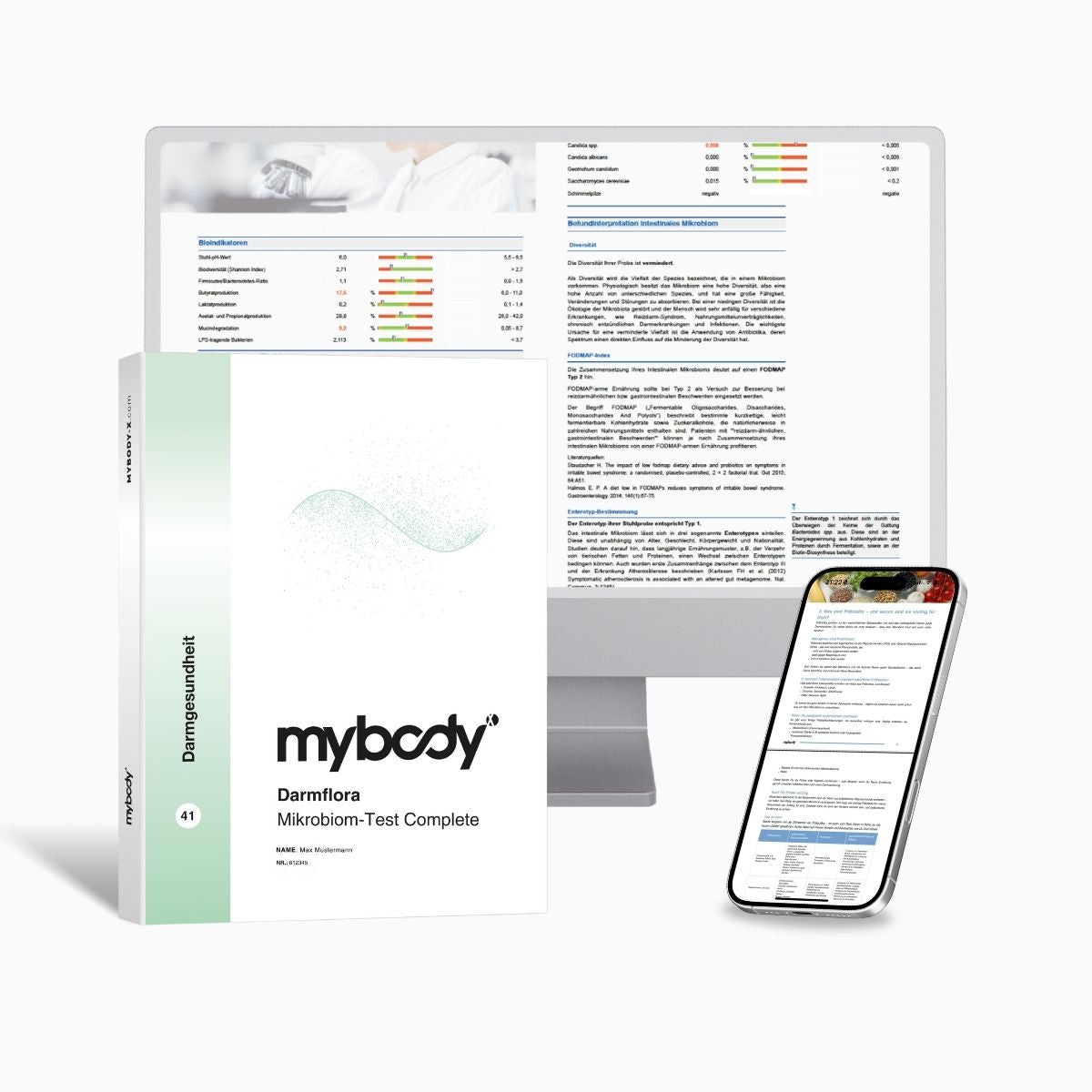
Gut test from a stool sample
Complete gut microbiome test | Complete
Using DNA sequencing, it records more than 1,500 bacterial species in the gut microbiome and describes their composition at the time of sampling. What the test does not provide in this situation: It does not determine whether your gut microbiome has recovered after antibiotic treatment, because there is no recognized target state for this and, without your own previous test result, no point of comparison. It does not test for an infection with Clostridioides difficile and does not replace a medical examination. The product page lists diet, digestion, and everyday routines as areas of application and, according to its own statement, explicitly does not provide a medical assessment.
Laboratory analysis 5–10 business days after sample receipt
Product page information without location, accessed 28 August 2026
When a test result becomes a point of comparison
A single test result describes a state. Two results taken months apart describe a change. This is the only way an analysis of the gut microbiome can say anything about a course over time.
For gut tests, a follow-up test after around three months is therefore customary, because the composition changes over the course of weeks. A DNA analysis follows a different logic: it remains the same throughout your life and is performed only once.
Even with two test results, the limitation stated above remains. A change in composition says nothing about whether your symptoms have improved. Your diary answers that question, not your laboratory report.
Who benefits from a test result now and who does not
Whether it is worthwhile to analyze the gut microbiome in this situation depends less on the antibiotic than on the question you want answered. The following comparison sets out both perspectives.
Useful for you if …
you are planning to change your diet and want to record a baseline against which you can identify a change in a few months.
your symptoms have persisted for months, have been medically evaluated, and you want to prepare for the discussion with additional information.
you are interested in which groups of bacteria occur in your sample and in what proportions—as a description, not an assessment.
Probably not, if …
one of the warning signs from chapter two applies to you. Then you need to make a medical appointment—before placing any order.
you want to know whether your gut flora is “back to normal.” The finding cannot answer that question because no target state has been defined.
you hope the result will tell you which supplement to take. A finding is not a prescription and does not replace professional advice.
Limitations: what no one in this field can deliver
The first limitation concerns the term itself. Recovery presupposes a target state, and none has been defined for the gut flora. As long as that remains the case, no one can say when it would be complete.
The second limitation lies in the data. The most precise time frames on this subject come from a study of twelve healthy men given three reserve antibiotics. Applying that to a pack of tablets from a pharmacy is an assumption, not a deduction.
The third limitation concerns the supplements. There is evidence of a possible small benefit for preventing diarrhea during antibiotic treatment; there is no such evidence for the return of the composition. Anyone who conflates the two is presenting one study as evidence for a different question.
The fourth limitation concerns the findings. A description of the gut flora is not a diagnostic procedure. It does not detect inflammatory bowel disease, a tumor, an infection, or celiac disease—and it does not detect recovery either.
Key message
A description of the gut flora shows a snapshot. It cannot determine whether anything has recovered after a course of antibiotics.
What matters in the weeks after antibiotics
The cited studies suggest a short sequence, and it is unremarkable. Warning signs before diet. Observation before supplements. Your own preliminary findings before testing. And the prescribing practice before anything you read online.
What stands out is found in no single source and yet follows from all of them: Research describes a course; it does not prescribe an intervention. Every intervention that appears in guides based on it is an addition by someone who has something to offer.
That is why the specific next step is smaller than the subject might suggest. Take a notebook and write down how you feel for four weeks. After that, you will know more about your own course than any number from a study of twelve strangers.
It began with the question of how to rebuild the gut flora after antibiotics. That was precisely the mistake: The question assumes a construction site where there is an observation.
If you are not sure whether a description of your gut flora fits your question: The consultation costs nothing, and it does not sell you anything.
Frequently asked questions
How long does it take for the gut flora to change after antibiotics?
The observed period ranges from weeks to months. In the study by Palleja and colleagues, the overall composition in twelve healthy men was again close to their individual baseline after about a month and a half; nine species that had previously been present in all participants were no longer detectable in most of them after 180 days (Nature Microbiology, 2018). There is no generally applicable duration because the active ingredient, treatment duration, age, and initial condition differ. The figures also come from a four-day course of three reserve antibiotics, not from a usual treatment course.
When does diarrhea after antibiotics require medical attention?
Persistent or bloody diarrhea after a course of antibiotics, fever, and severe abdominal pain require medical attention. They may indicate an infection with Clostridioides difficile. The Robert Koch Institute describes watery diarrhea with a characteristic foul smell and pain in the lower abdominal quadrants, often accompanied by fever; blood in the stool is usually detected only in very severe cases (as of January 22, 2025). According to the same guidance, the interval since the preceding antibiotic treatment is usually only a few days. If you notice these signs, do not take a test or change your diet; make an appointment instead.
Do probiotics help rebuild the gut flora after antibiotics?
There is no evidence for this question. The available evidence concerns a different question, namely the prevention of diarrhea during antibiotic treatment: A Cochrane review of 47 studies involving 15,260 adults and children describes a possible small benefit, with moderate to low confidence in the evidence (Esmaeilinezhad et al., Cochrane Database of Systematic Reviews, 2025). This does not apply to a return to your own original composition: A study in humans and mice even describes a delayed and incomplete course with a multistrain preparation compared with the course without intervention (Suez et al., Cell, 2018). Discuss whether and what you take with your medical practice or pharmacy.
Can a microbiome test show whether my gut flora has recovered?
No. A microbiome test describes a snapshot: which bacterial groups are present and in what proportions at the time of sampling. It could determine recovery only if there were a recognized normal state against which it could compare the results—and there is no such state for the gut microbiome. There is no reference range like there is for a blood value. What a report can provide is a comparison point: if you test before making a change and again months later, you can see a change in the composition. Whether you feel better as a result will not appear in any laboratory report.
Can I stop taking the antibiotic if my stomach is acting up?
This decision is made by the medical practice that prescribed the medication. The Institute for Quality and Efficiency in Health Care puts it this way: “Antibiotics should be taken for as long as the doctor has prescribed them.” (As of 03/09/2025) If you want to stop or interrupt the treatment because of symptoms, call the practice and discuss it with them. They know what the medication is being used to treat and what alternatives are available. According to the same patient information, nausea and diarrhea are known adverse effects—a reason to have a conversation, not to stop treatment on your own.
Next step
If you want to record your current status
The gut microbiome test | Complete describes the composition of your gut microbiome from a stool sample. It does not determine whether anything has recovered after a course of antibiotics and does not replace medical evaluation. If you only want to look up what individual bacterial species mean, you can get further without a test.
Complete gut microbiome test | Complete Gut encyclopedia without a testRead more
You might also be interested in this
In case the question of which test to choose comes before the question of composition.
The cost side: who pays for a gut microbiome test and under what conditions.
For looking up which bacterial species and markers appear in a report and what they mean.
Sources
- Albert Palleja, Kristian H. Mikkelsen, Sofia K. Forslund and colleagues: Recovery of gut microbiota of healthy adults following antibiotic exposure, Nature Microbiology, Volume 3, pages 1255–1265, 2018 – nature.com
- Robert Koch Institute: RKI guide to Clostridioides (formerly Clostridium) difficile, as of 01/22/2025 – rki.de
- Institute for Quality and Efficiency in Health Care (IQWiG): Using antibiotics correctly and preventing resistance, gesundheitsinformation.de, updated 03/09/2025 – gesundheitsinformation.de
- Zahra Esmaeilinezhad, Nirjhar R. Ghosh, Bradley C. Johnston and colleagues: Probiotics for the prevention of Clostridioides difficile-associated diarrhea in adults and children, Cochrane Database of Systematic Reviews 2025, Issue 9, CD006095 – cochrane.org
The verbatim quotation about the course after antibiotic treatment, as well as the information on four days of treatment, one and a half months, 180 days, nine species, and twelve participants, comes from [1]; the descriptions of the increase in Enterobacteriaceae and the decrease in bifidobacteria and butyrate producers also come from that source. The information on the symptoms of an infection with Clostridioides difficile, blood in the stool, the time interval, and the causative drug classes comes from [2]. The verbatim quotation about the duration of use and the mention of nausea and diarrhea as adverse effects come from [3]. The figures of 47 studies, 15,260 participants, 38 studies, and 13,179 participants, as well as the assessment of the benefits and certainty, come from [4]. The delayed and incomplete course under a multi-strain preparation is attributed in the main text to Suez and colleagues, Cell, volume 174, pages 1406–1423, 2018. The information on 36 participants, ten weeks, 19 inflammatory proteins, and diversity in both dietary groups is attributed in the main text to Wastyk and colleagues, Cell, 2021. The reference value of 25 grams of fiber per day comes from the European Food Safety Authority's opinion on reference values for carbohydrates and dietary fiber, EFSA Journal, 2010. Information on price, scope of testing, sample type, and laboratory comes from the mybody®x product page, accessed on 28.08.2026; processing times follow the central specification for gut tests. All sources were accessed and checked on 28.08.2026.

mybody®x Editorial & Specialist Team
Microbiome and gut science Nutritional science Study findings and evidence assessment Laboratory diagnostics
This article was created by the mybody®x editorial and specialist team. The team brings together microbiome and gut science, nutritional science, and the interpretation of findings. Those who contribute to it are listed on the authors page.
Published on 21.11.2025 · Last updated on 27.08.2026
The content is intended for general information and does not replace medical advice, diagnosis, or treatment. The prescribing medical practice alone decides on the selection, dosage, and duration of antibiotic therapy. Medical evaluation is required in cases of persistent or bloody diarrhea, fever, or severe abdominal pain after taking antibiotics.



Share now:
Celiac disease: How to correctly interpret the symptoms in adults
Bifidobacteria and Lactobacilli: The Most Important Helpers for Your Gut